Polaskia chende
| Polaskia chende | |
|---|---|
 | |
Scientific classification  | |
| Kingdom: | Plantae |
| Clade: | Embryophytes |
| Clade: | Tracheophytes |
| Clade: | Angiosperms |
| Clade: | Eudicots |
| Order: | Caryophyllales |
| Family: | Cactaceae |
| Subfamily: | Cactoideae |
| Genus: | Polaskia |
| Species: | P. chende |
| Binomial name | |
| Polaskia chende (Rol-.Goss.) A.C.Gibson & K.E.Horak | |
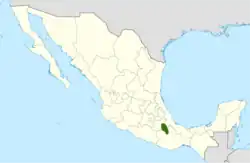 | |
| Distribution of Polaskia chende | |
| Synonyms[2] | |
| |

Polaskia chende is a succulent cactus native to a small area of mountains of northern Oaxaca and southern Puebla, Mexico. It grows in xerophytic shrubland between 1,500 and 2,000 m (4,900 and 6,600 ft) above mean sea level.[1]
Description
Polaskia chende forms 3 to 5 m tall (9 ft 10 in – 16 ft 5 in), branching columnar stems, 40 to 80 cm long and 5 to 7 cm wide, and can reach up to 4.5 m in height. It has 7 or 8 ribs, rarely 9, 1.7 to 3 cm high, with areoles 5 mm long, circular to elliptical, spaced 2 cm apart, with the presence of black trichomes. It has 5 or 6 radial spines 2 cm long and 0.8 cm wide, grey, and the central spine may be absent or rudimentary; the fertile zone is not differentiated from the infertile zone. Its flowers are white, reach a length of 5 cm, oblanceolate, with a mucronate apex, green, some with a red to purple middle stripe. The fruit are about 3 cm long and 4 cm wide, purple in color, with short bracts, yellow trichomes, short spines, and juicy purple pulp. Seeds are 1.6 mm long and 1 mm wide. Flowering occurs between August and January, and the plant bears fruit between December and June.[3][1]
Distribution
It inhabits oak (Quercus) forests, xeric scrublands, tropical deciduous forests, and among riparian vegetation, at elevations from 1,700 to 2,200 m (5,600 to 7,200 ft).
 Limestone habitat in Oaxaca
 Adult plant in Oaxaca
 scrublands habitat in Oaxaca
Taxonomy
The plant, initially named Cereus chende, was described by Robert Roland-Gosselin in 1905.[4] The specific epithet chende comes from its Spanish common name. In 1979, Arthur Charles Gibson and Karl E. Horak reclassified the species under the genus Polaskia.[5]
References
- 1 2 3 Arias, S.; Valverde, T.; Zavala-Hurtado, A. (2017) [amended version of 2013 assessment]. "Polaskia chende". IUCN Red List of Threatened Species. 2017 e.T151722A121564109. doi:10.2305/IUCN.UK.2017-3.RLTS.T151722A121564109.en. Retrieved 20 February 2022.
- ↑ "Polaskia chende (Rol-.Goss.) A.C.Gibson & K.E.Horak". Retrieved 20 February 2022.
- ↑ "Polaskia Species, Chende, Chinoa, Tunillo (Rol-.Goss.) A.C.Gibson & K.E.Horak". Dave's garden. Retrieved 20 February 2022.
- ↑ D&Amp, Um National; (France), histoire naturelle (1905). "Bulletin du Muséum d'histoire naturelle". Impr. nationale. ISSN 0027-4070. Retrieved 2024-03-31.
- ↑ Garden., Missouri Botanical; Botany., Henry Shaw School of (1978). Annals of the Missouri Botanical Garden. Vol. v.65 (1978). Missouri Botanical Garden Press. Retrieved 2024-03-31.
External links
 Media related to Polaskia chende at Wikimedia Commons
 Data related to Polaskia chende at Wikispecies