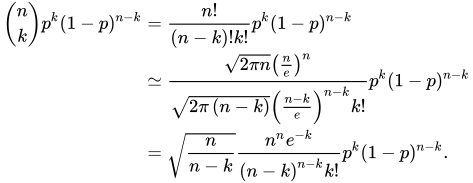
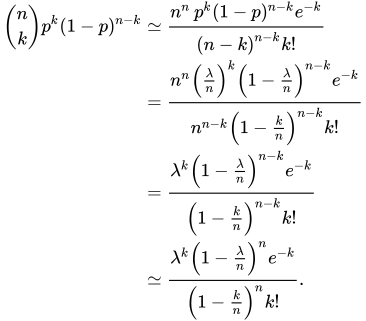
Comparison of the Poisson distribution (black lines) and the binomial distribution with n = 10 (red circles), n = 20 (blue circles), n = 1000 (green circles). All distributions have a mean of 5. The horizontal axis shows the number of events k . As n gets larger, the Poisson distribution becomes an increasingly better approximation for the binomial distribution with the same mean. In probability theory , the law of rare events or Poisson limit theorem states that the Poisson distribution may be used as an approximation to the binomial distribution , under certain conditions.[ 1] Siméon Denis Poisson (1781– 1840). A generalization of this theorem is Le Cam's theorem .
First proof
Assume
λ
>
0
{\displaystyle \lambda >0}
λ
=
0
{\displaystyle \lambda =0}
lim
n
→
∞
(
n
k
)
p
n
k
(
1
−
p
n
)
n
−
k
=
lim
n
→
∞
n
(
n
−
1
)
(
n
−
2
)
…
(
n
−
k
+
1
)
k
!
(
λ
n
(
1
+
o
(
1
)
)
)
k
(
1
−
λ
n
(
1
+
o
(
1
)
)
)
n
−
k
=
lim
n
→
∞
n
k
+
O
(
n
k
−
1
)
k
!
λ
k
n
k
(
1
−
λ
n
(
1
+
o
(
1
)
)
)
n
(
1
−
λ
n
(
1
+
o
(
1
)
)
)
−
k
=
lim
n
→
∞
λ
k
k
!
(
1
−
λ
n
(
1
+
o
(
1
)
)
)
n
.
{\displaystyle {\begin{aligned}\lim \limits _{n\rightarrow \infty }{n \choose k}p_{n}^{k}(1-p_{n})^{n-k}&=\lim _{n\to \infty }{\frac {n(n-1)(n-2)\dots (n-k+1)}{k!}}\left({\frac {\lambda }{n}}(1+o(1))\right)^{k}\left(1-{\frac {\lambda }{n}}(1+o(1))\right)^{n-k}\\&=\lim _{n\to \infty }{\frac {n^{k}+O\left(n^{k-1}\right)}{k!}}{\frac {\lambda ^{k}}{n^{k}}}\left(1-{\frac {\lambda }{n}}(1+o(1))\right)^{n}\left(1-{\frac {\lambda }{n}}(1+o(1))\right)^{-k}\\&=\lim _{n\to \infty }{\frac {\lambda ^{k}}{k!}}\left(1-{\frac {\lambda }{n}}(1+o(1))\right)^{n}.\end{aligned}}}
Since
lim
n
→
∞
(
1
−
λ
n
(
1
+
o
(
1
)
)
)
n
=
e
−
λ
{\displaystyle \lim _{n\to \infty }\left(1-{\frac {\lambda }{n}}(1+o(1))\right)^{n}=e^{-\lambda }}
this leaves
(
n
k
)
p
k
(
1
−
p
)
n
−
k
≃
λ
k
e
−
λ
k
!
.
{\displaystyle {n \choose k}p^{k}(1-p)^{n-k}\simeq {\frac {\lambda ^{k}e^{-\lambda }}{k!}}.}
Ordinary generating functions
It is also possible to demonstrate the theorem through the use of ordinary generating functions of the binomial distribution:
G
bin
(
x
;
p
,
N
)
≡
∑
k
=
0
N
[
(
N
k
)
p
k
(
1
−
p
)
N
−
k
]
x
k
=
[
1
+
(
x
−
1
)
p
]
N
{\displaystyle G_{\operatorname {bin} }(x;p,N)\equiv \sum _{k=0}^{N}\left[{\binom {N}{k}}p^{k}(1-p)^{N-k}\right]x^{k}={\Big [}1+(x-1)p{\Big ]}^{N}}
by virtue of the binomial theorem . Taking the limit
N
→
∞
{\displaystyle N\rightarrow \infty }
p
N
≡
λ
{\displaystyle pN\equiv \lambda }
lim
N
→
∞
G
bin
(
x
;
p
,
N
)
=
lim
N
→
∞
[
1
+
λ
(
x
−
1
)
N
]
N
=
e
λ
(
x
−
1
)
=
∑
k
=
0
∞
[
e
−
λ
λ
k
k
!
]
x
k
{\displaystyle \lim _{N\rightarrow \infty }G_{\operatorname {bin} }(x;p,N)=\lim _{N\rightarrow \infty }\left[1+{\frac {\lambda (x-1)}{N}}\right]^{N}=\mathrm {e} ^{\lambda (x-1)}=\sum _{k=0}^{\infty }\left[{\frac {\mathrm {e} ^{-\lambda }\lambda ^{k}}{k!}}\right]x^{k}}
which is the OGF for the Poisson distribution. (The second equality holds due to the definition of the exponential function .)