Poe, Alberta
Poe | |
|---|---|
Settlement | |
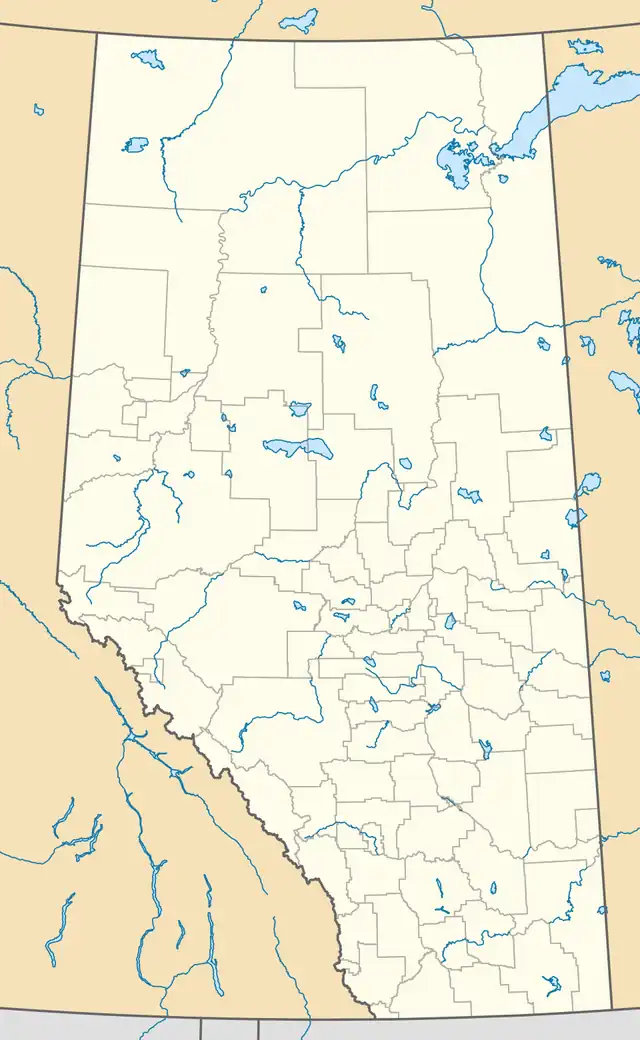  Poe Location of Poe in Alberta | |
| Coordinates: 53°15′34″N 112°20′00″W / 53.259444°N 112.333333°W | |
| Country | Canada |
| Province | Alberta |
| Region | Central Alberta |
| Census division | Division No. 10, Alberta |
| County | Beaver County |
| Time zone | MDT |
| Highways | Alberta Highway 14 |
Poe is a locality in central Alberta in Beaver County,[1][2] located on Highway 14, 42 kilometres (26 mi) northeast of Camrose.[3]
Toponymy
Poe is named for American novelist Edgar Allan Poe.[4][5] Its name derives from a station established by the Grand Trunk Pacific Railway (GTPR) in 1909, as part of a route colloquially known as the "alphabet line".[5][6] The railway line earned its moniker due to the GTPR's practice of "more or less" naming each station in alphabetical order, repeating the alphabet twice across Alberta.[5][6] Poe's station came before Ryley, Shonts, and Tofield.[7]
History
Founding and early development: 1909–1929
In 1909, the GTPR established a railway station named Poe along its main line between Winnipeg and Edmonton.[4][7] The Walsh Land Company began selling surrounding land the following year, claiming to have sold 200 lots by July 1910 to a mix of investors and settlers.[8]
A grain elevator was soon installed to serve farms appearing in the area.[9] The settlement also received a post office in 1912, which operated out of a general store, followed by Poe School in 1916.[10][11]
Rest of 20th century: 1930–2000
The arrival of a decade-long drought known as the Dust Bowl in the 1930s effectively curbed Poe's early growth,[9] though it was recognized as a locality for mapping purposes by the Government of Alberta in 1950.[3]
Following steady depopulation in the area, Poe School closed in 1952, and current students were transferred to schools in Holden and Ryley.[9] The building sat dormant until 1955, when a group of locals convened as the Poe Community Club; they purchased the facility for a dollar and converted it into a community centre.[9]
Poe's post office closed permanently in August 1964.[10] In 1972, the Poe Community Club disbanded, and the former Poe School building once again fell into disuse.[9] By 1978, the land that hosted the original Poe townsite was privately owned by one farming operation,[11] though official records continued to use the Poe toponym as a shorthand for the vicinity.[12][13]
21st century: 2001–present
In 2011, the Canadian National Railway (now the owner of the railway connection through Poe) decided to close a temporary access road it had established for the settlement.[14] This road represented the only form of vehicle access to Poe; furthermore, its status as an unofficial road had complicated the ability of emergency services to locate the settlement.[14][15] Beaver County's council subsequently voted to construct its own road into Poe.[14]
In its 2024 municipal development plan,[16] Beaver County described Poe as a "former community" that the county had recognized as a hamlet "at one time".[2] The plan ruled out allowing any "further [non-agricultural] development" in Poe for the foreseeable future.[2]
Services
The Canadian National Railway tracks through Poe are still in use for freight services as of 2026.[17] A detachment in Tofield provides RCMP services to Poe.[18]
Places of interest
As of 2023, Poe's disused grain elevator still stands in the original townsite.[19]
Demographics
Poe's population was recorded as 16 by the 1981 Canadian census,[13] and 15 by the 1986 Canadian census.[12]
Gallery
 Poe School, shortly after its construction in 1916
 Poe's grain elevator, photographed in 2010
 Grain elevator, photographed in 2016
References
- ↑ Government of Canada, Statistics Canada (January 25, 2022). "Variant of Standard Geographical Classification (SGC) 2021 for North and South - 4810016 - Beaver County". www23.statcan.gc.ca. Retrieved July 18, 2026.
- 1 2 3 Bylaw 24-1153 - Municipal Development Plan. Beaver County. December 2024. p. 73. Retrieved July 18, 2026.
- 1 2 "Poe". Geographical Names Data Base. Natural Resources Canada. Retrieved May 2, 2026.
- 1 2 Canadian Board on Geographical Names (1928). Place-names of Alberta. Ottawa: F. A. Acland, printer. p. 103.
- 1 2 3 Hunter, Shaun (June 17, 2024). "Storied Alberta Place Names". Read Alberta. Retrieved July 19, 2026.
- 1 2 Barry, William R.; Center, University of Regina Canadian Plains Research (1997). People Places: Saskatchewan and Its Names. Canadian Plains Research Center, University of Regina. p. 61. ISBN 978-0-88977-114-7.
- 1 2 Grand Trunk Pacific Railway Company (February 1, 1913). Time Tables: Fort William, Winnipeg, Regina, Saskatoon, Edmonton, Yellowhead Pass. Grand Trunk Pacific. p. 4.
- ↑ "Business Opportunities - Unequalled by any other town on the market are to be found at - POE ALBERTA". The Western Home Monthly. July 1910. p. 21.
- 1 2 3 4 5 Holden History Book Committee. Hemstitches and Hackamores: A History of Holden and District. Holden, Alberta: Holden Historical Society. pp. 37, 137, 257. ISBN 0-88925-362-5.
- 1 2 Library and Archives Canada (July 10, 2026). "Poe". Archives / Post Offices and Postmasters.
- 1 2 Brown, Harriet (1978). Beaver tales: history of Ryley & district. Royal Canadian Legion Ryley Branch 192. pp. 223, 267.
- 1 2 Statistics Canada (July 1988). Population and Dwelling Counts - Canada - Unincorporated Places. Ottawa: Minister of Supply and Services Canada. p. 249. ISBN 0-660-53454-1.
- 1 2 Statistics Canada (May 1983). "TABLE 1. 1981 PLACE NAME REFERENCE LIST OF CENSUS SUBDIVISIONS AND UNINCORPORATED PLACES". 1981 Census of Canada: Place name reference list: Western provinces and the Territories (PDF). Minister of Supply and Services Canada. p. 93.
- 1 2 3 Harcourt, Patricia (May 10, 2011). "County decides to build Poe access road itself after rejecting three tenders". The Tofield Mercury. pp. B2.
- ↑ Beaver County (August 18, 2010). "BEAVER COUNTY 2010 ACCOMPLISHMENTS/ONGOING PROJECTS". Regular Meeting of Council, August 18, 2010 (PDF). p. 156.
- ↑ "Bylaws, Plans & Policies". www.beaver.ab.ca. Retrieved July 19, 2026.
- ↑ "CN - Network Map". cnebusiness.geomapguide.ca. Retrieved July 19, 2026.
- ↑ "Alberta RCMP detachment locations". Royal Canadian Mounted Police. Retrieved July 19, 2026.
- ↑ Gray, Audrey (June 26, 2023). "Poe Grain Elevator". Historic Places Days. National Trust for Canada. Retrieved July 19, 2026.