Pir Ghaib Hunting Lodge and Observatory
| Pir Ghaib Hunting Lodge and Observatory | |
|---|---|
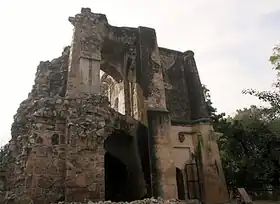 Pir Ghaib | |
  Location within Delhi | |
General information | |
Architectural style | Indo-Islamic |
| Location | Delhi, India |
| Coordinates | 28°40′34″N 77°12′47″E / 28.676°N 77.213°E |
Pir Ghaib Hunting Lodge and Observatory is a medieval heritage structure in Delhi, India. It is believed to be built by Sultan Firuz Shah Tughlaq of the Delhi Sultanate in the 14th century.[1] Standing two storeys tall, similar to other contemporaneous counterparts of the Tughlaq era architecture, it is made up of rubble.[2] The building has a hollow masonry cylinder, which is believed to have been used for astronomical purposes. Apart from its theorised uses as a hunting lodge and observatory, it is also believed to have been used as a clock tower[3]
Etymology
The monument's original name was Khushk-i-Shikar (hunting lodge).[4] Its current name, Pir Ghaib, literally means "the saint who vanished". This refers to the popular story of an Muslim saint, who had occupied a part of the building (two chambers, to be precise) after it had been abandoned by the rulers, vanishing into thin air towards the end of his life.[5] Owing to this miracle, he came to be known as "Pir Ghaib" (the saint who vanished), and is still revered today by a few localities.[6]
History
The monument and the stepwell adjacent to it were built by Sultan Firuz Shah Tughlaq in the year 1351 AD. The hunting lodge, along with an enclosure for game animals, was built by the Sultan following the death of his favorite son, Fateh Khan, to help him divert his mind by partaking in hunting.[7]
References
- ↑ Taneja, Anand Vivek (2017). "Saintly visions: Other histories and history's others in the medieval ruins of Delhi". The Indian Economic & Social History Review. 49 (4): 557–590. doi:10.1177/0019464612463843.
- ↑ "Pir Ghaib". Archaeological Survey of India. Retrieved 5 December 2019.
- ↑ Varma, Urmila (2001). Delhi, a tale of seven cities. Smriti Books. p. 55. ISBN 9788187967040.
- ↑ Chaudhuri, Dhruva N. (2005). Delhi, Light, Shades, Shadows. Niyogi Offset. p. 71. ISBN 9788190193641.
- ↑ Smith, Ronald Vivian (2005). The Delhi that No-one Knows. Orient Blackswan. p. xxiv. ISBN 9788180280207.
- ↑ "Pir Ghaib: Medieval observatory or a vanished saint's mausoleum". Hindustan Times. 10 July 2017.
- ↑ Chopra, Prabha (1976). Delhi Gazetteer. The Unit. p. 1066. OCLC 499238960.