Piora Oscillation
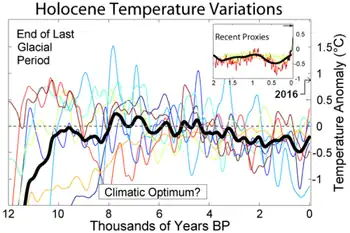
The Piora Oscillations are two cold periods in the Alpine climate history of the Holocene Epoch. Its dating differs between authors and no consistent modern approach currently exists. The spatial extent of the change is unclear; moreover, it does not show up as a major, or even identifiable, event in hemispheric temperature reconstructions.
The phenomenon is named after the Val Piora (Piora Valley) in Switzerland, where it was first detected.[1]
The water level of Lake Constance in the Alps show a considerable history of variations as reconstructed from sediment and pollen analysis. In 5,375 BP (3,375 BCE) there occurred an abrupt rise in lake level at the archaeological site of Arbon-Bleiche 3, indicating a cooling of the temperatures. This caused an abandonment of this prehistoric lake-shore location.[2]
Two stages of Piora Oscillation, Piora 1, and the later Piora 2 are suggested in recent literature. The Piora 2 oscillation, also called Rootmos 2, refers to the transition between Late Atlantic and Subboreal around 3500 BCE. This period also coincides with the transition between the Pfyn and Horgen cultures in Switzerland.[3]
See also
Notes
- ↑ Lamb, pp. 124, 128, 143.
- ↑ Magny, Michel; Leuzinger, Urs; Bortenschlager, Sigmar; Haas, Jean Nicolas (2006). "Tripartite climate reversal in Central Europe 5600–5300 years ago". Quaternary Research. 65 (1): 3–19. doi:10.1016/j.yqres.2005.06.009. ISSN 0033-5894. Retrieved 2026-06-21.
- ↑ Celine Maicher, Matthieu Le Bailly 2024, The impact of climate change upon intestinal parasites in central Europe during the 4th millennium BCE. Quaternary Science Reviews. Elsevier.
References
- Baronia, Carlo; Orombelli, Giuseppe (1996). "The Alpine "Iceman" and Holocene Climatic Change". Quaternary Research. 46 (1): 78–83. Bibcode:1996QuRes..46...78B. doi:10.1006/qres.1996.0046. S2CID 128772817.
- Burroughs, William J. (2003). Climate: Into the 21st Century. Cambridge: Cambridge University Press. ISBN 0-521-79202-9.
- Caseldine, C.; Thompson, G.; Langdon, C.; Hendon, D. (2005). "Evidence for an extreme climatic event on Achill Island, Co. Mayo, Ireland around 5200–5100 cal. yr BP". Journal of Quaternary Science. 20 (2): 169–178. Bibcode:2005JQS....20..169C. doi:10.1002/jqs.901. S2CID 140619228.
- Hou, Mei; Wu, Wen Xiang (5 December 2020). "A review of 6000-5000 cal BP climatic anomalies in China". Quaternary International. 571: 58–72. doi:10.1016/j.quaint.2020.12.004. ISSN 1040-6182.
- Lamb, Hubert H. (1995). Climate, History, and the Modern World. London: Routledge. ISBN 0-415-12735-1.
- Magny, Michel; Haas, Jean Nicolas (2004). "A major widespread climatic change around 5300 cal. yr BP at the time of the Alpine Iceman". Journal of Quaternary Science. 19 (5): 423–430. Bibcode:2004JQS....19..423M. doi:10.1002/jqs.850. S2CID 128697360.
- Matossian, Mary A. K. (1997). Shaping World History: Breakthroughs in Ecology, Technology, Science, and Politics. New York: M. E. Sharpe. ISBN 0-7656-0061-7.
- Wick, Lucia; Tinner, Willy (1997). "Vegetation Changes and Timberline Fluctuations in the Central Alps as Indicators of Holocene Climatic Oscillations". Arctic and Alpine Research. 29 (4): 445–458. doi:10.2307/1551992. JSTOR 1551992.