Physalaemus atlanticus
| Physalaemus atlanticus | |
|---|---|
 | |
Scientific classification  | |
| Kingdom: | Animalia |
| Phylum: | Chordata |
| Class: | Amphibia |
| Order: | Anura |
| Family: | Leptodactylidae |
| Genus: | Physalaemus |
| Species: | P. atlanticus |
| Binomial name | |
| Physalaemus atlanticus Haddad & Sazima, 2004 | |

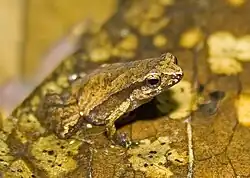
Physalaemus atlanticus is a species of frog in the family Leptodactylidae. It is endemic to Brazil.[2][3]
Description
The adult male frog measures 20.1 22.1 mm in snout-vent length and the adult female frog 21.0-23.9 mm long. Its belly is orange in color.[4]
Habitat
This frog is found on the leaf litter in coastal rainforests. Scientists have seen this frog between 0 and 50 m (0 and 164 ft) above sea level.[1][2]
Most of the frog's known range is inside a protected park, Parque Estadual da Serra do Mar.[1]
Reproduction
This frog deposits its eggs in foam nests in ponds. The nests float on the water or sits on wet leaf litter.[1]
Threats
The IUCN classifies this frog as least concern of dying extinction. Because most of the frog's range is within Serra do Mar, which has large tracts of suitable Atlantic forest habitat, the frog is not in danger. Only about 30 percent of the population is subject to habitat fragmentation and degradation associated with urbanization, both cash crop and small-scale agriculture, silviculture, and livestock cultivation.[1]
References
- 1 2 3 4 5 IUCN SSC Amphibian Specialist Group & Instituto Boitatá de Etnobiologia e Conservação da Fauna (2023). "Physalaemus atlanticus". IUCN Red List of Threatened Species. 2023 e.T57240A172227542. doi:10.2305/IUCN.UK.2023-1.RLTS.T57240A172227542.en.
- 1 2 Frost, Darrel R. "Physalaemus atlanticus Haddad and Sazima, 2004". Amphibian Species of the World, an Online Reference. Version 6.0. American Museum of Natural History, New York. Retrieved May 16, 2026.
- ↑ "Physalaemus atlanticus Haddad & Sazima, 2004". AmphibiaWeb. University of California, Berkeley. Retrieved May 16, 2026.
- ↑ C.F.B. HADDAD; I. SAZIMA (2004). "A new species of Physalaemus (Amphibia; Leptodactylidae) from the Atlantic forest in southeastern Brazil". Zootaxa (Abstract and references). 479 (1): 1–12. doi:10.11646/zootaxa.479.1.1. Retrieved May 16, 2026.