Phosphoribosylformylglycinamidine synthase
| Phosphoribosylformylglycinamidine synthase | |||||||||
|---|---|---|---|---|---|---|---|---|---|
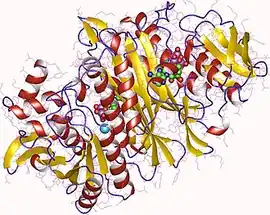 FGAM synthase II monomer, Thermotoga maritima | |||||||||
| Identifiers | |||||||||
| EC no. | 6.3.5.3 | ||||||||
| CAS no. | 9032-84-2 | ||||||||
| Databases | |||||||||
| BRENDA | enzyme data | ||||||||
| ExPASy | NiceZyme view | ||||||||
| KEGG | enzyme entry | ||||||||
| MetaCyc | metabolic pathway | ||||||||
| Rhea | reactions | ||||||||
| PDB structures | RCSB PDB PDBe PDBsum | ||||||||
| Gene Ontology | AmiGO / QuickGO | ||||||||
| |||||||||
In enzymology, a phosphoribosylformylglycinamidine synthase (EC 6.3.5.3) is an enzyme that catalyzes the chemical reaction
- ATP + N2-formyl-N1-(5-phospho-D-ribosyl)glycinamide + L-glutamine + H2O ADP + phosphate + 2-(formamido)-N1-(5-phospho-D-ribosyl)acetamidine + L-glutamate

The 4 substrates of this enzyme are ATP, N2-formyl-N1-(5-phospho-D-ribosyl)glycinamide, L-glutamine, and H2O, whereas its 4 products are ADP, phosphate, 2-(formamido)-N1-(5-phospho-D-ribosyl)acetamidine, and L-glutamate.
This enzyme belongs to the family of ligases, specifically those forming carbon-nitrogen bonds carbon-nitrogen ligases with glutamine as amido-N-donor. The systematic name of this enzyme class is N2-formyl-N1-(5-phospho-D-ribosyl)glycinamide:L-glutamine amido-ligase (ADP-forming). Other names in common use include phosphoribosylformylglycinamidine synthetase, formylglycinamide ribonucloetide amidotransferase, phosphoribosylformylglycineamidine synthetase, FGAM synthetase, FGAR amidotransferase, 5'-phosphoribosylformylglycinamide:L-glutamine amido-ligase, (ADP-forming), 2-N-formyl-1-N-(5-phospho-D-ribosyl)glycinamide:L-glutamine, and amido-ligase (ADP-forming).[1][2]
It is known as ADE6 in Saccharomyces cerevisiae (budding yeast) genetics.[3]
Structural studies
As of late 2007, 8 structures have been solved for this class of enzymes, with PDB accession codes PDB: 1T3T, PDB: 1VK3, PDB: 1VQ3, PDB: 2HRU, PDB: 2HRY, PDB: 2HS0, PDB: 2HS3, and PDB: 2HS4.
Regulation
This enzyme participates in purine metabolism. Oncogenic and physiological signals lead to the ERK-dependent PFAS phosphorylation at the T619 site, stimulating de novo purine synthesis flux. In addition, ERK-mediated PFAS phosphorylation is required for cell and tumor growth.[4]
References
- ↑ Ali, Eunus S.; Sahu, Umakant; Villa, Elodie; O’Hara, Brendan P.; Gao, Peng; Beaudet, Cynthia; Wood, Antony W.; Asara, John M.; Ben-Sahra, Issam (18 June 2020). "ERK2 Phosphorylates PFAS to Mediate Posttranslational Control of De Novo Purine Synthesis". Molecular Cell. 78 (6): 1178–1191.e6. doi:10.1016/j.molcel.2020.05.001. PMC 7306006. PMID 32485148.
- ↑ MELNICK I, BUCHANAN JM (1957). "Biosynthesis of the purines. XIV. Conversion of (alpha-N-formyl) glycinamide ribotide to (alpha-N-formyl) glycinamidine ribotide purification and requirements of the enzyme system". J. Biol. Chem. 225 (1): 157–62. doi:10.1016/S0021-9258(18)64918-X. PMID 13416226.
- ↑ Matsumoto, K.; Stotz, A.; Andreichuk YuV; Nielsen, I.S.; Paluh, J.L.; Hoffman, R.A. "ADE6 - phosphoribosylformylglycinamidine synthase". Wikigenes. PubMed. Retrieved 21 October 2019.
- ↑ Ali, ES; Sahu, U; Villa, E; O'Hara, BP; Gao, P; Beaudet, C; Wood, AW; Asara, JM; Ben-Sahra, I (18 June 2020). "ERK2 Phosphorylates PFAS to Mediate Posttranslational Control of De Novo Purine Synthesis". Molecular Cell. 78 (6): 1178–1191.e6. doi:10.1016/j.molcel.2020.05.001. PMC 7306006. PMID 32485148.