Fuscoporia gilva
| Fuscoporia gilva | |
|---|---|
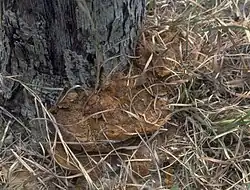 | |
| Fruiting bodies growing on Quercus sp. | |
Scientific classification  | |
| Kingdom: | Fungi |
| Division: | Basidiomycota |
| Class: | Agaricomycetes |
| Order: | Hymenochaetales |
| Family: | Hymenochaetaceae |
| Genus: | Fuscoporia |
| Species: | F. gilva |
| Binomial name | |
| Fuscoporia gilva (Schwein.) T. Wagner & M. Fisch. (2002) | |
| Synonyms | |
|
List
| |
| Fuscoporia gilva | |
|---|---|
| Mycological characteristics | |
 | Pores on hymenium |
 | No distinct cap |
 | Hymenium attachment is irregular or not applicable |
| Lacks a stipe |
 | Spore print is yellow |

 | Ecology is parasitic or saprotrophic |
 | Edibility is unknown |
Fuscoporia gilva, commonly known as the oak conk,[1] is a species of fungal plant pathogen that infects several hosts.
Description
The fruit bodies typically grow in rows of horizontal platforms, which grow over several years and sometimes "smear" onto the wood.[2] The caps are usually semicircular with lumpy margins, 2–15 centimetres (3⁄4–5+7⁄8 inches) wide, with zonate colouration ranging from dark brown to light reddish-brown or yellowish at the margin,[1] which is up to 1 cm thick and velvety.[2] There are 5–8 pores per square millimetre. The flesh is tough and corky. The spore print is whitish or yellow.[1][2]
Similar species
Mensularia radiata, the alder bracket,[3] is usually found on non-oak hardwoods; fresh specimens often exhibit white-tipped pores near the margin.[2]
Ecology
F.gilva is a plant pathogen that infects several hosts.[4]
It is occasionally eaten by the widespread American pleasing fungus beetle Ischyrus quadripunctatus.[5]
Uses
In traditional Chinese medicine, it is used to treat stomachaches and cancer; polysaccharides isolated from lab-grown F. gilvus have been shown to inhibit the growth of melanoma in a mouse model.[6][7]
See also
References
- 1 2 3 Arora, David (1986) [1979]. Mushrooms Demystified: A Comprehensive Guide to the Fleshy Fungi (2nd ed.). Berkeley, CA: Ten Speed Press. p. 582. ISBN 978-0-89815-170-1.
- 1 2 3 4 Audubon (2023). Mushrooms of North America. Knopf. p. 140. ISBN 978-0-593-31998-7.
- ↑ Jarvis, Peter J. (2020). The Pelagic Dictionary of Natural History of the British Isles. Exeter: Pelagic. ISBN 9781784271947.
- ↑ Rizzo, David M.; Rentmeester, Rita M.; Burdsall, Harold H. (1995-11-01). "Sexuality and somatic incompatibility in Phellinus gilvus". Mycologia. 87 (6): 805–820. doi:10.1080/00275514.1995.12026602. ISSN 0027-5514.
- ↑ Goodrich, Michael A. and Springer, Charles A. (1999): The Pleasing Fungus Beetles (Coleoptera: Erotylidae) of Nebraska. Transactions of the Nebraska Academy of Sciences 25: 53-71.Fulltext
- ↑ Huo, Jinxi; Zhong, Shi; Du, Xin; Cao, Yinglong; Wang, Wenqiong; Sun, Yuqing; Tian, Yu; Zhu, Jianxun; Chen, Jine; Xuan, Lijiang; Wu, Chongming; Li, Yougui (2020-07-01). "Whole-genome sequence of Phellinus gilvus (mulberry Sanghuang) reveals its unique medicinal values". Journal of Advanced Research. 24: 325–335. doi:10.1016/j.jare.2020.04.011. ISSN 2090-1232. PMC 7235939. PMID 32455007.
- ↑ Bae, Jae-sung; Jang, Kwang-ho; Yim, Hyunee; Jin, Hee-kyung (2005-01-31). "Polysaccharides isolated from Phellinus gilvus inhibit melanoma growth in mice". Cancer Letters. 218 (1): 43–52. doi:10.1016/j.canlet.2004.08.002. ISSN 0304-3835.