Perrier's sifaka
| Perrier's sifaka | |
|---|---|
 | |
Scientific classification  | |
| Kingdom: | Animalia |
| Phylum: | Chordata |
| Class: | Mammalia |
| Infraclass: | Placentalia |
| Order: | Primates |
| Suborder: | Strepsirrhini |
| Family: | Indriidae |
| Genus: | Propithecus |
| Species: | P. perrieri |
| Binomial name | |
| Propithecus perrieri | |
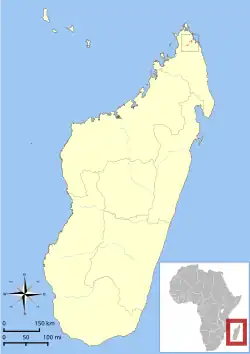 | |
| Distribution of P. perrieri[1] | |

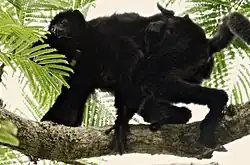
Perrier's sifaka (Propithecus perrieri) is a lemur endemic to Madagascar. It was formerly considered to be a subspecies of diademed sifaka[4] It has a very small range in northeastern Madagascar where its habitat is dry deciduous or semihumid forest. Part of its range is in protected areas. It is an almost entirely black sifaka and measures about 90 cm (35 in), half of which is a bushy tail. Females are slightly larger than males.
It moves in small family groups through the canopy feeding on fruit, leaves, flowers, buds, and seeds. Groups have territories around one hectare and vocalise with each other. The main threats faced by this sifaka are habitat destruction and fragmentation due to slash-and-burn agriculture, charcoal gathering, and logging. The International Union for Conservation of Nature has rated its conservation status as "critically endangered".[5]
Etymology
Perrier's sifaka was named in honor of Henri Perrier de La Bâthie by Louis Lavauden in 1931. The term "sifaka" is derivative of the terrestrial alarm vocalization produced by species of western sifakas belonging to the Propithecus verreauxi group. Because Perrier's sifaka belongs to the eastern (P. diadema) group, it does not produce such a vocalization.[6]
The Antankarana people refer to the species as radjako, rajako, jakoe, or jakoey in honor of a legendary hero of the same name from whom they believe Perrier's sifakas are descended.[7]: 570 [8] An alternative narrative states that Radjako was a man who was hit with a spoon by his wife, which transformed him into a Perrier's sifaka. Elsewhere in Madagascar, Radjako appears in similar etiological myths for other lemur species, including the ring-tailed lemur and the indri.[8] Radjako was borrowed into French as jacquot as a derogatory term for lemurs. Derivations of this term may be found in Bourbonnais Creole and Comorian languages.[9]
Perrier's sifaka is also known as ankomba joby, which is Malagasy for "black lemur."[8] This term can also refer to the male blue-eyed black lemur.[9] Ankomba is a derivation of the Swahili word komba, which means galago.[9]
Taxonomy
Perrier's sifaka belongs to the P. diadema group of eastern sifakas within the Propithecus genus. Like all eastern sifakas except for Milne-Edwards's sifaka (P. edwardsi), it has a somatic number of 2n = 42.[10] 18 autosomnal chromosomes are metacentric, 14 are submetacentric, and eight are acrocentric. The X chromosome is metacentric, and the Y chromosome is acrocentric.[10] Perrier's sifaka could have previously had two additional acrocentric chromosomes that underwent a Robertsonian translocation, resulting in a metacentric chromosome.[11] Perrier's sifaka and the silky sifaka (P. candidus) form a clade to the exclusion of the diademed sifaka (P. diadema) and Milne-Edwards's sifaka.[12]
Changes in taxonomy
Like other eastern sifakas, Perrier's sifaka was previously considered to be a subspecies of a broader P. diadema species that included the silky sifaka, the diademed sifaka, and Milne-Edwards's sifaka.[13] The consolidation of the eastern lemurs into a single species was widely accepted following the publication of Ernst Schwarz's 1931 revision of lemur taxonomy.[13][14] A fifth subspecies known as the black sifaka (P. d. holomelas)[10] was recognized prior to the 1980s, but was considered synonymous with Milne-Edwards's sifaka after Ian Tattersall found the two subspecies to be sympatric.[15] The broad P. diadema species classification was largely abandoned due to mitochondrial evidence found by Mireya Mayor et al. which indicated that the genetic distance between the four subspecies met the criteria for speciation according to the phylogenetic species concept.[12][16]
Description
Perrier's sifaka is the smallest eastern sifaka.[7]: 570 It has a body length of 85–92 cm, of which 42–46 cm are tail.[17] It weighs 3.7–6.0 kg, with females tending to be heavier than males. Otherwise, there is little sexual dimorphism.[18]
Its skull is shorter and wider than other eastern sifakas'.[7]: 570 It has small, brown, forward-facing eyes.[7]: 570 [18] The salivary glands are very large.[7]: 542 Its deciduous dental formula is 2.1.22.1.2.[19]: 253 The deciduous incisors erupt before birth.[7]: 552 Adolf Remane interpreted the permanent dental formula as 2.1.2.32.0.2.3, wherein the lower deciduous canines are not replaced. Other scholars, such as William Warwick James and Daris Swindler, have argued that the lower deciduous canines are instead replaced by an incisor-like tooth, and that it is two of the lower deciduous incisors that are not replaced, giving the appearance of 2.1.2.32.0.2.3 despite being 2.1.2.31.1.2.3. In either case, Perrier's sifaka differs from lemurs outside of the Indriidae and Daubentoniidae families in that its toothcomb consists of four, rather than six, incisor-shaped teeth, and it has two, rather than three, permanent premolars.[19]: 254
Its pelage is almost entirely black,[17] and the ventral coat has a brownish tint.[20] All but the face is furred, though some individuals' ears are bald.[20]
The digestive tract of Perrier's sifaka includes a long cecum without an appendix or appendix-like structure.[19]: 496 [21] The cecum typically exceeds the body length of an adult, though it is relatively smaller in immature individuals. The cecum has three rows of sacculations, which do not develop until after birth. The first colon is arranged as a large, oval-shaped spiral called a tortillon,[7]: 543 which may play a role in preventing blockages. This differs from the smaller, corkscrew-shaped spirals seen in the colons of strepsirrhines outside of the Propithecus and Indri genera.[19]: 498 Beyond the tortillon is a dorsal second colon, which terminates into the rectum without structural demarcation. Overall, the lower gastrointestinal tract of Perrier's sifaka is about nine times an individual's body length.[7]: 543
Behavior
Perrier's sifakas use vocalizations to communicate including warning calls and have even been observed to make a sound described as sneezing.[18]
Social Structure
Sifakas have groups of two to six individuals.[17] Dispersal of sex is unbiased, which is uncommon among most species. Aggression between groups is extremely low, as is the overall encounter rates between groups. Society is largely matriarchal and females have feeding priority.[16] Mating habits have not been thoroughly studied yet.[18]
Reproduction
The reproductive cycle is bound to the season and sifakas reproduce either every year or every two years. Infants have a slow growth rate given the large abundance of food on Madagascar, but dental development is just the opposite. A hypothesis has been put forth that this is to reduce the dependency period of the offspring and increase the chance of survival for the mother, which does not have to expend energy and time to raise her offspring. Most females do not place much effort into individual offspring, as half of sifaka infants die before the age of one.[16] Infants become independent at the age of two and reach sexual maturity at the age of four for females and five for males. Males use genital swelling to communicate that they are ready for sex.[18]
Diet
The diet of Perrier's sifaka resembles that of other sifakas, consisting of fruit, leaves, flowers, buds, petioles, and seeds. Sifakas are naturally suited for this herbivorous diet because they have long gastrointestinal tracts and enlarged ceca.[16] Groups of sifaka do not show any aggression towards other groups when feeding, let alone come into contact with each other.[22] Sifakas in general show seasonal variation in diet. During the wet season, Perrier's sifakas contribute most of their feeding time, about 70 to 90%, to fruits and seeds, but in the dry season, most of the species' feeding time is spent on leaves and flowers.[16]
Distribution and habitat
Perrier's sifaka has a very limited range in northeastern Madagascar between the Irodo River to the north and the Lokia River to the south.[17] The species' geographic range is concentrated on the Analamerana Special Reserve managed by Madagascar National Parks and in the Andrafiamena Protected Area managed by the NGO Fanamby.[23] Its presence in the Ankarana Special Reserve has been reported a few decades ago, but could not be confirmed in the last decade.[23]

Its habitat consists of dry deciduous and semihumid forest.[17] Groups of this species have a home range around a hectare.
Past distribution
The hypothesis that northern sifaka species had their distribution contract is supported by phylogeographic, genetic, and fossil data.[24] In contrast to the other sifaka species, P. tattersalli and P. perrieri have a disjunct and restricted distribution in the northern part of Madagascar, far removed from the northern limit of their sister species. (Supplementary figure 1 in Salmona et al. 2017[24]) In addition, bones attributed to P. cf. verreauxi (i.e. western sifaka) and P. cf diadema (i.e. eastern sifaka) were found in Ankarana (Figure 1 in Salmona et al., 2017,[24] Jungers et al. 1995) and bones of P. cf diadema were reported at Andavakoera (Montagne des Français, Figure 1 in Salmona et al., 2017;[24] Godfrey et al. 1996). Although these sifaka subfossils were not radiocarbon dated, they suggest that the paleodistributions of both sifaka species were much wider than today and possibly overlapping.[24]
Demographic History
Using population genetic analyses, Salmona et al. 2017[24] inferred the demographic history of P.perrieri. Their analyses show that P. perrieri underwent a major demographic decline, which most likely occurred after the mid-Holocene transition (in the last 5,000 years). While mid-Holocene climate change probably triggered major demographic changes in northern lemur species range and connectivity, human settlements that expanded over the last four millennia in northern Madagascar likely played a role in the loss and fragmentation of the forest cover.[24]
Conservation status
Perrier's sifaka is one of the most endangered primates due to the limited distribution and low population density.[23][25] It is listed in CITES Appendix I.[2] A recent conservation plan for Perrier's sifaka has been developed following the International Union for Conservation of Nature Species Survival Commission (SSC) Lemur Red List reassessment meeting in Antananarivo in 2012.[26][27] While selective logging still seems to be one of the main threads in Analamerana special reserve, deforestation for slash and burn agriculture and for charcoal production is predominant in Andrafiamena-Andavakoera protected area. Given the small total population size, persistence of local threats, and the paucity of wildlife patrols, an appraisal of its population levels and an effective control of habitat loss are urgently needed. This requires a unified regional management plan, since the species' natural range and potential areas of migration/seasonal presence overlap with three areas of different protective status, independently managed by Madagascar National Parks (Analamerana and Ankarana) and Fanamby (Andrafiamena). Given the diverse group of stakeholders involved (e.g. park services, ministries, universities, tour operators, local businesses, farmers, etc.), P. perrieri conservation requires a clearly defined institution, committed to leading its conservation plan with incentives for inclusive action that take advantage of the strengths of the different participants .
References
- 1 2 Heriniaina, R.; Hosnah, H.B.; Zaonarivelo, J. (2020). "Propithecus perrieri". IUCN Red List of Threatened Species. 2020 e.T18361A115573556. doi:10.2305/IUCN.UK.2020-2.RLTS.T18361A115573556.en. Retrieved 19 November 2021.
- 1 2 "Checklist of CITES Species". CITES. UNEP-WCMC. Retrieved 18 March 2015.
- ↑ Groves, C. P. (2005). Wilson, D. E.; Reeder, D. M. (eds.). Mammal Species of the World: A Taxonomic and Geographic Reference (3rd ed.). Baltimore: Johns Hopkins University Press. ISBN 0-801-88221-4. OCLC 62265494.
- ↑ Christoph Schwitzer; Olivier Arnoult; Berthe Rakotosamimanana. "An international conservation and research programme for Perrier's sifaka (Propithecus perrieri Lavauden, 1931) in northern Madagascar" (PDF). Lemur News Vol. 11, 2006. Lemur News. Archived from the original (PDF) on 4 March 2014. Retrieved 24 July 2012.
- ↑ "IUCN".
- ↑ Powzyk, J.A. (1997). The Socio-Ecology of Two Sympatric Indriids: Propithecus diadema diadema and Indri indri, A Comparison of Feeding Strategies and Their Possible Perercussions on Species-Specific Behaviors (PhD thesis). Duke University. ProQuest 304344985. Retrieved 15 May 2026.
- 1 2 3 4 5 6 7 8 Hill, W.C.O. (1953). "Family III. Indriidae". Primates: Comparative Anatomy and Taxonomy. Edinburgh: Edinburgh University Press.
- 1 2 3 Anania, Alessio; Salmona, Jordi; Rasolondraibe, Emmanuel; Jan, Fabien; Chikhi, Lounès; Fichtel, Claudia; Kappeler, Peter M.; Rasoloarison, Rodin (23 May 2018). "Taboo adherence and presence of Perrier's sifaka (Propithecus perrieri) in Andrafiamena forest". Madagascar Conservation & Development. 13 (1): 6. doi:10.4314/mcd.v13i1.1.
- 1 2 3 Blench, Roger & Martin Walsh 2009. Faunal names in Malagasy: their etymologies and implications for the prehistory of the East African coast.
- 1 2 3 Tattersall, I. (1982). The Primates of Madagascar. New York City, NY: Columbia University Press. pp. 102–104. ISBN 0231047045.
- ↑ Rumpler, Yves; Andriaholinirina, Nicole; Warter, Stéphanie; Hauwy, Marcel; Rabarivola, Clément (July 2004). "Phylogenetic history of the Sifakas (Propithecus: Lemuriformes) derived from cytogenetic studies". Chromosome Research. 12 (5): 453–463. doi:10.1023/B:CHRO.0000034738.18012.05. PMID 15252241.
- 1 2 Mayor, M.I.; Sommer, J.A.; Houck, M.L.; Zaonarivelo, J.R.; Wright, P.C.; Ingram, C.; Engel, S.R.; Louis Jr, E.E. (2004). "Specific status of Propithecus spp". International Journal of Primatology. 25 (4): 875–900. doi:10.1023/B:IJOP.0000029127.31190.e9. Retrieved 13 May 2026.
- 1 2 Groves, Colin P.; Helgen, Kristofer M. (December 2007). "Craniodental Characters in the Taxonomy of Propithecus". International Journal of Primatology. 28 (6): 1363–1383. doi:10.1007/s10764-007-9226-5. Retrieved 13 May 2026.
- ↑ Schwarz, Ernst (June 1931). "20. A Revision of the Genera and Species of Madagascar Lemuridæ". Proceedings of the Zoological Society of London. 101 (2): 399–428. doi:10.1111/j.1096-3642.1931.tb01020.x.
- ↑ Tattersall, Ian (14 February 1986). "Notes on the Distribution and Taxonomic Status of Some Subspecies of Propithecus in Madagascar". Folia Primatologica. 46 (1): 51–63. doi:10.1159/000156236.
- 1 2 3 4 5 Irwin, Mitchell. "Ecologically Enigmatic Lemurs: The Sifakas of the Eastern Forests (Propithecus candidus, P. diadema, P. edwardsi, P. perrieri, and P. tattersalli)" (PDF). Archived from the original (PDF) on 7 April 2014. Retrieved 24 July 2012.
- 1 2 3 4 5 Garbutt, Nick (2007). Mammals of Madagascar, A Complete Guide. pp. 189–191.
- 1 2 3 4 5 "Facts about Perrier's Sifaka (Propithecus perrieri)". Retrieved 26 July 2012.
- 1 2 3 4 Ankel-Simons, Friderun (2007). Primate Anatomy: An Introduction (3rd ed.). London: Elsevier Science & Technology. ISBN 978-0-12-372576-9. Retrieved 16 May 2026.
- 1 2 Mittermeier, R.A.; Louis Jr, E.E.; Richardson, M.; Schwitzer, C.; Langrand, O.; Rylands, A.B.; Hawkins, F.; Rajaobelina, S.; Ratsimbazafy, J.; Rasoloarison, R.; Roos, C.; Kappeler, P.M.; Mackinnon, J. (2010). "Indriidae". Lemurs of Madagascar (3rd ed.). Arlington, Va: Conservation International. p. 574. ISBN 978-1-934151-23-5.
- ↑ Fisher, R.E. (2000). "The Primate Appendix: A Reassessment". The Anatomical Record. 261 (6): 228–236. doi:10.1002/1097-0185(20001215)261:6<228::AID-AR1005>3.0.CO;2-O. Retrieved 19 May 2026.
- ↑ Shawn Lehman; Mireya Mayor. "Dietary Patterns in Perrier's Sifakas (Propithecus diadema perrieri): A Preliminary Study" (PDF). Archived from the original (PDF) on 9 August 2015. Retrieved 24 July 2012.
- 1 2 3 4 Salmona J, Jan F, Rasolondraibe E, Zaranaina R, Saïd Ousseni D, Mohamed-Thani I, Rakotonanahary A, Ralantoharijaona T, Kun-Rodrigues C, Carreira M, Wohlhauser S, Ranirison P, Zaonarivelo JR, Rabarivola JC, Chikhi L (2013). "Survey of the critically endangered Perrier's sifaka (Propithecus Perrieri) across most if its distribution range. Lemur News 17:9–12". Retrieved 3 April 2014.
- 1 2 3 4 5 6 7 Salmona, Jordi; Heller, Rasmus; Quéméré, Erwan; Chikhi, Lounès (2017-10-01). "Climate change and human colonization triggered habitat loss and fragmentation in Madagascar". Molecular Ecology. 26 (19): 5203–5222. Bibcode:2017MolEc..26.5203S. doi:10.1111/mec.14173. ISSN 1365-294X. PMID 28488335. S2CID 27524388.
- ↑ Banks MA, Ellis ER, Wright PC (2007) Global population size of a critically endangered lemur, Perrier's sifaka. Animal Conservation 10:254–262
- ↑ Salmona J, Zaonarivelo JR, Banks MA (2013) Analamerana and Andrafiamena, site-based action plan for Perrier's sifaka conservation. In: Schwitzer C, Mittermeier RA, Davies N, Johnson SE, Ratsimbazafy J, Razafindramanana J, Louis EE, Rajaobelina S (eds) Lemurs of Madagascar: a strategy for their conservation 2013–2016. Bristol, UK: IUCN SSC Primate Specialist Group, Bristol Conservation and Science Foundation, and Conservation International. p, p 140–141
- ↑ Schwitzer C, Mittermeier RA, Davies N, Johnson S, Ratsimbazafy J, Razafindramanana J, Louis Jr EE, Rajaobelina S (2013). "Lemurs of Madagascar A Strategy for their Conservation 2013–2016. IUCN SSC Primate Specialist Group, Bristol Conservation and Science Foundation, and Conservation International, Bristol, UK" (PDF). Retrieved 3 April 2014.
External links
