Peperomia puberuliformis
| Peperomia puberuliformis | |
|---|---|
 | |
Scientific classification  | |
| Kingdom: | Plantae |
| Clade: | Embryophytes |
| Clade: | Tracheophytes |
| Clade: | Angiosperms |
| Clade: | Magnoliids |
| Order: | Piperales |
| Family: | Piperaceae |
| Genus: | Peperomia |
| Species: | P. puberuliformis |
| Binomial name | |
| Peperomia puberuliformis | |
Peperomia puberuliformis or Peperomia puberulaeformis is a species of terrestrial or epiphytic herb in the genus Peperomia that is native to Peru.[1][2] It grows on wet tropical biomes.[1] Its conservation status is threatened.[3]
Description
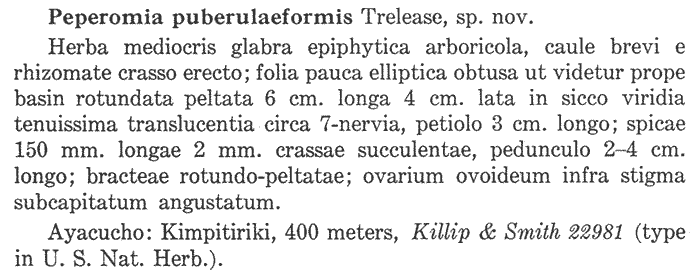
The type specimen were collected at Kimpitiriki, Peru at an altitude of 400 meters above sea level.[4]
Peperomia puberuliformis is a medium-sized, glabrous, epiphytic, tree-dwelling herb with a short stem arising from a thick rhizome and erect. The few leaves are elliptic, obtuse, apparently rounded at the base and peltate, measuring 6 cm long and 4 cm wide. When dry, they are green, very thin, translucent, and about 7-nerved. The petiole is 3 cm long. The spikes are 150 mm long and 2 mm thick, succulent, with a peduncle 2–4 cm long. The ovary is ovoid, narrowed below a subcapitate stigma.[4]
Taxonomy and naming
It was described in 1936 by William Trelease in Publications of the Field Museum of Natural History, Botanical Series 13, from specimens collected by Ellsworth Paine Killip & Albert Charles Smith.[5]
The epithet combines puberulus (minutely pubescent) and -formis (shaped), referring to the resemblance of this species to others in the puberula group, despite being largely glabrous.[4]
Distribution and habitat
It is native to Peru.[2] It grows as a terrestrial or epiphytic herb.[1] It grows on wet tropical biomes.[1]
Conservation
This species has been assessed as threatened in a preliminary report.[3]
References
- 1 2 3 4 "Peperomia puberuliformis Trel". Plants of the World Online. Royal Botanic Gardens, Kew. Retrieved 26 March 2026.
- 1 2 "Peperomia puberuliformis Trel". Global Biodiversity Information Facility. Retrieved 26 March 2026.
- 1 2 Bachman, Steven P.; Brown, Matilda J. M.; Leão, Tarciso C. C.; Lughadha, Eimear Nic; Walker, Barnaby E. (2024). "Extinction risk predictions for the world's flowering plants to support their conservation". New Phytologist. 242 (2): 797–808. doi:10.1111/nph.19592. PMID 38437880.
- 1 2 3 Trelease, William. "Publications of the Field Museum of Natural History, Botanical Series 13(2): 80. 1936". Publ. Field Mus. Nat. Hist., Bot. Ser. 13(2): 80.
- ↑ "Peperomia puberuliformis Trel". Tropicos. Retrieved 26 March 2026.