Peperomia pseudoalpina
| Peperomia pseudoalpina | |
|---|---|
 | |
Scientific classification  | |
| Kingdom: | Plantae |
| Clade: | Embryophytes |
| Clade: | Tracheophytes |
| Clade: | Angiosperms |
| Clade: | Magnoliids |
| Order: | Piperales |
| Family: | Piperaceae |
| Genus: | Peperomia |
| Species: | P. pseudoalpina |
| Binomial name | |
| Peperomia pseudoalpina | |
| Synonyms | |
| |
Peperomia pseudoalpina is a species of epiphyte in the genus Peperomia that is endemic in Costa Rica.[1][2] It grows on wet tropical biomes.[1] Its conservation status is Threatened.[3]
Description
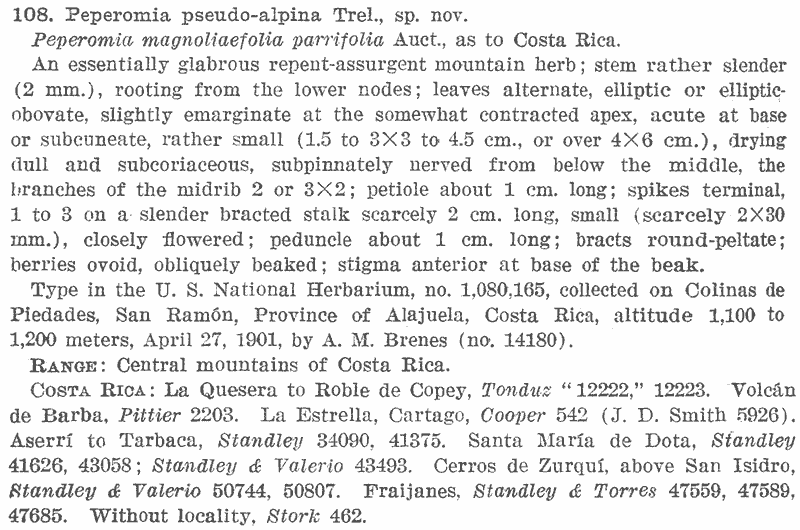
The type specimen was collected in San Ramón, Costa Rica at an altitude of 1100-1200 meters .[4]
Peperomia pseudoalpina is an essentially hairless, creeping then ascending mountain herb. The stem is rather slender at 2 millimeters thick and roots from the lower nodes. The leaves are alternate, either elliptic or elliptic-obovate, with a slightly notched tip at the somewhat contracted apex and an acute or somewhat wedge-shaped base. They are rather small at 1.5 to 3 by 3 to 4.5 centimeters, sometimes exceeding 4 by 6 centimeters, and dry to a dull, somewhat leathery texture. The leaves are subpinnately nerved from below the middle, with branches of the midrib numbering 2 or 3 pairs by 2. The petiole is about 1 centimeter long. The spikes are terminal, numbering 1 to 3 on a slender, bracted stalk scarcely 2 centimeters long. The spikes are small at scarcely 2 by 30 millimeters, with densely clustered flowers. The peduncle is about 1 centimeter long. The floral bracts are round and shield-shaped (peltate). The berries are ovoid with an oblique beak. The stigma is positioned at the front at the base of the beak.[4]
Taxonomy and naming
It was described in 1929 by William Trelease in Contributions from the United States National Herbarium 6.[5] The epithet pseudoalpina comes from the Greek pseudo- meaning "false" and the Latin alpinus meaning "alpine" or "of high mountains," referring to its resemblance to alpine species despite growing at lower elevations.[4]
Distribution and habitat
It is endemic in Costa Rica.[2] It grows as an epiphyte and is a herb.[1][4] It grows on wet tropical biomes.[1]
Conservation
This species is assessed as Threatened.[3]
References
- 1 2 3 4 "Peperomia pseudoalpina Trel". Plants of the World Online. Royal Botanic Gardens, Kew. Retrieved 29 April 2026.
- 1 2 "Peperomia pseudoalpina Trel". Global Biodiversity Information Facility. Retrieved 29 April 2026.
- 1 2 Bachman, Steven P.; Brown, Matilda J. M.; Leão, Tarciso C. C.; Lughadha, Eimear Nic; Walker, Barnaby E. (2024). "Extinction risk predictions for the world's flowering plants to support their conservation". New Phytologist. 242 (2): 797–808. doi:10.1111/nph.19592. PMID 38437880.
- 1 2 3 4 Trelease, William. "Contr. U.S. Natl. Herb. 26: 217. 1929". Contr. U.S. Natl. Herb. 26: 217.
- ↑ "Peperomia pseudoalpina Trel". Tropicos. Retrieved 29 April 2026.