Paupiette
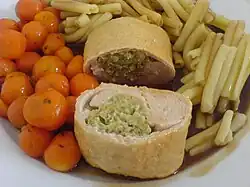

A 'paupiette' is a type of savory roulade[1] sometimes called a braciole.
There are several variants, The dish may be a piece of meat, beaten thin, and rolled with a savory stuffing[2] such as forcemeat.[3] It is often featured in recipes from Normandy. It is often fried or braised, or baked in wine or stock. Paupiettes are very popular in France, being sold ready-prepared in supermarkets and butchers. Paupiettes can be made with various items such as chicken, beef, lamb, fish, veal, cabbage, turkey escalopes, or slices of calves' sweetbreads.[3][4]
Another variant of the classic French fish dish include using a thin slice of fish (tuna, sole, whiting, or even anchovy) which is stuffed, rolled and secured with string before cooking in a stock.[3][4]
A synonym of paupiette is oiseau sans tête ("headless bird").[2][3] In British cuisine, a paupiette of beef is called a beef olive,[2][4] where olive is a corruption of Old French alou (modern alouette), "lark."[5]
Variants
Paupiettes de Volaille Florentine, where the stuffing is spinach and prosciutto and rice.[6]
Les paupiettes d'agneau à la créole (English.Paupiettes of lamb à la créole), where the stuffing is lamb or mutton forcemeat with onions and peppers.
Paupiettes de dinde à la crécy, is made with turkey, where the stuffing is a pork forcemeat mixed with a dry mushroom duxelle, chopped parsley and bound with eggs.
See also
References
- ↑ "Fish paupiette". Chef Sojus Food. Retrieved 6 August 2026.
- 1 2 3 John Ayto (1990). "Paupiette". The Glutton's Glossary. Routledge. p. 211.
- 1 2 3 4 Joël Robuchon, ed. (2007). "Paupiette". New Concise Larousse Gastronomique. Hamlyn. pp. 848–849.
- 1 2 3 Charles G. Sinclair (1998). International Dictionary of Food & Cooking. Fitzroy Dearborn. p. 400. ISBN 9781579580575.
- ↑ John Ayto (1990). "Beef olive". The Glutton's Glossary. Routledge. p. 22.
- ↑ Craig Claiborne (1979). "Paupiettes de Volaille Florentine". The New New York Times Cookbook. Harper & Row. pp. 259–260.
