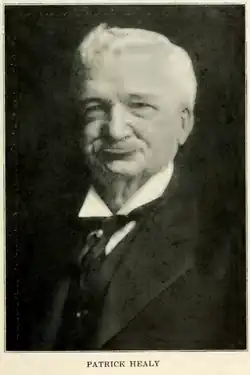
Patrick Healy (sheepman)
Patrick Healy | |
|---|---|
 | |
| Born | February 17, 1847 Kenmare, County Kerry, Ireland |
| Died | May 23, 1918 (aged 71) Ogden, Utah, U.S. |
| Occupations | Railroad engineer, sheepman, banker, hotel proprietor |
| Known for | Construction of the first transcontinental railroad; Healy and Patterson Sheep Company; Commercial National Bank of Ogden; Healy Hotel |
| Spouse | Mary Ann Patterson (m. 1876) |
| Children | 3 (surviving) |
Patrick "Patsy" Healy (February 17, 1847 – May 23, 1918) was an Irish-born American railroad engineer, sheepman, banker, and businessman based in Ogden, Utah. After emigrating from Ireland as a teenager, he worked on construction of the first transcontinental railroad and witnessed the driving of the Golden Spike at Promontory Summit, Utah, on May 10, 1869. He later co-founded one of the largest sheep operations in the western United States, served for many years as president of the Commercial National Bank of Ogden, and built the Healy Hotel in Ogden.[1][2]
Early life
Healy was born on February 17, 1847, in Kenmare, County Kerry, Ireland. He emigrated to the United States in October 1862 at the age of fifteen, arriving with his mother and siblings. Alongside his father, who had arrived there a couple of years earlier, Healy worked in the copper mines of Hancock, Michigan.[3] He then worked for while in the Michigan timber industry, where he learned to operate steam locomotives, hauling felled logs out of the forest.[4][5] After the American Civil War, Healy left to seek his fortune in the West.[1][2][5]
Railroad career
After a sojourn in the Black Hills, young Healy got a job with the Union Pacific Railroad out of Omaha, Nebraska, working in the westbound direction of what would become the transcontinental railroad.[6] He left his Union Pacific job at Green River, Wyoming in 1868, and kept going west.[5] In that year, the Central Pacific Railroad was seeking additional men as it expanded its line eastward across Nevada.[7] Given his experience operating steam engines, it is plausible that Healy sought to find a higher level of skilled work with the Central Pacific than he had with Union Pacific. Healy arrived in Utah in 1868, reportedly walking 180 miles or so from Green River to Salt Lake City.[1][5][6] He and a companion quickly secured horses and traveled to Central Pacific's operations hub at Wadsworth, Nevada. Healy, age 21, then obtained employment with the Central Pacific as an engineer.[1][5][8] Healy's engine was named "The Emigrant."[8] This was engine number 64.[9] On May 10, 1869, Healy was present at Promontory Summit when the Golden Spike was driven, completing the first transcontinental railroad across the United States.[1][6] Healy operated Central Pacific trains between Ogden and California for about ten years.[1][6] He later became an honorary life member of the Brotherhood of Locomotive Engineers.[1]
Sheep business
After he left the railroad, Healy briefly ran some cattle in Idaho.[5] Around 1880, Healy became a sheepman in partnership with his brother-in-law, Adam Patterson. Their firm, the Healy and Patterson Sheep Company, became one of the largest sheep operations in the American West.[1][2][5] The partnership developed an extensive system of seasonal sheep drives across the open range of the unfenced Old West. Each spring, flocks purchased in Oregon were trailed to summer range near Soda Springs, Idaho. In autumn, portions of the flocks were sold locally while others were driven to Wyoming's Red Desert for winter grazing.[2][5]
In the summer of 1892, the flock was driven high into the Bighorn Mountains of northern Wyoming. The Johnson County War had just ended, and the ranges in the Bighorns around Buffalo, Wyoming were depleted of cattle. Hence the opportunity for a flock was unusual. The sheep outfit trailed into Johnson County, where Healy and Patterson established a permanent operation.[5][10]
In the early 1890s the partnership also purchased the Ross outfit at Mountain City, Nevada, where it maintained a flock of 30,000–40,000 sheep. For several years, the property served as an important operational base from which sheep were trailed to the summer range, before continuing on the firm's annual Wyoming grazing circuit.[2] During the summer of 1897, Healy and Patterson reportedly controlled more than 100,000 sheep, including animals moving on the trail.[2][5] Sheep were trailed in bands of as many as 8,000-10,000 sheep, with three men typically traveling with each band.[5]
Healy preferred to avoid long-term investment in real estate, instead concentrating on livestock enterprises and partnerships in Utah, Idaho, Nevada and Wyoming. Under these other partnerships, the partner did the range work and Healy provided the financing and general supervision.[2]
Healy helped many people, including his employees, develop their own sheep enterprises. In an oral history, Healy's grandson Dan Healy described the process. "They would give them a band of sheep and they would split the lambs and the wool and one thing and another. And at the end of the first year the herder would own one-sixth of the sheep, the second year, they would own one-third and the third year they would own one-half and meanwhile they would build up the herd. They would try to keep most of the ewe lambs.... They literally lived with the sheep. It was tough out there. Maybe they didn’t even have much, they might have had a wagon. But they would eat mutton and flour and sugar and that was about it. So at the end of three years, why, they owned a half a band of sheep and the band had gotten larger."[5]
As the era of long-distance open-range sheep trailing declined in the early twentieth century, Healy and later his sons continued their primary operations in northern Wyoming, where they made seasonal movements of sheep between winter and summer ranges near Buffalo and in the Bighorn Mountains.[2][3]
Anecdotal evidence suggests that Healy could be a "pretty tough guy," if the occasion called for it.[3] The story goes that despite repeated warnings not to do so, another sheep outfit was running its flock on land in the Bighorns to which Healy had the grazing rights. One day on the land the intruding sheepman was sitting on a rock, holding the reins of his mule. A rifle shot rang out and the reins were severed. Healy had made himself very well understood.[3]
The Healy and Patterson partnership was one of the largest sheep operations in the West — yet it never kept a book or an account. When livestock or property was divided between the partners, the assets were apportioned by agreement, after which a card game determined which partner received each share.[2][3]
Recruitment of Basque sheepherders
Healy played an important role in the early recruitment of Basque sheepherders to northern Wyoming. According to accounts preserved by the Basque community in Buffalo, in 1902 the French Basque immigrant Jean Esponda met Healy while traveling west by train after arriving in the United States. Esponda had intended to return to California, where he had previously worked as a sheepherder, but accepted employment after Healy offered him a position with Healy and Patterson in Buffalo.[11] Esponda subsequently encouraged relatives and fellow Basques from the Baigorri region of the French Basque Country to immigrate to Johnson County. Their arrival marked the beginning of a chain migration that established one of the largest Basque communities in Wyoming, supplying experienced sheepherders to the state's sheep industry for decades. Many of these also became leading ranchers and other businessmen in their own right.[11][12]
Banking and other business interests
During the 1880s, Healy acquired stock in the Commercial National Bank of Ogden. He later became its president and remained in that office until his death in 1918.[1][6] Through the bank Healy financed numerous sheepmen in Utah, Idaho, Nevada and Wyoming, including several former employees who later established independent sheep operations.[2] As described above, Healy and Patterson had already "staked out" (i.e. financially backed) such sheepmen independently, before Healy's formal affiliation with the bank.[5] Healy also held large investments in the sugar industries of both Utah and Wyoming, and in 1901 constructed the Healy Hotel in Ogden.[1]
Personal life
Healy married Mary Ann Patterson in February 1876. They owned a fine home at 2529 Jefferson Avenue in Ogden.[3] Of ten children born to the couple, only the three oldest survived childhood: Patrick "Patsy" Healy Jr.; Helen "Nellie" Healy Lynch; and Alexander "Alec" Healy.[5] In declining health, Healy spent the winter of 1917–1918 in southern California before returning to Ogden, where he died on May 23, 1918, aged seventy-one.[1][6]
Legacy
Patrick Healy was among the leading figures in the development of the western sheep industry during the late nineteenth century. Through Healy and Patterson he established large-scale sheep operations extending across Oregon, Idaho, Utah, Nevada, and Wyoming. He also helped to provide financing for numerous independent sheep ranchers throughout the Intermountain West.[2][3][5] The Healy and Patterson Sheep Company amicably dissolved in 1904, when Patrick Jr. bought out his uncle Adam Patterson's share.[5] The firm operated as Healy & Healy until 1906, when Alexander, an MIT-trained mining engineer, bought out Patrick Sr.'s share of the sheep operation.[5] The firm then operated as Healy Brothers.[3][5] With its LU Ranch, the Healy family remains active in northern Wyoming livestock operations to the present day.[3]
References
- 1 2 3 4 5 6 7 8 9 10 11 Warrum, Noble, ed. (1919). Utah Since Statehood: Historical and Biographical. Vol. 2. Chicago and Salt Lake City: S. J. Clarke Publishing Company. pp. 236–239.
- 1 2 3 4 5 6 7 8 9 10 11 Wentworth, Edward Norris (1948). America's Sheep Trails: History, Personalities. Ames, Iowa: The Iowa State College Press. pp. 612–613.
- 1 2 3 4 5 6 7 8 9 Healy, Cathy (2013). An Improbable Pioneer: The Letters of Edith S. Holden Healy, 1911–1950. Worland, Wyoming: Washakie Museum & Cultural Center. ISBN 978-0-9897453-0-7.
- ↑ "Local News". Intermountain Catholic. Salt Lake City. August 14, 1909. p. 7.
- 1 2 3 4 5 6 7 8 9 10 11 12 13 14 15 16 17 18 "Oral History Interview with Dan Healy". Wyoming State Archives Oral History Collection. Wyoming State Archives. October 5, 1990. Retrieved July 26, 2026.
- 1 2 3 4 5 6 "Patrick Healy, Sr. Called By Death Yesterday". The Ogden Standard. Ogden City, Utah: Standard Publishing Co. May 24, 1918. Retrieved July 25, 2026.
- ↑ "Western Items". The Cheyenne Leader. Cheyenne, Wyoming. July 18, 1868. p. 1. Retrieved August 7, 2026.
- 1 2 "Ogden Man Tells About Railroads in Earliest Days". Ogden Examiner. May 4, 1919. p. 12 – via Utah Digital Newspapers.
- ↑ "Central Pacific Railroad Locomotives". CPRR.org. Central Pacific Railroad Photographic History Museum. Retrieved August 29, 2026.
- ↑ Wentworth, Edward Norris (1948). America's Sheep Trails: History, Personalities. Ames, Iowa: The Iowa State College Press. p. 324.
- 1 2 Iberlin, Dollie; Romtvedt, David, eds. (2011). Buffalotarrak: An Anthology of the Basques of Buffalo, Wyoming. Basque Diaspora and Migration Studies. Vol. 6. Reno, Nevada: Center for Basque Studies, University of Nevada, Reno. ISBN 978-1-935709-14-5.
- ↑ Bañales Atxirika, Victoria (2015). The Basque Diaspora in Wyoming: Identity, Culture and Community (PDF) (PhD thesis). University of the Basque Country.
Sources
- Bañales Atxirika, Victoria (2015). The Basque Diaspora in Wyoming: Identity, Culture and Community (PDF) (PhD thesis). University of the Basque Country.
- "Ogden Man Tells About Railroads in Earliest Days". Ogden Examiner. May 4, 1919. p. 12 – via Utah Digital Newspapers.
- Healy, Cathy (2013). An Improbable Pioneer: The Letters of Edith S. Holden Healy, 1911–1950. Worland, Wyoming: Washakie Museum & Cultural Center. ISBN 978-0-9897453-0-7.
- Iberlin, Dollie; Romtvedt, David, eds. (2011). Buffalotarrak: An Anthology of the Basques of Buffalo, Wyoming. Basque Diaspora and Migration Studies. Vol. 6. Reno, Nevada: Center for Basque Studies, University of Nevada, Reno. ISBN 978-1-935709-14-5.
- "Local News". Intermountain Catholic. Salt Lake City. August 14, 1909. p. 7.
- "Oral History Interview with Dan Healy". Wyoming State Archives Oral History Collection. Wyoming State Archives. October 5, 1990. Retrieved July 26, 2026.
- Warrum, Noble, ed. (1919). Utah Since Statehood: Historical and Biographical. Vol. 2. Chicago and Salt Lake City: S. J. Clarke Publishing Company.
- Wentworth, Edward Norris (1948). America's Sheep Trails: History, Personalities. Ames, Iowa: The Iowa State College Press.
- "Patrick Healy, Sr. Called By Death Yesterday". The Ogden Standard. Ogden City, Utah: Standard Publishing Co. May 24, 1918. Retrieved July 25, 2026.
- Schaetzl, Randall. "Railroad logging". Geography of Michigan and the Great Lakes Region. Michigan State University. Retrieved August 19, 2026.
- "Central Pacific Railroad Locomotives". CPRR.org. Central Pacific Railroad Photographic History Museum. Retrieved August 29, 2026.
- "Western Items". The Cheyenne Leader. Cheyenne, Wyoming. July 18, 1868. p. 1. Retrieved August 7, 2026.