Parking guidance and information

Parking guidance and information (PGI) systems, or car park guidance systems, present drivers with dynamic information on parking within controlled areas.[1] The systems combine traffic monitoring, communication, processing and variable message sign technologies to provide the service.
Purpose and function
Modern parking lots utilize a variety of technologies to help motorists find unoccupied parking spaces, car location when returning to the vehicle and improve their experience. This includes adaptive lighting sensors, parking space indicators above every parking space (red for occupied, green for available, blue is reserved for disabled people), and indoor positioning systems (IPS).
PGI systems are part of the development of intelligent transportation systems in urban areas.[2] PGI systems can assist in the development of safe, efficient and environmentally friendly transportation networks.[3]
PGI systems are designed to aid in the search for vacant parking spaces by directing drivers to car parks where occupancy levels are low. The objective is to reduce search time, which in turn reduces congestion on the surrounding roads for other traffic with related benefits to air pollution with the ultimate aim of enhancement of the urban area.
Parking guidance systems have evolved a lot in recent times. Ultrasonic and laser technologies provide information on the availability of parking spaces throughout the parking facility. At the same time, new camera-based technologies now make it possible to read the license plate of the vehicle in each parking space. This is an added value since it allows the identification of a specific vehicle in a specific parking space and, in addition, sometimes records possible incidents occurring in that space. These new methods increase security and revenue for the parking owners.
Components
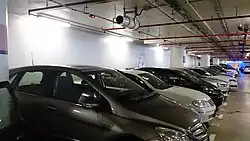
Parking guidance systems (PGS) may use elements including:
- Ultrasound detectors[4]
- Camera-based sensors and computer vision strategies[5]
- Internet of things technologies[5]
- Individual indicators
- Zone controllers
- Data / intermediate controllers
- Central control system
- Signs or displays
- Kiosks
See also
References
- ↑ Chai, Huajun; Ma, Rui; Zhang, H. Michael (2019-11-02). "Search for parking: A dynamic parking and route guidance system for efficient parking and traffic management". Journal of Intelligent Transportation Systems. 23 (6): 541–556. doi:10.1080/15472450.2018.1488218. ISSN 1547-2450.
- ↑ Yang, Zhaosheng; Liu, Honghong; Wang, Xinyue (October 2003). "The research on the key technologies for improving efficiency of parking guidance system". Proceedings of the 2003 IEEE International Conference on Intelligent Transportation Systems. 2: 1177–1182 vol.2. doi:10.1109/ITSC.2003.1252670.
- ↑ "Traffic Advisory Leaflet ITS 4/03". Parking Guidance and Information. Department for Transport, United Kingdom. March 2003. Archived from the original on 6 February 2007. Retrieved 13 April 2007.
- ↑ Dokur, Omkar; Katkoori, Srinivas; Elmehraz, Nouredddine (April 2016). "Embedded system design of a real-time parking guidance system". 2016 Annual IEEE Systems Conference (SysCon): 1–8. doi:10.1109/SYSCON.2016.7490653.
- 1 2 Rajesh, Pranav; Kallakuri, Dheeraj; Chagarlamudi, Sudeeksha; Manoj Vissavajhula, Sai; Meng, Jingxiong; Zhao, Junfeng (2025). "Intelligent Parking Guidance System Using Computer Vision, IoT, and Edge Computing". IEEE Open Journal of Intelligent Transportation Systems. 6: 1185–1199. doi:10.1109/OJITS.2025.3605318. ISSN 2687-7813.