Pangram (AI detector)
| Pangram | |
|---|---|
 | |
| Developers |
|
| Release | October 23, 2023[1] |
| Website | pangram |
Pangram is an artificial intelligence detection software developed to identify text produced by large language models (LLMs), developed by Brooklyn-based Pangram Labs.[2][3] Compared to other AI detection tools tested, it is more accurate, though like other tools it struggles on certain types of text. It has been used in a number of high-profile accusations of AI use in published writing, and criticized for contributing to "witch hunts" for AI writing.
History
Pangram Labs was founded by CEO Max Spero and CTO Bradley Emi in 2023,[4][5] originally named Checkfor.ai until rebranding in 2024.[6]
In 2025, the company raised US$4 million in seed funding in a round led by ScOp Venture Capital.[7] In December, they released Pangram 3, adding the ability to categorize text as partially AI generated.[8]
In July 2026, Pangram Labs finished a fundraising round of US$9 million led by Menlo Ventures, with participation from ScOp, Haystack Ventures and others.[9] Shortly afterwards, they launched the fourth version of their text detection model (Pangram 4) and a new AI image detection model (Pangram Image).[10][11][9]
Between June 2025 and June 2026, Pangram's monthly users increased from 2,700 to 120,000, with annual revenue increasing by a factor of 35.[9]
Description and usage
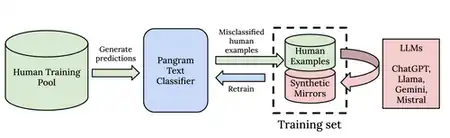
Pangram assesses the probability that a given text is fully written by AI, AI-assisted, or fully written by a human.[3][12] It uses a transformer-based neural network trained on a mix of human writing and text generated by LLMs to match the human samples' topic, length, and tone.[13][14][15] They contrast this technique with some other AI text classifiers, which use statistical measures like perplexity and burstiness.[16][17] Pangram also breaks down longer documents into sections and classifies each individually, to determine how much of a text is AI generated.[18]
As of August 2026, free users got 2,000 words quota per day on Pangram's website, with a paid $20 per month tier providing 300,000 words a month and AI plagiarism detection.[19][20][21] They also provide a Chrome extension[22] and integration with Canvas[3] and Google Classroom.[23][24]
In July 2026, Substack added an AI detection feature using Pangram.[25][26] The browser extension NewsGuard added similar integration in March the same year.[27] Quora is also a customer.[9] According to The New York Times, "[t]he company has also signed contracts with a number of universities and publishers looking to crack down on A.I. writing."[9]
Efficacy
In a 2025 study comparing Pangram to OriginalityAI, GPTZero and a classifier built on the open source model RoBERTa, researchers at the University of Chicago found that Pangram significantly outperformed all the other detectors, having a zero false positive rate (FPR) and near-zero false negative rate (FNR) on longer passages and maintaining FPR and FNR below 0.01 on shorter passages.[28]: 13 However, on a different sample from Chatbot Arena Pangram's false negative rate was closer to one in 70.[3][29] In the University of Chicago study, Pangram also outperformed the other models in detecting AI generated text ran through the "humanizer" StealthGPT, and was cheaper than the other two commercial detectors.[28]
In 2025, researchers at the University of Maryland, UMass Amherst, and Microsoft found that Pangram was the only AI detector to match the performance of the majority vote among human evaluators with experience using LLMs.[30]
A study published June 2026 by researchers at Vrije Universiteit Brussel found Pangram to be the most accurate among GPTZero, Pangram, Copyleaks, and Turnitin for AI detection in master's theses; it gave a median score of 80% on fully AI-generated papers (varying between 60% and 100%), while the other tools had medians below 20%. Pangram's median score on partially AI-generated papers also "showed closest alignment to the ground truth" among the detectors.[17]
Failure modes

Pangram is in an "arms race" with the developers of large language models, which aim to produce more humanlike prose; the detector tends to perform worse on newer LLMs not included in its training set.[3][12] It also performs worse when the LLM text has been fed into a "humanizer" program.[12]
Like other AI detectors, Pangram was found to misclassify synthetic text as human if the AI was asked to imitate specific human authors.[31][14] Pangram was also more likely to misclassify AI-generated text as written by humans when it rhymed, repeated itself, or used archaic language; an adversarial set of AI text examples built by researcher Alexios Mantzarlis was incorrectly labelled as human by Pangram 86% of the time.[12]
Pangram also has historically struggled to accurately distinguish if a text is partly or wholly AI generated; for example, author Freddie deBoer found adding LLM-generated text to the end of a human-written piece made Pangram treat the whole document as AI written.[9] University of Maryland researchers found that like other detectors, applying "AI polishing" to change small portions of a text causes the likelihood Pangram detects the sample as AI-written to increase dramatically, especially when using older or smaller LLMs.[32]
Pangram Labs has said that its newest model (Pangram 4) is more robust to humanizers and adversarial prompting, and is better at distinguishing human and AI parts of a document.[33]
Reception and criticism
An August 2026 article in The New York Times said "Pangram excels at distinguishing chatbot-generated words from human writing. But it's not reliable for spotting artificial images."[34]
After Pangram identified three of his writers' articles as AI-written, editor James Taranto of The Wall Street Journal called the tool a "defamation machine".[35] Two of the authors admitted they used AI for revision of some of their work, which Taranto said is "inaccurate and unfair to characterize" as AI-generated.[3]
Tim Requarth of Slate wrote that the Pangram-fueled "culture of callouts" about whether the final prose of a text was AI generated obscures more fundamental problems regarding the influence of AI use in earlier stages (e.g. for research).[36]
According to Matteo Wong of The Atlantic: "While Pangram is accumulating the power to end reputations and careers, the tool does make mistakes, perhaps to a greater extent than is currently understood. In turn, AI accusations could very quickly spiral into a witch hunt...Just like chatbots, AI-detection tools have become effective enough for widespread use, but not reliable enough to fully trust." Wong also raised concerns about the black box nature of Pangram's algorithm, similar to other neural networks; while Pangram can show what part of a text is likely to be generated by an LLM, it cannot describe why it was flagged.[3]
Usage
Pangram has been used as ostensible evidence in a number of accusations that published writing was AI generated. According to a 2026 article in The Atlantic, "[b]asically every recent, high-profile accusation of someone passing off AI-generated writing as their own has started in the same way: with a tool called Pangram."[3]
- Pangram, in addition to other stylistic indicators such as em-dashes and word choice, was used to claim some paragraphs of Pope Leo XIV's encyclical Magnifica humanitas, on "safeguarding the human person in the time of artificial intelligence",[37] were partially or wholly AI written.[38][39] In one analysis, Pangram flagged it as 4% AI-generated and 2% AI-assisted, with the remaining content fully human-written. All previous encyclicals checked by Snopes and the author of the original accusation were assessed by Pangram as fully human written.[39] The claim about Magnifica humanitas remains unproven and a collection of the Pope's other writings on the subject, Maps of Hope, has been certified as human-written by Proudly Human.[40]
- Multiple winners in the 2026 Commonwealth Short Story Prize competition were labeled as mostly AI-generated by Pangram; the winning stories were published in Granta.[41][42][43]
- Pangram flagged an entry from the New York Times column "Modern Love" as likely AI generated; the author, Kate Gilgan, said she used AI for "inspiration and guidance and correction", but not writing.[44]
- Pangram CEO Max Spero added onto controversy over Mia Ballard's novel Shy Girl, saying it was 78 percent AI generated.[45] The book was later pulled from shelves.[46]
- Vanity Fair journalist Taylor Lorenz was accused of AI use in an article based on Pangram's output; upon investigation by Spero, it was found to be a false positive.[3]
Pangram also has been used to determine population-level information about the use of AI text in various fields. For example, 9% of news articles published the summer of 2025 were AI generated, according to research by Pangram Labs.[47] Their 2026 analysis of data from social media visited by opted-in users of Pangram's browser extension found that 41% of content on LinkedIn longer than 250 words was AI-generated. Medium, X, Reddit, and Substack had lower percentages of AI-generated content; Substack was the lowest, with 10% of the 250+ word content flagged.[48][22][49]
Pangram has repeatedly been applied to detect AI in academic works. 21% of peer reviews for the 2026 machine learning conference International Conference on Learning Representations were AI generated, according to Pangram Labs.[50] Using Pangram, the American Association for Cancer Research found that 23% of abstracts and 5% of peer-review reports submitted to its journals in 2024 contained likely LLM-generated text.[51] Similarly, the AI Task Force for the journal Organization Science found a "marked decrease" in article submissions whose abstracts had an average Pangram score under 15% (i.e. mostly or fully human-written), from near 100 percent in 2022 to below 40 percent by early 2026.[52]
See also
References
- ↑ "AI detection just got a lot better: Announcing Checkfor.ai". Pangram Labs. 2023-10-23. Retrieved 2026-06-25.
- ↑ "Pangram AI Detector". iF Design. Retrieved 2026-06-25.
- 1 2 3 4 5 6 7 8 9 Wong, Matteo (2026-05-30). "America Has a Pangram Problem". The Atlantic. Retrieved 2026-07-22.
- ↑ Jancer, Matt (2026-06-01). "We've Reached the Point Where AI Has to Catch AI (The Internet Is Full of Slop)". VICE. Retrieved 2026-07-22.
- ↑ "Our Story". Pangram Labs. Retrieved 2026-07-22.
- ↑ Spero, Max (2024-04-08). "Checkfor.ai is now Pangram Labs". Pangram Labs. Retrieved 2026-07-22.
- ↑ "Former Tesla, Google engineers raise $4 million for AI-text detection startup Pangram". Reuters. Retrieved 2026-07-22.
- ↑ Bastian, Matthias (2025-12-12). "Pangram 3.0 AI text detector claims up to 99.98% accuracy, even for subtly AI-assisted content". The Decoder. Retrieved 2026-07-29.
- 1 2 3 4 5 6 Gallogly, Niko (2026-07-29), "Sick of A.I.-Generated Content? The 'Slop Janitor' Is Here to Help.", The New York Times, retrieved 2026-07-29
- ↑ Bellan, Rebecca (2026-07-29). "As AI content floods the internet, Pangram raises $9M to detect it". TechCrunch. Retrieved 2026-07-29.
- ↑ "Pangram Launches New World's Best AI Detector, Expands to Images Backed by $9M From Menlo Ventures". Business Wire. 2026-07-29. Retrieved 2026-07-29.
- 1 2 3 4 "A human wrote this – believe me". Reuters Institute for the Study of Journalism. 2026-07-17. Retrieved 2026-07-22.
- ↑ Emi, Bradley; Spero, Max (2024). "Technical Report on the Pangram AI-Generated Text Classifier". arXiv:2402.14873 [cs.CL].
- 1 2 Bastian, Matthias (2026-07-19). "AI text detectors struggle when language models mimic an author's style". The Decoder. Retrieved 2026-07-22.
- ↑ Tech & Startup Desk (2026-08-03). "Pangram raises $9 million to scale AI content detection". The Daily Star. Retrieved 2026-08-27.
- ↑ "How does Pangram work?". Pangram Labs. Retrieved 2026-07-22.
- 1 2 Van Vlasselaer, Marijke; Van Droogenbroeck, Filip; Spruyt, Bram (2026-06-29). "Who wrote this? Evaluating the reliability of AI detection tools in higher education". International Journal for Educational Integrity. 22 (1): 16. doi:10.1007/s40979-026-00226-w.
- ↑ "Introducing Pangram 3.0 with AI assistance detection". Pangram Labs. Retrieved 2026-07-29.
- ↑ Nield, David (2026-07-19). "Do AI writing detectors actually work? We put 5 to the test". Popular Science. Retrieved 2026-07-22.
- ↑ Caswell, Amanda (2025-09-17). "I tested dozens of AI detectors — this one (claims 99% accuracy) beat the rest". Tom's Guide. Retrieved 2026-07-22.
- ↑ "AI Detector: Free AI Checker for ChatGPT, Claude & Gemini | Pangram". www.pangram.com. Archived from the original on 2026-08-18. Retrieved 2026-08-18.
- 1 2 Koebler, Jason (2026-07-09). "LinkedIn and X Are Flooded With AI Spam, Browsing Data Suggests". 404 Media. Retrieved 2026-07-22.
- ↑ "Does Google Classroom Have an AI Detector? What Teachers Actually Need". Pangram Labs. 2026-07-22. Retrieved 2026-07-22.
- ↑ Quellman, Carly (2025-09-08). "I Tried Using AI to Uncover AI-Written Work. I Don't Know if I'm Sold". CNET. Retrieved 2026-07-22.
- ↑ Roth, Emma (2026-07-21). "Substack adds an AI detector to help spot blogs written by no one". The Verge. Retrieved 2026-07-22.
- ↑ Perez, Sarah (2026-07-22). "Substack's new tool tells you who's been writing their newsletters with AI". TechCrunch. Retrieved 2026-07-25.
- ↑ Barnett, Kendra (2026-03-12). "EXCLUSIVE: NewsGuard Taps Startup Pangram to Identify AI-Generated News and Misinformation". Adweek. Retrieved 2026-07-25.
- 1 2 Jabarian, Brian; Imas, Alex (September 2025), Artificial Writing and Automated Detection (Working Paper), Working Paper Series, National Bureau of Economic Research, doi:10.3386/w34223, 34223, retrieved 2026-07-22
- ↑ Masrour, Elyas; Spero, Max; Emi, Bradley; Thai, Katherine (2026-05-13). "Pangram 3.3 Model Card". Pangram Labs. Retrieved 2026-08-17.
- ↑ Russell, Jenna; Karpinska, Marzena; Iyyer, Mohit (2025-05-19). "People who frequently use ChatGPT for writing tasks are accurate and robust detectors of AI-generated text". arXiv:2501.15654 [cs.CL].
- ↑ Lee, Jaeho. "AI detectors rarely flag human writing, but sometimes miss AI text imitating real authors". Epoch AI. Retrieved 2026-07-30.
- ↑ Saha, Shoumik; Feizi, Soheil (2025). "Almost AI, Almost Human: The Challenge of Detecting AI-Polished Writing". Findings of the Association for Computational Linguistics: ACL 2025. Association for Computational Linguistics. pp. 25414–25431. doi:10.18653/v1/2025.findings-acl.1303. Retrieved 2026-07-30.
- ↑ "Pangram 4 Technical Report". Pangram Labs. 2026-07-29. Retrieved 2026-07-29.
- ↑ Chen, Brian X. (2026-08-13), I Tested a Popular A.I. Slop Detector. It Felt Empowering., ISSN 0362-4331, retrieved 2026-08-27
- ↑ Taranto, James (2026-04-03). "Opinion | The 'AI Detector' as Defamation Machine". Wall Street Journal. Retrieved 2026-07-22.
- ↑ Requarth, Tim (2026-04-17). "The A.I. Writing Panic Is Completely Missing the Point". Slate. Retrieved 2026-07-25.
- ↑ "Encyclical Letter of His Holiness Leo XIV Magnifica Humanitas (15 May 2026)". www.vatican.va. Retrieved 2026-08-09.
- ↑ Peters, Jay (2026-05-27). "Did the Pope use AI to write about the dangers of AI?". The Verge. Retrieved 2026-07-25.
- 1 2 Liles, Jordan (2026-06-03). "Investigating claim Pope Leo XIV used AI to write encyclical about dangers of AI". Snopes. Retrieved 2026-07-25.
- ↑ Constantin, Ana Maria (22 July 2026). "To prove the anti-AI Pope's words were human, his camp used AI". The Next Web.
- ↑ Down, Aisha; Creamer, Ella (2026-05-19). "'Obvious markers of AI': doubts raised over winner of short story prize". The Guardian. Retrieved 2026-07-25.
- ↑ Klee, Miles (2026-05-19). "Literary Prizewinners Are Facing AI Allegations. It Feels Like the New Normal". WIRED. Archived from the original on 2026-06-03. Retrieved 2026-07-25.
- ↑ Vara, Vauhini. "This Literary AI Scandal Changes Everything". The Atlantic. Archived from the original on 2026-07-18. Retrieved 2026-07-25.
- ↑ Vara, Vauhini (2026-03-25). "How AI Is Creeping Into The New York Times". The Atlantic. Retrieved 2026-07-25.
- ↑ Alter, Alexandra (2026-03-19). "A.I. Is Writing Fiction. Publishers Are Unprepared". The New York Times. ISSN 0362-4331. Retrieved 2026-08-17.
- ↑ Landymore, Frank (2026-03-20). "Novel Pulled From Shelves After Author Is Accused of Using AI". Futurism. Retrieved 2026-07-25.
- ↑ Russell, Jenna; Karpinska, Marzena; Akinode, Destiny; Zhou, James; Thai, Katherine; Emi, Bradley; Spero, Max; Iyyer, Mohit (July 2026). Liakata, Maria; Moreira, Viviane P.; Zhang, Jiajun; Jurgens, David (eds.). "AI use in American newspapers is widespread, uneven, and rarely disclosed". Proceedings of the 64th Annual Meeting of the Association for Computational Linguistics (Volume 1: Long Papers). San Diego, California, United States: Association for Computational Linguistics: 14554–14580. arXiv:2510.18774. doi:10.18653/v1/2026.acl-long.663. ISBN 979-8-89176-390-6.
{{cite journal}}: CS1 maint: periodical has ISBN (link) - ↑ Sengupta, Ramarko (2026-07-13). "Almost Half Of All LinkedIn Posts Are Now AI-Written Research Shows". NDTV.
- ↑ Spero, Max; Aerts, Annamieka (2026-07-09). "AI Content Is Everywhere on Social Media, Especially LinkedIn". Pangram Labs. Retrieved 2026-07-26.
- ↑ Naddaf, Miryam (2025-11-27). "Major AI conference flooded with peer reviews written fully by AI". Nature. 648 (8093): 256–257. Bibcode:2025Natur.648..256N. doi:10.1038/d41586-025-03506-6. PMID 41310138.
- ↑ Naddaf, Miryam (2025-09-11). "AI tool detects LLM-generated text in research papers and peer reviews". Nature. doi:10.1038/d41586-025-02936-6. PMID 40935844.
- ↑ Gartenberg, Claudine; Hasan, Sharique; Murray, Alex; Pierce, Lamar (2026). "More Versus Better: Artificial Intelligence, Incentives, and the Emerging Crisis in Peer Review". Organization Science. 37 (3): 795–812. doi:10.1287/orsc.2026.ed.v37.n3. Retrieved 2026-07-30.