Paleobiota of Burmese amber
Burmese amber is fossil resin dating to the early Late Cretaceous Cenomanian age recovered from deposits in the Hukawng Valley of northern Myanmar. It is known for being one of the most diverse Cretaceous age amber paleobiotas, containing rich arthropod fossils, along with uncommon vertebrate fossils and even rare marine inclusions. A mostly complete list of all taxa described up to the end of 2023 can be found in Ross (2024).[1]
Microbiota
Plants
Chlorophyte green algaes
| Family | Genus | Species | Authority | Year described | Notes | image |
|---|---|---|---|---|---|---|
|
†Chlamydomonas hanublikanus[2] |
Hinkelman & Vršanská |
2020 |
A chlamydomonadaceous green algae. | |||
Bryophyte true mosses
| Family | Genus | Species | Authority | Year described | Notes | image |
|---|---|---|---|---|---|---|
| Calymperaceae | †Calymperites |
†Calymperites burmensis[3] |
Heinrichs 'et al. |
2014 |
A Calymperaceous dicranale moss |
|
|
†Calymperites chenianus[4] |
Li in Tan et al. |
2025 |
A Calymperaceous dicranale moss |
|||
|
†Calymperites heinrichsianus[5] |
Li & Wang in Li et al. |
2025 |
A Calymperaceous dicranale moss |
|||
|
†Calymperites marginatus[5] |
Li et al. |
2025 |
A Calymperaceous dicranale moss |
|||
|
†Calymperites proboscideus[4] |
Li in Tan et al. |
2025 |
A Calymperaceous dicranale moss |
|||
|
†Calymperites striatus[5] |
Li et al. |
2025 |
A Calymperaceous dicranale moss |
|||
|
Incertae sedis |
Li in Tan et al. |
2025 |
A member of Dicranales sensu lato. |
|||
| Family | Genus | Species | Authority | Year described | Notes | image |
|---|---|---|---|---|---|---|
| Incertae sedis | †Vetiplanaxis |
†Vetiplanaxis espinosus[6] |
Hedenäs, Heinrichs, & Schmidt |
2014 |
A hypnodendralean moss |
|
|
†Vetiplanaxis longiacuminatus[6] |
Hedenäs, Heinrichs, & Schmidt |
2014 |
A hypnodendralean moss |
|||
|
†Vetiplanaxis oblongus[6] |
Hedenäs, Heinrichs, & Schmidt |
2014 |
A hypnodendralean moss |
|||
|
†Vetiplanaxis obtusus[7] |
Li et al. |
2022 |
A hypnodendralean moss |
|||
|
†Vetiplanaxis pyrrhobryoides[6] |
Bell |
2007 |
A hypnodendralean moss |
 | ||
Lycopods and spike mosses
| Family | Genus | Species | Authority | Year described | Notes | image |
|---|---|---|---|---|---|---|
| Selaginellaceae | Selaginella |
†Selaginella alata[8] |
Li & Wang |
2022 |
A clubmoss |
|
|
†Selaginella amplexicaulis[9] |
A. R. Schmidt & L. Regalado |
2022 |
A clubmoss of uncertain subgenus affiliation |
 | ||
|
†Selaginella aurita[9] |
A. R. Schmidt & L. Regalado |
2022 |
A clubmoss of uncertain subgenus affiliation |
 | ||
|
†Selaginella ciliifera[9] |
A. R. Schmidt & L. Regalado |
2022 |
A Selaginella subg. Stachygynandrum clubmoss |
 | ||
|
†Selaginella cretacea[10] |
Li et al. |
2022 |
A Selaginella subg. Stachygynandrum clubmoss[9] |
 | ||
|
†Selaginella grimaldii[9] |
A. R. Schmidt & L. Regalado |
2022 |
A Selaginella subg. Stachygynandrum clubmoss |
 | ||
|
†Selaginella heinrichsii[9] |
A. R. Schmidt & L. Regalado |
2022 |
A clubmoss of uncertain subgenus affiliation |
 | ||
|
†Selaginella heterosporangiata[9] |
A. R. Schmidt & L. Regalado |
2022 |
A Selaginella subg. Stachygynandrum clubmoss |
 | ||
|
†Selaginella isophylla[9] |
A. R. Schmidt & L. Regalado |
2022 |
A Selaginella subg. Ericetorum clubmoss |
 | ||
|
†Selaginella konijnenburgiae[9] |
A. R. Schmidt & L. Regalado |
2022 |
A clubmoss of uncertain subgenus affiliation |
 | ||
|
†Selaginella longifimbriata[9] |
A. R. Schmidt & L. Regalado |
2022 |
A Selaginella subg. Stachygynandrum clubmoss |
 | ||
|
†Selaginella minutissima[9] |
A. R. Schmidt & L. Regalado |
2022 |
A Selaginella subg. Stachygynandrum clubmoss |
 | ||
|
†Selaginella obscura[9] |
A. R. Schmidt & L. Regalado |
2022 |
A clubmoss of uncertain subgenus affiliation |
 | ||
|
†Selaginella ohlhoffiorum[9] |
A. R. Schmidt & L. Regalado |
2022 |
A Selaginella subg. Stachygynandrum clubmoss |
 | ||
|
†Selaginella ovoidea[9] |
A. R. Schmidt & L. Regalado |
2022 |
A clubmoss of uncertain subgenus affiliation |
 | ||
|
†Selaginella patrickmuelleri[9] |
A. R. Schmidt & L. Regalado |
2022 |
A Selaginella subg. Stachygynandrum clubmoss |
 | ||
|
†Selaginella pellucida[9] |
A. R. Schmidt & L. Regalado |
2022 |
A clubmoss of uncertain subgenus affiliation |
 | ||
|
†Selaginella tomescui[9] |
A. R. Schmidt & L. Regalado |
2022 |
A clubmoss of uncertain subgenus affiliation |
 | ||
|
†Selaginella villosa[9] |
A. R. Schmidt & L. Regalado |
2022 |
A Selaginella subg. Stachygynandrum clubmoss |
 | ||
|
†Selaginella wangboi[9] |
A. R. Schmidt & L. Regalado |
2022 |
A clubmoss of uncertain subgenus affiliation |
 | ||
|
†Selaginella wangxinii[9] |
A. R. Schmidt & L. Regalado |
2022 |
A Selaginella subg. Stachygynandrum clubmoss |
 | ||
|
†Selaginella wunderlichiana[9] |
A. R. Schmidt & L. Regalado |
2022 |
A Selaginella subg. Ericetorum clubmoss |
 | ||
Marchantiophyte liverworts
| Family | Genus | Species | Authority | Year described | Notes | image |
|---|---|---|---|---|---|---|
| Frullaniaceae | Frullania |
†Frullania baerlocheri[11] |
Heinrichs et al. |
2011 |
A frullaniacious liverwort. |
|
|
Frullania cretacea[13] |
Hentschel, Schmidt & Heinrichs |
2009 |
A frullaniacious liverwort |
|||
|
Frullania kachinensis[14] |
Li et al. |
2021 |
A frullaniacious liverwort |
|||
|
Frullania partita[15] |
Li et al. |
2020 |
A frullaniacious liverwort |
|||
|
†Protofrullania |
†Protofrullania cornigera[16] |
Heinrichs |
2017 |
A frullaniacious liverwort |
||
|
†Gackstroemia |
†Gackstroemia cretacea[17] |
Heinrichs, Schäfer-Verwimp, Feldberg, & A.R. Schmidt |
2017 |
A lepidolaenacious liverwort |
||
| Radulaceae | Radula |
†Radula cretacea[18] |
Bechteler, Renner, Schäfer-Verwimp, & Heinrichs |
2017 |
A Radulaceae liverwort |
 |
|
†Radula heinrichsii[19] |
Feldberg et al. |
2021 |
A radulaceous liverwort |
|||
|
†Radula patrickmuelleri[20] |
Feldberg, Schäfer-Verwimp & Renner |
2022 |
A radulaceous liverwort |
|||
|
†Radula tanaiensis[20] |
Feldberg, Schäfer-Verwimp & Renner |
2022 |
A radulaceous liverwort |
|||
Polypodiopsid ferns
| Family | Genus | Species | Authority | Year described | Notes | image |
|---|---|---|---|---|---|---|
| Thyrsopteridaceae | Thyrsopteris |
†Thyrsopteris cretacea[21] |
Li et al. |
2020 |
A thyrsopteridacious tree-fern |
|
|
†Thyrsopteris cyathindusia[22] |
Zhang et al. |
2021 |
A thyrsopteridacious tree-fern |
|||
| Family | Genus | Species | Authority | Year described | Notes | image |
|---|---|---|---|---|---|---|
|
†Cystodium sorbifolioides[23] |
Regalado et al. |
2017 |
A Cystodiacious fern |
 | ||
| Dennstaedtiaceae |
†Cladarastega |
†Cladarastega burmanica[24] |
Poinar |
2021 |
A dennstaedtiaceous fern |
|
| †Krameropteris |
Krameropteris calophyllum[25] |
Li in Li & Meng |
2025 |
A dennstaedtiacious fern |
||
|
Krameropteris resinatus[26] |
Schneider, Smith, & Heinrichs |
2016 |
A dennstaedtiacious fern |
|||
|
†Microlepia burmasia[27] |
Long, Wang & Shi in Long et al. |
2022 |
A species of Microlepia. |
|||
| Hymenophyllaceae | †Hymenophyllites |
†Hymenophyllites angustus[8] |
Li & Wang |
2022 |
||
|
†Hymenophyllites kachinensis[8] |
Li & Wang |
2022 |
||||
|
†Hymenophyllites setosus[8] |
Li & Wang |
2022 |
||||
|
†Proodontosoria |
†Proodontosoria myanmarensis[28] |
Li et al. |
2020 |
A lindsaeacious fern |
| |
|
†Marsileaceaephyllum |
†Marsileaceaephyllum ciliatum[29] |
Wang et al. |
2021 |
A marsileaceous fern. |
||
|
†Heinrichsia |
†Heinrichsia cheilanthoides[30] |
Regalado, Schmidt, Krings & Schneider |
2019 |
A pteridacious fern |
||
| Incertae sedis |
†Cretacifilix |
†Cretacifilix fungiformis[31] |
Poinar & Buckley |
2008 |
A eupolypod fern |
|
|
†Holttumopteris |
†Holttumopteris burmensis[32] |
Regalado, Schneider, Krings, & Heinrichs |
2018 |
A fern of uncertain placement |
||
Angiosperm flowering plants
| Family | Genus | Species | Authority | Year described | Notes | image |
|---|---|---|---|---|---|---|
|
†Eoëpigynia |
Eoëpigynia burmensis[33] |
Poinar, Chamber & Buckley |
2007 |
A cornalean flower |
| |
|
†Nyssapollenites |
Sp.[34] |
N/A |
2019 |
A nyssaceous pollen morphotype |
| Family | Genus | Species | Authority | Year described | Notes | image |
|---|---|---|---|---|---|---|
|
†Phantophlebia |
†Phantophlebia dicycla[35] |
Poinar & Chambers |
2020 |
An ericalean flower of uncertain affinities |
||
| Family | Genus | Species | Authority | Year described | Notes | image |
|---|---|---|---|---|---|---|
|
†Dasykothon |
Dasykothon leptomiscus[36] |
Poinar & Chambers |
2020 |
A lauralean flowering plant of uncertain phylogenetic placement. |
||
|
†Zygadelphus |
†Zygadelphus aetheus[37] |
Poinar & Chambers |
2019 |
A possible lauralian of uncertain phylogenetic placement |
||
|
†Cascolaurus |
†Cascolaurus burmitis[38] |
Poinar |
2017 |
A lauracious angiosperm |
||
| Monimiaceae |
†Palaeoanthella |
†Palaeoanthella huangii[39] |
Poinar & Chambers |
2005 |
A possible monimiacious angiosperm |
|
|
†Setitheca |
†Setitheca lativalva[40] |
Poinar & Chambers |
2018 |
A possible monimiacious angiosperm |
||
|
†Thymolepis |
†Thymolepis toxandra[41] |
Chambers & Poinar |
2020 |
A possible monimiacious angiosperm |
||
|
†Valviloculus |
†Valviloculus pleristaminis[42] |
Poinar et al. |
2020 |
A possible monimiacious angiosperm |
||
| Incertae sedis |
†Cyathitepala |
†Cyathitepala papillosa[43] |
Poinar & Chambers |
2020 |
A lauralean angiosperm of uncertain affinity |
|
|
†Dispariflora |
†Dispariflora robertae[44] |
Poinar & Chambers |
2019 |
A possible lauralean flower |
||
|
†Jamesrosea |
Jamesrosea burmensis[45] |
Crepet et al. |
2016 |
A mosaic laralean genus |
||
| Family | Genus | Species | Authority | Year described | Notes | image |
|---|---|---|---|---|---|---|
|
†Mirafloris |
†Mirafloris burmitis[46] |
Poinar |
2021 |
A lilialean flower. |
||
| Family | Genus | Species | Authority | Year described | Notes | image |
|---|---|---|---|---|---|---|
|
†Praenymphaeapollenites |
†Praenymphaeapollenites cenomaniensis[47] |
Barrón, Peris & Labandeira |
2020 |
Pollen of a member of Nymphaeaceae. |
 | |
| Family | Genus | Species | Authority | Year described | Notes | image |
|---|---|---|---|---|---|---|
| Cunoniaceae | †Tropidogyne |
†Tropidogyne euthystyla[48] |
Poinar, Chambers & Vega |
2021 |
A small flowered cunoniacious angiosperm. |
|
|
†Tropidogyne lobodisca[49] |
Poinar & Chambers |
2019 |
A cunoniacious angiosperm. |
|||
|
†Tropidogyne pentaptera[50] |
Poinar & Chambers |
2017 |
A cunoniacious angiosperm. |
|||
|
†Tropidogyne pikei[51] |
Chambers, Poinar & Buckley |
2010 |
A cunoniacious angiosperm. |
| ||
| Incertae sedis | †Lachnociona |
†Lachnociona camptostylus[52] |
Poinar & Chambers |
2018 |
An oxalidalean angiosperm of uncertain affinity |
|
|
†Lachnociona terriae[53] |
Poinar, Chambers & Buckley |
2008 |
An oxalidalean angiosperm of uncertain affinity |
|||
| family | Genus | Species | Authority | Year described | Notes | image |
|---|---|---|---|---|---|---|
| Poaceae | †Programinis |
†Programinis burmitis[54] |
Poinar |
2004 |
A poalean of uncertain placement |
|
|
Programinis laminatus[54] |
Poinar |
2004 |
A poalean of uncertain placement |
| ||
| Family | Genus | Species | Authority | Year described | Notes | image |
|---|---|---|---|---|---|---|
| Rhamnaceae |
†Eophylica |
†Eophylica priscastellata[55] |
Shi et al. |
2022 |
A rhamnaceous floral morphotaxon |
|
|
†Phylica piloburmensis[55] |
Shi et al. |
2022 |
A rhamnaceous floral morphotaxon. |
|||
| Genus | Species | Authority | Year described | Notes | image |
|---|---|---|---|---|---|
|
†Antiquifloris |
†Antiquifloris latifibris[58] |
Poinar, Buckley & Chen |
2016 |
An angiosperm of uncertain placement |
 |
|
†Chainandra |
†Chainandra zeugostylus[59] |
Poinar & Chambers |
2020 |
An angiosperm of uncertain placement |
|
|
†Chenocybus |
†Chenocybus allodapus[60] |
Poinar |
2018 |
An angiosperm of uncertain placement |
|
|
†Exalloanthum |
↑Exalloanthum burmense[60] |
Poinar |
2018 |
An angiosperm of uncertain placement, |
|
|
†Lijinganthus |
†Lijinganthus revoluta[62] |
Liu et al. |
2018 |
A core eudicot of uncertain placement |
 |
|
†Micropetasos |
†Micropetasos burmensis[63] |
Poinar, Chambers, & Wunderlich |
2004 |
An angiosperm of uncertain placement |
|
|
†Rasenganus |
†Rasenganus auricularus[64] |
Xing & Gu |
2020 |
A possible epizoochorous fruit. |
|
| †Strombothelya |
†Strombothelya monostyla[65] |
Poinar & Chambers |
2019 |
An angiosperm of uncertain phylogenetic placement |
|
|
†Strombothelya grammogyna[65] |
Poinar & Chambers |
2019 |
An angiosperm of uncertain phylogenetic placement |
| |
Fungi
| Family | Genus | Species | Authority | Year described | Notes | image |
|---|---|---|---|---|---|---|
|
†Palaeoclaviceps |
†Palaeoclaviceps parasiticus[66] |
Poinar, Alderman & Wunderlich |
2015 |
An ergot |
||
|
Sung, Poinar & Spatafora |
2008 |
A parasite of a scale insect |
| |||
| Incertae sedis |
Poinar & Buckley |
2007 |
A hypermycoparasitic fungus |
|||
|
Poinar & Buckley |
2007 |
A hypermycoparasitic fungus |
||||
| Family | Genus | Species | Authority | Year described | Notes | image |
|---|---|---|---|---|---|---|
|
†Paleoambrosia |
†Paleoambrosia entomophila[69] |
Poinar & Vega |
2018 |
An ambrosia fungus associated with Palaeotylus femoralis. |
 | |
| Family | Genus | Species | Authority | Year described | Notes | image |
|---|---|---|---|---|---|---|
|
Incertae sedis |
Poinar & Buckley |
2007 |
An agaric of uncertain placement within the Agaricales |
 | ||
| Family | Genus | Species | Authority | Year described | Notes | image |
|---|---|---|---|---|---|---|
|
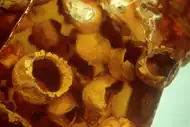
†Palaeogaster |
†Palaeogaster micromorpha[70] |
Poinar, Alfredo & Baseia |
2014 |
A gasteroid fungus belonging to the Boletales |
 | |
incertae sedis
| Family | Genus | Species | Authority | Year described | Notes | image |
|---|---|---|---|---|---|---|
| Spheciophilaceae |
†Philothysanus |
†Philothysanus burmanicus[71] |
Poinar |
2021 |
An ectoparasitic fungus |
|
|
†Spheciophila |
†Spheciophila adercia[72] |
Poinar |
2016 |
An ectoparasitic fungus |
 | |
|
Incertae sedis |
†Palaeomycus |
†Palaeomycus epallelus[73] |
Poinar |
2018 |
A fungus belonging to the Pezizomycotina |
|
Rozellomycota
| Family | Genus | Species | Authority | Year described | Notes | image |
|---|---|---|---|---|---|---|
|
Incertae sedis |
†Microsporidium burmanicum[74] |
Poinar |
2019 |
A microsporidian fungus |
||
"Zygomycetes"
Priscadvenales
| Family | Genus | Species | Authority | Year described | Notes | image |
|---|---|---|---|---|---|---|
|
†Priscadvenaceae |
†Priscadvena |
†Priscadvena corymbosa[75] |
Poinar & Vega |
2019 |
 | |
Echinodermata
Crinoidea
| Family | Genus | Species | Authority | Year described | Notes | image |
|---|---|---|---|---|---|---|
|
Isocrinus |
†Isocrinus cf. legeri[76] |
Salamon et al. |
2019 |
An Isocrinid crinoid, described from ossicles encased in the resin |
| |
Arthropoda
Arachnida
| Family | Genus | Species | Authority | Year described | Notes | image |
|---|---|---|---|---|---|---|
| Incertae sedis |
†Burmacharon |
†Burmacharon dunlopi[77] |
Hu et al. |
2020 |
 | |
| †Kronocharon |
†Kronocharon engeli[78] |
Wunderlich |
2015 |
A tailless whip scorpion of uncertain placement. |
 | |
|
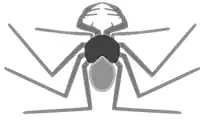
†Kronocharon longicalcaris[78] |
Wunderlich |
2015 |
A tailless whip scorpion of uncertain placement. |
 | ||
|
†Kronocharon prendinii[79] |
Rossi & Merendino |
2016 |
A tailless whip scorpion of uncertain placement. |
 | ||
| Family | Genus | Species | Authority | Year described | Notes | image |
|---|---|---|---|---|---|---|
|
†Aliendiguetidae |
Aliendiguetia |
†Aliendiguetia praecursor[81] |
Wunderlich & Müller |
2020 |
An aliendiguetid spider of uncertain affinities |
|
|
†Alteruloboridae |
†Alteruloborus |
†Alteruloborus araneoides[82] |
Wunderlich in Wunderlich & Müller |
2018 |
An alteruloborid spider. |
|
| Archaeidae | †Burmesarchaea |
†Burmesarchaea alissa[83] |
Wunderlich |
2017 |
An archaeid spider |
|
|
†Burmesarchaea bilongapophyses[81] |
Wunderlich & Müller |
2020 |
An archaeid spider. |
|||
|
†Burmesarchaea caudata[83] |
Wunderlich |
2017 |
An archaeid spider |
|||
|
†Burmesarchaea crassicaput [83] |
Wunderlich |
2017 |
An archaeid spider |
|||
|
†Burmesarchaea crassichelae[83] |
Wunderlich |
2017 |
An archaeid spider |
|||
|
†Burmesarchaea gibber[83] |
Wunderlich |
2017 |
An archaeid spider |
|||
|
†Burmesarchaea gibberoides[83] |
Wunderlich |
2017 |
An archaeid spider |
|||
|
†Burmesarchaea gibbosa[83] |
Wunderlich |
2017 |
An archaeid spider |
|||
|
(Penny) |
2003 |
An archaeid spider, |
||||
|
†Burmesarchaea longicollum[83] |
Wunderlich |
2017 |
An archaeid spider |
|||
|
†Burmesarchaea propinqua[83] |
Wunderlich |
2017 |
An archaeid spider |
|||
|
†Burmesarchaea pseudogibber[83] |
Wunderlich |
2017 |
An archaeid spider |
|||
|
†Burmesarchaea pustulata[83] |
Wunderlich |
2017 |
An archaeid spider |
|||
|
†Burmesarchaea quadrata[83] |
Wunderlich |
2017 |
An archaeid spider |
|||
|
†Burmesarchaea speciosa[83] |
(Wunderlich) |
2008 |
An archaeid spider, |
|||
| †Eomysmauchenius |
†Eomysmauchenius cretaceominimus[85] |
Peng et al. |
2023 |
A planarchaeid[86] palpimanoid spider. |
||
|
†Eomysmauchenius dubius[83] |
Wunderlich |
2017 |
A planarchaeid[86] palpimanoid spider. |
|||
|
(Wunderlich) |
2017 |
A planarchaeid[86] palpimanoid spider, |
||||
|
Eomysmauchenius septentrionalis[83] |
Wunderlich |
2008 |
A planarchaeid[86] palpimanoid spider |
|||
|
†Spiniarchaea |
†Spiniarchaea aberrans[86] |
Wunderlich in Wunderlich & Müller |
2021 |
An archaeid spider. |
||
| †Burmascutidae | †Burmascutum |
†Burmascutum aenigma[84] |
Wunderlich |
2008 |
A burmascutid spider. |
|
|
†Burmascutum brevis[82] |
Wunderlich |
2018 |
A burmascutid spider. |
|||
|
†Burmathelidae |
†Burmathele |
†Burmathele biseriata[83] |
Wunderlich |
2017 |
A burmathelid mesothele spider. |
|
| †Burmorsolidae | †Burmorsolus |
Wunderlich |
2015 |
Transferred to the separate genus Pseudorsolus in 2017, but moved back to the genus Burmorsolus in 2020. |
||
|
(Wunderlich) |
2017 |
Originally described as "Loxoderces" curvatus. |
||||
|
Burmorsolus globosus[81] |
Wunderlich & Müller |
2020 |
||||
|
Burmorsolus longembolus[81] |
Wunderlich & Müller |
2020 |
||||
|
Burmorsolus longibulbus[81] |
Wunderlich & Müller |
2020 |
||||
|
(Wunderlich) |
2017 |
Originally described as "Loxoderces" longicymbium. |
||||
|
Burmorsolus longitibia[86] |
Wunderlich in Wunderlich & Müller |
2021 |
||||
|
Burmorsolus nonplumosus[87] |
Wunderlich |
2015 |
Probably a relative of trogloraptorids.[81] |
|||
|
(Wunderlich) |
2017 |
Originally described as "Loxoderces" rectus. |
||||
|
†Crassicephalidae |
†Crassicephalus |
†Crassicephalus parvibulbus[86] |
Wunderlich in Wunderlich & Müller |
2021 |
A Deinopoidean spider. |
|
|
†Cretaceothelidae |
†Cretaceothele |
†Cretaceothele lata[87] |
Wunderlich |
2015 |
A cretaceothelid Mesothelaen spider.[83] |
|
|
†Cretamysmenidae |
†Cretamysmena |
†Cretamysmena fontana[82] |
Wunderlich in Wunderlich & Müller |
2018 |
A cretamysmenid spider. |
|
|
†Parvocteniza |
†Parvocteniza parvula[81] |
Wunderlich & Müller |
2020 |
A ctenizid spider. |
||
| Dipluridae? |
†Alterphyxioschemoides |
†Alterphyxioschemoides spicula[86] |
Wunderlich in Wunderlich & Müller |
2021 |
A possible curtain-web spider. |
|
|
†Phyxioschemoides |
†Phyxioschemoides collembola[87] |
Wunderlich |
2015 |
A spider of uncertain affinities,[88] originally described as a curtain-web spider. |
||
|
†Dubiodeinopsidae |
†Dubiodeinopsis |
†Dubiodeinopsis spinifemora[86] |
Wunderlich in Wunderlich & Müller |
2021 |
A deinopoidean spider. |
|
| †Dubiouloboridae |
†Dubiouloborix |
†Dubiouloborix incompletus[86] |
Wunderlich in Wunderlich & Müller |
2021 |
A deinopoidean spider. |
|
| †Dubiouloborus |
†Dubiouloborus praeta[86] |
Wunderlich in Wunderlich & Müller |
2021 |
A deinopoidean spider. |
||
|
†Dubiouloborus procerembolus[86] |
Wunderlich in Wunderlich & Müller |
2021 |
A deinopoidean spider. |
|||
| †Eodeinopidae |
†Deinopedes |
Wunderlich |
2017 |
An eodeinopid[86] deinopoid spider. |
||
|
†Eodeinopis |
†Eodeinopis longipes[83] |
Wunderlich |
2017 |
An eodeinopid[86] deinopoid spider. |
||
| †Eomesothelidae |
†Eomesothele |
†Eomesothele noninclinata[90] |
Wunderlich |
2019 |
An eomesothelid spider. |
|
|
†Intermesothele |
†Intermesothele pulcher[90] |
Wunderlich |
2019 |
An eomesothelid spider. |
||
| †Eopsilodercidae | †Eopsiloderces |
†Eopsiloderces filiformis[91] |
(Wunderlich) |
(2012) |
An eopsilodercid spider. |
|
|
Eopsiloderces loxosceloides[84] |
Wunderlich |
2008 |
An eopsilodercid spider. |
|||
|
Eopsiloderces serenitas[87] |
Wunderlich |
2015 |
An eopsilodercid spider. |
|||
| †Propterpsiloderces |
†Propterpsiloderces crassitibia[81] |
Wunderlich & Müller |
2020 |
An eopsilodercid spider. |
||
|
†Propterpsiloderces cymbioseta[81] |
Wunderlich & Müller |
2020 |
An eopsilodercid spider. |
|||
|
†Propterpsiloderces duplex[81] |
Wunderlich & Müller |
2020 |
An eopsilodercid spider. |
|||
|
†Propterpsiloderces longisetae[87] |
Wunderlich |
2015 |
An eopsilodercid spider.[81] |
|||
|
†Propterpsiloderces similis[86] |
Wunderlich in Wunderlich & Müller |
2021 |
An eopsilodercid spider. |
|||
| †Eotibiaapophysidae |
†Eoagelenomorphus |
†Eoagelenomorphus cretaceus[86] |
Wunderlich in Wunderlich & Müller |
2021 |
A spider of uncertain phylogenetic placement |
|
|
†Eotibiaapophysis |
†Eotibiaapophysis reliquus[82] |
Wunderlich in Wunderlich & Müller |
2018 |
A spider of uncertain phylogenetic placement |
||
|
Wunderlich |
2015 |
|||||
|
†Frateruloboridae |
†Frateruloborus |
†Frateruloborus bulbosus[82] |
Wunderlich in Wunderlich & Müller |
2018 |
A frateruloborid spider. |
|
|
†Gigarachnidae |
†Gigarachne |
†Gigarachne bian[92] |
Jiang & Li in Jiang et al. |
2020 |
An Araneomorphae of uncertain affinity. |
|
| Hersiliidae |
†Breviscauda |
†Breviscauda translucens[93] |
Wunderlich |
2024 |
||
| †Burmesiola |
†Burmesiola cretacea[94] |
Wunderlich |
2011 |
|||
|
†Burmesiola daviesi[87] |
Wunderlich |
2015 |
||||
|
†?Burmesiola kachinensis[81] |
Wunderlich & Müller |
2020 |
A tree trunk spider. |
|||
|
†Spinasilia |
†Spinasilia dissoluta[87] |
Wunderlich |
2015 |
|||
| †Lagonomegopidae |
†Albiburmops |
†Albiburmops annulipes[83] |
Wunderlich |
2017 |
||
| †Archaelagonops |
†Archaelagonops propinquus[87] |
Wunderlich |
2015 |
|||
|
†Archaelagonops salticoides[91] |
Wunderlich |
2012 |
||||
|
†Archaelagonops scorsum[87] |
Wunderlich |
2015 |
||||
|
†Burlagonomegops |
†Burlagonomegops eskovi[95] |
Penny |
2005 |
|||
|
†Cymbiolagonops |
†Cymbiolagonops cymbiocalcar[87] |
Wunderlich |
2015 |
|||
|
†Hiatomegops |
†Hiatomegops spinalis[96] |
Guo, Selden & Ren |
2021 |
A lagonomegopid spider |
||
| †Lagonoburmops |
†Lagonoburmops plumosus[91] |
Wunderlich |
2012 |
|||
|
†?Lagonomegops tuber[87] |
Wunderlich |
2015 |
A lagonomegopid spider of uncertain generic placement. |
|||
| †Lineaburmops |
†Lineaburmops beigeli[87] |
Wunderlich |
2015 |
|||
|
†Lineaburmops hirsutipes[87] |
Wunderlich |
2015 |
||||
|
†Lineaburmops longiantepes[97] |
Guo, Selden & Ren in Guo et al. |
2024 |
||||
|
†Lineaburmops maculatus[83] |
Wunderlich |
2017 |
||||
|
†Lineaburmops rhombus[97] |
Guo et al. |
2024 |
||||
|
†Myanlagonops |
†Myanlagonops gracilipes[91] |
Wunderlich |
2012 |
|||
|
†Odontomegops |
†Odontomegops titan[98] |
Guo et al. |
2020 |
A lagonomegopid spider |
||
| †Parviburmops |
†Parviburmops? bigibber |
Wunderlich |
2017 |
A possible lagonomegopid spider. |
||
|
†Parviburmops brevipalpus[87] |
Wunderlich |
2015 |
||||
| †Paxillomegops |
†?Paxillomegops brevipes[87] |
Wunderlich |
2015 |
A lagonomegopid spider of uncertain generic placement. |
||
|
?Paxillomegops cornutus[83] |
Wunderlich |
2017 |
A lagonomegopid spider of uncertain generic placement. |
|||
|
Paxillomegops longipes[87] |
Wunderlich |
2015 |
||||
|
†Picturmegops |
†Picturmegops signatus[87] |
Wunderlich |
2015 |
|||
|
†Planimegops |
†Planimegops parvus[83] |
Wunderlich |
2017 |
|||
|
†Scopomegops |
†Scopomegops fax[96] |
Guo, Selden & Ren |
2021 |
A lagonomegopid spider |
||
| †Leviunguidae | †Leviunguis |
†Leviunguis altus[82] |
Wunderlich in Wunderlich & Müller |
2018 |
A leviunguid spider. |
|
|
†Leviunguis anulus[82] |
Wunderlich in Wunderlich & Müller |
2018 |
A leviunguid spider. |
|||
|
†Leviunguis anulusoides[82] |
Wunderlich in Wunderlich & Müller |
2018 |
A leviunguid spider. |
|||
|
†Leviunguis bruckschi[91] |
Wunderlich |
2012 |
A leviunguid spider.[82] |
|||
|
†Leviunguis bruckschoides[82] |
Wunderlich in Wunderlich & Müller |
2018 |
A leviunguid spider. |
|||
|
†Leviunguis erectus[82] |
Wunderlich in Wunderlich & Müller |
2018 |
A leviunguid spider. |
|||
|
†Leviunguis glomulus[82] |
Wunderlich in Wunderlich & Müller |
2018 |
A leviunguid spider. |
|||
|
†Leviunguis glomus[82] |
Wunderlich in Wunderlich & Müller |
2018 |
A leviunguid spider. |
|||
|
†Leviunguis graciliembolus[82] |
Wunderlich in Wunderlich & Müller |
2018 |
A leviunguid spider. |
|||
|
†Leviunguis gradus[82] |
Wunderlich in Wunderlich & Müller |
2018 |
A leviunguid spider. |
|||
|
†Leviunguis porrigens[82] |
Wunderlich in Wunderlich & Müller |
2018 |
A leviunguid spider. |
|||
|
†Leviunguis pseudobruckschi[82] |
Wunderlich in Wunderlich & Müller |
2018 |
A leviunguid spider. |
|||
|
†Leviunguis quadratus[82] |
Wunderlich in Wunderlich & Müller |
2018 |
A leviunguid spider. |
|||
| Macrothelidae | †Acanthomacrothele |
†Acanthomacrothele geminata[99] |
Wang et al. |
2024 |
A macrothelid spider. |
|
|
†Acanthomacrothele longicaudata[99] |
Wang et al. |
2024 |
A macrothelid spider. |
|||
|
†Acanthomacrothele pauciverrucae[99] |
Wang et al. |
2024 |
A macrothelid spider. |
|||
|
†Promacrothele |
†Promacrothele polyacantha[100] |
Tang, Engel & Yang |
2023 |
A macrothelid spider. |
||
|
†Palaeozearchaea |
†Palaeozearchaea depressa[86] |
Wunderlich in Wunderlich & Müller |
2021 |
A mecysmaucheniid spider. |
||
| †Megasetidae |
†Megasetae |
†Megasetae colphepeiroides[86] |
Wunderlich |
2021 |
A megasetid araneomorph spider. |
|
|
†Parvimegasetae |
†Parvimegasetae araneoides[101] |
Wunderlich |
2023 |
A megasetid spider. |
||
| †Micropalpimanidae | †Micropalpimanus |
†Micropalpimanus gibber[86] |
Wunderlich in Wunderlich & Müller |
2021 |
A micropalpimanid palpimanoid spider |
|
|
†Micropalpimanus poinari[84] |
Wunderlich |
2008 |
A micropalpimanid palpimanoid spider |
|||
|
†Myanmarmysmena |
†Myanmarmysmena grandipalpus[101] |
Wunderlich |
2023 |
A possible mysmenid spider. |
||
|
†Nanoaenigmatidae |
†Nanoaenigma |
†Nanoaenigma pumilio[101] |
Wunderlich |
2023 |
A nanoaenigmatid araneoid spider. |
|
| Nemesiidae |
†Burmesiana |
(Wunderlich & Müller) |
2020 |
A member of the family Nemesiidae |
||
|
†Cethegoides |
†Cethegoides patricki[83] |
Wunderlich |
2017 |
A member of the family Nemesiidae |
||
|
†Myannemesia |
†Myannemesia glaber[81] |
Wunderlich & Müller |
2020 |
A member of the family Nemesiidae. |
||
|
†Nephila burmanica[102] |
Poinar |
2012 |
A nephiline spider |
 | ||
| Oecobiidae | †Retrooecobius |
†"Retrooecobius" chomskyi[87] |
Wunderlich |
2015 |
||
|
†Retrooecobius convexus[87] |
Wunderlich |
2015 |
||||
|
†Retrooecobius lwini[104] |
Jiang & Li in Xin et al. |
2022 |
A disc web spider. |
|||
| †Zamilia |
Zamilia aculeopectens[87] |
Wunderlich |
2015 |
|||
|
†Zamilia antecessor[84] |
Wunderlich |
2008 |
||||
|
†Zamilia arkari[104] |
Jiang & Li in Xin et al. |
2022 |
A disc web spider. |
|||
|
†Zamilia quattuormammillae[87] |
Wunderlich |
2015 |
||||
|
†Zamilia sheini[104] |
Jiang & Li in Xin et al. |
2022 |
A disc web spider. |
|||
|
†Zamilia shwayi[104] |
Jiang & Li in Xin et al. |
2022 |
A disc web spider. |
|||
| Oonopidae | †Burmorchestina |
†Burmorchestina acuminata[83] |
Wunderlich |
2017 |
||
|
†Burmorchestina biangulata[83] |
Wunderlich |
2017 |
||||
|
†Burmorchestina bo[105] |
Jiang & Li in Xin et al. |
2021 |
A goblin spider. |
|||
|
†Burmorchestina circular[81] |
Wunderlich & Müller |
2020 |
A goblin spider. |
|||
|
†Burmorchestina convexa[105] |
Jiang & Li in Xin et al. |
2021 |
A goblin spider. |
|||
|
†Burmorchestina plana[83] |
Wunderlich |
2017 |
||||
|
†Burmorchestina pulcher[84] |
Wunderlich |
2008 |
||||
|
†Burmorchestina pulcheroides[83] |
Wunderlich |
2017 |
||||
|
†Burmorchestina tuberosa[83] |
Wunderlich |
2017 |
||||
|
†Orchestina globus[105] |
Jiang & Li in Xin et al. |
2021 |
A goblin spider. |
|||
| Pacullidae | †Furcembolus |
†Furcembolus andersoni[84] |
Wunderlich |
2008 |
||
|
†Furcembolus armatura[83] |
(Wunderlich) |
2015 |
A pacullid spider. |
|||
|
†Furcembolus biacuta[83] |
(Wunderlich) |
2015 |
A pacullid spider. |
|||
|
†Furcembolus chuandiani[106] |
Jiang & Li in Xin et al. |
2021 |
||||
|
†Furcembolus crassitibia[83] |
Wunderlich |
2017 |
||||
|
†Furcembolus dissolata[83] |
(Wunderlich) |
2015 |
A pacullid spider. |
|||
|
†Furcembolus equester[83] |
(Wunderlich) |
2015 |
A pacullid spider. |
|||
|
†Furcembolus fengzheni[106] |
Jiang & Li in Xin et al. |
2021 |
A pacullid spider. |
|||
|
†Furcembolus grossa[83] |
Wunderlich |
2017 |
||||
|
†Furcembolus inzaliae[104] |
Jiang & Li in Xin et al. |
2022 |
A pacullid spider. |
|||
|
†Furcembolus longior[83] |
Wunderlich |
2017 |
||||
|
†Furcembolus martensi[106] |
Jiang & Li in Xin et al. |
2021 |
A pacullid spider. |
|||
|
†Furcembolus tuberosa[83] |
(Wunderlich) |
2015 |
A pacullid spider. |
|||
| †Parvithelidae | †Parvithele |
†Parvithele muelleri[83] |
Wunderlich |
2017 |
A parvithelid mesothelaen spider. |
|
|
†Parvithele spinipes[83] |
Wunderlich |
2017 |
A parvithelid mesothelaen spider. |
|||
|
†Pulvillothele |
†Pulvillothele haupti[83] |
Wunderlich |
2017 |
A parvithelid mesothelaen spider. |
||
| †Parvosegestriidae | †Parvosegestria |
Parvosegestria caederens[87] |
Wunderlich |
2015 |
A tube-dwelling spider, a member of the stem group of Segestriidae or a stem dysderoid.[88] |
|
|
Parvosegestria elegans[93] |
Wunderlich |
2024 |
A tube-dwelling spider, a member of the stem group of Segestriidae or a stem dysderoid. |
|||
|
Parvosegestria engin[87] |
Wunderlich |
2015 |
A tube-dwelling spider, a member of the stem group of Segestriidae or a stem dysderoid.[88] |
|||
|
Parvosegestria longitibialis[87] |
Wunderlich |
2015 |
A tube-dwelling spider, a member of the stem group of Segestriidae or a stem dysderoid.[88] |
|||
|
Parvosegestria obscura[87] |
Wunderlich |
2015 |
A tube-dwelling spider, a member of the stem group of Segestriidae or a stem dysderoid.[88] |
|||
|
Parvosegestria pintgu[87] |
Wunderlich |
2015 |
A tube-dwelling spider, a member of the stem group of Segestriidae or a stem dysderoid.[88] |
|||
|
(Wunderlich) |
2015 |
A tube-dwelling spider, a member of the stem group of Segestriidae or a stem dysderoid.[88] Originally described as "Denticulsegestria" rugosa. |
||||
|
Parvosegestria triplex[87] |
Wunderlich |
2015 |
A tube-dwelling spider, a member of the stem group of Segestriidae or a stem dysderoid.[88] |
|||
| †Pholcochyroceridae | †Autotomiana |
†Autotomiana brevisetosa[86] |
Wunderlich in Wunderlich & Müller |
2021 |
A pholcochyrocerid spider. |
|
|
†Autotomiana hirsutipes[87] |
Wunderlich |
2015 |
A Pholcochyrocerid spider. |
|||
|
†Kachinarachne |
†Kachinarachne oblonga[86] |
Wunderlich in Wunderlich & Müller |
2021 |
A pholcochyrocerid spider. |
||
| †Longissipalpus |
†Longissipalpus albistriatus[107] |
Hou et al. |
2024 |
|||
|
†Longissipalpus aliter[108] |
Wunderlich |
2022 |
A Mongolarachnid spider. |
|||
|
†Longissipalpus cochlea[83] |
Wunderlich |
2017 |
||||
|
†Longissipalpus impudicus[86] |
Wunderlich |
2021 |
||||
|
†Longissipalpus magnus[87] |
Wunderlich |
2015 |
||||
|
†Longissipalpus maior[87] |
Wunderlich |
2015 |
||||
|
†Longissipalpus minor[87] |
Wunderlich |
2015 |
||||
|
†Parvibulbus |
†Parvibulbus incompletus[82] |
Wunderlich in Wunderlich & Müller |
2018 |
A pholcochyrocerid. |
||
| †Pedipalparaneus |
†Pedipalparaneus protumidus[107] |
Hou et al. |
2024 |
|||
|
†Pedipalparaneus seldeni[87] |
Wunderlich |
2015 |
||||
| †Pholcochyrocer |
†Pholcochyrocer altipecten[83] |
Wunderlich |
2017 |
A pholcochyrocerid spider. |
||
|
†?Pholcochyrocer baculum[91] |
Wunderlich |
2012 |
A pholcochyrocerid spider of uncertain generic placement |
|||
|
†Pholcochyrocer calidum[82] |
Wunderlich in Wunderlich & Müller |
2018 |
A pholcochyrocerid spider. |
|||
|
†Pholcochyrocer guttulaeque[84] |
Wunderlich |
2008 |
A pholcochyrocerid spider. |
|||
|
†Pholcochyrocer pecten[91] |
Wunderlich |
2012 |
A pholcochyrocerid spider. |
|||
|
†Pholcochyrocer vermiculus[82] |
Wunderlich in Wunderlich & Müller |
2018 |
A pholcochyrocerid spider. |
|||
| †Spinicreber |
†Spinicreber antiquus[87] |
Wunderlich |
2015 |
A pholcochyrocerid spider. |
||
|
†Spinicreber vacuus[81] |
Wunderlich & Müller |
2020 |
A pholcochyrocerid spider. |
|||
|
†Spinipalpus |
†Spinipalpus vetus[87] |
Wunderlich |
2015 |
A pholcochyrocerid spider. |
||
|
†Pilosarachnidae |
†Pilosarachne |
†Pilosarachne ju[92] |
Jiang & Li in Jiang et al. |
2020 |
A member of the group Araneomorphae of uncertain affinity |
|
| †Planarchaeidae | †Planarchaea |
†Planarchaea incompleta[86] |
Wunderlich in Wunderlich & Müller |
2021 |
A planarchaeid[86] palpimanoid spider. |
|
|
†Planarchaea kopp[87] |
Wunderlich |
2015 |
A planarchaeid[86] palpimanoid spider. |
|||
|
†Planarchaea longissipes |
(Wunderlich) |
2015 |
A planarchaeid[86] palpimanoid spider, |
|||
|
†?Planarchaea paucidentata |
(Wunderlich) |
2008 |
A planarchaeid[86] palpimanoid spider, |
|||
|
†Planarchaea pilosa |
(Wunderlich) |
2015 |
A planarchaeid[86] palpimanoid spider, |
|||
|
†Platythelae |
†Platythelae longicorpus[86] |
Wunderlich in Wunderlich & Müller |
2021 |
A planarchaeid palpimanoid spider. |
||
| †Praearaneidae | †Praearaneus |
†Praearaneus araneoides[81] |
Wunderlich & Müller |
2020 |
A praearaneid spider. |
|
|
†Praearaneus bruckschi[83] |
Wunderlich |
2017 |
A praearaneid spider. |
|||
| †Praepholcidae |
†Hamoderces |
†Hamoderces opilionoides[81] |
Wunderlich & Müller |
2020 |
A spider belonging to the superfamily Scytodoidea and the family Praepholcidae. |
|
|
†Praepholcus |
†Praepholcus huberi[83] |
Wunderlich |
2017 |
An praepholcid spider. |
||
| †Praeterleptonetidae |
†Palaeohygropoda |
†Palaeohygropoda myanmarensis[109] |
Penny |
2004 |
A palaeohygropodine praeterleptonetid spider |
|
|
†Praeterleptoneta |
†Praeterleptoneta spinipes[84] |
Wunderlich |
2008 |
A Praeterleptonetine praeterleptonetid spider |
||
| †Protoaraneoididae | †Praeteraraneoides |
†Praeteraraneoides bifurcatum[82] |
Wunderlich in Wunderlich & Müller |
2018 |
A protoaraneoidid spider. |
|
|
†Praeteraraneoides bipartitum[82] |
Wunderlich in Wunderlich & Müller |
2018 |
A protoaraneoidid spider. |
|||
|
†Praeteraraneoides leni[82] |
Wunderlich in Wunderlich & Müller |
2018 |
A protoaraneoidid spider. |
|||
|
†Praeteraraneoides multidentatum[108] |
Wunderlich |
2022 |
A protoaraneoidid spider. |
|||
| †Proaraneoides |
†Proaraneoides cribellatum[82] |
Wunderlich in Wunderlich & Müller |
2018 |
A protoaraneoidid spider. |
||
|
†Proaraneoides lanceatum[86] |
Wunderlich in Wunderlich & Müller |
2021 |
A protoaraneoidid spider. |
|||
|
†Protoaraneoides |
†Protoaraneoides longispina[82] |
Wunderlich in Wunderlich & Müller |
2018 |
A protoaraneoidid spider. |
||
| †Spinipalpitibia |
†Spinipalpitibia hirsuta[82] |
Wunderlich in Wunderlich & Müller |
2018 |
A protoaraneoidid spider. |
||
|
†Spinipalpitibia maior[87] |
Wunderlich |
2015 |
A protoaraneoidid spider. |
|||
|
†Spinipalpitibia occulta[101] |
Wunderlich |
2023 |
A protoaraneoidid spider. |
|||
| Psilodercidae |
†Aculeatosoma |
†Aculeatosoma pyritmutatio[83] |
Wunderlich |
2017 |
||
| Priscaleclercera |
†Priscaleclercera brevispinae[83] |
Wunderlich |
2017 |
|||
|
†Priscaleclercera chimei[104] |
Jiang & Li in Xin et al. |
2022 |
A psilodercid spider. |
|||
|
†Priscaleclercera christae[110] |
Magalhaes et al. |
2021 |
A psilodercid spider. |
|||
|
†Priscaleclercera ellenbergeri[83] |
(Wunderlich) |
2015 |
A psilodercid spider. |
|||
|
†Priscaleclercera foshou[104] |
Jiang & Li in Xin et al. |
2022 |
A psilodercid spider. |
|||
|
†Priscaleclercera furcata[81] |
Wunderlich & Müller |
2020 |
A psilodercid spider. |
|||
|
†Priscaleclercera hamo[81] |
Wunderlich & Müller |
2020 |
A psilodercid spider. |
|||
|
†Priscaleclercera hlaingi[104] |
Jiang & Li in Xin et al. |
2022 |
A psilodercid spider. |
|||
|
†Priscaleclercera kani[104] |
Jiang & Li in Xin et al. |
2022 |
A psilodercid spider. |
|||
|
†Priscaleclercera kyawae[104] |
Jiang & Li in Xin et al. |
2022 |
A psilodercid spider. |
|||
|
†Priscaleclercera liber[81] |
Wunderlich & Müller |
2020 |
A psilodercid spider. |
|||
|
†Priscaleclercera longissipes[83] |
(Wunderlich) |
2012 |
A psilodercid spider. |
|||
|
†Priscaleclercera paucispinae[83] |
Wunderlich |
2017 |
||||
|
†Priscaleclercera sexaculeata[83] |
(Wunderlich) |
2015 |
A psilodercid spider. "Leclercera" sexaculeata.[87] |
|||
|
†Priscaleclercera spicula[83] |
(Wunderlich) |
2012 |
A psilodercid spider. "Leclercera" spicula.[91] |
|||
|
†Priscaleclercera thanae[104] |
Jiang & Li in Xin et al. |
2022 |
A psilodercid spider. |
|||
|
†Priscaleclercera thaungi[104] |
Jiang & Li in Xin et al. |
2022 |
A psilodercid spider. |
|||
| †Salticoididae | †Burmadictyna |
†Burmadictyna clava[87] |
Wunderlich |
2015 |
||
|
†Burmadictyna crassembolus[86] |
Wunderlich in Wunderlich & Müller |
2021 |
A salticoidid[86] deinopoid. |
|||
|
†Burmadictyna excavata[87] |
Wunderlich |
2015 |
||||
|
†Burmadictyna fissura[86] |
Wunderlich in Wunderlich & Müller |
2021 |
A salticoidid[86] deinopoid. |
|||
|
†Burmadictyna pectin[84] |
Wunderlich |
2008 |
||||
|
†Burmadictyna postcopula[83] |
Wunderlich |
2017 |
||||
|
†Burmadictyna similis[86] |
Wunderlich in Wunderlich & Müller |
2021 |
A salticoidid[86] deinopoid. |
|||
| †Scutuloboridae |
†Scutuloborella |
†Scutuloborella admirabilis[86] |
Wunderlich in Wunderlich & Müller |
2021 |
A member of the group Deinopoidea belonging to the family Scutuloboridae. |
|
|
†Scutuloboroides |
Scutuloboroides pumilio[86] |
Wunderlich in Wunderlich & Müller |
2021 |
A member of the group Deinopoidea belonging to the family Scutuloboridae. |
||
|
†Scutuloborus |
†Scutuloborus spiralembolus[86] |
Wunderlich in Wunderlich & Müller |
2021 |
A member of the group Deinopoidea belonging to the family Scutuloboridae. |
||
|
†Scytodes? nonalta[101] |
Wunderlich |
2023 |
||||
|
†Magnosegestria |
†Magnosegestria tuber[81] |
Wunderlich & Müller |
2020 |
Probably a tube-dwelling spider. |
||
|
†Spatiatoridae |
†Spatiator |
†Spatiator putescens[87] |
Wunderlich |
2015 |
A spatiatorid spider. |
|
| Telemidae |
†Kachintelema |
†Kachintelema calcarfemur[108] |
Wunderlich |
2022 |
A telemid spider. |
|
| Telemofila? |
Telemofila? crassifemoralis[86] |
Wunderlich |
2017 |
Possibly a species of Telemofila. |
||
|
Telemofila? ovalis[86] |
Wunderlich in Wunderlich & Müller |
2021 |
Possibly a species of Telemofila. |
|||
| Tetrablemmidae |
†Alticorona |
†Alticorona plenfemur[86] |
Wunderlich in Wunderlich & Müller |
2021 |
An armored spider. |
|
| †Bicornoculus |
†Bicornoculus aungi[104] |
Jiang & Li in Xin et al. |
2022 |
An armored spider. |
||
|
†Bicornoculus granulans[81] |
Wunderlich & Müller |
2020 |
An armored spider. |
|||
|
†Bicornoculus levis[87] |
Wunderlich |
2015 |
An armored spider. |
|||
|
vBicornoculus wunnai[104] |
Jiang & Li in Xin et al. |
2022 |
An armored spider. |
|||
|
†Bicornoculus yarzari[104] |
Jiang & Li in Xin et al. |
2022 |
An armored spider. |
|||
|
†Claspingblemma |
†Claspingblemma duospinae[108] |
Wunderlich |
2022 |
A tetrablemmid armored spider. |
||
| †Cymbioblemma |
†Cymbioblemma corniger[83] |
Wunderlich |
2017 |
An armored spider. |
||
|
†Cymbioblemma fusca[81] |
Wunderlich & Müller |
2020 |
An armored spider. |
|||
|
†Cymbioblemma hamoembolus[81] |
Wunderlich & Müller |
2020 |
An armored spider. |
|||
|
†Cymbioblemma ohnmari[104] |
Jiang & Li in Xin et al. |
2022 |
An armored spider. |
|||
| †Electroblemma |
†Electroblemma acuminataformis[108] |
Wunderlich |
2022 |
A tetrablemmid armored spider. |
||
|
†Electroblemma bifida[111] |
Selden, Zhang & Ren |
2016 |
A tetrablemmid armored spider. |
|||
|
†Electroblemma bifurcata[81] |
Wunderlich & Müller |
2020 |
An armored spider. |
|||
|
(Wunderlich) |
2017 |
An armored spider. |
||||
|
†Electroblemma caula[81] |
Wunderlich & Müller |
2020 |
An armored spider. |
|||
|
(Wunderlich) |
2017 |
An armored spider. |
||||
|
(Wunderlich) |
2017 |
An armored spider. |
||||
|
†Electroblemma pinnae[81] |
Wunderlich & Müller |
2020 |
An armored spider. |
|||
|
†Electroblemma retroflectum[101] |
Wunderlich |
2023 |
An armored spider. |
|||
|
†Electroblemma spermaferens[86] |
Wunderlich in Wunderlich & Müller |
2021 |
An armored spider. |
|||
| †Eogamasomorpha |
†Eogamasomorpha? clara[87] |
Wunderlich |
2015 |
An armored spider of uncertain generic placement. |
||
|
†Eogamasomorpha hamata[83] |
Wunderlich |
2017 |
An armored spider. |
|||
|
†Eogamasomorpha magnaseta[108] |
Wunderlich |
2022 |
A tetrablemmid armored spider. |
|||
|
†Eogamasomorpha nubila[84] |
Wunderlich |
2008 |
||||
|
†Eogamasomorpha ohlhoffi[83] |
(Wunderlich) |
2011 |
An armored spider. |
|||
|
†Eogamasomorpha rostratis[81] |
Wunderlich & Müller |
2020 |
An armored spider. |
|||
|
†Kachinblemma |
†Kachinblemma constrictum[101] |
Wunderlich |
2023 |
A tetrablemmid armored spider. |
||
|
†Longissithorax |
†Longissithorax myanmarensis[83] |
Wunderlich |
2017 |
An armored spider. |
||
|
†Longthorax |
(Wunderlich) |
2017 |
An armored spider. Originally described as Longithorax furca. |
|||
| †Palpalpaculla |
†Palpalpaculla phyui[104] |
Jiang & Li in Xin et al. |
2022 |
An armored spider. |
||
|
†Palpalpaculla pulcher[83] |
Wunderlich |
2017 |
An armored spider. |
|||
| †Procerclypeus |
†Procerclypeus corniculatus[108] |
Wunderlich |
2022 |
An armored spider. |
||
|
†Procerclypeus deformans[86] |
Wunderlich in Wunderlich & Müller |
2021 |
An armored spider. |
|||
|
†Saetosoma |
†Saetosoma filiembolus[91] |
Wunderlich |
2012 |
An armored spider. |
||
|
†Tenuicephalus |
†Tenuicephalus penicillus[86] |
Wunderlich in Wunderlich & Müller |
2021 |
An armored spider. |
||
| †Unicornutiblemma |
†Unicornutiblemma brevicornis[81] |
Wunderlich & Müller |
2020 |
An armored spider. |
||
|
†Unicornutiblemma gracilicornis[81] |
Wunderlich & Müller |
2020 |
An armored spider. |
|||
|
†Unicornutiblemma longicornis[81] |
Wunderlich & Müller |
2020 |
An armored spider. |
|||
|
(Wunderlich) |
2017 |
An armored spider. |
||||
|
†Uniscutosoma |
†Uniscutosoma aberrans[87] |
Wunderlich |
2015 |
An armored spider. |
||
|
†Protertheraphosa |
†Protertheraphosa spinipes[81] |
Wunderlich & Müller |
2020 |
A tarantula. |
||
| Theridiidae | †Burmatheridion |
†Burmatheridion cetani[104] |
Jiang & Li in Xin et al. |
2022 |
A theridiid spider. |
|
|
†Burmatheridion sinespinae[82] |
Wunderlich in Wunderlich & Müller |
2018 |
A theridiid spider. |
|||
|
†Cornutheridion |
Cornutheridion concavum[86] |
Wunderlich in Wunderlich & Müller |
2021 |
A cobweb spider. |
||
| †Cretotheridion |
†Cretotheridion champoi[104] |
Jiang & Li in Xin et al. |
2022 |
A cobweb spider. |
||
|
†Cretotheridion inopinatum[87] |
Wunderlich |
2015 |
||||
|
†Microtheridion |
†Microtheridion longissispinae[86] |
Wunderlich in Wunderlich & Müller |
2021 |
Probably a cobweb spider. |
||
|
†Triangulum |
†Triangulum thutai[104] |
Jiang & Li in Xin et al. |
2022 |
A theridiid spider. |
||
| Uloboridae |
†Bicalamistrum |
†Bicalamistrum mixtum[87] |
Wunderlich |
2015 |
||
|
†Boavista |
†Boavista crassifemora[86] |
Wunderlich in Wunderlich & Müller |
2021 |
A cribellate orb weaver. |
||
|
†Burmasuccinus |
†Burmasuccinus bulla[82] |
Wunderlich in Wunderlich & Müller |
2018 |
A uloborid spider. |
||
| †Burmuloborus |
†Burmuloborus antefixus[87] |
Wunderlich |
2015 |
|||
|
†Burmuloborus parvus[84] |
Wunderlich |
2008 |
||||
|
†Burmuloborus? prolongatus[87] |
Wunderlich |
2015 |
A cribellate orb weaver of uncertain placement. |
|||
| †Kachin |
†Kachin fruticosoides[83] |
Wunderlich |
2017 |
|||
|
†Kachin fruticosus[83] |
Wunderlich |
2017 |
||||
|
†Kachin serratus[82] |
Wunderlich |
2018 |
||||
| †Microuloborus |
†Microuloborus ater[108] |
Wunderlich |
2022 |
|||
|
†Microuloborus birmanicus[87] |
Wunderlich |
2015 |
A cribellate orb weaver. |
|||
|
†Microuloborus oblongus[86] |
Wunderlich in Wunderlich & Müller |
2021 |
A cribellate orb weaver. |
|||
|
†Ocululoborus |
†Ocululoborus curvatus[91] |
Wunderlich |
2012 |
|||
|
†Parakachin |
†Parakachin pectunculus[101] |
Wunderlich |
2023 |
A cribellate orb weaver. |
||
| †Paramiagrammopes |
Paramiagrammopes appendix[86] |
Wunderlich in Wunderlich & Müller |
2021 |
A cribellate orb weaver. |
||
|
†Paramiagrammopes cretaceus[84] |
Wunderlich |
2008 |
||||
|
†Paramiagrammopes curvatus[86] |
Wunderlich in Wunderlich & Müller |
2021 |
A cribellate orb weaver. |
|||
|
†Paramiagrammopes furca[86] |
Wunderlich in Wunderlich & Müller |
2021 |
A cribellate orb weaver. |
|||
|
†Paramiagrammopes granulatus[86] |
Wunderlich in Wunderlich & Müller |
2021 |
A cribellate orb weaver. |
|||
|
†Paramiagrammopes inaequalis[86] |
Wunderlich in Wunderlich & Müller |
2021 |
A cribellate orb weaver. |
|||
|
†Paramiagrammopes inclinatus[86] |
Wunderlich in Wunderlich & Müller |
2021 |
A cribellate orb weaver. |
|||
|
†Paramiagrammopes longiclypeus[87] |
Wunderlich |
2015 |
||||
|
†Paramiagrammopes multifemurspinae[86] |
Wunderlich in Wunderlich & Müller |
2021 |
A cribellate orb weaver. |
|||
|
†Paramiagrammopes paracurvatus[86] |
Wunderlich in Wunderlich & Müller |
2021 |
A cribellate orb weaver. |
|||
|
(Wunderlich) |
2017 |
A cribellate orb weaver. Originally described as Furculoborus patellaris. |
||||
|
†Paramiagrammopes patellidens[87] |
Wunderlich |
2015 |
||||
|
†Paramiagrammopes pilosus[86] |
Wunderlich in Wunderlich & Müller |
2021 |
A cribellate orb weaver. |
|||
|
†Paramiagrammopes pollex[86] |
Wunderlich in Wunderlich & Müller |
2021 |
A cribellate orb weaver. |
|||
|
†Paramiagrammopes pusillus[82] |
Wunderlich in Wunderlich & Müller |
2018 |
||||
|
†Paramiagrammopes semiapertus[86] |
Wunderlich in Wunderlich & Müller |
2021 |
A cribellate orb weaver. |
|||
|
†Paramiagrammopes simplex[86] |
Wunderlich in Wunderlich & Müller |
2021 |
A cribellate orb weaver. |
|||
|
†Paramiagrammopes sulcus[86] |
Wunderlich in Wunderlich & Müller |
2021 |
A cribellate orb weaver. |
|||
|
†Paramiagrammopes texter[86] |
Wunderlich in Wunderlich & Müller |
2021 |
A cribellate orb weaver. |
|||
|
†Paramiagrammopes unibrevispina[86] |
Wunderlich in Wunderlich & Müller |
2021 |
A cribellate orb weaver. |
|||
|
(Wunderlich) |
2008 |
A cribellate orb weaver. Originally described as Palaeomiagrammopes vesica. |
||||
|
†Planibulbus |
†Planibulbus longisoma[82] |
Wunderlich in Wunderlich & Müller |
2018 |
A uloborid spider. |
||
| †Propterkachin |
†Propterkachin bispinatus[86] |
Wunderlich in Wunderlich & Müller |
2021 |
A cribellate orb weaver. |
||
|
†Propterkachin magnoculus[83] |
Wunderlich |
2017 |
||||
|
†Propterkachin pygmaeus[108] |
Wunderlich |
2022 |
A cribellate orb weaver. |
|||
|
†Propterkachin unispinatus[108] |
Wunderlich |
2022 |
A cribellate orb weaver. |
|||
|
†Pseudokachin |
†Pseudokachin tuberculatus[86] |
Wunderlich in Wunderlich & Müller |
2021 |
A cribellate orb weaver. |
||
|
†Spiniuloborus |
†Spiniuloborus crux[86] |
Wunderlich in Wunderlich & Müller |
2021 |
A cribellate orb weaver. |
||
| †Vetiaroridae |
†Pekkachilus |
†Pekkachilus vesica[83] |
Wunderlich |
2017 |
A vetiatorid spider. |
|
| †Praetervetiator |
†Praetervetiator circulus[86] |
Wunderlich in Wunderlich & Müller |
2021 |
A vetiatorid palpimanoid spider. |
||
|
†Praetervetiator parvicirculus[108] |
Wunderlich |
2022 |
A vetiatorid spider. |
|||
|
†Procervetiator |
†Procervetiator fruticosus[86] |
Wunderlich in Wunderlich & Müller |
2021 |
A vetiatorid palpimanoid spider. |
||
|
†Vetiator |
†Vetiator gracilipes[87] |
Wunderlich |
2015 |
A vetiatorid spider.[83] |
||
| †Zarqaraneidae |
†Alteraraneus |
Alteraraneus gracilipes[82] |
Wunderlich in Wunderlich & Müller |
2018 |
A zarqaraneid spider. |
|
|
†Burmaforceps |
†Burmaforceps amputatus[82] |
Wunderlich in Wunderlich & Müller |
2018 |
A zarqaraneid spider. |
||
|
†Burmaspiralis |
†Burmaspiralis trispinae[86] |
Wunderlich in Wunderlich & Müller |
2021 |
A zarqaraneid spider. |
||
|
†Converszarqaraneus |
†Converszarqaraneus annulipedes[82] |
Wunderlich in Wunderlich & Müller |
2018 |
A zarqaraneid spider. |
||
| †Cornicaraneus |
†Cornicaraneus scutatus[82] |
Wunderlich in Wunderlich & Müller |
2018 |
A zarqaraneid spider. |
||
|
†Cornicaraneus? unuspedipalpus[101] |
Wunderlich |
2023 |
A zarqaraneid spider. |
|||
| †Crassitibia |
†Crassitibia baculum[82] |
Wunderlich in Wunderlich & Müller |
2018 |
A zarqaraneid spider. |
||
|
†Crassitibia longispina[87] |
Wunderlich |
2015 |
A zarqaraneid spider. |
|||
|
†Crassitibia sicilicula[86] |
Wunderlich in Wunderlich & Müller |
2021 |
A zarqaraneid spider. |
|||
|
†Crassitibia tenuimana[87] |
Wunderlich |
2015 |
A zarqaraneid spider. |
|||
| †Curvitibia |
†Curvitibia curima[87] |
Wunderlich |
2015 |
A zarqaraneid spider.[82] The type species is Curvitibia . |
||
|
†Curvitibia pellucidus[101] |
Wunderlich |
2023 |
A zarqaraneid spider. |
|||
|
†Gibberaraneoid |
†Gibberaraneoid furcula[101] |
Wunderlich |
2023 |
Probably a zarqaraneid spider. |
||
|
†Groehnianus |
Groehnianus burmensis[87] |
Wunderlich |
2015 |
A zarqaraneid spider.[82] |
||
|
†Hypotheridiosoma |
†Hypotheridiosoma paracymbium[91] |
Wunderlich |
2012 |
A zarqaraneid spider.[82] |
||
|
†Microproxiaraneus |
†Microproxiaraneus annulatus[82] |
Wunderlich in Wunderlich & Müller |
2018 |
A zarqaraneid spider. |
||
|
†Palazarqaraneus |
†Palazarqaraneus hamulus[81] |
Wunderlich & Müller |
2020 |
A zarqaraneid spider. |
||
|
†Palptibiaap |
Palptibiaap cochlear[108] |
Wunderlich |
2022 |
A zarqaraneid spider. |
||
|
†Parvispinina |
(Wunderlich) |
2011 |
A zarqaraneid spider.[82] |
|||
| †Paurospina |
†Paurospina curvata[82] |
Wunderlich in Wunderlich & Müller |
2018 |
A zarqaraneid spider. |
||
|
†Paurospina fastigata[81] |
Wunderlich & Müller |
2020 |
A zarqaraneid spider. |
|||
|
†Paurospina fortis[82] |
Wunderlich in Wunderlich & Müller |
2018 |
A zarqaraneid spider. |
|||
|
†Paurospina paulocurvata[82] |
Wunderlich in Wunderlich & Müller |
2018 |
A zarqaraneid spider. |
|||
|
†Proxiaraneus |
†Proxiaraneus rarus[82] |
Wunderlich in Wunderlich & Müller |
2018 |
A zarqaraneid spider. |
||
|
†Ramozarqaraneus |
†Ramozarqaraneus pauxillus[82] |
Wunderlich in Wunderlich & Müller |
2018 |
A zarqaraneid spider. |
||
| †Spinicymbium |
†Spinicymbium curvimetatarsus[82] |
Wunderlich in Wunderlich & Müller |
2018 |
A zarqaraneid spider. |
||
|
†Spinicymbium curviparacymbium[108] |
Wunderlich |
2022 |
A zarqaraneid spider. |
|||
|
†Spinicymbium falcata[82] |
(Wunderlich) |
2015 |
A zarqaraneid spider. |
|||
|
†Spinicymbium unispina[86] |
Wunderlich in Wunderlich & Müller |
2021 |
A zarqaraneid spider. |
|||
| Incertae sedis |
†Alioatrax |
Wunderlich |
2017 |
A spider of uncertain affinities,[88] originally described as a hexathelid funnel web spider. |
||
|
†Biapophyses |
†Biapophyses beate[87] |
Wunderlich |
2015 |
First described as a praeterleptonetid spider. |
||
| †Palaeoleptoneta |
†Palaeoleptoneta acus[108] |
Wunderlich |
2022 |
Originally described as a leptonetid spider. |
||
|
†Palaeoleptoneta baculum[108] |
Wunderlich |
2022 |
Originally described as a leptonetid spider. |
|||
|
†Palaeoleptoneta calcar[91] |
Wunderlich |
2012 |
A member of Araneomorphae of uncertain affinities,[88] originally described as a leptonetid spider. |
|||
|
†Palaeoleptoneta crus[83] |
Wunderlich |
2017 |
Originally described as a leptonetid spider. |
|||
|
†Palaeoleptoneta fissura[86] |
Wunderlich in Wunderlich & Müller |
2021 |
Originally described as a leptonetid spider. |
|||
|
†Palaeoleptoneta laticymbium[108] |
Wunderlich |
2022 |
Originally described as a leptonetid spider. |
|||
|
†Palaeoleptoneta nils[82] |
Wunderlich in Wunderlich & Müller |
2018 |
A member of Araneomorphae of uncertain affinities,[88] originally described as a leptonetid spider. |
|||
|
†Palaeoleptoneta thilo[82] |
Wunderlich in Wunderlich & Müller |
2018 |
A member of Araneomorphae of uncertain affinities,[88] originally described as a leptonetid spider. |
|||
| Family | Genus | Species | Authority | Year described | Notes | image |
|---|---|---|---|---|---|---|
| Ixodidae | Amblyomma |
†Amblyomma birmitum[113] |
Chitimia-Dobler et al. |
2017 |
An ixodid hard tick. |
|
|
†Archaeocroton kaufmani[114] |
Chitimia-Dobler, Mans & Dunlop |
2022 |
An ixodid hard tick. |
|||
|
†Bothriocroton muelleri[114] |
Chitimia-Dobler, Mans & Dunlop |
2022 |
An ixodid hard tick. |
|||
|
†Compluriscutula |
†Compluriscutula vetulum[115] |
Poinar & Buckley |
2008 |
An ixodid hard tick. |
||
|
†Cornupalpatum |
†Cornupalpatum burmanicum[116] |
Poinar & Brown |
2003 |
 | ||
|
†Haemaphysalis cretacea[117] |
Chitimia-Dobler, Pfeffer & Dunlop |
2018 |
||||
|
†Ixodes antiquorum[118] |
Chitimia-Dobler, Mans & Dunlop in Chitimia-Dobler et al. |
2022 |
A tick, a species of Ixodes. |
|||
|
Chitimia-Dobler, Mans & Dunlop in Chitimia-Dobler et al. |
2022 |
A tick combining a body resembling that of a soft tick with a basis capitulum more like that of a hard tick, assigned to a new family Khimairidae as a possible transitional form between soft and hard ticks. |
||||
| Nuttalliellidae | †Deinocroton |
Deinocroton bicornis[119] |
Chitimia-Dobler, Mans & Dunlop in Chitimia-Dobler et al. |
2024 |
||
|
Deinocroton copia[118] |
Chitimia-Dobler, Mans & Dunlop in Chitimia-Dobler et al. |
2022 |
||||
|
Deinocroton draculi[120] |
Peñalver, Arillo, Anderson & Pérez-de la Fuente |
2017 |
 | |||
|
Deinocroton lacrimus[119] |
Chitimia-Dobler, Mans & Dunlop in Chitimia-Dobler et al. |
2024 |
||||
|
†Legionaris robustus[119] |
Chitimia-Dobler, Mans & Dunlop in Chitimia-Dobler et al. |
2024 |
A nuttalliellid tick. |
 | ||
| Nuttalliella |
Nuttalliella gratae[119] |
Chitimia-Dobler, Mans & Dunlop in Chitimia-Dobler et al. |
2024 |
A nuttalliellid tick. |
||
|
Nuttalliella odyssea[119] |
Chitimia-Dobler, Mans & Dunlop in Chitimia-Dobler et al. |
2024 |
A nuttalliellid tick. |
|||
|
Chitimia-Dobler, Mans & Dunlop in Chitimia-Dobler et al. |
2024 |
A nuttalliellid tick. |
||||
|
Nuttalliella tropicasylvae[119] |
Chitimia-Dobler, Mans & Dunlop in Chitimia-Dobler et al. |
2024 |
A nuttalliellid tick. |
|||
|
Chitimia-Dobler, Mans & Dunlop in Chitimia-Dobler et al. |
2024 |
A nuttalliellid tick. |
||||
| Family | Genus | Species | Authority | Year described | Notes | image |
|---|---|---|---|---|---|---|
|
†Opilioacarus? groehni[121] |
Dunlop & Bernardi |
2014 |
An opilioacarid mite. |
|||
| Taxon | Authority | Year described | Notes | image |
|---|---|---|---|---|
|
Biungulus xiai[122] |
Bartel et al. |
2020 |
||
|
Burmalomanius circularis[123] |
Bartel et al. |
2022 |
||
|
Ellenbergellus tuberculatus[122] |
Bartel et al. |
2020 |
A tithaeid harvestman. |
|
|
Foveacorpus cretaceus[124] |
Bartel, Dunlop & Giribet |
2023 |
A member of Cyphophthalmi. |
|
|
Foveacorpus parvus[124] |
Bartel, Dunlop & Giribet |
2023 |
A member of Cyphophthalmi. |
|
|
Gigantocheles nilsi[122] |
Bartel et al. |
2020 |
An epedanid armoured harvestman. |
|
|
Halitherses grimaldii[125] |
Giribet & Dunlop |
2005 |
||
|
Leptopsalis breyeri[124] |
Bartel, Dunlop & Giribet |
2023 |
||
|
Mesodibunus tourinhoae[123] |
Bartel et al. |
2022 |
||
|
Mesokanus oehmkuehnlei[122] |
Bartel et al. |
2020 |
A mesokanid laniatorean harvestman. |
|
|
Mesopsalis oblongus[124] |
Bartel, Dunlop & Giribet |
2023 |
A member of Cyphophthalmi. |
|
|
Monooculricinuleus incisus[126] |
Wunderlich |
2017 |
A monooculricinuleid harvestman.[89] |
|
|
Monooculricinuleus semiglobosus[126] |
Wunderlich |
2017 |
A monooculricinuleid harvestman.[89] |
|
|
Palaeobeloniscus thilolebi[122] |
Bartel et al. |
2020 |
A beloniscid harvestman. |
|
|
Palaeosiro burmanicum[127] |
Poinar |
2008 |
||
|
Petrobunoides sharmai[128] |
Selden et al. |
2016 |
||
|
Petroburma tarsomeria[123] |
Bartel et al. |
2022 |
||
|
Protopyramidops nalae[122] |
Bartel et al. |
2020 |
Possibly a pyramidopid harvestman. |
|
|
Sirocellus iunctus[124] |
Bartel, Dunlop & Giribet |
2023 |
A member of Cyphophthalmi. |
|
|
Tyrannobunus aculeus[129] |
Bartel & Dunlop |
2023 |
A eupnoid harvestman. |
|
| Taxon | Authority | Year described | Notes | image |
|---|---|---|---|---|
|
Engel & Huang |
2016 |
A Eukoeneniid microwhip scorpion |
| |
| Taxon | Authority | Year described | Notes | image |
|---|---|---|---|---|
|
Amblyolpium burmiticum[131] |
(Cockerell) |
1920 |
A garypinid pseudoscorpion. |
|
|
Burmeochthonius kachinae[132] |
Johnson et al. |
2022 |
A chthoniid pseudoscorpion. |
|
|
Burmeochthonius muelleri[132] |
Johnson et al. |
2022 |
A chthoniid pseudoscorpion. |
|
|
Electrobisium acutum[133] |
Cockerell |
1917 |
||
|
Hya fynni[134] |
Röschmann et al. |
2024 |
||
|
Prionochthonius burmiticus[135] |
Wriedt et al. |
2021 |
A chthoniid pseudoscorpion |
|
|
Proalbiorix compactus[136] |
Geißler et al. |
2021 |
A pseudoscorpion belonging to the family Ideoroncidae. |
|
|
Proalbiorix gracilis[136] |
Geißler et al. |
2021 |
A pseudoscorpion belonging to the family Ideoroncidae. |
|
|
Procheiridium judsoni[137] |
Porta et al. |
2020 |
A cheiridiid pseudoscorpion. |
 |
|
Protofeaella peetersae[138] |
Henderickx in Henderickx & Boone |
2016 |
A pseudoscorpion of uncertain placement.[139] |
|
|
Weygoldtiella plausus[140] |
Harvey et al. |
2018 |
| |
| Taxon | Authority | Year described | Notes | image |
|---|---|---|---|---|
|
Hirsutisoma acutiformis[126] |
Wunderlich |
2017 |
A Hirsutisomid hooded tickspider. |
|
|
Hirsutisoma bruckschi[126] |
Wunderlich |
2017 |
A Hirsutisomid hooded tickspider. |
|
|
Hirsutisoma dentata[126] |
Wunderlich |
2017 |
A Hirsutisomid hooded tickspider. |
|
|
Hirsutisoma grimaldii[141] |
Botero-Trujillo et al. |
2022 |
A hirsutisomid hooded tickspider. |
|
|
?Poliochera cretacea[142] |
Wunderlich |
2012 |
A poliocherid hooded tickspider of uncertain generic placement. |
|
|
Primoricinuleus pugio[78] |
Wunderlich |
2015 |
A primoricinuleid hooded tickspider. |
|
|
Sigillaricinuleus tripares[143] |
Wunderlich |
2022 |
||
| Family | Genus | Species | Authority | Year described | Notes | image |
|---|---|---|---|---|---|---|
|
†Cerachipteria |
†Cerachipteria ahsokatanoae[144] |
Arillo, Subías & Huang |
2023 |
An achipteriid mite. |
||
|
Pediculochelidae |
†Paralycus |
†Paralycus primus[145] |
Kolesnikov et al. |
2025 |
A pediculochelid mite. |
|
| Taxon | Authority | Year described | Notes | image |
|---|---|---|---|---|
|
Annazomus parvulus[146] |
De Francesco Magnussen in De Francesco Magnussen et al. |
2022 |
A member of the family Hubbardiidae. |
|
|
Cretaceozomus angustocaudatus[146] |
De Francesco Magnussen in De Francesco Magnussen et al. |
2022 |
||
|
Cretaceozomus robustus[146] |
De Francesco Magnussen in De Francesco Magnussen et al. |
2022 |
||
|
Groehnizomus oculiferans[146] |
De Francesco Magnussen & Müller in De Francesco Magnussen et al. |
2022 |
||
|
Groehnizomus rodrigoi[146] |
Müller in De Francesco Magnussen et al. |
2022 |
||
|
Mesozomus groehni[147] |
Müller et al. |
2020 |
A short-tailed whip scorpion |
|
|
Muellerizomus amandae[146] |
De Francesco Magnussen & Müller in De Francesco Magnussen et al. |
2022 |
||
|
Muellerizomus palicaudatus[146] |
De Francesco Magnussen in De Francesco Magnussen et al. |
2022 |
||
| Taxon | Authority | Year described | Notes | image |
|---|---|---|---|---|
|
Archaeoananteroides carusoi[148] |
Lourenço in Lourenço & Velten |
2025 |
||
|
Archaeoananteroides maderai[149] |
Lourenço & Velten |
2016 |
A buthoid scorpion. |
|
|
Archaeoscorpiops cretacicus[150] |
Lourenço |
2015 |
A palaeoeuscorpiid scorpion. |
|
|
Archaeoscorpiops grossei[151] |
Lourenço in Lourenço & Velten |
2023 |
A palaeoeuscorpiid scorpion. |
|
|
Betaburmesebuthus bellus[152] |
Lourenço |
2016 |
A palaeoburmesebuthid scorpion. |
 |
|
Betaburmesebuthus bidentatus[153] |
Lourenço |
2015 |
||
|
Betaburmesebuthus fleissneri[154] |
Lourenço & Velten |
2016 |
||
|
Betaburmesebuthus fuscus[155] |
Xuan, Cai & Huang |
2023 |
A palaeoburmesebuthid scorpion. |
|
|
Betaburmesebuthus joergi[156] |
Lourenço & Rossi |
2017 |
A palaeoburmesebuthid scorpion. |
|
|
Betaburmesebuthus kobberti[157] |
Lourenço |
2015 |
A palaeoburmesebuthid scorpion. |
|
|
Betaburmesebuthus larafleissnerae[158] |
Lourenço & Velten |
2016 |
A palaeoburmesebuthid scorpion. |
|
|
Betaburmesebuthus muelleri[153] |
Lourenço |
2015 |
A palaeoburmesebuthid scorpion. |
|
|
Betaburmesebuthus spinipedis[159] |
Xuan, Cai & Huang |
2022 |
A palaeoburmesebuthid scorpion. |
|
|
Betaburmesebuthus thomasvelteni[160] |
Lourenço in Lourenço & Velten |
2024 |
A palaeoburmesebuthid scorpion. |
|
|
Betaburmesebuthus villosus[155] |
Xuan, Cai & Huang |
2023 |
A palaeoburmesebuthid scorpion. |
|
|
Burmesescorpiops groehni[161] |
Lourenço |
2016 |
An Archaeoscorpiopinae palaeoeuscorpiid scorpion. |
|
|
Burmesescorpiops velteni[162] |
Lourenço |
2024 |
An Archaeoscorpiopinae palaeoeuscorpiid scorpion. |
|
|
Chaerilobuthus birmanicus[163] |
Lourenço |
2015 |
A chaerilobuthid or pseudochactid[164] scorpion. |
|
|
Chaerilobuthus brandti[165] |
Lourenço |
2022 |
A chaerilobuthid or pseudochactid scorpion. |
|
|
Chaerilobuthus bruckschi[163] |
Lourenço |
2015 |
A chaerilobuthid or pseudochactid scorpion. |
|
|
Chaerilobuthus complexus[166] |
Lourenço & Beigel |
2011 |
A chaerilobuthid or pseudochactid scorpion. |
|
|
Chaerilobuthus enigmaticus[167] |
Lourenço |
2015 |
A chaerilobuthid or pseudochactid scorpion. |
|
|
Chaerilobuthus gigantosternum[161] |
Lourenço |
2016 |
A chaerilobuthid or pseudochactid scorpion. |
|
|
Chaerilobuthus hansgeorgmuelleri[168] |
Lourenço |
2019 |
A chaerilobuthid or pseudochactid scorpion. |
|
|
Chaerilobuthus knodelorum[169] |
Lourenço |
2018 |
A chaerilobuthid or pseudochactid scorpion. |
|
|
Chaerilobuthus longiaculeus[170] |
Lourenço |
2013 |
A chaerilobuthid or pseudochactid scorpion. |
|
|
Chaerilobuthus meggeri[171] |
Lourenço |
2021 |
A chaerilobuthid or pseudochactid scorpion. |
|
|
Chaerilobuthus petersi[172] |
Lourenço in Lourenço & Velten |
2024 |
A chaerilobuthid or pseudochactid scorpion. |
|
|
Chaerilobuthus serratus[161] |
Lourenço |
2016 |
A chaerilobuthid or pseudochactid scorpion. |
|
|
Chaerilobuthus schwarzi[173] |
Lourenço |
2015 |
A chaerilobuthid or pseudochactid scorpion. |
|
|
Chaerilobuthus staxi[174] |
Lourenço in Lourenço & Velten |
2024 |
A chaerilobuthid or pseudochactid scorpion. |
|
|
Chaeriloiurus brigittemuellerae[175] |
Lourenço |
2020 |
A chaerilobuthid or pseudochactid scorpion. Possibly a species of Chaerilobuthus.[164] |
|
|
Chaeriloscorpiops bautschi[175] |
Lourenço |
2020 |
A palaeoeuscorpiid scorpion. |
|
|
Cretaceousbuthus fraaijeorum[176] |
Lourenço |
2022 |
||
|
Cretaceousbuthus petersi[177] |
Lourenço in Lourenço & Velten |
2023 |
||
|
Cretaceoushormiops elegans[178] |
Xuan et al. |
2023 |
A protoischnurid scorpion. |
|
|
Cretaceoushormiops knodeli[179] |
Lourenço |
2018 |
A protoischnurid scorpion. |
|
|
Cretaceoushormiops petersi[180] |
Lourenço |
2025 |
A protoischnurid scorpion. |
|
|
Cretaceoushormiops staxi[181] |
Lourenço in Lourenço & Velten |
2022 |
A protoischnurid scorpion. |
|
|
Cretaceousopisthacanthus smeelei[182] |
Lourenço in Lourenço & Velten |
2021 |
A protoischnurid scorpion. |
|
|
Electrochaerilus buckleyi[183] |
Santiago-Blay, Fet, Solegrad & Anderson |
2004 |
A chaerilid scorpion |
|
|
Palaeoburmesebuthus andrewrossi[184] |
Santiago-Blay et al. |
2022 |
A palaeoburmesebuthid scorpion. |
|
|
Palaeoburmesebuthus grimaldii[185] |
Lourenço |
2002 |
A palaeoburmesebuthid scorpion. |
|
|
Palaeoburmesebuthus knodeli[186] |
Lourenço |
2018 |
A palaeoburmesebuthid scorpion. |
|
|
Palaeoburmesebuthus longipalpis[156] |
Lourenço & Rossi |
2017 |
A palaeoburmesebuthid scorpion. |
|
|
Palaeoburmesebuthus ohlhoffi[163] |
Lourenço |
2015 |
A palaeoburmesebuthid scorpion. |
|
|
Palaeoburmesebuthus smithi[184] |
Santiago-Blay, Soleglad, Craig & Fet in Santiago-Blay et al. |
2022 |
A palaeoburmesebuthid scorpion. |
|
|
Palaeotrilineatus ellenbergeri[187] |
Lourenço |
2012 |
A palaeotrilineatid scorpion. |
|
|
Paranotaburmesebuthus schmidti[188] |
Lourenço in Lourenço & Velten |
2024 |
A palaeoburmesebuthid scorpion. |
|
|
Serratochaerilobuthus schmidti[189] |
Lourenço in Lourenço & Velten |
2024 |
A chaerilobuthid or pseudochactid scorpion. Possibly a species of Chaerilobuthus.[164] |
|
|
Spinoburmesebuthus knodelorum[190] |
Lourenço |
2021 |
A palaeoburmesebuthid buthoidean scorpion. |
|
|
Spinoburmesebuthus pohli[191] |
Lourenço & Velten |
2017 |
A palaeoburmesebuthid buthoidean scorpion. |
|
|
Sucinlourencous adrianae[192] |
Rossi |
2015 |
A sucinlourencoid scorpion. |
|
| Taxon | Authority | Year described | Notes | image |
|---|---|---|---|---|
|
Cushingia ellenbergeri[193] |
Dunlop et al. |
2015 |
A solifuge of uncertain phylogenetic placement. |
|
Uropygi (Thelyphonida)
| Taxon | Authority | Year described | Notes | image |
|---|---|---|---|---|
|
Burmathelyphonia prima[78] |
Wunderlich |
2015 |
A whip scorpion of uncertain placement. |
|
|
Crethypoctonus kachinus[194] |
Zhou et al. |
2023 |
A whip scorpion. |
|
|
Mesothelyphonus parvus[195] |
Cai & Huang |
2017 |
||
| Family | Genus | Species | Authority | Year described | Notes | image |
|---|---|---|---|---|---|---|
|
†Odontoscirus cretacico[196] |
Porta et al. |
2020 |
A bdellid mite. |
|||
|
†Procaeculus |
†Procaeculus coineaui[197] |
Porta et al. |
2019 |
A caeculid mite. |
| |
|
†Cheyletus |
†Cheyletus burmiticus[198] |
Cockerell |
1917 |
|||
| Erythraeidae |
†Burerythrites |
†Burerythrites pankowskii[199] |
Konikiewicz & Mąkol |
2018 |
An erythraeid mite. |
|
|
†Burphanolophus |
†Burphanolophus joergwunderlichi[199] |
Konikiewicz & Mąkol |
2018 |
An erythraeid mite. |
||
|
Resinacaridae |
†Protoresinacarus |
†Protoresinacarus brevipedis[200] |
Khaustov & Poinar |
2011 |
A resinacarid pyemotoid mite. |
|
| Smarididae |
†Burfessonia |
†Burfessonia maryae[199] |
Konikiewicz & Mąkol |
2018 |
||
|
†Immensmaris |
†Immensmaris chewbaccei[201] |
Dunlop, Frahnert & Mąkol |
2018 |
 | ||
|
Trochometridiidae |
†Rhombometridium |
†Rhombometridium pankowskiorum[202] |
Khaustov, Vorontsov & Lindquist |
2024 |
A trochometridiid mite. |
|
|
Trombellidae |
†Nothrotrombidium |
†Nothrotrombidium myanmarum[199] |
Konikiewicz & Mąkol |
2018 |
A trombellid mite. |
|
| Taxon | Authority | Year described | Notes | image |
|---|---|---|---|---|
|
Chimerarachne alexbeigel[101] |
Wunderlich |
2023 |
||
|
Chimerarachne longiflagellum[101] |
(Wunderlich) |
2022 |
Originally described as Parachimerarachne longiflagellum.[108] |
|
|
Chimerarachne patrickmueller[101] |
Wunderlich |
2023 |
||
|
Chimerarachne spiniflagellum[101] |
Wunderlich |
2023 |
||
|
Wang et al. |
2018 |
A stem-group spider |
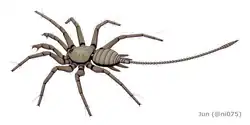 | |
Chilopoda
| Taxon | Authority | Year described | Notes | image |
|---|---|---|---|---|
|
Kachinophilus pereirai[204] |
Bonato, Edgecombe & Minelli |
2013 |
||
|
Lithopendra anjafliessae[205] |
Haug, Haug & Haug |
2023 |
A centipede belonging to the group Pleurostigmophora |
|
Diplopoda
| Taxon | Authority | Year described | Notes | image |
|---|---|---|---|---|
|
Stoev, Moritz & Wesener |
2019 |
 | ||
| Taxon | Authority | Year described | Notes | image |
|---|---|---|---|---|
|
Heterochordeuma liae[207] |
Su, Cai & Huang |
2024 |
||
| Taxon | Authority | Year described | Notes | image |
|---|---|---|---|---|
|
Andrognathus burmiticus[208] |
Moritz & Wesener |
2019 |
| |
| Taxon | Authority | Year described | Notes | image |
|---|---|---|---|---|
|
Monstrodesmus grimaldii[209] |
Su, Cai & Huang |
2022 |
A trichopolydesmid millipede |
|
|
Propolydesmus cretaceus[210] |
Su, Cai & Huang |
2023 |
A polydesmid millipede |
|
| Taxon | Authority | Year described | Notes | image |
|---|---|---|---|---|
|
Pauropsxenus extraneus[211] |
Su, Cai & Huang |
2020 |
||
|
Pauropsxenus ordinatus[211] |
Su, Cai & Huang |
2020 |
||
|
Phryssonotus burmiticus[198] |
Cockerell |
1917 |
||
| Taxon | Authority | Year described | Notes | image |
|---|---|---|---|---|
|
Siphoniulus muelleri[212] |
Liu, Rühr & Wesener |
2017 |
||
|
Siphoniulus preciosus[212] |
Liu, Rühr & Wesener |
2017 |
| |
| Taxon | Authority | Year described | Notes | image |
|---|---|---|---|---|
|
Siphonophora hui[213] |
Jiang et al. |
2019 |
A siphonophorid sucking millipede. |
|
|
Siphonorhinus globosus[214] |
Su, Cai & Huang |
2024 |
A siphonorhinid millipede. |
|
|
Siphonorhinus peculiaris[214] |
Su, Cai & Huang |
2024 |
A siphonorhinid millipede. |
|
| Taxon | Authority | Year described | Notes | image |
|---|---|---|---|---|
|
Electrocambala cretacea[215] |
Moritz & Wesener |
2021 |
A member of Cambalidea. |
|
|
Electrocambala ornata[215] |
Moritz & Wesener |
2021 |
A member of Cambalidea. |
|
|
Kachincambala distorta[215] |
Moritz & Wesener |
2021 |
A member of Cambalidea. |
|
|
Kachincambala muelleri[215] |
Moritz & Wesener |
2021 |
A member of Cambalidea. |
|
"Entognatha"
| Taxon | Authority | Year described | Notes | image |
|---|---|---|---|---|
|
Burmisotoma lamellifera[216] |
Christiansen & Nascimbene |
2006 |
||
|
Cretacentomobrya burma[216] |
Christiansen & Nascimbene |
2006 |
||
|
Praentomobrya avita[216] |
Christiansen & Nascimbene |
2006 |
||
|
Proisotoma pettersonae[216] |
Christiansen & Nascimbene |
2006 |
||
|
Propachyotoma conica[216] |
Christiansen & Nascimbene |
2006 |
||
|
Protodesoria granda[216] |
Christiansen & Nascimbene |
2006 |
||
|
Protoisotoma burma[216] |
Christiansen & Nascimbene |
2006 |
||
|
Villusisotoma brevis[216] |
Christiansen & Nascimbene |
2006 |
||
|
Villusisotoma longa[216] |
Christiansen & Nascimbene |
2006 |
| |
| Taxon | Authority | Year described | Notes | image |
|---|---|---|---|---|
|
Protodontella minicornis[216] |
Christiansen & Nascimbene |
2006 |
| |
| Taxon | Authority | Year described | Notes | image |
|---|---|---|---|---|
|
Grinnellia ventis[216] |
Christiansen & Nascimbene |
2006 |
||
|
Mucrovirga incompleta[216] |
Christiansen & Nascimbene |
2006 |
||
|
Sminthurconus grimaldi[216] |
Christiansen & Nascimbene |
2006 |
||
|
Sminthuricinus deceptus[216] |
Christiansen & Nascimbene |
2006 |
| |
Insecta
Malacostraca
| Taxon | Authority | Year described | Notes | image |
|---|---|---|---|---|
|
Cretapsara athanata[217] |
Luque in Luque et al. |
2021 |
A crab belonging to the group Eubrachyura and to the family Cretapsaridae. |
|
|
Xiaopenaeus electrinus[218] |
Xing et al. |
2021 |
A member of the family Penaeidae. |
|
| Taxon | Authority | Year described | Notes | image |
|---|---|---|---|---|
|
Cryptolacruma nidis[219] |
Schädel et al. |
2021 |
A member of Epicaridea. |
|
|
Electrolana madelineae[220] |
Schädel, Hyžný & Haug |
2021 |
A member of Cymothoida, possibly a species of Cirolana.[221] |
|
|
Metacirolana jimlowryi[221] |
Bruce & Rodcharoen |
2023 |
A member of the family Cirolanidae. |
|
|
Myanmariscus deboiseae[222] |
Broly, Maillet & Ross |
2015 |
A possible styloniscid woodlouse.[223] |
|
|
Palaeoarmadillo microsoma[223] |
Poinar |
2018 |
An armadillid woodlouse. |
|
| Taxon | Authority | Year described | Notes | image |
|---|---|---|---|---|
|
Tanaidaurum kachinensis[224] |
Pazinato, Müller & Haug |
2023 |
||
Ostracoda
| Taxon | Authority | Year described | Notes | |
|---|---|---|---|---|
|
Electrocypria burmitei[225] |
Wang, Matzke-Karasz & Horne |
2022 |
A candonid ostracod. |
|
|
Myanmarcypris hui[226] |
Wang et al. |
2020 |
A candonid ostracod. | |
|
Sanyuania sp.[226] |
Wang et al. |
2020 |
A loxoconchid cytheroid. | |
|
Thalassocypria sp.[226] |
Wang et al. |
2020 |
A candonid ostracod. | |
Symphyla
| Taxon | Authority | Year described | Notes | image |
|---|---|---|---|---|
|
Symphylella patrickmuelleri[227] |
Moritz & Wesener |
2017 |
| |
Mollusca
Cephalopoda
| Taxon | Authority | Year described | Notes | image |
|---|---|---|---|---|
|
N/A |
"2019" |
An immature Puzosia (Bhimaites) species dead shell |
 | |
Gastropoda
| Taxon | Authority | Year described | Notes | image |
|---|---|---|---|---|
|
Archaeocyclotus brevivillosus[229] |
Bichain et al. |
2022 |
A cyclophorid land snail |
|
|
Archaeocyclotus plicatula[230] |
Asato & Hirano in Hirano et al. |
2019 |
A cyclophorid land snail |
 |
|
Burminella artiukhini[231] |
Balashov, Perkovsky & Vasilenko |
2021 |
A land snail possessing morphological traits intermediate between members of the family Pupinidae and other members of Cyclophoroidea. |
|
|
(Asato & Hirano in Hirano et al.) |
2019 |
A species of Coptocheilus. |
 | |
|
Coptocheilus kachinensis[233] |
Yu, Zhuo & Páll-Gergely |
2022 |
A species of Coptocheilus. |
|
|
Cretadiostoma caperatum[233] |
Yu, Zhuo & Páll-Gergely |
2022 |
A member of the family Pupinidae. |
|
|
Cretadiostoma umbilicarinatum[233] |
Yu, Zhuo & Páll-Gergely |
2022 |
A member of the family Pupinidae. |
|
|
Cretatortulosa cretakachinensis[234] |
Yu, Salvador & Jarzembowski |
2021 |
A pupinid land snail |
|
|
Cretatortulosa gignens[235] |
Jochum, Yu & Neubauer |
2021 |
A pupinid land snail |
|
|
Eotrichophorus kachin[236] |
Bullis et al. |
2020 |
A cyclophorid land snail |
|
|
Balashov |
2020 |
A diplommatinid land snail |
||
|
Euthema hesoana[230] |
Asato & Hirano in Hirano et al. |
2019 |
A diplommatinid land snail |
 |
|
Balashov, Perkovsky & Vasilenko |
2020 |
A diplommatinid land snail |
||
|
Hirsuticyclus canaliculatus[239] |
Yu |
2021 |
A cyclophorid land snail |
|
|
Hirsuticyclus electrum[240] |
Neubauer, Xing & Jochum |
2019 |
A cyclophorid land snail |
|
|
Lagocheilus cretaspira[230] |
Asato & Hirano in Hirano et al. |
2019 |
A cyclophorid land snail |
 |
|
Lagocheilus electrospira[230] |
Asato & Hirano in Hirano et al. |
2019 |
A cyclophorid land snail. |
 |
|
Macropupina electricus[236] |
Bullis et al. |
2020 |
A pupinid land snail. |
|
|
Paleodiplommatina spelomphalos[236] |
Bullis et al. |
2020 |
A diplommatinid land snail. |
|
|
Perissocyclos kyrtostoma[236] |
Bullis et al. |
2020 |
A cyclophorid land snail. |
|
|
(Yu, Wang & Jarzembowski) |
2019 |
A cyclophorid land snail, |
||
|
(Yu, Wang & Jarzembowski) |
2019 |
A cyclophorid land snail, |
||
|
Pulchraspira teneristoma[234] |
Yu, Salvador & Jarzembowski |
2021 |
A diplommatinid land snail |
|
|
Rhaphaulus zhuoi[234] |
Yu, Salvador & Jarzembowski |
2021 |
A pupinid land snail |
|
|
Xenostoma lophopleura[236] |
Bullis et al. |
2020 |
Originally described as a pupinid land snail. |
|
| Taxon | Authority | Year described | Notes | image |
|---|---|---|---|---|
|
Galba prima[244] |
Yu, Neubauer & Jochum |
2021 |
A species of Galba. |
|
|
N/A |
"2019" |
2 dead shells likely entombed as shoreline debris |
||
|
Truncatellina dilatatus[245] |
Yu |
2020 |
Originally described as a species of Truncatellina. |
|
| Taxon | Authority | Year described | Notes | image |
|---|---|---|---|---|
|
Assiminea striatura[236] |
Bullis et al. |
2020 |
An assimineid land snail |
|
| Taxon | Authority | Year described | Notes | image |
|---|---|---|---|---|
|
?Hydrocena praecursor[246] |
Yu & Neubauer |
2021 |
A member of the family Hydrocenidae. |
|
|
Panneritina ambrae[247] |
Salvador & Yu |
2022 |
A member of the family Neritidae. |
| Taxon | Authority | Year described | Notes | image |
|---|---|---|---|---|
| Palaeolignopholas[248] | Bolotov et al. | 2021 | A member of the family Pholadidae |
Nematoda
Chromadorea
| Taxon | Authority | Year described | Notes | image |
|---|---|---|---|---|
|
Cretodiplogaster termitophilous[249] |
Poinar |
2011 |
A rhabditid nematode of uncertain placement |
|
|
Palaeocosmocerca burmanica[249] |
Poinar |
2011 |
A cosmocercid nematode |
|
|
Proheterorhabditis burmanicus[249] |
Poinar |
2011 |
A heterorhabditid nematode |
 |
Enoplea
| Taxon | Authority | Year described | Notes | image |
|---|---|---|---|---|
|
Cretacimermis aphidophilus[250] |
Poinar |
2017 |
||
|
Cretacimermis chironomae[249] |
Poinar |
2011 |
||
|
Cretacimermis protus[251] |
Poinar & Buckley |
2006 |
| |
Secernentea
| Taxon | Authority | Year described | Notes | image |
|---|---|---|---|---|
|
Cretaciaphelenchoides burmensis[249] |
Poinar |
2011 |
An aphelenchoidid nematode |
|
| Taxon | Authority | Year described | Notes | image |
|---|---|---|---|---|
|
Paleothelastoma tipulae[249] |
Poinar |
2011 |
A thelastomatid nematode |
|
Nematomorpha
Gordioidea
| Taxon | Authority | Year described | Notes | image |
|---|---|---|---|---|
|
Cretachordodes burmitis[251] |
Poinar & Buckley |
2006 |
| |
Onychophora
| Taxon | Authority | Year described | Notes | image |
|---|---|---|---|---|
|
Engel & Grimaldi |
2002 |
 (artist reconstruction) | ||
Vertebrata
Amphibia
| Taxon | Authority | Year described | Notes | image |
|---|---|---|---|---|
|
Daza et al. |
2020 |
 | ||
| Taxon | Authority | Year described | Notes | image |
|---|---|---|---|---|
|
Xing et al. |
2018 |
A tropical frog |
| |

Reptilia
Archosauria
| Taxon | Authority | Year described | Notes | image |
|---|---|---|---|---|
|
Xing et al. |
2016 |
Preserved tail with feathers |
||
|
Xing et al. |
2019 |
An enantiornithean avialan, known from a preserved wing and foot with a long toe. |
||
|
Multiple |
Various |
Several partial wings and feet, and more completely preserved juveniles |
||
|
Clark & O'Connor |
2021 |
An enantiornithean avialan |
||
| Taxon | Authority | Year described | Notes | image |
|---|---|---|---|---|
| Barlochersaurus winhtini[264] | Daza et al. | 2018 | A tiny possible stem-anguimorph | |
|
Daza et al. |
2026 |
A probable gekkonomorph |
| |
|
Arnold & Poinar |
2008 |
A gecko |
| |
|
Electroscincus zedi[267] |
Daza et al. |
2024 |
A skink |
|
|
Xing et al. |
2020 |
|||
|
Bolet et al. |
2021 |
|||
|
Wagner et al. |
2021 |
An agamid lizard |
||
|
Čerňanský et al. |
2022 |
| ||
|
Xing et al. |
2018 |
| ||
| Squamata[274] | Daza et al. | 2016 | Several unnamed squamate specimens varying from largely complete to isolated limbs, assignable to various families | |


Insecta
Dictyoptera
| Ichnotaxon | Authority | Year described | Notes | image |
|---|---|---|---|---|
|
Blattocoprolites mesoblattamaxi[2] |
Hinkelman in Hinkelman & Vršanská |
2020 |
A mesoblattinid cockroach coprolite. |
|
Mollusca
Bivalvia
| Ichnotaxon | Authority | Year described | Notes | image |
|---|---|---|---|---|
|
Teredolites clavatus |
n/a |
2018 |
pholadid burrowing crypts in the amber nodules, |
 |
References
- ↑ Ross, A. J. (2024). "Complete checklist of Burmese (Myanmar) amber taxa 2023". Mesozoic. 1 (1): 21–57. doi:10.11646/mesozoic.1.1.4.
- 1 2 Hinkelman, J.; Vršanská, L. (2020). "A Myanmar amber cockroach with protruding feces contains pollen and a rich microcenosis". The Science of Nature. 107 (2) 13. Bibcode:2020SciNa.107...13H. doi:10.1007/s00114-020-1669-y. PMID 32125545. S2CID 211730431.
- ↑ Heinrichs, J.; Schäfer-Verwimp, A.; Hedenäs, L.; Ignatov, M. S.; Schmidt, A. R. (2014). "An acrocarpous moss in Cretaceous amber from Myanmar". Cretaceous Research. 51: 260–265. Bibcode:2014CrRes..51..260H. doi:10.1016/j.cretres.2014.06.010.
- 1 2 3 Tan, Z.-Z.; Cui, Y.-M.; Saing, L. M.; Li, C.-X.; Li, Y. (2025). "Systematics and Palaeoecology of Three New Acrocarpous Mosses from the Mid-Cretaceous of Kachin, Myanmar". Plants. 14 (14) 2124. Bibcode:2025Plnts..14.2124T. doi:10.3390/plants14142124. PMC 12300249. PMID 40733361.
- 1 2 3 Li, Y.; Wang, Y.-D.; Wu, P.-C.; Saing, L. M.; Li, C.-X.; Wang, Q. (2025). "Three new exquisitely preserved haplolepideous mosses from the mid-Cretaceous of Kachin, Myanmar". Review of Palaeobotany and Palynology. 344 105459. doi:10.1016/j.revpalbo.2025.105459.
- 1 2 3 4 Hedenäs, L.; Heinrichs, J.; Schmidt, A. R. (2014). "Bryophytes of the Burmese amber forest: amending and expanding the circumscription of the Cretaceous moss genus Vetiplanaxis". Review of Palaeobotany and Palynology. 209: 1–10. Bibcode:2014RPaPa.209....1H. doi:10.1016/j.revpalbo.2014.05.008.
- ↑ Li, Y.; Wang, Y.-D.; Feldberg, K.; Wang, S.; Shi, C.; Cui, Y.-M.; Zhang, X.-Q. (2022). "New insights into the moss genus Vetiplanaxis with a description of V. obtusus sp. nov. from the mid-Cretaceous Kachin amber, Myanmar". Review of Palaeobotany and Palynology. 301 104659. Bibcode:2022RPaPa.30104659L. doi:10.1016/j.revpalbo.2022.104659. S2CID 247925481.
- 1 2 3 4 Li, Y.; Wang, Y.-D.; Nosova, N.; Lu, N.; Xu, Y.-Y. (2022). "Filmy Ferns (Hymenophyllaceae) and Associated Spike-Mosses (Selaginellaceae) from the Mid-Cretaceous Kachin Amber, Myanmar". Biology. 11 (11). 1629. doi:10.3390/biology11111629. PMC 9687414. PMID 36358330.
- 1 2 3 4 5 6 7 8 9 10 11 12 13 14 15 16 17 18 19 20 21 Schmidt, A.R.; Korall, P.; Krings, M.; Weststrand, S.; Bergschneider, L.; Sadowski, E.-M.; Bechteler, J.; Rikkinen, J.; Regalado, L. (2022). "Selaginella in Cretaceous amber from Myanmar". Willdenowia. 52 (2): 179–245. Bibcode:2022Willd..5252203S. doi:10.3372/wi.52.52203.
- ↑ Li, Y.; Li, Y.-D.; Wang, Y.-D.; Schneider, H.; Shi, G.-L. (2022). "Re-appraisal of lacewing mimicry of liverworts from the mid-Cretaceous Kachin amber, Myanmar with a description of Selaginella cretacea sp. nov. (Selaginellales, Selaginellaceae)". Cretaceous Research. 133 105143. Bibcode:2022CrRes.13305143L. doi:10.1016/j.cretres.2022.105143. S2CID 245939368.
- ↑ Heinrichs, J.; Reiner-Drewald, M.E.; Feldberg, K.; von Konrat, M.; Hentschel, J.; Váňa, J.; Grimaldi, D.A.; Nascimbene, P.C.; Schmidt, A.R. (2011). "The leafy liverwort Frullania (Jungermanniopsida) in the Cretaceous amber forest of Myanmar". Review of Palaeobotany and Palynology. 169: 21–28. doi:10.1016/j.revpalbo.2011.10.002.
- ↑ Heinrichs, J.; Feldberg, K.; Müller, P.; Schäfer-Verwimpe, A.; von Konrat, M.; Ilsemann, B; Krings, M. (2017). "Frullania pinnata spec. nov. (Frullaniaceae, Porellales), a new leafy liverwort in mid-Cretaceous Burmese amber from Myanmar". Cretaceous Research. 78: 56–60. Bibcode:2017CrRes..78...56H. doi:10.1016/j.cretres.2017.05.030.
- ↑ Hentschel, J.; Schmidt, A. R.; Heinrichs, J. (2009). "Frullania cretacea, sp. nov. (Porellales, Jungermanniopsida), a leafy liverwort preserved in Cretaceous amber from Myanmar". Cryptogamie, Bryologie. 30 (3): 323–328.
- ↑ Li, Y.; Wang, Y.-D.; Feldberg, K.; Wang, Q.; Yang, X.-J. (2021). "A new leafy liverwort of Frullania (Frullaniaceae, Porellales) from the mid-Cretaceous Kachin amber, Myanmar". Geological Journal. 56 (10): 5046–5057. Bibcode:2021GeolJ..56.5046L. doi:10.1002/gj.4222. S2CID 238795680.
- ↑ Li, Y.; Wang, Y.-D.; Schnerder, H.; Wu, P.-C. (2020). "Frullania partita sp. nov. (Frullaniaceae, Porellales), a new leafy liverwort from the mid-Cretaceous of Myanmar". Cretaceous Research. 108 104341. Bibcode:2020CrRes.10804341L. doi:10.1016/j.cretres.2019.104341. S2CID 213553976.
- ↑ Heinrichs, J.; Feldberg, K.; Bechteler, J.; Müller, P.; Renner, M. A.; Váňa, J.; Schäfer-Verwimp, A.; Schmidt, A. R. (2017). "A fossil genus of the Frullaniaceae (Porellales, Jungermanniopsida) from the mid-Cretaceous of Myanmar". Cretaceous Research. 74: 223–226. Bibcode:2017CrRes..74..223H. doi:10.1016/j.cretres.2017.02.023.
- ↑ Heinrichs, J.; Schäfer-Verwimp, A.; Feldberg, K.; Schmidt, A. R. (2014). "The extant liverwort Gackstroemia (Lepidolaenaceae, Porellales) in Cretaceous amber from Myanmar". Review of Palaeobotany and Palynology. 203: 48–52. Bibcode:2014RPaPa.203...48H. doi:10.1016/j.revpalbo.2014.01.004.
- ↑ Bechteler, J.; Schmidt, A. R.; Renner, M.A.; Wang, B.; Pérez-Escobar, O. A.; Schäfer-Verwimp, A.; Feldberg, K.; Heinrichs, J. (2017). "A Burmese amber fossil of Radula (Porellales, Jungermanniopsida) provides insights into the Cretaceous evolution of epiphytic lineages of leafy liverworts". Fossil Record. 20 (2): 201–213. Bibcode:2017FossR..20..201B. doi:10.5194/fr-20-201-2017.
- ↑ Feldberg, K.; Schäfer-Verwimp, A.; Renner, M. A. M.; von Konrat, M.; Bechteler, J.; Müller, P.; Wang, Y.-D.; Schneider, H.; Schmidt, A. R. (2021). "Liverworts from Cretaceous amber". Cretaceous Research. 128 104987. Bibcode:2021CrRes.12804987F. doi:10.1016/j.cretres.2021.104987. S2CID 238782100.
- 1 2 Feldberg, K.; Schäfer-Verwimp, A.; Li, Y.; Renner, M. A. M. (2022). "Extending the diversity of the bryoflora in Kachin amber (Myanmar), with the description of Radula patrickmuelleri, sp. nov. and R. tanaiensis, sp. nov. (Jungermanniopsida, Porellales, Radulaceae)". Fossil Record. 25 (1): 213–230. Bibcode:2022FossR..25..213F. doi:10.3897/fr.25.82362 (inactive 14 May 2026).
{{cite journal}}: CS1 maint: DOI inactive as of May 2026 (link) - ↑ Li, C.; Moran, R. C.; Ma, J.; Wang, B.; Hao, J.; Yang, Q. (2020). "A mid-Cretaceous tree fern of Thyrsopteridaceae (Cyatheales) preserved in Myanmar amber". Cretaceous Research. 105 104050. Bibcode:2020CrRes.10504050L. doi:10.1016/j.cretres.2019.01.002.
- ↑ Zhang, H.-R.; Shi, C.; Long, X.-X.; Feng, Q.; Cai, H.-H.; Lü, Y.-T.; Wang, S. (2022). "A new fossil record of Thyrsopteridaceae (Cyatheales) from the mid-Cretaceous amber of Myanmar". Palaeoworld. 31 (3): 478–484. doi:10.1016/j.palwor.2021.09.002. S2CID 240519538.
- ↑ Regalado, L.; Schmidt, A. R.; Appelhans, M. S.; Ilsemann, B.; Schneider, H.; Krings, M.; Heinrichs, J. (2017). "A fossil species of the enigmatic early polypod fern genus Cystodium (Cystodiaceae) in Cretaceous amber from Myanmar". Scientific Reports. 7 (1): 1–9. Bibcode:2017NatSR...714615R. doi:10.1038/s41598-017-14985-7. PMC 5668433. PMID 29097728.
- ↑ Poinar, G. (2021). "A new fern, Cladarastega burmanica gen. et sp. nov. (Dennstaedtiaceae: Polypodiales) in mid-Cretaceous Burmese amber". Palaeodiversity. 14 (1): 153–160. doi:10.18476/pale.v14.a7.
- ↑ Li, C.X.; Meng, F.W. (2025). "A New Species of Krameropteris (Dennstaedtiaceae) from Mid-Cretaceous Myanmar Amber". Taxonomy. 5 (1). 3. doi:10.3390/taxonomy5010003.
- ↑ Schneider, H.; Schmidt, A. R.; Heinrichs, J. (2016). "Burmese amber fossils bridge the gap in the Cretaceous record of polypod ferns". Perspectives in Plant Ecology, Evolution and Systematics. 18: 70–78. Bibcode:2016PPEES..18...70S. doi:10.1016/j.ppees.2016.01.003. hdl:10141/610456.
- ↑ Long, X.; Peng, Y.; Zhang, H.; Fan, Y.; Shi, C.; Wang, S. (2022). "Microlepia burmasia sp. nov., a new fern species from mid-Cretaceous Kachin amber of northern Myanmar (Dennstaedtiaceae, Polypodiales)". Cretaceous Research. 143 105417. 105417. doi:10.1016/j.cretres.2022.105417. S2CID 253494172.
- ↑ Li, C.; Moran, R. C.; Ma, J.; Wang, B.; Hao, J. (2020). "A new fossil record of Lindsaeaceae (Polypodiales) from the mid-Cretaceous amber of Myanmar". Cretaceous Research. 105 104040. Bibcode:2020CrRes.10504040L. doi:10.1016/j.cretres.2018.12.010.
- ↑ Wang, S.; Long, X.; Zhang, H.; Cai, H.; Engel, M. S.; Shi, C. (2021). "A semi-aquatic fern (Marsileaceae) from the mid-Cretaceous amber of northern Myanmar". Cretaceous Research. 133 105119. doi:10.1016/j.cretres.2021.105119. S2CID 245298780.
- ↑ Regalado, L.; Schmidt, A. R.; Müller, P.; Niedermeier, L.; Krings, M.; Schneider, H. (2019). "Heinrichsia cheilanthoides gen. et sp. nov., a fossil fern in the family Pteridaceae (Polypodiales) from the Cretaceous amber forests of Myanmar". Journal of Systematics and Evolution. 57 (4): 329–338. Bibcode:2019JSyEv..57..329R. doi:10.1111/jse.12514.
- ↑ Poinar, G.O.Jr.; Buckley, R. (2008). "Cretacifilix fungiformis gen. and sp. nov., an eupolypod fern (Polypodiales) in Early Cretaceous Burmese amber". Journal of the Botanical Research Institute of Texas. 2 (2): 1175–1182.
- ↑ Regalado, L.; Schmidt, A. R.; Krings, M.; Bechteler, J.; Schneider, H.; Heinrichs, J. (2018). "Fossil evidence of eupolypod ferns in the mid-Cretaceous of Myanmar". Plant Systematics and Evolution. 304 (1): 1–13. Bibcode:2018PSyEv.304....1R. doi:10.1007/s00606-017-1439-2. S2CID 21617872.
- ↑ Poinar, G.; Chambers, K. L.; Buckley, R. (2007). "Eoëpigynia burmensis gen. and sp. nov., an Early Cretaceous eudicot flower (Angiospermae) in Burmese amber". Journal of the Botanical Research Institute of Texas: 91–96.
- ↑ Grimaldi, D. A.; Peñalver, E.; Barrón, E.; Herhold, H. W.; Engel, M. S. (2019). "Direct evidence for eudicot pollen-feeding in a Cretaceous stinging wasp (Angiospermae; Hymenoptera, Aculeata) preserved in Burmese amber". Communications Biology. 2 (1): 408. doi:10.1038/s42003-019-0652-7. ISSN 2399-3642. PMC 6838090. PMID 31728419.
- ↑ George O. Poinar, Jr; Kenton L. Chambers (2020). "Phantophlebia dicycla gen. et sp. nov., a five-merous fossil flower in mid-Cretaceous Myanmar amber". Journal of the Botanical Research Institute of Texas. 14 (1): 73–80. doi:10.17348/jbrit.v14.i1.898.
- ↑ George O. Poinar, Jr; Kenton L. Chambers (2020). "Dasykothon leptomiscus gen. et sp. nov., a fossil flower of possible Lauralean affinity from Myanmar amber". Journal of the Botanical Research Institute of Texas. 14 (1): 65–71. doi:10.17348/jbrit.v14.i1.897.
- ↑ Poinar, G. O. Jr; Chambers, K. L. (2019). "Zygadelphus aetheus gen. et sp. nov., an unusual fossil flower from mid-Cretaceous Myanmar amber". Journal of the Botanical Research Institute of Texas. 13 (2): 467–473. doi:10.17348/jbrit.v13.i2.799. S2CID 208232590.
- ↑ Poinar, G. O. Jr (2017). "A mid-Cretaceous Lauraceae flower, Cascolaurus burmitis gen. et sp. nov., in Myanmar amber". Cretaceous Research. 71: 96–101. Bibcode:2017CrRes..71...96P. doi:10.1016/j.cretres.2016.11.015.
- ↑ Poinar, G. O. Jr; Chambers, K. L. (2005). "Palaeoanthella huangii gen. and sp. nov., an Early Cretaceous flower (Angiospermae) in Burmese amber". Sida. 21 (4): 2087–2092.
- ↑ George O. Poinar Jr.; Kenton L. Chambers (2018). "Setitheca lativalva gen. et sp. nov., a fossil flower of Laurales from mid-Cretaceous Myanmar amber". Journal of the Botanical Research Institute of Texas. 12 (2): 643–653. doi:10.17348/jbrit.v12.i2.964. S2CID 195836861.
- ↑ Kenton L. Chambers; George O. Poinar, Jr (2020). "Thymolepis toxandra gen. et sp. nov., a mid-Cretaceous fossil flower with horseshoe-shaped anthers". Journal of the Botanical Research Institute of Texas. 14 (1): 57–64. doi:10.17348/jbrit.v14.i1.896.
- ↑ George O. Poinar, Jr; Kenton L. Chambers; Urszula T. Iwaniec; Fernando E. Vega (2020). "Valviloculus pleristaminis gen. et sp. nov., a Lauralean fossil flower with valvate anthers from mid-Cretaceous Myanmar amber". Journal of the Botanical Research Institute of Texas. 14 (2): 359–366. doi:10.17348/jbrit.v14.i2.1014.
- ↑ George O. Poinar, Jr; Kenton L. Chambers (2020). "Cyathitepala papillosa gen. et sp. nov., a mid-Cretaceous fossil flower from Myanmar amber with valvate anthers". Journal of the Botanical Research Institute of Texas. 14 (2): 351–358. doi:10.17348/jbrit.v14.i2.1013.
- ↑ Poinar, G. O. Jr.; Chambers, K. L. (2019). "Dispariflora robertae gen. et sp. nov., a mid-Cretaceous flower of possible Lauralean affinity from Myanmar amber". Journal of the Botanical Research Institute of Texas. 13 (1): 173–183. doi:10.17348/jbrit.v13.i1.839. S2CID 244510326.
- ↑ Crepet, W. L.; Nixon, K. C.; Grimaldi, D. A.; Riccio, M. (2016). "A mosaic Lauralean flower from the Early Cretaceous of Myanmar". American Journal of Botany. 103 (2): 290–297. doi:10.3732/ajb.1500393. PMID 26865118.
- ↑ Poinar, G. O. (2021). "A Monocot Flower, Mirafloris burmitis gen. et sp. nov. (Monocots: Angiospermae), in Burmese Amber". Biosis: Biological Systems. 2 (3): 342–348. doi:10.37819/biosis.002.03.0126. S2CID 238732295.
- ↑ Peris, D.; Labandeira, C. C.; Barrón, E.; Delclòs, X.; Rust, J.; Wang, B. (2020). "Generalist pollen-feeding beetles during the mid-Cretaceous". iScience. 23 (3) 100913. Bibcode:2020iSci...23j0913P. doi:10.1016/j.isci.2020.100913. PMC 7113562. PMID 32191877.
- ↑ Poinar, G. O.; Chambers, K. L.; Vega, F. E. (2021). "Tropidogyne euthystyla sp. nov., a new small-flowered addition to the genus from mid-Cretaceous Myanmar amber". Journal of the Botanical Research Institute of Texas. 15 (1): 113–119. doi:10.17348/jbrit.v15.i1.1053. S2CID 237700194.
- ↑ Poinar, G. O. Jr; Chambers, K. L. (2019). "Tropidogyne lobodisca sp. nov., a third species of the genus from mid-Cretaceous Myanmar amber". Journal of the Botanical Research Institute of Texas. 13 (2): 461–466. doi:10.17348/jbrit.v13.i2.798. S2CID 244494400.
- ↑ Poinar, G. O. Jr; Chambers, K. L. (2017). "Tropidogyne pentaptera, sp. nov., a new mid-Cretaceous fossil angiosperm flower in Burmese amber". Palaeodiversity. 10 (1): 135–140. doi:10.18476/pale.v10.a10.
- ↑ Chambers, K. L.; Poinar, G. O. Jr; Buckley, R. (2010). "Tropidogyne a new genus of Early Cretaceous eudicots (Angiospermae) from Burmese amber". Novon. 20 (1): 23–29. Bibcode:2010Novon..20...23C. doi:10.3417/2008039. S2CID 86227328.
- ↑ Poinar, G. O. Jr; Chambers, K. L. (2018). "Fossil flowers of Lachnociona camptostylus sp. nov., a second record for the genus in mid-Cretaceous Myanmar amber". Journal of the Botanical Research Institute of Texas. 12 (2): 655–666. doi:10.17348/jbrit.v12.i2.966. S2CID 195836349.
- ↑ Poinar, G. O. Jr; Chambers, K. L.; Buckley, R. (2008). "An early Cretaceous angiosperm fossil of possible significance in rosid floral diversification". Journal of the Botanical Research Institute of Texas. 2 (2): 1183–1192.
- 1 2 Poinar, G. O. Jr (2004). "Programinis burmitis gen. et sp. nov., and P. laminatus sp. nov., Early Cretaceous grass-like monocots in Burmese amber". Australian Systematic Botany. 17 (5): 497–504. Bibcode:2004AuSyB..17..497P. doi:10.1071/SB04002.
- 1 2 Shi, C.; Wang, S.; Cai, H.; Zhang, H.; Long, X.; Tihelka, E.; Song, W.; Feng, Q.; Jiang, R.; Cai, C.; Lombard, N.; Li, X.; Yuan, J.; Zhu, J.; Yang, H.; Liu, X.; Xiang, Q.; Zhao, Z.; Long, C.; Schneider, H.; Zhang, X.; Peng, H.; Li, D.-Z.; Fan, Y.; Engel, M. S.; Wang, Y.; Spicer, R. A. (2022). "Fire-prone Rhamnaceae with South African affinities in Cretaceous Myanmar amber". Nature Plants. 8 (2): 125–135. Bibcode:2022NatPl...8..125S. doi:10.1038/s41477-021-01091-w. PMID 35102275. S2CID 246443363.
- ↑ Poinar, G. O. Jr.; Brown, A. e. (2020). "A green algae (Chaetophorales: Chaetophoraceae) in Burmese amber". Historical Biology: An International Journal of Paleobiology. 33 (3): 323–327. doi:10.1080/08912963.2019.1616719. S2CID 182663732.
- ↑ Poinar, G.O.; Chambers, K.L. (2022). "Additional fossil specimens of Eophylica (Rhamnaceae) in mid-Cretaceous amber from the Hukawng valley, Myanmar". Journal of the Botanical Research Institute of Texas. 16 (1): 63–72. doi:10.17348/jbrit.v16.i1.1221. JSTOR 27181916.
- ↑ Poinar, G. O. Jr.; Buckley, R.; Chen, H. (2016). "A primitive Mid-Cretaceous angiosperm flower, Antiquifloris latifibris gen. & sp. nov., in Myanmar amber". Journal of the Botanical Research Institute of Texas. 10 (1): 155–162.
- ↑ George O. Poinar, Jr; Kenton L. Chambers (2020). "Chainandra zeugostylus gen. et sp. nov., a mid-Cretaceous amber fossil with sagittate anthers opening widely at maturity". Journal of the Botanical Research Institute of Texas. 14 (2): 367–372. doi:10.17348/jbrit.v14.i2.1015.
- 1 2 George Poinar, Jr. (2018). "Mid-Cretaceous angiosperm flowers in Myanmar amber". In Beatrice Welch; Micheal Wilkerson (eds.). Recent advances in plant research. Nova Science Publishers, Incorporated. pp. 187–218. ISBN 978-1-53614-170-2.
- ↑ Poinar, G. O. Jr (2019). "Exalloanthum, a new name for a fossil angiosperm flower in Myanmar amber". Journal of the Botanical Research Institute of Texas. 13 (2): 475–476. doi:10.17348/jbrit.v13.i2.800. S2CID 244521650.
- ↑ Liu, Z.-J.; Huang, D.; Cai, C.; Wang, X. (2018). "The core eudicot boom registered in Myanmar amber". Scientific Reports. 8 (1) 16765. Bibcode:2018NatSR...816765L. doi:10.1038/s41598-018-35100-4. PMC 6233203. PMID 30425298.
- ↑ Poinar, G. O. Jr.; Chambers, K. L.; Wunderlich, J. (2013). "Micropetasos, a new genus of angiosperms from mid-cretaceous Burmese amber". Journal of the Botanical Research Institute of Texas. 7 (2): 745–750.
- ↑ Xing, L.; Gu, L. (2020). "The possible earliest epizoochorous fruit preserved in mid-Cretaceous Burmese amber". Cretaceous Research. 114 104498. Bibcode:2020CrRes.11404498X. doi:10.1016/j.cretres.2020.104498. S2CID 219439641.
- 1 2 Poinar, G. O. Jr; Chambers, K. L. (2019). "Strombothelya gen. nov., a fossil angiosperm with two species in mid-Cretaceous Myanmar amber". Journal of the Botanical Research Institute of Texas. 13 (2): 451–460. doi:10.17348/jbrit.v13.i2.797. S2CID 244510839.
- ↑ Poinar, G. J.; Alderman, S.; Wunderlich, J. (2015). "One hundred million year old ergot: psychotropic compounds in the Cretaceous". Palaeodiversity. 8: 13–19.
- ↑ Sung, G. H.; Poinar, G. O.; Spatafora, J. W. (2008). "The oldest fossil evidence of animal parasitism by fungi supports a Cretaceous diversification of fungal–arthropod symbioses". Molecular Phylogenetics and Evolution. 49 (2): 495–502. Bibcode:2008MolPE..49..495S. doi:10.1016/j.ympev.2008.08.028. PMID 18817884.
- 1 2 3 Poinar, G.O.; Buckley, R. (2007). "Evidence of mycoparasitism and hypermycoparasitism in Early Cretaceous amber". Mycological Research. 111 (4): 503–506. Bibcode:2007MycR..111..503P. doi:10.1016/j.mycres.2007.02.004. PMID 17512712.
- ↑ Poinar, G. O. Jr.; Vega, F. E. (2018). "A mid-Cretaceous ambrosia fungus, Paleoambrosia entomophila gen. nov. et sp. nov. (Ascomycota: Ophiostomatales) in Burmese (Myanmar) amber, and evidence for a femoral mycangium". Fungal Biology. 122 (12): 1159–1162. Bibcode:2018FunB..122.1159P. doi:10.1016/j.funbio.2018.08.002. PMID 30449353. S2CID 53950691.
- ↑ Poinar Jr, G. O.; da Silva Alfredo, D.; Baseia, I. G. (2014). "A gasteroid fungus, Palaeogaster micromorpha gen. & sp. nov.(Boletales) in Cretaceous Myanmar amber". Journal of the Botanical Research Institute of Texas. 8 (1): 139–143.
- ↑ Poinar, G.O.Jr (2021). "A mid-Cretaceous fungus, Philothysanus burmanicus gen. et sp. nov.(Ascomycota: Spheciophilaceae), on a thrip (Thysanoptera) in Burmese amber". Biosis: Biological Systems. 2 (4): 408–415.
- ↑ "Spheciophila". www.mycobank.org. Retrieved 2020-02-26.
- ↑ Poinar, G. O. (2018). "A mid-Cretaceous pycnidia, Palaeomycus epallelus gen. et sp. nov., in Myanmar amber". Historical Biology. 38: 1–4. doi:10.1080/08912963.2018.1446531. S2CID 90373037.
- ↑ Poinar, G. O. Jr (2019). "The first fossil record of a Micro-sporidian (Micro-sporidia) in Burmese amber". Current Trends in Microbiology. 13: 1–5.
- ↑ Poinar, G. O. Jr; Vega, F. E. (2019). "A mid-Cretaceous trichomycete, Priscadvena corymbosa gen. et sp. nov., in Burmese amber". Fungal Biology. 123 (5): 393–396. Bibcode:2019FunB..123..393P. doi:10.1016/j.funbio.2019.02.007. PMID 31053328. S2CID 92176165.
- ↑ Salamon, M. A.; Lin, J.; Duda, P.; Gorzelak, P.; Ausich, W. I.; Oji, T. (2019). "Paleoenvironmental and biostratigraphic implications of echinoderm ossicles trapped within Burmese amber". PALAIOS. 34 (12): 652–656. Bibcode:2019Palai..34..652S. doi:10.2110/palo.2019.084. S2CID 209473464.
- ↑ Hu, X.; Lei, X.; Luo, C.; Jarzembowski, E.A.; Wang, B.; Xiao, C. (2020). "A new whip spider (Arachnida: Amblypygi) in mid-Cretaceous Kachin amber". Cretaceous Research. 116 104596. Bibcode:2020CrRes.11604596H. doi:10.1016/j.cretres.2020.104596. S2CID 225379275.
- 1 2 3 4 Wunderlich, J. (2015). "New and rare fossil Arachnida in Cretaceous Burmese Amber (Amblypygi, Ricinulei and Uropygi: Thelephonida)" (PDF). In Jörg Wunderlich (ed.). Beiträge zur Araneologie, 9: Mesozoic spiders and other fossil arachnids. pp. 409–436.
- ↑ Engel, M.; Grimaldi, D. (2014). "Whipspiders (Arachnida: Amblypygi) in amber from the Early Eocene and mid-Cretaceous, including maternal care". Novitates Paleoentomologicae. 9: 1–17.
- ↑ Rossi, A.; Merendino, H. (2016). "Una nuova sottospecie di amblipigio dall'ambra birmana del Myanmar (Amblypygi)". Arachnida – Rivista Aracnologica Italiana. 9: 30–32.
- 1 2 3 4 5 6 7 8 9 10 11 12 13 14 15 16 17 18 19 20 21 22 23 24 25 26 27 28 29 30 31 32 33 34 35 36 37 38 39 40 41 42 43 44 Wunderlich, J.; Müller, P. (2020). "New and already described fossil spiders (Araneae) of 20 families in mid and Late Cretaceous Burmese ambers, with notes on spider phylogeny, evolution and classification" (PDF). In Jörg Wunderlich (ed.). Beiträge zur Araneologie, 13. Self published. pp. 22–164. ISBN 978-3-931473-19-8.
- 1 2 3 4 5 6 7 8 9 10 11 12 13 14 15 16 17 18 19 20 21 22 23 24 25 26 27 28 29 30 31 32 33 34 35 36 37 38 39 40 41 42 43 44 45 46 47 48 49 50 51 52 Jörg Wunderlich; Patrick Müller (2018). "Reflections on the origin of the orb web, on the evolution and the relationships of selected spiders (Araneae): the RTA-clade, the superfamily Leptonetoidea as well as on the orb-weaving spiders (Araneoidea and Deinopoidea), based on "missing links" in Cretaceous Burmese amber; descriptions of new taxa, and notes on the spider fauna in Burmite" (PDF). In Jörg Wunderlich (ed.). Beiträge zur Araneologie, 11. Fossil spiders (Araneae) in Cretaceous Burmese amber. Publishing House Joerg Wunderlich. pp. 1–177. ISBN 978-3-931473-16-7.
- 1 2 3 4 5 6 7 8 9 10 11 12 13 14 15 16 17 18 19 20 21 22 23 24 25 26 27 28 29 30 31 32 33 34 35 36 37 38 39 40 41 42 43 44 45 46 47 48 49 50 51 52 53 54 55 56 57 58 59 60 61 62 63 64 65 66 67 68 69 70 71 72 73 74 75 76 Wunderlich, J. (2017). "New and rare fossil spiders (Araneae) in mid Cretaceous amber from Myanmar (Burma), including the description of new extinct families of the suborders Mesothelae and Opisthothelae as well as notes on the taxonomy, the evolution and the biogeography of the Mesothelae" (PDF). In Jörg Wunderlich (ed.). Beiträge zur Araneologie, 10. pp. 72–279.
- 1 2 3 4 5 6 7 8 9 10 11 12 13 14 Wunderlich, J (2008). "The dominance of ancient spider families of the Araneae: Haplogynae in the Cretaceous, and the late diversification of the advanced ecribellate spiders of the Entelegynae after the Cretaceous-Tertiary boundary extinction events, with descriptions of new families". Beiträge zur Araneologie. 5: 524–674, 802–813.
- ↑ Peng, Y.; Shi, C.; Long, X.; Engel, M. S.; Wang, S. (2023). "Discovery of a new species of Eomysmauchenius from mid-Cretaceous Kachin amber (Araneae: Archaeidae)". Cretaceous Research. 153 105703. 105703. doi:10.1016/j.cretres.2023.105703.
- 1 2 3 4 5 6 7 8 9 10 11 12 13 14 15 16 17 18 19 20 21 22 23 24 25 26 27 28 29 30 31 32 33 34 35 36 37 38 39 40 41 42 43 44 45 46 47 48 49 50 51 52 53 54 55 56 57 58 59 60 61 62 63 64 65 66 67 68 69 70 71 72 73 74 75 76 77 78 79 80 81 82 83 Wunderlich, J.; Müller, P. (2021). "Description of new fossil spiders (Araneae) in Late (mid) Cretaceous Burmese (Kachin) amber with focus on the superfamilies Palpimanoidea and Deinopoidea and members of the RTA-clade, as well as remarks on palaeobehaviour, palaeofauna, taxonomy and phylogenetics" (PDF). In Jörg Wunderlich (ed.). Beiträge zur Araneologie, 14. pp. 25–262. ISBN 978-3-931473-20-1.
{{cite book}}: Check|isbn=value: checksum (help) - 1 2 3 4 5 6 7 8 9 10 11 12 13 14 15 16 17 18 19 20 21 22 23 24 25 26 27 28 29 30 31 32 33 34 35 36 37 38 39 40 41 42 43 44 45 46 47 48 49 50 51 52 53 54 55 56 57 58 59 60 61 62 63 64 65 Wunderlich, J. (2015). "On the evolution and the classification of spiders, the Mesozoic spider faunas, and descriptions of new Cretaceous taxa mainly in amber from Myanmar (Burma) (Arachnida: Araneae)" (PDF). In Jörg Wunderlich (ed.). Beiträge zur Araneologie, 9: Mesozoic spiders and other fossil arachnids. pp. 21–408.
- 1 2 3 4 5 6 7 8 9 10 11 12 Ivan L. F. Magalhaes; Guilherme H. F. Azevedo; Peter Michalik; Martín J. Ramírez (2020). "The fossil record of spiders revisited: implications for calibrating trees and evidence for a major faunal turnover since the Mesozoic". Biological Reviews. 95 (1): 184–217. doi:10.1111/brv.12559. PMID 31713947.
- 1 2 3 4 Paul A. Selden; Dong Ren (2017). "A review of Burmese amber arachnids". Journal of Arachnology. 45 (3): 324–343. doi:10.1636/JoA-S-17-029. S2CID 90983791.
- 1 2 Wunderlich, J. (2019). "What is a spider? Cretaceous fossils modify strongly phylogenetics as well as diagnoses of families, superfamilies and even suborders of spiders (Araneida) and other arthropods" (PDF). In Jörg Wunderlich (ed.). Beiträge zur Araneologie, 12. pp. 1–32.
- 1 2 3 4 5 6 7 8 9 10 11 12 13 Wunderlich, J. (2012). "On the fossil spider (Araneae) fauna in Cretaceous ambers, with descriptions of new taxa from Myanmar (Burma) and Jordan, and on the relationships of the superfamily Leptonetoidea" (PDF). In Jörg Wunderlich (ed.). Beiträge zur Araneologie, 7: Fifteen papers on extant and fossil spiders (Araneae). pp. 157–232.
- 1 2 Jiang, T.; Xin, Y.; Yao, Z.; Li, S. (2020). "Two new spider families from Late Cretaceous Kachin amber (Arachnida: Araneae)". Zoological Systematics. 45 (4): 266–280. doi:10.11865/zs.202033.
- 1 2 Wunderlich, J. (2024). "New fossil spider taxa in Cretaceous Burmese (Kachin) amber (Araneida: Chimerarachnida and Araneae)" (PDF). In Jörg Wunderlich (ed.). Beiträge zur Araneologie, 17. Joerg Wunderlich. pp. 64–75.
- 1 2 Wunderlich, J. (2011). "Some fossil spiders (Araneae) in Cretaceous ambers". In Jörg Wunderlich (ed.). Beiträge zur Araneologie, 6. pp. 539–557.
- ↑ Penney, P. (2005). "The fossil spider family Lagonomegopidae". The Journal of Arachnology. 33: 439–444. doi:10.1636/04-55.1. S2CID 86341553.
- 1 2 Guo, X.; Selden, P. A.; Ren, D. (2022). "New specimens from Mid-Cretaceous Myanmar amber illuminate the phylogenetic placement of Lagonomegopidae (Arachnida: Araneae)". Zoological Journal of the Linnean Society. 195 (2): 399–416. doi:10.1093/zoolinnean/zlab027.
- 1 2 Guo, X.; Selden, P. A.; Ren, D.; Niu, Y.; Zhang, F. (2024). "New Lineaburmops fossils (Araneae: Lagonomegopidae) with contrasting color patterns from mid-Cretaceous Kachin amber, northern Myanmar". Cretaceous Research. 158 105835. 105835. Bibcode:2024CrRes.15805835G. doi:10.1016/j.cretres.2024.105835. S2CID 267009986.
- ↑ Guo, X.; Selden, P. A.; Shih, C.; Ren, D. (2020). "Two new lagonomegopid spiders (Arachnida: Araneae) from the mid-Cretaceous of northern Myanmar, with comments on the superfamilial placement of Lagonomegopidae". Cretaceous Research. 106 104257. Bibcode:2020CrRes.10604257G. doi:10.1016/j.cretres.2019.104257. S2CID 204270349.
- 1 2 3 Wang, X.; Yu, K.; Selden, P. A.; Ren, D.; Guo, X. (2024). "New mid-Cretaceous macrothelids showing a similar living mode to extant Macrothelidae (Araneae: Mygalomorphae)". Journal of Systematics and Evolution. 63 (3): 583–600. doi:10.1111/jse.13139.
- ↑ Tang, Y.-N.; Peng, A.-C.; Wu, Z.-Y.; Engel, M. S.; Yang, Z.-Z.; Liu, Y. (2023). "Mygalomorph spiders in mid-Cretaceous Kachin amber (Araneae: Mygalomorphae), northern Myanmar: a new genus and species of the family Macrothelidae". Cretaceous Research. 147 105514. 105514. Bibcode:2023CrRes.14705514T. doi:10.1016/j.cretres.2023.105514. S2CID 257306643.
- 1 2 3 4 5 6 7 8 9 10 11 12 13 14 15 Wunderlich, J. (2023). "Contribution to the spider (Araneida: Araneae and Chimerarachnida) fauna in Upper (Mid) Cretaceous Burmese (Kachin) amber" (PDF). In Jörg Wunderlich (ed.). Beiträge zur Araneologie, 16. Joerg Wunderlich. pp. 162–215.
- ↑ The world spider catalog-Fossils
- ↑ Poinar, G. O. Jr.; Buckley, R. (2012). "Predatory behaviour of the social orb-weaver spider, Geratonephila burmanica n. gen., n. sp. (Araneae: Nephilidae) with its wasp prey, Cascoscelio incassus n. gen., n. sp. (Hymenoptera: Platygastridae) in Early Cretaceous Burmese amber". Historical Biology. 24 (5): 519–525. Bibcode:2012HBio...24..519P. doi:10.1080/08912963.2011.640399. S2CID 86838688.
- 1 2 3 4 5 6 7 8 9 10 11 12 13 14 15 16 17 18 19 20 Xin, Y.; Jiang, T.; Yao, Z.; Li, S. (2022). "Twenty new spider species (Arachnida: Araneae) from Late Cretaceous Kachin amber (Myanmar)". Zoological Systematics. 47 (1): 1–65. doi:10.11865/zs.2022101.
- 1 2 3 Xin, Y.; Jiang, T.; Tong, Y.; Yao, Z.; Li, S. (2021). "The oonopid spiders from mid-Cretaceous Burmese amber of northern Myanmar, with descriptions of three new species". Cretaceous Research. 127 104917. Bibcode:2021CrRes.12704917X. doi:10.1016/j.cretres.2021.104917.
- 1 2 3 4 Xin, Y.; Jiang, T.; Yao, Z.; Li, S. (2021). "Three new species of the extinct spider genus Furcembolus (Araneae: Pacullidae) from Late Cretaceous Burmese amber". Zootaxa. 4984 (1): 258–273. doi:10.11646/zootaxa.4984.1.19. PMID 34186683. S2CID 235687701.
- 1 2 Hou, Y.M.; Guo, X.B.; Selden, P. A.; Wang, L.Y.; Ren, D. (2024). "Two new long-pedipalp spiders (Araneae: Pholcochyroceridae) from mid-Cretaceous Kachin amber of northern Myanmar". Palaeoentomology. 7 (2): 224–236. Bibcode:2024Plegy...7..224H. doi:10.11646/palaeoentomology.7.2.6.
- 1 2 3 4 5 6 7 8 9 10 11 12 13 14 15 16 17 Wunderlich, J.; Müller, P. (2022). "Some spiders in Cretaceous amber from Myanmar (Araneida: Chimerarachnida and Araneae)" (PDF). In Jörg Wunderlich (ed.). Beiträge zur Araneologie, 15. Joerg Wunderlich. pp. 119–173. ISBN 978-3-931473-22-8.
- ↑ Penny, D. (2004). "A new genus and species of Pisauridae (Araneae) in Cretaceous Burmese amber". Journal of Systematic Palaeontology. 2 (2): 141–145. Bibcode:2004JSPal...2..141P. doi:10.1017/S147720190400121X. S2CID 84354469.
- ↑ Magalhaes, I. L. F.; Porta, A .O.; Wunderlich, J.; Proud, D. N.; Ramírez, M. J.; Pérez-González, A. (2021). "Taxonomic revision of fossil Psilodercidae and Ochyroceratidae spiders (Araneae: Synspermiata), with a new species of Priscaleclercera from mid-Cretaceous Burmese amber, northern Myanmar". Cretaceous Research. 121 104751. Bibcode:2021CrRes.12104751M. doi:10.1016/j.cretres.2020.104751. S2CID 233562507.
- ↑ Selden, P. A.; Zhang, W.; Ren, D. (2016). "A bizarre armoured spider (Araneae: Tetrablemmidae) from Upper Cretaceous Myanmar amber". Cretaceous Research. 66: 129–135. Bibcode:2016CrRes..66..129S. doi:10.1016/j.cretres.2016.06.007.
- 1 2 Wunderlich, J. (2025). "Corrections" (PDF). In Jörg Wunderlich (ed.). Papers on Taxonomy and Evolution of Fossil and Extant Spiders (Araneida). Beiträge zur Araneologie. Vol. 18. Jörg Wunderlich. pp. 122–123.
- ↑ Chitimia-Dobler, L.; Cancian de Araujo, B.; Ruthensteiner, B.; Pfeffer, T.; Dunlop, J. (2017). "Amblyomma birmitum a new species of hard tick in Burmese amber". Parasitology. 144 (11): 1441–1448. doi:10.1017/S0031182017000853. PMID 28583219.
- 1 2 Chitimia-Dobler, L.; Dunlop, J. A.; Pfeffer, T.; Würzinger, F.; Handschuh, S.; Mans, B. (2022). "Hard ticks in Burmese amber with Australasian affinities". Parasitology. 150 (2): 157–171. doi:10.1017/S0031182022001585. PMC 10090639. PMID 36341553. S2CID 253382440.
- ↑ Poinar, G. O.; Buckley, R. (2008). "Compluriscutula vetulum (Acari: Ixodida: Ixodidae), a new genus and species of hard tick from lower Cretaceous Burmese amber". Proceedings of the Entomological Society of Washington. 110 (2): 445–450. doi:10.4289/07-014.1.
- ↑ Poinar, G.; Brown, A. E. (2003). "A new genus of hard ticks in Cretaceous Burmese amber (Acari: Ixodida: Ixodidae)". Systematic Parasitology. 54 (3): 199–205. doi:10.1023/A:1022689325158. PMID 12652071. S2CID 11527194.
- ↑ Chitimia-Dobler, L.; Pfeffer, T.; Dunlop, J. A. (2018). "Haemaphysalis cretacea a nymph of a new species of hard tick in Burmese amber". Parasitology. 145 (11): 1440–1451. doi:10.1017/S0031182018000537. PMID 29642954. S2CID 4805512.
- 1 2 3 Chitimia-Dobler, L.; Mans, B. J.; Handschuh, S.; Dunlop, J. A. (2022). "A remarkable assemblage of ticks from mid-Cretaceous Burmese amber". Parasitology. 149 (6): 820–830. doi:10.1017/S0031182022000269. PMC 10090602. PMID 35241194. S2CID 247227499.
- 1 2 3 4 5 6 7 8 9 Chitimia-Dobler, L.; Handschuh, S.; Dunlop, J. A.; Pienaar, R.; Mans, B. J. (2024). "Nuttalliellidae in Burmese amber: Implications for Tick Evolution". Parasitology. 151 (9): 891–907. doi:10.1017/S0031182024000477. PMC 11770530. PMID 38623697.
- ↑ Peñalver, Enrique; Arillo, Antonio; Delclòs, Xavier; Peris, David; Grimaldi, David A.; Anderson, Scott R.; Nascimbene, Paul C.; Pérez-de la Fuente, Ricardo (2017-12-12). "Ticks parasitised feathered dinosaurs as revealed by Cretaceous amber assemblages". Nature Communications. 8 (1): 1924. Bibcode:2017NatCo...8.1924P. doi:10.1038/s41467-017-01550-z. ISSN 2041-1723. PMC 5727220. PMID 29233973.
- ↑ Dunlop, J.; de Oliveira Bernardi, L. (2014). "An opilioacarid mite in Cretaceous Burmese amber". Naturwissenschaften. 101 (9): 759–763. Bibcode:2014NW....101..759D. doi:10.1007/s00114-014-1212-0. PMID 25027588. S2CID 11712907.
- 1 2 3 4 5 6 Bartel, C.; Dunlop, J. A.; Sharma, P. P.; Selden, P. A.; Ren, D.; Shih, C. (2020). "Laniatorean harvestmen (Arachnida: Opiliones) from mid-Cretaceous Burmese amber". Cretaceous Research. 119 104703. doi:10.1016/j.cretres.2020.104703. S2CID 228911877.
- 1 2 3 Bartel, C.; Dunlop, J. A.; Sharma, P. P.; Selden, P. A.; Tarasov, P. E.; Ren, D.; Shih, C. (2022). "Four new Laniatorean harvestmen (Arachnida: Opiliones) from mid-Cretaceous Burmese amber". Palaeoworld. 32 (1): 124–135. doi:10.1016/j.palwor.2022.06.006. S2CID 250401481.
- 1 2 3 4 5 Bartel, C.; Dunlop, J. A.; Giribet, G. (2023). "An unexpected diversity of Cyphophthalmi (Arachnida: Opiliones) in Upper Cretaceous Burmese amber". Zootaxa. 5296 (3): 421–445. doi:10.11646/zootaxa.5296.3.6. PMID 37518436. S2CID 258964248.
- ↑ Giribet, G.; Dunlop, J. (2005). "First identifiable Mesozoic harvestman (Opiliones: Dyspnoi) from Cretaceous Burmese amber" (PDF). Proceedings of the Royal Society B. 272 (1567): 1007–1013. Bibcode:2005PBioS.272.1007G. doi:10.1098/rspb.2005.3063. PMC 1039256. PMID 1599874.
- 1 2 3 4 5 Wunderlich, J. (2017). "New extinct taxa of the arachnid order Ricinulei, based on new fossils preserved in mid Cretaceous Burmese amber" (PDF). In Jörg Wunderlich (ed.). Beiträge zur Araneologie, 10. pp. 48–71.
- ↑ Poinar, G. O. Jr (2008). "Palaeosiro burmanicum n. gen., n. sp., a fossil Cyphophthalmi (Arachnida: Opiliones: Sironidae) in early Cretaceous Burmese amber". Advances in Arachnology and Developmental Biology. Papers Dedicated to Prof. Dr. Božidar Ćurčić. 12: 267–274.
- ↑ Selden, P. A.; Dunlop, J. A.; Giribet, G.; Zhang, W.; Ren, D. (2016). "The oldest armoured harvestman (Arachnida: Opiliones: Laniatores), from Upper Cretaceous Myanmar amber". Cretaceous Research. 65: 206–212. Bibcode:2016CrRes..65..206S. doi:10.1016/j.cretres.2016.05.004.
- ↑ Bartel, C.; Dunlop, J. A. (2023). "First eupnoid harvestmen (Arachnida: Opiliones: Eupnoi) from mid-Cretaceous Kachin amber, with notes on sexual dimorphism in Halitherses grimaldii (Arachnida: Opiliones: Dyspnoi)". Palaeoentomology. 6 (3): 278–291. Bibcode:2023Plegy...6.3.11B. doi:10.11646/palaeoentomology.6.3.11. S2CID 259732838.
- ↑ Engel, M. S.; Breitkreuz, L. C. V.; Cai, C.; Alvarado, M.; Azar, D.; Huang, D. (15 February 2016). "The first Mesozoic microwhip scorpion (Palpigradi): a new genus and species in mid-Cretaceous amber from Myanmar". The Science of Nature. 103 (3–4): 19. Bibcode:2016SciNa.103...19E. doi:10.1007/s00114-016-1345-4. PMID 26879963. S2CID 14816297.
- ↑ Cockerell, T. D. A. (1920). "Fossil arthropods in the British Museum - I.". The Annals and Magazine of Natural History. Ninth Series. 5 (27): 273–279. doi:10.1080/00222932008632376.
- 1 2 Johnson, J.; Loria, S. F.; Kotthoff, U.; Hammel, J. U.; Joseph, M. M.; Harms, D. (2022). "First record of the pseudoscorpion tribe Tyrannochthoniini Chamberlin, 1962 from mid-Cretaceous Burmese amber (Pseudoscorpiones: Chthoniidae: Chthoniinae) of northern Myanmar". Cretaceous Research. 144. 105459. doi:10.1016/j.cretres.2022.105459. S2CID 255297832.
- ↑ Cockerell, T. D. A. (1917). "Arthropods in Burmese amber". American Journal of Science. Series 4. 44 (263): 360–368. Bibcode:1917AmJS...44..360C. doi:10.2475/ajs.s4-44.263.360.
- ↑ Röschmann, L. M.; Harvey, M. S.; Hou, Y.; Harms, D.; Kotthoff, U.; Hammel, J. U.; Ren, D.; Loria, S. F. (2024). "First fossil species of family Hyidae (Arachnida: Pseudoscorpiones) confirms 99 million years of ecological stasis in a Gondwanan lineage". PeerJ. 12 e17515. e17515. doi:10.7717/peerj.17515. PMC 11214426. PMID 38948233.
- ↑ Wriedt, A.-L.; Harvey, M. S.; Hammel, J. U.; Kotthoff, U.; Harms, D. (2021). "The second chthonioid pseudoscorpion (Pseudoscorpiones: Chthoniidae) from mid-Cretaceous Burmese amber: a new genus with unique morphological features and potential Gondwanan affinities". The Journal of Arachnology. 48 (3): 311–321. doi:10.1636/JoA-S-20-017. S2CID 232021004.
- 1 2 Geißler, C.; Kotthoff, U.; Hammel, J.; Harvey, M. S.; Harms, D. (2021). "The first fossil of the pseudoscorpion family Ideoroncidae (Arachnida: Pseudoscorpiones): a new taxon from the mid-Cretaceous of northern Myanmar". Cretaceous Research. 130 105030. doi:10.1016/j.cretres.2021.105030. S2CID 239104785.
- ↑ Porta, A. O.; Michalik, P.; Franchi, E.; Proud, D. N. (2020). "The first fossil pycnocheiridiine pseudoscorpion (Pseudoscorpiones: Cheiridiidae: Procheiridium gen. nov.) from Cretaceous Burmese amber". Zootaxa. 4801 (1): 142–150. doi:10.11646/zootaxa.4801.1.6. PMID 33056675. S2CID 222841354.
- ↑ Henderickx, H.; Boone, M. (2016). "The basal pseudoscorpion family Feaellidae Ellingsen, 1906 walks the Earth for 98.000.000 years: a new fossil genus has been found in Cretaceous Burmese amber (Pseudoscorpiones: Feaellidae)". Entomo-Info. 27 (1): 7–12.
- ↑ Wolfe, J. M.; Daley, A. C.; Legg, D. A.; Edgecombe, G. D. (2016). "Fossil calibrations for the arthropod Tree of Life". Earth-Science Reviews. 160: 43–110. Bibcode:2016ESRv..160...43W. doi:10.1016/j.earscirev.2016.06.008.
- ↑ Harvey, M. S.; Cosgrove, J .G.; Harms, D.; Selden, P. A.; Shih, C.; Wang, C. (2018). "The oldest chthonioid pseudoscorpion Arachnida: Pseudoscorpiones: Chthonioidea: Chthoniidae: A new genus and species from mid-Cretaceous Burmese amber". Zoologischer Anzeiger. 273: 102–111. Bibcode:2018ZooAn.273..102H. doi:10.1016/j.jcz.2017.12.009.
- ↑ Botero-Trujillo, R.; Davis, S. R.; Michalik, P.; Prendini, L. (2022). "Hirsutisoma grimaldii sp. nov., a ca. 99-million-year-old ricinuleid (Primoricinulei, Hirsutisomidae) from Cretaceous Burmese amber with a corticolous, scansorial lifestyle". Palaeoentomology. 5 (5): 493–504. Bibcode:2022Plegy...5.5.11B. doi:10.11646/palaeoentomology.5.5.11. S2CID 252492618.
- ↑ Wunderlich, J. (2012). "Description of the first fossil Ricinulei in amber from Burma (Myanmar), the first report of this arachnid order from the Mesozoic and from Asia, with notes on the related extinct order Trigonotarbida" (PDF). In Jörg Wunderlich (ed.). Beiträge zur Araneologie, 7: Fifteen papers on extant and fossil spiders (Araneae). pp. 233–244.
- ↑ Wunderlich, J. (2022). "A new extinct family of the arachnid order Ricinulei in Cretaceous Burmese (Kachin) amber, with notes on the order Trigonotarbida and on sperm transfer in Arachnida" (PDF). In Jörg Wunderlich (ed.). Beiträge zur Araneologie, 15. Joerg Wunderlich. pp. 185–204. ISBN 978-3-931473-22-8.
- ↑ Arillo, A.; Subías, L. S.; Huang, D.Y. (2023). "Oribatid mites in Burmese amber I. First record of the family Achipteriidae (Acariformes, Oribatida) in Cretaceous amber, with the description of a new species of Cerachipteria Grandjean, 1935". Palaeoentomology. 6 (5): 443–446. Bibcode:2023Plegy...6..5.1A. doi:10.11646/palaeoentomology.6.5.1.
- ↑ Kolesnikov, V. B.; Vorontsov, D. D.; Norton, R. A.; Klimov, P. B. (2025). "First fossil evidence of pediculochelid mites: two new species from Middle Cretaceous and Late Eocene amber revealing morphological stasis over at least 99 million years". Acarologia. 65 (1): 67–90. doi:10.24349/uxz4-s4sq.
- 1 2 3 4 5 6 7 De Francesco Magnussen, I.; Müller, S. P.; Hammel, J. U.; Kotthoff, U.; Harms, D. (2022). "Diversity of schizomids (Arachnida: Schizomida) revealed by new fossil genera and species from mid-Cretaceous Burmese amber with implications for a Gondwanan origin of the Burma Terrane". Zoological Journal of the Linnean Society. 196 (2): 792–844. doi:10.1093/zoolinnean/zlac034.
- ↑ Müller, S. P.; Dunlop, J. A.; Kotthoff, U.; Hammel, J. U.; Harms, D. (2020). "The oldest short-tailed whipscorpion (Schizomida): a new genus and species from the Upper Cretaceous amber of northern Myanmar". Cretaceous Research. 106 104227. Bibcode:2020CrRes.10604227M. doi:10.1016/j.cretres.2019.104227. S2CID 202899476.
- ↑ Lourenço, W. R.; Velten, J. (2025). "A new species for the genus Archaeoananteroides Lourenço, 2016, fossil scorpion from Burmite (Scorpiones: Buthoidea: Ananteridae)". Faunitaxys. 13 (3): 1–6. doi:10.57800/faunitaxys-13(03).
- ↑ Lourenço, W. R.; Velten, J. (2016). "A new genus and species of fossil scorpion from Burmese Cretaceous amber (Scorpiones: Buthoidea: Buthidae)". Arachnida – Rivista Aracnologica Italiana. 10: 2–9.
- ↑ Lourenço, W. (2015). "A new subfamily, genus and species of fossil scorpions from Cretaceous Burmese amber (Scorpiones: Palaeoeuscorpiidae)" (PDF). In Jörg Wunderlich (ed.). Beiträge zur Araneologie, 9: Mesozoic spiders and other fossil arachnids. pp. 457–464.
- ↑ Lourenço, W. R.; Velten, J. (2023). "A second species of Archaeoscorpiops Lourenço, 2015 from Cretaceous Burmese amber (Scorpiones: Palaeoeuscorpiidae)". Faunitaxys. 11 (57): 1–4. doi:10.57800/faunitaxys-11(57).
- 1 2 3 Lourenço, W. R. (2016). "A preliminary synopsis on amber scorpions with special reference to Burmite species: an extraordinary development of our knowledge in only 20 years". ZooKeys (600): 75–87. Bibcode:2016ZooK..600...75L. doi:10.3897/zookeys.600.8913. PMC 4926682. PMID 27408601.
- 1 2 Lourenço, W. (2015). "New contribution to the knowledge of Cretaceous Burmese amber scorpions: descriptions of two new species of Betaburmesebuthus Lourenço, 2015 (Scorpiones: Archaeobuthidae: Palaeoburmesebuthinae)". Arachnida – Rivista Aracnologica Italiana. 3: 27–36.
- ↑ Lourenço, W. R.; Velten, J. (2016). "One more new species of Betaburmesebuthus Lourenço, 2015 (Scorpiones: Palaeoburmesebuthinae) from Cretaceous burmite". Arachnida – Rivista Aracnologica Italiana. 6: 4–11.
- 1 2 Xuan, Q.; Cai, C.Y.; Huang, D.Y. (2023). "Revision of palaeoburmesebuthid scorpions in mid-Cretaceous amber from northern Myanmar (Scorpiones: Buthoidea)". Palaeoentomology. 6 (1): 64–101. Bibcode:2023Plegy...6.1.10X. doi:10.11646/palaeoentomology.6.1.10. S2CID 257247707.
- 1 2 Lourenço, W.; Rossi, A. (2017). "Two more new species of Burmese amber scorpions of the family Palaeoburmesebuthidae Lourenço, 2015 (Scorpiones)". Arachnida – Rivista Aracnologica Italiana. 13: 11–21.
- ↑ Lourenço, W.; Beigel, A. (2015). "A new genus and species of Palaeoburmesebuthinae Lourenço, 2015 (Scorpiones: Archaeobuthidae) from Cretaceous amber of Burmese" (PDF). In Jörg Wunderlich (ed.). Beiträge zur Araneologie, 9: Mesozoic spiders and other fossil arachnids. pp. 476–480.
- ↑ Lourenço, W. R.; Velten, J. (2016). "A sixth new species of Cretaceous Burmese amber scorpion of the genus Betaburmesebuthus Lourenço, 2015 (Scorpiones: Palaeoburmesebuthidae)". Arachnida – Rivista Aracnologica Italiana. 10: 10–17.
- ↑ Xuan, Q.; Cai, C.; Huang, D. (2022). "A new Palaeoburmesebuthidae scorpion from mid-Cretaceous Burmese amber (Arachnida: Scorpiones: Buthoidea)". Cretaceous Research. 134 105165. Bibcode:2022CrRes.13405165X. doi:10.1016/j.cretres.2022.105165. S2CID 246664669.
- ↑ Lourenço, W. R.; Velten, J. (2024). "An unusual new species of Betaburmesebuthus Lourenço, 2015 trapped in Burmite (Scorpiones: Palaeoburmesebuthidae)". Faunitaxys. 12 (26): 1–5. doi:10.57800/faunitaxys-12(26).
- 1 2 3 Lourenço, W. R. (2016). "A new genus and three new species of scorpions from Cretaceous Burmese amber (Scorpiones: Chaerilobuthidae: Palaeoeuscorpiidae)". Arthropoda Selecta. 25 (1): 67–74. doi:10.15298/arthsel.25.1.06.
- ↑ Lourenço, W. R. (2024). "A new scorpion species for the genus Burmesescorpiops Lourenço, 2016 from Cretaceous Burmese amber (Scorpiones: Palaeoeuscorpiidae: Archaeoscorpiopinae)". Faunitaxys. 12 (4): 1–5. doi:10.57800/faunitaxys-12(4).
- 1 2 3 Lourenço, W. (2015). "Clarification of the familiar status of the genus Palaeoburmesebuthus Lourenço, 2002 from Cretaceous Burmese amber (Scorpiones: Archaeobuthidae: Palaeoburmesebuthinae)" (PDF). In Jörg Wunderlich (ed.). Beiträge zur Araneologie, 9: Mesozoic spiders and other fossil arachnids. pp. 465–475.
- 1 2 3 Xuan, Q.; Prendini, L.; Engel, M. S.; Cai, C.; Huang, D. (2025). "Extinct scorpion family Chaerilobuthidae from Mid-Cretaceous Burmese amber reinterpreted as subfamily of extant family Pseudochactidae (Chelicerata: Scorpiones)". Zoological Journal of the Linnean Society. 203 (1). zlae169. doi:10.1093/zoolinnean/zlae169.
- ↑ Lourenço, W. R.; Velten, J. (2022). "The remarkable variability of the genus Chaerilobuthus Lourenço & Beigel, 2011 ( Scorpiones: Chaerilobuthidae) and description of a new species from Early Cretaceous Burmite". Faunitaxys. 10 (10): 1–6.
- ↑ Lourenço, W.; Beigel, A. (2011). "A new scorpion fossil from the Cretaceous amber of Myanmar (Burma). New phylogenetic implications". Comptes Rendus Palevol. 10 (8): 635–639. Bibcode:2011CRPal..10..635L. doi:10.1016/j.crpv.2011.08.001.
- ↑ Lourenço, W. (2015). "An unusual new species of Chaerilobuthus Lourenço & Beigel, 2011 (Scorpiones: Chaerilobuthidae) from the Cretaceous amber of Myanmar (Burma)". Arachnida – Rivista Aracnologica Italiana. 5: 44–48.
- ↑ Lourenço, W. R.; Velten, J. (2019). "One more contribution to the knowledge of Cretaceous Burmese amber scorpions: description of one new species of Chaerilobuthus Lourenço et Beigel, 2011 (Scorpiones: Chaerilobuthidae)". Arachnida – Rivista Aracnologica Italiana. 25: 2–10.
- ↑ Lourenço, W. R. (2018). "Further data on the genus Chaerilobuthus Lourenço et Beigel, 2011 (Scorpiones: Chaerilobuthidae) from Cretaceous Burmite and description of a new species". Arachnida – Rivista Aracnologica Italiana. 19: 2–13.
- ↑ Lourenço, W. (2013). "A new species of Chaerilobuthus Lourenço & Beigel, 2011 from Cretaceous Burmese amber (Scorpiones: Chaerilobuthidae)". Acta Biológica Paranaense. 42 (1–4): 1–5. doi:10.5380/abpr.v42i1-4.35095.
- ↑ Lourenço, W. R.; Velten, J. (2021). "Early Cretaceous Burmite fossils of the genus Chaerilobuthus Lourenço & Beigel, 2011 (Scorpiones: Chaerilobuthidae) and description of a particular new species". Faunitaxys. Revue de Faunistique, Taxonomie et Systématique morphologique et moléculaire. 9 (30): 1–5.
- ↑ Lourenço, W. R.; Velten, J. (2024). "The remarkable diversity of the genus Chaerilobuthus Lourenço & Beigel, 2011 with the description of one more new species (Scorpiones: Chaerilobuthidae)". Faunitaxys. 12 (56): 1–5. doi:10.57800/faunitaxys-12(56).
- ↑ Lourenço, W.; Velten, J. (2015). "Another new species of Chaerilobuthus Lourenço & Beigel, 2011 (Scorpiones: Chaerilobuthidae) from the Cretaceous amber of Myanmar (Burma)". Arachnida – Rivista Aracnologica Italiana. 5: 2–8.
- ↑ Lourenço, W. R.; Velten, J. (2024). "One more particular new species belonging to the genus Chaerilobuthus Lourenço & Beigel, 2011 (Scorpiones: Chaerilobuthidae)". Faunitaxys. 12 (24): 1–5. doi:10.57800/faunitaxys-12(24).
- 1 2 Lourenço, W. R.; Velten, J. (2020). "A new contribution to the knowledge of Cretaceous Burmese amber scorpions with the descriptions of two new genera and two new species (Scorpiones: Chaerilobuthidae; Palaeoeuscorpiidae: Archaeoscorpiopinae)". Arachnida – Rivista Aracnologica Italiana. 28: 34–50.
- ↑ Lourenço, W. R.; Velten, J. (2022). "Further insights on Cretaceous Burmite scorpions with the descriptions of a new genus and species (Scorpiones: Buthoidea: Buthidae)". Faunitaxys. 10 (35): 1–5. doi:10.57800/faunitaxys-10(35).
- ↑ Lourenço, W. R.; Velten, J. (2023). "Confirmation of the validity of the genus Cretaceousbuthus Lourenço, 2022 and description of a new species from Burmite (Scorpiones: Buthoidea: Buthidae)". Faunitaxys. 11 (35): 1–6. doi:10.57800/faunitaxys-11(35).
- ↑ Xuan, Q.; Cai, C.; Zhang, Z.; Huang, D. (2023). "A new species of Cretaceoushormiops from the mid-Cretaceous amber of northern Myanmar (Arachnida: Scorpiones: Protoischnuridae)". PalZ. 98 (1): 191–201. doi:10.1007/s12542-023-00673-7.
- ↑ Lourenço, W. R. (2018). "A new remarkable scorpion genus and species from Cretaceous Burmese amber (Scorpiones: Protoischnuridae)". Arachnida – Rivista Aracnologica Italiana. 18: 2–14.
- ↑ Lourenço, W. R.; Velten, J. (2025). "One more new species for the genus Cretaceoushormiops Lourenço, 2018 from Cretaceous Burmite (Scorpiones: Protoischnuridae)". Faunitaxys. 13 (2): 1–6. doi:10.57800/faunitaxys-13(02).
- ↑ Lourenço, W. R.; Velten, J. (2022). "A second new species for the genus Cretaceoushormiops Lourenço, 2018 from Cretaceous Burmite (Scorpiones: Protoischnuridae)". Faunitaxys. 10 (43): 1–5. doi:10.57800/faunitaxys-10(43).
- ↑ Lourenço, W. R.; Velten, J. (2021). "One more new genus and species of scorpion from Early Cretaceous Burmese amber (Scorpiones: Protoischnuridae)". Faunitaxys. Revue de Faunistique, Taxonomie et Systématique morphologique et moléculaire. 9 (14): 1–5.
- ↑ Santiago-Blay, J. A.; Fet, V.; Soleglad, M. E.; Anderson, S. (2004). "A new genus and subfamily of scorpions from Cretaceous Burmese amber (Scorpiones: Chaerilidae)". Revista Ibérica de Aracnología. 9: 3–14.
- 1 2 Santiago-Blay, J. A.; Soleglad, M. E.; Fet, V.; Craig, P. R.; Smith, L. B. (2022). "Two new species of Cretaceous scorpions from Burmese amber (Arachnida: Scorpiones: Palaeoburmesebuthidae)" (PDF). Life: The Excitement of Biology. 10 (1): 4–52.
- ↑ Lourenço, W. (2002). "The first scorpion fossil from the Cretaceous amber of Myanmar (Burma). New implications for the phylogeny of Buthoidea". Comptes Rendus Palevol. 1 (2): 97–101. Bibcode:2002CRPal...1...97L. doi:10.1016/S1631-0683(02)00017-9.
- ↑ Lourenço, W. R. (2018). "A further new species of Palaeoburmesebuthus Lourenço, 2002 from burmite (Scorpiones: Palaeoburmesebuthidae)". Revista Ibérica de Aracnología. 32: 51–54.
- ↑ Lourenço, W. (2012). "About the scorpion fossils from the Cretaceous amber of Myanmar (Burma) with the descriptions of a new family, genus and species". Acta Biológica Paranaense. 41 (3–4): 75–87. Archived from the original on 2014-01-02. Retrieved 2020-07-06.
- ↑ Lourenço, W. R.; Velten, J. (2024). "An exceptional new genus of fossil scorpion from Burmese Cretaceous amber belonging to the family Palaeoburmesebuthidae Lourenço, 2015". Faunitaxys. 12 (13): 1–7. doi:10.57800/faunitaxys-12(13).
- ↑ Lourenço, W. R.; Velten, J. (2024). "New insights on the diversity of the family Chaerilobuthidae Lourenço & Beigel, 2011 with the description of one new genus and species (Scorpiones)". Faunitaxys. 12 (46): 1–6. doi:10.57800/faunitaxys-12(46).
- ↑ Lourenço, W. R. (2021). "Further comments on the elements of the family Palaeoburmesebuthidae Lourenço, 2015 with description of a new species of Spinoburmesebuthus Lourenço, 2017 from Early Cretaceous Burmite amber (Scorpiones)". Faunitaxys. Revue de Faunistique, Taxonomie et Systématique morphologique et moléculaire. 9 (17): 1–6.
- ↑ Lourenço, W.; Velten, J. (2017). "One more new genus and species of fossil scorpion from Burmese Cretaceous amber belonging to the family Palaeoburmesebuthidae (Scorpiones)". Arachnida – Rivista Aracnologica Italiana. 13: 2–10.
- ↑ Rossi, A. (2015). "A new family, genus and species of scorpion from the burmite of Burmese amber (Scorpiones: Sucinlourencoidae)". Arachnida – Rivista Aracnologica Italiana. 1: 3–21.
- ↑ Dunlop, J.; Bird, T.; Brookhart, J.; Bechly, G. (2015). "A camel spider from Cretaceous Burmese amber". Cretaceous Research. 56: 265–273. Bibcode:2015CrRes..56..265D. doi:10.1016/j.cretres.2015.05.003.
- ↑ Zhou, L.-J.; Wang, H.; Jarzembowski, E. A.; Xiao, C. (2023). "A new genus of whip scorpion (Arachnida: Thelyphonida: Thelyphonidae) from mid-Cretaceous Kachin amber of northern Myanmar". Cretaceous Research. 153 105702. 105702. doi:10.1016/j.cretres.2023.105702.
- ↑ Cai, C.; Huang, D. (2017). "A new genus of whip-scorpions in Upper Cretaceous Burmese amber: Earliest fossil record of the extant subfamily Thelyphoninae (Arachnida: Thelyphonida: Thelyphonidae)". Cretaceous Research. 69: 100–105. Bibcode:2017CrRes..69..100C. doi:10.1016/j.cretres.2016.09.004. S2CID 88585229.
- ↑ Porta, A. O.; Proud, D. N.; Michalik, P.; Hernandes, F. A. (2020). "Notes on fossil Bdelloidea 1: the first snout mite (Acariformes: Bdellidae: Odontoscirinae) from the Cretaceous amber of Myanmar". Systematic and Applied Acarology. 25 (10): 1754–1764. doi:10.11158/saa.25.10.4. S2CID 222231757.
- ↑ Porta, A. O.; Proud, D. N.; Franchi, E.; Porto, W.; Bernarda Epele, M.; Michalik, P. (2019). "The first record of caeculid mites from the Cretaceous amber of Myanmar with notes on the phylogeny of the family". Zootaxa. 4647 (1): 23–43. doi:10.11646/zootaxa.4647.1.5. hdl:11336/120338. PMID 31716973. S2CID 199637683.
- 1 2 Cockerell, T. D. A. (1917). "Arthropods in Burmese amber". Psyche: A Journal of Entomology. 24 (263): 40–44. Bibcode:1917AmJS...44..360C. doi:10.1155/1917/83242.
- 1 2 3 4 Konikiewicz, M.; Mąkol, J. (2018). "Insight into fossil fauna of terrestrial Parasitengona mites (Trombidiformes: Prostigmata) – The first representatives of Erythraeina Welbourn, 1991 and Trombidiina Welbourn, 1991 in Burmese amber". Cretaceous Research. 89: 60–74. Bibcode:2018CrRes..89...60K. doi:10.1016/j.cretres.2018.02.017. S2CID 133679393.
- ↑ Khaustov, A. A.; Poinar, G. (2011). "Protoresinacarus brevipedis gen. n., sp. n. from Early Cretaceous Burmese amber: the first fossil record of mites of the Family Resinacaridae (Acari: Heterostigmata: Pyemotoidea)". Historical Biology: An International Journal of Paleobiology. 23 (2–3): 219–222. Bibcode:2011HBio...23..219K. doi:10.1080/08912963.2010.508881.
- ↑ Dunlop, J. A.; Frahnert, K.; Mąkol, J. (2018). "A giant mite in Cretaceous Burmese amber". Fossil Record. 21 (2): 285–290. Bibcode:2018FossR..21..285D. doi:10.5194/fr-21-285-2018.
- ↑ Khaustov, A. A.; Vorontsov, D. D.; Lindquist, E. E. (2024). "The oldest evidence of symbiosis between mites and fungi with description of a new genus and species of Trochometridiidae (Acari: Heterostigmata) from Cretaceous amber". Systematic and Applied Acarology. 29 (4): 475–500. doi:10.11158/saa.29.4.3.
- ↑ Wang, B.; Dunlop, J. A.; Selden, P. A.; Garwood, R. J.; Shear, W. A.; Müller, P.; Lei, X. (2018). "Cretaceous arachnid Chimerarachne yingi gen. et sp. nov. illuminates spider origins". Nature Ecology & Evolution. 2 (4): 614–622. Bibcode:2018NatEE...2..614W. doi:10.1038/s41559-017-0449-3. ISSN 2397-334X. PMID 29403075. S2CID 4239867.
- ↑ Bonato, L.; Edgecombe, G. D.; Minelli, A. (2013). "Geophilomorph centipedes from the Cretaceous amber of Burma". Palaeontology. 57 (1): 97–110. Bibcode:2014Palgy..57...97B. doi:10.1111/pala.12051. S2CID 131477143.
- ↑ Haug, G. T.; Haug, J. T.; Haug, C. (2023). "Convergent evolution of defensive appendages – a lithobiomorph-like centipede with a scolopendromorph-type ultimate leg from about 100 million-year-old amber". Palaeobiodiversity and Palaeoenvironments. 104 (1): 131–140. doi:10.1007/s12549-023-00581-3. S2CID 259349020.
- ↑ Stoev, P.; Moritz, L.; Wesener, T. (2019). "Dwarfs under dinosaur legs: a new millipede of the order Callipodida (Diplopoda) from Cretaceous amber of Burma". ZooKeys (841): 79–96. Bibcode:2019ZooK..841...79S. doi:10.3897/zookeys.841.34991. ISSN 1313-2970. PMC 6529722. PMID 31148918.
- ↑ Su, Y.-T.; Cai, C.-Y.; Huang, D.-Y. (2024). "A new species of Heterochordeumatidae (Myriapoda: Diplopoda: Chordeumatida) from mid-Cretaceous Burmese amber". Mesozoic. 1 (3): 223–234. doi:10.11646/mesozoic.1.3.3.
- ↑ Moritz, L.; Wesener, T. (2019). "The first known fossils of the Platydesmida—an extant American genus in Cretaceous amber from Myanmar (Diplopoda: Platydesmida: Andrognathidae)". Organisms Diversity & Evolution. 19 (3): 423–433. Bibcode:2019ODivE..19..423M. doi:10.1007/s13127-019-00408-0. S2CID 195744191.
- ↑ Su, Y.T.; Cai, C.Y.; Huang, D.Y. (2022). "A new species of Trichopolydesmidae (Myriapoda, Diplopoda, Polydesmida) from the mid-Cretaceous Burmese amber". Palaeoentomology. 5 (6): 606–622. Bibcode:2022Plegy...5.6.10S. doi:10.11646/palaeoentomology.5.6.10. S2CID 255085500.
- ↑ Su, Y.T.; Cai, C.Y.; Huang, D.Y. (2023). "A new species of Polydesmidae (Myriapoda, Diplopoda, Polydesmida) from the mid-Cretaceous Burmese amber". Zootaxa. 5396 (1): 112–123. doi:10.11646/zootaxa.5396.1.16. PMID 38220976.
- 1 2 Su, Y.; Cai, C.; Huang, D. (2020). "Two new species of the bristle millipede genus Pauropsxenus (Diplopoda, Polyxenidae) in mid-Cretaceous Burmese amber". Cretaceous Research. 111 104427. Bibcode:2020CrRes.11104427S. doi:10.1016/j.cretres.2020.104427. S2CID 212755986.
- 1 2 Liu, W.; Rühr, P. T.; Wesener, T. (2017). "A look with μCT technology into a treasure trove of fossils: The first two fossils of the millipede order Siphoniulida discovered in Cretaceous Burmese amber (Myriapoda, Diplopoda)". Cretaceous Research. 74: 100–108. Bibcode:2017CrRes..74..100L. doi:10.1016/j.cretres.2017.01.009.
- ↑ Jiang, X.; Shear, W. A.; Hennen, D. A.; Chen, H.; Xie, X. (2019). "One hundred million years of stasis: Siphonophora hui sp. nov., the first Mesozoic sucking millipede (Diplopoda: Siphonophorida) from mid-Cretaceous Burmese amber". Cretaceous Research. 97: 34–39. Bibcode:2019CrRes..97...34J. doi:10.1016/j.cretres.2019.01.011. S2CID 134500770.
- 1 2 Su, Y.-T.; Cai, C.-Y.; Huang, D.-Y. (2024). "Two new species of Siphonorhinidae (Myriapoda: Diplopoda: Siphonophorida) from mid-Cretaceous Burmese amber". Mesozoic. 1 (1): 70–89. doi:10.11646/mesozoic.1.1.6.
- 1 2 3 4 Moritz, L.; Wesener, T. (2021). "Electrocambalidae fam. nov., a new family of Cambalidea from Cretaceous Burmese amber (Diplopoda, Spirostreptida)". European Journal of Taxonomy (755): 22–46. Bibcode:2021EJTax.755...22M. doi:10.5852/ejt.2021.755.1397. S2CID 237859264.
- 1 2 3 4 5 6 7 8 9 10 11 12 13 14 Christiansen, K.; Nascimbene, P. (2006). "Collembola (Arthropoda, Hexapoda) from the mid Cretaceous of Myanmar (Burma)". Cretaceous Research. 27 (3): 318–363. Bibcode:2006CrRes..27..318C. doi:10.1016/j.cretres.2005.07.003.
- ↑ Luque, J.; Xing, L.; Briggs, D. E. G.; Clark, E. G.; Duque, A.; Hui, J.; Mai, H.; McKellar, R. C. (2021). "Crab in amber reveals an early colonization of nonmarine environments during the Cretaceous". Science Advances. 7 (43) eabj5689. Bibcode:2021SciA....7.5689L. doi:10.1126/sciadv.abj5689. PMC 8528423. PMID 34669480.
- ↑ Xing, L.; Liu, Y.; McKellar, R. C.; Luque, J.; Li, G.; Wang, Y.; Yi, Q.; Sun, R.; Wang, E.; Audo, D. (2021). "The first shrimp preserved in mid-Cretaceous Kachin amber: systematics, palaeoecology, and taphonomy". Science Bulletin. 66 (17): 1723–1726. Bibcode:2021SciBu..66.1723X. doi:10.1016/j.scib.2021.05.008. PMID 36654378.
- ↑ Schädel, M.; Hörnig, M. K.; Hyžný, M.; Haug, J. T. (2021). "Mass occurrence of small isopodan crustaceans in 100-million-year-old amber: an extraordinary view on behaviour of extinct organisms". PalZ. 95 (3): 429–445. Bibcode:2021PalZ...95..429S. doi:10.1007/s12542-021-00564-9. S2CID 235272269.
- ↑ Schädel, M.; Hyžný, M.; Haug, J. T. (2021). "Ontogenetic development captured in amber - the first record of aquatic representatives of Isopoda in Cretaceous amber from Myanmar". Nauplius. 29 e2021003. Bibcode:2021Naup...29E1003S. doi:10.1590/2358-2936e2021003.
- 1 2 Bruce, N. L.; Rodcharoen, E. (2023). "Electrolana Schädel, Hyžný & Haug, 2021 (Crustacea: Isopoda: Cirolanidae), a junior synonym of Cirolana Leach, 1818 and a new species of Metacirolana Kussakin, 1978 from Cretaceous amber of Myanmar". Records of the Australian Museum. 75 (4): 405–412. doi:10.3853/j.2201-4349.75.2023.1880.
- ↑ Broly, P.; Maillet, S.; Ross, A. J. (2015). "The first terrestrial isopod (Crustacea: Isopoda: Oniscidea) from Cretaceous Burmese amber of Myanmar" (PDF). Cretaceous Research. 55: 220–228. Bibcode:2015CrRes..55..220B. doi:10.1016/j.cretres.2015.02.012.
- 1 2 Poinar, G. O. Jr. (2018). "A new genus of terrestrial isopods (Crustacea: Oniscidea: Armadillidae) in Myanmar amber". Historical Biology: An International Journal of Paleobiology. 32 (5): 1–6. doi:10.1080/08912963.2018.1509964. S2CID 91494413.
- ↑ Pazinato, P. G.; Müller, P.; Haug, J. T. (2023). "New species of Tanaidacea from Cretaceous Kachin amber, with a brief review of the fossil record of tanaidacean crustaceans". Fossil Record. 26 (1): 39–50. Bibcode:2023FossR..26...39P. doi:10.3897/fr.26.99995. S2CID 256482676.
- ↑ Wang, H.; Matzke-Karasz, R.; Horne, D. J. (2022). "Mid-Cretaceous coastal amber forest palaeoenvironment revealed by exceptionally preserved ostracods from an extant lineage". Fossil Record. 25 (1): 147–172. Bibcode:2022FossR..25..147W. doi:10.3897/fr.25.e84604.
- 1 2 3 Wang, H.; Matzke-Karasz, R.; Horne, D. J.; Zhao, X.; Cao, M.; Zhang, H.; Wang, B. (2020). "Exceptional preservation of reproductive organs and giant sperm in Cretaceous ostracods". Proceedings of the Royal Society B: Biological Sciences. 287 (1935) 20201661. doi:10.1098/rspb.2020.1661. PMC 7542813. PMID 32933445. S2CID 221714233.
- ↑ Moritz, L.; Wesener, T. (2017). "Symphylella patrickmuelleri sp. nov. (Myriapoda: Symphyla): The oldest known Symphyla and first fossil record of Scolopendrellidae from Cretaceous Burmese amber". Cretaceous Research. 84: 258–263. Bibcode:2018CrRes..84..258M. doi:10.1016/j.cretres.2017.11.018.
- 1 2 Yu, T.; Kelly, R.; Mu, L; Ross, A.; Kennedy, J.; Broly, P.; Xia, F.; Zhang, H.; Wang, B.; Dilcher, D. (2019-06-04). "An ammonite trapped in Burmese amber". Proceedings of the National Academy of Sciences. 116 (23): 11345–11350. Bibcode:2019PNAS..11611345Y. doi:10.1073/pnas.1821292116. ISSN 0027-8424. PMC 6561253. PMID 31085633.
- ↑ Bichain, J.-M.; Jochum, A.; Pouillon, J.-M.; Neubauer, T. A. (2022). "Archaeocyclotus brevivillosus sp. nov., a new cyclophorid land snail (Gastropoda: Cyclophoroidea) from mid-Cretaceous Burmese amber". Cretaceous Research. 140 105359. 105359. Bibcode:2022CrRes.14005359B. doi:10.1016/j.cretres.2022.105359. S2CID 252253356.
- 1 2 3 4 5 Hirano, T.; Asato, K.; Yamamoto, S.; Takahashi, Y.; Chiba, S. (2019). "Cretaceous amber fossils highlight the evolutionary history and morphological conservatism of land snails". Scientific Reports. 9 (1). 15886. Bibcode:2019NatSR...915886H. doi:10.1038/s41598-019-51840-3. PMC 6828811. PMID 31685840.
- ↑ Balashov, I. A.; Perkovsky, E. E.; Vasilenko, D. V. (2021). "A mid-Cretaceous land snail Burminella artiukhini gen. et sp. nov. from Burmese amber: a "missing link" between Pupinidae and other Cyclophoroidea? (Caenogastropoda)". Cretaceous Research. 127 104941. Bibcode:2021CrRes.12704941B. doi:10.1016/j.cretres.2021.104941.
- ↑ Li, X.; Xiao, C.; Yu, T. (2026). "New data of Coptocheilus electrothauma (Gastropoda: Cyclophoroidea: Pupinidae) from Mid-Cretaceous Kachin Amber of northern Myanmar". Palaeontologia Electronica. 29 (1) 29.1.a1. doi:10.26879/1606.
- 1 2 3 Yu, T.; Zhuo, D.; Páll-Gergely, B. (2022). "The Family Pupinidae (Gastropoda: Caenogastropoda: Cyclophoroidea) from mid-Cretaceous Kachin amber". Cretaceous Research. 144 105431. 105431. doi:10.1016/j.cretres.2022.105431. S2CID 254332589.
- 1 2 3 Yu, T.; Salvador, R.; Jarzembowski, E. A. (2021). "New terrestrial gastropods of Pupinidae and Diplommatinidae (Cyclophoroidea) from mid-Cretaceous Burmese amber". Cretaceous Research. 124 104828. Bibcode:2021CrRes.12404828Y. doi:10.1016/j.cretres.2021.104828. S2CID 233682256.
- ↑ Jochum, A.; Yu, T.; Neubauer, T. A. (2021). "Mother snail labors for posterity in bed of mid-Cretaceous amber". Gondwana Research. 97: 68–72. Bibcode:2021GondR..97...68J. doi:10.1016/j.gr.2021.05.006.
- 1 2 3 4 5 6 Bullis, D. A.; Herhold, H. W.; Czekanski-Moir, J. E.; Grimaldi, D. A.; Rundell, R. J. (2020). "Diverse new tropical land snail species from mid-Cretaceous Burmese amber (Mollusca: Gastropoda: Cyclophoroidea, Assimineidae)". Cretaceous Research. 107 104267. Bibcode:2020CrRes.10704267B. doi:10.1016/j.cretres.2019.104267. S2CID 210289753.
- 1 2 3 Balashov, I. A. (2020). "An inventory of molluscs recorded from mid-Cretaceous Burmese amber, with the description of a land snail, Euthema annae sp. nov. (Caenogastropoda, Cyclophoroidea, Diplommatinidae)". Cretaceous Research. 118 104676. doi:10.1016/j.cretres.2020.104676. S2CID 225122436.
- ↑ Balashov, I. A.; Perkovsky, E. E.; Vasilenko, D. V. (2020). "A mid-Cretaceous land snail Euthema truncatellina sp. nov. (Caenogastropoda, Cyclophoroidea, Diplommatinidae) from Burmese amber". Zootaxa. 4858 (2): 295–300. doi:10.11646/zootaxa.4858.2.11. PMID 33056238. S2CID 222819671.
- ↑ Yu, T. (2021). "New data on gastropod genus Hirsuticyclus (Caenogastropoda, Cyclophoridae) from mid-Cretaceous Kachin amber". In S-C. Chang; D. Zheng (eds.). Mesozoic Biological Events and Ecosystems in East Asia. Geological Society, London, Special Publications. Vol. 521. The Geological Society of London. pp. 153–160. doi:10.1144/SP521-2021-127. S2CID 244091697.
- ↑ Neubauer, T. A.; Xing, L.; Jochum, A. (2019). "Land snail with periostracal hairs preserved in Burmese amber". iScience. 20: 567–574. Bibcode:2019iSci...20..567N. doi:10.1016/j.isci.2019.09.034. PMC 6834951. PMID 31611056.
- 1 2 Yu, T.-T.; Wang, B.; Jarzembowski, E. (2019). "First record of marine gastropods (wentletraps) from mid-Cretaceous Burmese amber". Palaeoworld. 28 (4): 508–513. doi:10.1016/j.palwor.2018.12.004. S2CID 135265902.
- 1 2 Neubauer, T. A.; Páll-Gergely, B.; Jochum, A.; Harzhauser, M. (2019). "Striking case of convergence — alleged marine gastropods in Cretaceous Burmese amber are terrestrial cyclophoroids. Comment on Yu et al". Palaeoworld. 28 (4): 572–575. doi:10.1016/j.palwor.2019.05.015. S2CID 197578859.
- 1 2 Igor Balashov (2021). "The first records of mollusks from mid-Cretaceous Hkamti amber (Myanmar), with the description of a land snail, Euthema myanmarica n. sp. (Caenogastropoda, Cyclophoroidea, Diplommatinidae)". Journal of Paleontology. 95 (5): 994–1003. Bibcode:2021JPal...95..994B. doi:10.1017/jpa.2021.26. S2CID 233690461.
- ↑ Yu, T.; Neubauer, T. A.; Jochum, A. (2021). "First freshwater gastropod preserved in amber suggests long-distance dispersal during the Cretaceous Period". Geological Magazine. 158 (7): 1327–1334. Bibcode:2021GeoM..158.1327Y. doi:10.1017/S0016756821000285. S2CID 235529278.
- ↑ Yu, T. (2020). "New material of terrestrial gastropods from mid-Cretaceous Burmese amber". Acta Palaeontologica Sinica. 59 (1): 43–48.
- ↑ Yu, T.; Neubauer, T. A. (2021). "The oldest fossil Hydrocenidae found in mid-Cretaceous Burmese amber (Gastropoda: Cycloneritida)". Cretaceous Research. 122 104765. Bibcode:2021CrRes.12204765T. doi:10.1016/j.cretres.2021.104765. S2CID 233585283.
- ↑ Salvador, R. B.; Yu, T. (2022). "Reassessment of Asian Mesoneritina spp. (Gastropoda, Neritidae), with the description of a new genus and species from middle Cretaceous amber of northern Myanmar". Cretaceous Research. 138 105274. 105274. Bibcode:2022CrRes.13805274S. doi:10.1016/j.cretres.2022.105274.
- ↑ Bolotov, Ivan N.; Aksenova, Olga V.; Vikhrev, Ilya V.; Konopleva, Ekaterina S.; Chapurina, Yulia E.; Kondakov, Alexander V. (2021-03-23). "A new fossil piddock (Bivalvia: Pholadidae) may indicate estuarine to freshwater environments near Cretaceous amber-producing forests in Myanmar". Scientific Reports. 11 (1): 6646. Bibcode:2021NatSR..11.6646B. doi:10.1038/s41598-021-86241-y. ISSN 2045-2322. PMC 7988128. PMID 33758318.
- 1 2 3 4 5 6 Poinar, G.O. (2011). "The Evolutionary History of Nematodes: As Revealed in Stone, Amber and Mummies". Nematology Monographs and Perspectives Pages. 9: 91–93, 239–240, 324–325.
- ↑ Poinar, G. O. Jr. (2017). "A mermithid nematode, Cretacimermis aphidophilus sp. n. (Nematoda: Mermithidae), parasitising an aphid (Hemiptera: Burmitaphididae) in Myanmar amber: a 100 million year association". Nematology. 19 (5): 509–513. doi:10.1163/15685411-00003063.
- 1 2 Poinar, G. O. Jr.; Buckley, R. (2006). "Nematode (Nematoda: Mermithidae) and hairworm (Nematomorpha: Chordodidae) parasites in Early Cretaceous amber". Journal of Invertebrate Pathology. 93 (1): 36–41. Bibcode:2006JInvP..93...36P. doi:10.1016/j.jip.2006.04.006. PMID 16737709.
- ↑ Daza, J. D.; Stanley, E. L.; Bolet, A.; Bauer, A. M.; Arias, J. S.; Čerňanský, A.; Bevitt, J. J.; Wagner, P.; Evans, S. E. (2020). "Enigmatic amphibians in mid-Cretaceous amber were chameleon-like ballistic feeders" (PDF). Science. 370 (6517): 687–691. Bibcode:2020Sci...370..687D. doi:10.1126/science.abb6005. hdl:11336/141945. PMID 33154135. S2CID 226254862.
- ↑ Xing, L.; Stanley, E. L.; Bai, M.; Blackburn, D. C. (2018). "The earliest direct evidence of frogs in wet tropical forests from Cretaceous Burmese amber". Scientific Reports. 8 (1): Article number: 8770. Bibcode:2018NatSR...8.8770X. doi:10.1038/s41598-018-26848-w. PMC 6002357. PMID 29904068.
- ↑ Xing, L.; McKellar, R. C.; Xu, X.; Li, G.; Bai, M.; Persons, W. S.; Miyashita, T.; Benton, M. J.; Zhang, J.; Wolfe, A. P.; Yi, Q.; Tseng, K.; Ran, H.; Currie, P.J. (2016). "A feathered dinosaur tail with primitive plumage trapped in mid-Cretaceous amber". Current Biology. 26 (24): 3352–3360. Bibcode:2016CBio...26.3352X. doi:10.1016/j.cub.2016.10.008. hdl:1983/d3a169c7-b776-4be5-96af-6053c23fa52b. PMID 27939315.
- ↑ Xing, L.; O'Connor, J. K.; Chiappe, L. M.; McKellar, R. C.; Carroll, N.; Hu, H.; Bai, M.; Lei, F. (2019). "A New Enantiornithine Bird with Unusual Pedal Proportions Found in Amber". Current Biology. 29 (14): 2396–2401. Bibcode:2019CBio...29E2396X. doi:10.1016/j.cub.2019.05.077. PMID 31303484.
- ↑ Xing, L.; McKellar, R. C.; Wang, M.; Bai, M.; O'Connor, J. K.; Benton, M. J.; Zhang, J.; Wang, Y.; Tseng, K.; Lockley, M. G.; Li, G.; Zhang, W.; Xu, X. (2016). "Mummified precocial bird wings in mid-Cretaceous Burmese amber". Nature Communications. 7 12089. Bibcode:2016NatCo...712089X. doi:10.1038/ncomms12089. PMC 4931330. PMID 27352215.
- ↑ Xing, L.; O'Connor, J. K.; McKellar, R. C.; Chiappe, L. M.; Tseng, K.; Li, G.; Bai, M. (2017). "A mid-Cretaceous enantiornithine (Aves) hatchling preserved in Burmese amber with unusual plumage". Gondwana Research. 49: 264–277. Bibcode:2017GondR..49..264X. doi:10.1016/j.gr.2017.06.001.
- ↑ Xing, L.; O'Connor, J. K.; McKellar, R. C.; Chiappe, L. M.; Bai, M.; Tseng, K.; Zhang, J.; Yang, H.; Fang, J.; Li, G. (2018). "A flattened enantiornithine in mid-Cretaceous Burmese amber: morphology and preservation". Science Bulletin. 63 (4): 235–243. Bibcode:2018SciBu..63..235X. doi:10.1016/j.scib.2018.01.019. PMID 36659012.
- ↑ Xing, L.; McKellar, R. C.; O'Connor, J.; Bai, M.; Tseng, K.; Chiappe, L. M. (2019). "A fully feathered enantiornithine foot and wing fragment preserved in mid-Cretaceous Burmese amber". Scientific Reports. 9 (1) 927. Bibcode:2019NatSR...9..927X. doi:10.1038/s41598-018-37427-4. PMC 6353931. PMID 30700773.
- ↑ Xing, L.; McKellar, R. C.; O'Connor, J. K. (2020). "An unusually large bird wing in mid-Cretaceous Burmese amber". Cretaceous Research. 110 104412. Bibcode:2020CrRes.11004412X. doi:10.1016/j.cretres.2020.104412. S2CID 213510021.
- ↑ Xing, L.; Cockx, P.; O'Connor, J. K.; McKellar, R. C. (2020). "A newly discovered enantiornithine foot preserved in mid-Cretaceous Burmese amber". Palaeoentomology. 3 (2): 212–219. Bibcode:2020Plegy...3..212X. doi:10.11646/palaeoentomology.3.2.11. S2CID 219014899.
- ↑ Xing, L.; McKellar, R. C.; O'Connor, J. K.; Niu, K.; Mai, H. (2019). "A mid-Cretaceous enantiornithine foot and tail feather preserved in Burmese amber". Scientific Reports. 9 (1) 15513. Bibcode:2019NatSR...915513X. doi:10.1038/s41598-019-51929-9. PMC 6820775. PMID 31664115.
- ↑ Clark, A. D.; O'Connor, J. K. (2021). "Exploring the Ecomorphology of Two Cretaceous Enantiornithines With Unique Pedal Morphology". Frontiers in Ecology and Evolution. 9 654156. Bibcode:2021FrEEv...954156C. doi:10.3389/fevo.2021.654156.
- ↑ Daza, J. D.; Bauer, A. M.; Stanley, E. L.; Bolet, A.; Dickson, B.; Losos, J. B. (2018-11-01). "An Enigmatic Miniaturized and Attenuate Whole Lizard from the Mid-Cretaceous Amber of Myanmar" (PDF). Breviora. 563 (1): 1. doi:10.3099/mcz49.1. hdl:1983/0955fcf4-a32a-4498-b920-1421dcea67de. ISSN 0006-9698. S2CID 91589111.
- ↑ Daza, Juan D.; Selling, Emily G.; Jenkins, Kelsey M.; Stanley, Edward L.; Doucet, Daniel S.; Fotanarrosa, Gabriela; Bauer, Aaron M. (2026-08-07). "Evidence of male anatomy in a mid-Cretaceous Burmese miniaturised amber gecko". Swiss Journal of Palaeontology. 145: 785–799. doi:10.3897/sjp.145.188227. ISSN 1664-2384.
- ↑ Arnold, E.N.; Poinar, G. O. Jr. (2008). "A 100 million year old gecko with sophisticated adhesive toe pads, preserved in amber from Myanmar (abstract)" (PDF). Zootaxa. doi:10.11646/zootaxa.1847.1.5.
- ↑ Daza, J. D.; Stanley, E. L.; Heinicke, M. P.; Leah, C.; Doucet, D. S.; Fenner, K. L.; Arias, J. S.; Smith, R. D. A.; Peretti, A. M.; Aung, N. N.; Bauer, A. M. (2024). "Compound osteoderms preserved in amber reveal the oldest known skink". Scientific Reports. 14 (1). 15662. Bibcode:2024NatSR..1415662D. doi:10.1038/s41598-024-66451-w. PMC 11231356. PMID 38977836.
- ↑ Xing, L.; O'Connor, J. K.; Schmitz, L.; Chiappe, L. M.; McKellar, R. C.; Yi, Q.; Li, G. (2020). "Hummingbird-sized dinosaur from the Cretaceous period of Myanmar". Nature. 579 (7798): 245–249. Bibcode:2020Natur.579..245X. doi:10.1038/s41586-020-2068-4. PMID 32161388. S2CID 212670113. (Retracted, see doi:10.1038/s41586-020-2553-9, PMID 32699407, Retraction Watch)
- 1 2 Li, Z.-H.; Wang, W.; Hu, H.; Wang, M.; Yi, H.; Lu, J. (2020). "Reanalysis of Oculudentavis shows it is a lizard". Vertebrata PalAsiatica. 59 (2): 95–105. doi:10.19615/j.cnki.1000-3118.201020.
- ↑ Bolet, A.; Stanley, E. L.; Daza, J. D.; Arias, J. S.; Čerňanský, A.; Vidal-García, M.; Bauer, A. M.; Bevitt, J. J.; Peretti, A.; Evans, S. E. (2021). "Unusual morphology in the mid-Cretaceous lizard Oculudentavis". Current Biology. 31 (15): 3303–3314.e3. Bibcode:2021CBio...31E3303B. doi:10.1016/j.cub.2021.05.040. hdl:11336/148383. ISSN 0960-9822. PMID 34129826. S2CID 235430437.
- ↑ Wagner, P.; Stanley, E. L.; Daza, J. D.; Bauer, A. M. (2021). "A new agamid lizard in mid-Cretaceous amber from northern Myanmar". Cretaceous Research. 124 104813. Bibcode:2021CrRes.12404813W. doi:10.1016/j.cretres.2021.104813. S2CID 233704307.
- ↑ Čerňanský, Andrej; Stanley, Edward L.; Daza, Juan D.; Bolet, Arnau; Arias, J. Salvador; Bauer, Aaron M.; Vidal-García, Marta; Bevitt, Joseph J.; Peretti, Adolf M.; Aung, Nyi Nyi; Evans, Susan E. (2022-01-31). "A new Early Cretaceous lizard in Myanmar amber with exceptionally preserved integument". Scientific Reports. 12 (1): 1660. Bibcode:2022NatSR..12.1660C. doi:10.1038/s41598-022-05735-5. PMC 8803969. PMID 35102237.
- ↑ Xing, L.; Caldwell, M. W.; Chen, R.; Nydam, R. L.; Palci, A.; Simões, T.R.; McKellar, R. C.; Lee, M. S. Y.; Liu, Y.; Shi, H.; Wang, K.; Bai, M. (2018). "A mid-Cretaceous embryonic-to-neonate snake in amber from Myanmar". Science Advances. 4 (7) eaat5042. Bibcode:2018SciA....4.5042X. doi:10.1126/sciadv.aat5042. PMC 6051735. PMID 30035227.
- ↑ Daza, Juan D.; Stanley, Edward L.; Wagner, Philipp; Bauer, Aaron M.; Grimaldi, David A. (4 March 2016). "Mid-Cretaceous amber fossils illuminate the past diversity of tropical lizards". Science Advances. 2 (3) e1501080. Bibcode:2016SciA....2E1080D. doi:10.1126/sciadv.1501080. ISSN 2375-2548. PMC 4783129. PMID 26973870.