Pagaruyung VI inscription
| Pagaruyung VI inscription | |
|---|---|
 | |
| Type | Stone inscription |
| Material | Andesite stone |
| Length | 36 cm |
| Height | 100 cm |
| Width | 46,5 cm |
| Writing | Post Pallava Sumatran script[1] |
| Period/culture | Prior to or during Adityawarman's reign |
| Place | Bukit Gombak, Tanah Datar Regency, West Sumatra, Indonesia |
| Present location | Adityawarman Inscription Complex |
| Coordinates | 0°27′35″S 100°36′28″E / 0.4597310°S 100.6077240°E |
| Registration | 26/BCB-TB/SMB[2] |
| Language | Old Javanese |
| Location | |
  Pagaruyung VI Pagaruyung VI inscription (Sumatra) Paguruyung VI location | |


Pagaruyung VI inscription, formerly known as the Kapalo Bukit Gombak II inscription,[3] is one of several inscriptions discovered at Kapalo Bukit Gombak, Baringin Nagari (village), Tanah Datar, West Sumatra, Indonesia.[4] This monolithic stone inscription was carved on a block of andesite with a brownish-yellow hue.[4][5] The text inscribed on it is closely related to the Hindu-Buddhist epigraphic tradition of the Indonesian archipelago, as it is written in Old Javanese, in contrast to most inscriptions found in West Sumatra, which are typically written in Old Malay or Sanskrit. Paleographically, the script used belongs to Post-Pallava type, dating to the late 13th or early 14th century CE. [1][6]
The content of the inscription is brief, consisting of only two lines. The carved letters appear somewhat irregular, possibly reflecting the engraver’s level of skill or the carving technique employed. The text mentions a figure named Tumanggung Kudawira, who is presumed to have been a local official of medium or lower rank. Some researchers suggest that this figure may have had Javanese ancestry and lived either prior to or during the reign of King Adityawarman. [4]
Today, the Pagaruyung VI Inscription forms part of the protected cultural heritage collection of West Sumatra. It is preserved by heritage conservation authorities along with seven other inscriptions within the Adityawarman Inscription Complex, located in Gudam Jorong, Pagaruyung Nagari, Tanah Datar Regency, West Sumatra.[5]
Discovery and preliminary study
Dr. Nicolaas Johannes Krom, Commission Head for Archaeological Research in Java and Madura, was the first to initiate the research of inscriptions in Pagaruyung. He was assigned by the Dutch East Indies Government through Regulation No. 12, dated March 23, 1912, to conduct research on artifacts and inscriptions around Fort van der Capellen, Batusangkar, West Sumatra. The research was performed from late April to May 1912.[7] One of the inscriptions recorded as a result was the Pagaruyung VI inscription, formerly known as the Kapalo Bukit Gombak II inscription,[3] in accordance with the location of discovery in Kapalo Bukit Gombak, Bukit Gombak Jorong (hamlet), Baringin Nagari, Lima Kaum District, Tanah Datar Regency.[4][8][9] This inscription was inventoried as an antique by Krom and later re-published by Brandes in 1913.[10][11]

This inscription is one of eight inscriptions found around Bukit Gombak area, which were later collected in a single location known as the Adityawarman Inscription Complex. These inscriptions are named Pagaruyung inscription I to VIII.[12] The Adityawarman Inscription Complex is located in Gudam Jorong, Pagaruyung Nagari, Tanjung Emas District, Tanah Datar Regency, on the roadside between Pagaruyung and Batusangkar, West Sumatra.[12] This complex currently functions as a protected archeological site and serves as a location for historical research as well as a cultural tourism destination for communities and academicians interested in studying West Sumatra's history, especially the early kingdoms of the Minangkabau region.[13]
Description
The Pagaruyung VI inscription is carved on a monolithic andesite stone of yellowish-brown color. The rock stands vertically and is rectangular in shape, but the edges appear irregular and are not symmetrically carved. The inscription is positioned at the top of the stone surface and is carved with relatively small, rough, and visually unstructured strokes, which may reflect either technical limitations or an intention for concise writing.[5][14]
In terms of dimensions, the stone measures 100 cm in height, 36 cm in width, and 46.5 cm in thickness.[15][16] Although the height and width of the stone are relatively large, the proportions between the stone surface and the distribution of the writing appear unbalanced. The empty space around the text on the stone surface dominates, with text centered near the top, indicating that monumental elements may have been prioritized over complex communicative functions, as is often seen in other inscriptions containing long narratives.[17]
Transliteration and translation
The Pagaruyung VI inscription consists of only two lines. Several scholars have proposed both transliterations and translations of the original script into the Latin alphabet, as follows:[a]
Transliteration
Based on paleographic study, the script used in the Pagaruyung VI inscription is derived from the Pallava script, which originated in South India. According to Louis-Charles Damais (1995: 12–13), as cited by Sri Ambarwati Kusumadewi (2012), the Pallava script in Sumatra developed independently and gave rise to a distinct variant known as the Old Sumatran script, characterized by features not found elsewhere. In inscriptions from the time of King Adityawarman, several letter forms show a direct connection to the Pallava type rather than to the Old Javanese script. This suggests that the writing tradition in Sumatra evolved independently from the script developments that occurred in Java.[8]
The following is the critical transliteration[b] of the inscription according to Krom (1912, Archaeological Report, Quarter II, p. 43, No. 28),[10] which was later republished by Brandes without alteration the following year:[11][18]
- oṃ pagunnira tumanggung ku
- ḍawira
In the re-examination by Arlo Griffith (2012), there is an alternative view regarding the form of the letters and their interpretation. Parentheses indicate two possible readings, namely pabhunnira or pagunnira. The following is the diplomatic transliteration according to Griffith, as follows:[19]
- °om̐ pa(bh/g)unnira tumaṅguṃ ku-
- ḍa vira |
Translation

The symbol °om̐ (Oṁ) that appears at the beginning of the inscription is a sacred invocation[20][21] commonly found in ancient Hindu-Buddhist manuscripts. Its use signifies the beginning of a text regarded as sacred or religiously significant, particularly within the Shaiva Siddhanta tradition originating from South India.[20][22] In Indonesia, this tradition venerates the Tripurusa—Brahma, Vishnu, and Shiva as the supreme deity—and their manifestations through the lingam and the sacred syllable Om.[20][21] The presence of this symbol in inscriptions issued by government officials often signifies an act of devotion or ritual consecration.[22]
Both Krom and Brandes proposed the reading oṃ pagunnira tumaṅguṅ kuḍavira as a possible interpretation of the text, though they did not suggest any translation.[18]
The first proposed translation was offered by Machi Suhadi (1990), who interpreted the text as:[4][14][23]
- "Hail the fact that Tumanggung Kudawira has been made firm"
Later on, Budi Istiawan (2006) suggested an alternative translation:[4][14][23]
- "Happiness. On the basis of the result of the work of Tumanggung Kudawira"
Subsequently, Arlo Griffiths (2012) criticized both of the earlier translations, arguing that the word pagunnira, from both grammatical and lexical perspectives, cannot be interpreted as “the fact of having been made firm” or “result of work.”[19] Based on paleographic analysis, the root word pagun (with the added suffix -nira) according to Zoetmulder’s Old Javanese Dictionary (1982:1231) means “solid foundation” or “support” (pagon in modern Javanese). Thus, pagunnira may metaphorically signify “his resting place” or “his tomb.” Furthermore, Griffiths also proposed a variant reading pabhunnira, derived from pa-awu-an (Old Javanese: “cremation site” or “place where ashes are kept”).[19] From these analyses, Griffiths proposed two possible translations of the inscription:[4][19]
- "Om̐. The resting place of lord Kuḍa Vīra", and
- "Om̐. The ash-deposit of lord Kuḍa Vīra".
Historical context and interpretation
The Pagaruyung VI inscription mentions a figure, Tumanggung Kudawira, who, according to Uli Kozok, is thought to have been a Javanese official of middle or lower rank. This social status cannot yet be definitively ascertained from the inscription alone. According to paleographic analysis and comparison of names in other inscriptions, his lifetime is estimated to be before or during the reign of Adityawarman (13th-14th century).[4] The title tumanggung itself is an administrative position commonly used in the government systems of kingdoms in Java, such as Singhasari and Majapahit.[24][25] The name Kudawira can be etymologically interpreted as "a gallant horse", which may represent the heroic or symbolic nature of the officer.[12] Based on the title and elements of the name, it is highly likely that Kudawira was an important person of Javanese descent.[25] However, his complete identity cannot be confirmed because no other sources have been found that mention his name.[14]
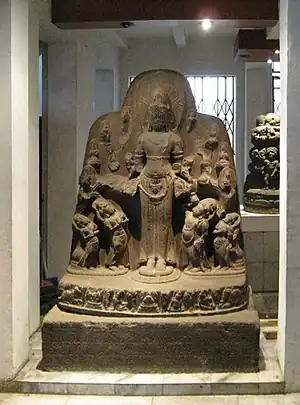
Budi Istiawan estimates that the inscription dates from before the reign of King Adityawarman. This is based on Adityawarman's historical background, who is equated with the son of Dara Petak, a noblewoman from the Malay Kingdom who is mentioned in the Pararaton book as being brought to Java by the Singhasari troops upon their return from the Pamalayu expedition.[26] Istiawan believes that Tumanggung Kudawira may have been a member of the expedition, who came to Sumatra before Adityawarman's time.[26]
Likewise, interpretations of the function of this inscription also vary. According to Istiawan, the Pagaruyung VI inscription can be interpreted as a form of appreciation or confirmation of authority for the services of Tumanggung Kudawira. Thus, this inscription likely functioned as an authoritative seal or stamp that marked the status or role of the officer.[14] In contrast, Arlo Griffiths argues that this inscription is not an official royal inscription. He noted that it does not contain the name of the king, the year, important events, or administrative information commonly found in official inscriptions of the Adityawarman kingdom. Therefore, Griffiths concludes that this inscription is more appropriately understood as a memorial or grave marker.[19]
Griffiths strengthens his argument by mentioning the existence of names with phonetic or structural similarities in a number of other inscriptions from the adjacent period and region. One example is a person named Biraparākramakuda in the Pagaruyung VII inscription (also called the Gudam II inscription) in Old Malay, which is now stored alongside the Pagaruyung VI inscription. In addition, the Padang Roco inscription inscribed on the base of the Amoghapāśa statue and dated 1286 CE also records the presence of a Javanese official named Rakryān Damuṅ Pu Vīra, who was part of the Singhasari diplomatic mission to Sumatra (dari Bhūmi Jāva ka Svarṇnabhūmi).[27]
Although the Padang Roco inscription dates to an earlier period—ranging from several decades to more than a century earlier—Griffiths suggests that the emergence of Old Javanese elements in West Sumatran inscriptions may reflect the possibility of a direct migration process from Java, or even a continuity of lineage among Javanese officials such as Rakryān Damuṅ Pu Vīra. He also emphasizes that this issue remains open for further study, and is part of his plan to write an epigraphic monograph on the Adityawarman inscriptions.[27]
Preservation effort
This inscription has been officially recognized as a National Cultural Heritage Site. The cultural heritage status was determined through Decree (SK) Number 77/M/2019, issued on March 12, 2019, by the Ministry of Education and Culture of the Republic of Indonesia. [28]
See also

Notes
- ↑ Experts generally perform transliteration based on the standards of the International Alphabet of Sanskrit Transliteration (IAST)
- ↑ The transliteration of the Pagaruyung VI inscription has been examined through two main approaches: diplomatic transliteration and critical transliteration. Diplomatic transliteration maintains a one-to-one correspondence between the original script and the Latin alphabet, preserving the orthographic characteristics of the source text. Critical transliteration, on the other hand, adapts the written forms to reflect the phonetic sounds of the language used.
References
- 1 2 Kusumadewi 2012, pp. 35–36.
- ↑ Kusumadewi 2012, p. 35.
- 1 2 Griffiths 2012, pp. 198–199.
- 1 2 3 4 5 6 7 8 Kozok 2015, p. 37.
- 1 2 3 BPCB Sumbar (30 December 2016). "Kompleks Prasasti Adityawarman" [Adityawarman Inscription Complex]. kebudayaan.kemdikbud.go.id. Balai Pelestarian Cagar Budaya Sumatera Barat, Direktorat Jenderal Kebudayaan Republik Indonesia. Retrieved 31 August 2018.
- ↑ Griffiths 2012, pp. 198–201.
- ↑ Krom 1912, p. 22.
- 1 2 Kusumadewi 2012, pp. 36, 102.
- ↑ Tjoa-Bonatz 2019, p. 43.
- 1 2 Krom 1912, p. 43.
- 1 2 Brandes & Krom 1913, p. 260.
- 1 2 3 "Prasasti Pagaruyung » Budaya Indonesia" [Pagaruyung Inscriptions » Indonesian Culture]. budaya-indonesia.org (in Indonesian). Retrieved 2025-08-17.
- ↑ Roza, Darwyta (29 November 2024). "Kompleks Prasasti Pagaruyung, Jejak Sejarah Adityawarman melalui 9 Prasasti Kuno". rri.co.id. Retrieved 19 August 2025.
- 1 2 3 4 5 Istiawan 2006, p. 17.
- ↑ Kusumadewi 2012, pp. 37, 102.
- ↑ Tjoa-Bonatz 2019, p. 50.
- ↑ Kusumadewi 2012.
- 1 2 Griffiths 2012, p. 199.
- 1 2 3 4 5 Griffiths 2012, pp. 200–201.
- 1 2 3 Poesponegoro, Marwati Djoened; Notosusanto, Nugroho (2008). Sejarah Nasional Indonesia Jilid 2: Zaman Kuno [Indonesian National History Volume 2: Ancient Times] (in Indonesian). Balai Pustaka. p. 367. ISBN 978-979-407-408-4. Archived from the original on 25 Nov 2025.
- 1 2 Ekawana, I Gusti Putu (1985). "Selembar Prasasti Raja Patih Kbo Parud" [A Sheet Inscription of King Patih Kbo Parud] (PDF). Pertemuan Ilmiah Arkeologi III (PIA III): Ciloto 23-28 Mei 1983 (in Indonesian). Proyek Penelitian Purbakala Jakarta, Departemen Pendidikan dan Kebudayaan: 513.
- 1 2 Miksic, John Norman; Yian, Goh Geok (2016). Ancient Southeast Asia. Routledge. ISBN 978-1-317-27903-7. Archived from the original on 25 Nov 2025.
- 1 2 Griffiths 2012, p. 200.
- ↑ Nur, Mhd.; Thaib, Puti Reno Raudha; Jamrah, Alfian; Arda, Fitra; Nurmatias; Undri (2016). Perjuangan Sultan Alam Bagagar Syah dalam Melawan Penjajah Belanda di Minangkabau pada Abad ke-19 [The Struggle of Sultan Alam Bagagar Syah in Fighting the Dutch Colonizers in Minangkabau in the 19th Century] (PDF) (in Indonesian). Padang: Balai Pelestarian Nilai Budaya Sumatera Barat. p. 25. ISBN 978-602-6554-04-8. Archived (PDF) from the original on 7 June 2023.
- 1 2 Kusumadewi 2012, p. 36.
- 1 2 Istiawan 2006, pp. 17–18.
- 1 2 Griffiths 2012, p. 201.
- ↑ "Daftar Cagar Budaya peringkat Nasional Tahun 2013-2022" (PDF) (in Indonesian). October 2022. Retrieved 2025-09-19.
Further reading
- Bonatz, Dominik; Miksic, John; Neidel, J. David (2009). From Distant Tales: Archaeology and Ethnohistory in the Highlands of Sumatra. Cambridge Scholars Publishing. p. 239. ISBN 9781443807845.
- Brandes, J.L.A.; Krom, N.J (1913). "Oud-Javaansche Oorkonden: Nagelaten Transscripties van wijlen Dr. J.L.A. Brandes, uitgegeven door Dr. N.J Krom" [Old Javanese Charters: Posthumous Transcriptions of the late Dr. J.L.A. Brandes, edited by Dr. N.J. Krom]. Verhandelingen van het Bataviaasch Genootschap van Kunsten en Wetenschappen (in Dutch). IX. Albrecht & Co. (Batavia); Martinus Nijhoff ('s-Gravenhage).
- Griffiths, Arlo (2012). "Inscriptions of Sumatra: II. Short Epigraphs in Old Javanese" (PDF). Wacana, Journal of the Humanities of Indonesia. 14 (2). Faculty of Humanities, University of Indonesia: 197–201. doi:10.17510/wjhi.v14i2.61 (inactive 1 January 2026).
{{cite journal}}: CS1 maint: DOI inactive as of January 2026 (link) - Istiawan, Budi (2006). Selintas Prasasti dari Melayu Kuno [A Glimpse of Ancient Malay Inscriptions] (PDF) (in Indonesian) (1 ed.). Balai Pelestarian Peninggalan Purbakala Batusangkar (Wilayah Kerja Provinsi Sumatera Barat dan Riau). pp. 39–40.
- Kozok, Uli (2015). A 14th Century Malay Code of Laws: The Nitisarasamuccaya. Institute of Southeast Asian Studies. p. 36. ISBN 9789814459747.
- Krom, Nicolaas Johannes (1912). "Inventaris de Oudheden in de Padangsche Bovenlanden" [Inventory of the Antiquities in the Padang Highlands]. Oudheidkundig Verslag (in Dutch). 49. Weltevreden: Bataviaasch Genootschap van Kunsten en Wetenschappen.
- Kusumadewi, Sri Ambarwati (2012). Adityawarman (1347-1374 Masehi): Kajian Epigrafi [Adityawarman (1347-1374 AD): Epigraphic Study] (PDF) (Thesis) (in Indonesian). Fakultas Ilmu Pengetahuan Budaya Universitas Indonesia.
- Miksic, John Norman; Yian, Goh Geok (2016). Ancient Southeast Asia. Routledge. ISBN 978-1-317-27903-7.
- Tjoa-Bonatz, Mai Lin (2019). A View from the Highlands: Archaeology and Settlement History of West Sumatra, Indonesia. ISEAS-Yusof Ishak Institute. ISBN 978-981-4843-02-7.