Paan Khaye Saiyan Hamaar (film)
| Paan Khaye Saiyan Hamaar | |
|---|---|
 | |
| Directed by | Sujit Kumar |
| Written by | Kiran Singh (story) Sujit Kumar (screenplay) Rahi Masoom Raza (dialogue) |
| Screenplay by | Sujit Kumar |
| Story by | Kiran Singh |
| Starring | Sujit Kumar Bandini Mishra |
| Music by | Naushad |
Production company | Shiv Bhakti Films |
Release date |
|
Running time | 159 minutes |
| Country | India |
| Language | Bhojpuri |
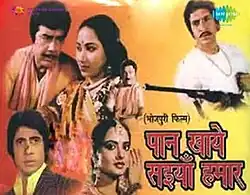
Paan Khaye Saiyan Paan Hamaar (Bhojpuri for My lover chews betel leaves) is a 1984 Bhojpuri language film directed by Sujit Kumar and produced under the banner of Shiv Bhakti Films. The film stars Sujit Kumar and Bandini Mishra in the lead roles, with S. N. Tripathi, Kumud Tripathi, Ranjeet, and Vinod Singh appearing in supporting parts. The screenplay was written by Sujit Kumar, with the story by Kiran Singh and dialogue by Rahi Masoom Raza. The film features a soundtrack composed by Naushad.
Paan Khaye Saiyan Paan Hamaar marked several notable firsts in Bhojpuri cinema. The film introduced Sujit Kumar—widely regarded as the first superstar of Bhojpuri films[1]—in his directorial debut. It also featured Bandini Mishra, previously known for supporting roles in Hindi language films,[2] in her first leading role in a Bhojpuri production. The story was written by Kiran Singh, spouse of Sujit Kumar, who made her debut as a story writer with the film. It was also the first Bhojpuri film to feature major Hindi film stars Amitabh Bachchan and Rekha in special appearances, marking an unprecedented crossover from mainstream Bollywood.[3] As in much of Indian cinema, Bhojpuri films place strong emphasis on song sequences, which significantly influence audience turnout and ancillary revenue.[4][5] Continuing this sequence of firsts, the film's soundtrack was composed by Naushad—described as a “legendary” music composer[6] and regarded as “one of India’s great music composers”[7]—who made his Bhojpuri film debut with this production.
Paan Khaye Saiyan Paan Hamaar has been classified as a “modestly popular” film of the Bhojpuri cinema in the 1980s.[8]
Plot
In a rural setting, the narrative centers on Bhola, an upright and courageous man admired for his loyalty and his skill in stick fighting. Bhola works in the service of Thakur Harpal Singh, to whom he has long been devoted. He is also in love with Lali, a paan (betel leaf) vendor, and the two eventually marry and begin building a modest life together.
The story shifts dramatically when Bhola requests the payment of his long overdue wages—eleven years’ worth of unpaid dues. Instead of settling the amount, Thakur Harpal Singh humiliates him and makes a predatory demand: he insists that Bhola send Lali to him as a justification for the money owed. Outraged by this violation of trust and dignity, Bhola attacks the Thakur. Seizing the opportunity, the Thakur and his political advisor devise a scheme to have Bhola arrested on fabricated charges, intending to remove him permanently.
While in prison, Bhola receives news that Lali is pregnant and that he is soon to become a father. This revelation tempers his anger and strengthens his resolve to complete his sentence peacefully so he can return to his family. However, Thakur Harpal Singh continues his campaign of malice from afar, spreading rumors of an illicit relationship with Lali. These falsehoods deepen Bhola's suffering, testing both his endurance and his faith as he struggles to reclaim his life and protect his family's honor.
Cast
- Sujit Kumar as Bhola
- Bandini Mishra as Lali
- S. N. Tripathi
- Kumud Tripathi
- Ranjeet as Thakur Harpal Singh
- Vinod Singh
- Hari Shukla
- Yunus Parvez
- Madhuri Mishra
- K. D. Singh
- Amitabh Bachchan as Nahar Singh in a special appearance
- Rekha as herself in a special appearance
Soundtrack
The film's soundtrack was composed by Naushad, with lyrics written by Ram Murti Chaturvedi.[9][10]
| No. | Title | Singer(s) |
|---|---|---|
| 1 | Dil Debe Na Hum | Asha Bhosle |
| 2 | Jaan Marat Ba Goriya | Asha Bhosle, Mahendra Kapoor |
| 3 | Jai Bajrang Bali | Manna Dey |
| 4 | Ham Ta Lut Gaili | Manna Dey |
| 5 | Sonvaan Dehiyan | Asha Bhosle |
References
- ↑ "Happy Birthday, Sujit Kumar! The first superstar of Bhojpuri films was first approached by THIS director". Times of India. 7 February 2022. Retrieved 26 April 2026.
- ↑ "Bandini Mishra". MySwar. Retrieved 26 April 2026.
- ↑ "Bollywood stars who ventured into Bhojpuri cinema". The Times of India. 9 May 2018. Retrieved 26 April 2026.
- ↑ "Indian Music Industry: Market Stats, Analysis, & 2020 Trends". Soundcharts. 15 March 2020. Retrieved 15 March 2026.
soundtracks still account for nearly 80% of all recording revenues in India
- ↑ "The changing shape of the Indian recorded music industry in the age of music streaming". South Asian Popular Culture. 2023. doi:10.1080/09584935.2023.2206998. Retrieved 15 March 2026.
- ↑ "Legendary composer Naushad is dead". The Economic Times. 6 May 2006. Retrieved 25 April 2026.
- ↑ "Veteran music composer Naushad passes away". The Times of India. 5 May 2006. Retrieved 25 April 2026.
- ↑ Abbi, Kumool (17 August 2013). "Politics of Linguistic, Cultural Recovery and Reassertion: Bhojpuri Migrant Population and Its Films". Economic and Political Weekly. 48 (33): 55. JSTOR 23528090. Retrieved 7 March 2026.
- ↑ "Paan Khaye Saiyan Hamar". Gaana. Retrieved 26 April 2026.
- ↑ "Paan Khaye Saiyan Hamar". Saregama. Retrieved 26 April 2026.