PF-06372222
 | |
| Clinical data | |
|---|---|
| ATC code |
|
| Identifiers | |
| |
| CAS Number | |
| PubChem CID | |
| IUPHAR/BPS | |
| ChemSpider | |
| ChEMBL | |
| PDB ligand | |
| Chemical and physical data | |
| Formula | C26H28F3N5O3 |
| Molar mass | 515.537 g·mol−1 |
| 3D model (JSmol) | |
| |
| |
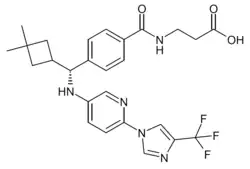
PF-06372222 is a drug which acts as a potent and selective allosteric antagonist of both the glucagon receptor and the glucagon-like peptide-1 receptor (GLP-1). It was originally developed as a potential treatment for diabetes but was unsuccessful, however it has subsequently been used as a pharmacological tool compound for the study of the GLP-1 receptor and led to the discovery of non-peptide GLP-1 agonists such as orforglipron.[1][2][3][4]
See also
References
- ↑ Guzman-Perez A, Pfefferkorn JA, Lee EC, Stevens BD, Aspnes GE, Bian J, et al. (15 May 2013). "The design and synthesis of a potent glucagon receptor antagonist with favorable physicochemical and pharmacokinetic properties as a candidate for the treatment of type 2 diabetes mellitus". Bioorganic & Medicinal Chemistry Letters. 23 (10): 3051–3058. doi:10.1016/j.bmcl.2013.03.014. PMID 23562063.
- ↑ Song G, Yang D, Wang Y, de Graaf C, Zhou Q, Jiang S, et al. (8 June 2017). "Human GLP-1 receptor transmembrane domain structure in complex with allosteric modulators". Nature. 546 (7657): 312–315. Bibcode:2017Natur.546..312S. doi:10.1038/nature22378. PMID 28514449.
- ↑ Wu F, Yang L, Hang K, Laursen M, Wu L, Han GW, et al. (9 March 2020). "Full-length human GLP-1 receptor structure without orthosteric ligands". Nature Communications. 11 (1) 1272. Bibcode:2020NatCo..11.1272W. doi:10.1038/s41467-020-14934-5. PMC 7062719. PMID 32152292.
{{cite journal}}: CS1 maint: unflagged free DOI (link) - ↑ Kawai T, Sun B, Yoshino H, Feng D, Suzuki Y, Fukazawa M, et al. (24 November 2020). "Structural basis for GLP-1 receptor activation by LY3502970, an orally active nonpeptide agonist". Proceedings of the National Academy of Sciences of the United States of America. 117 (47): 29959–29967. Bibcode:2020PNAS..11729959K. doi:10.1073/pnas.2014879117. PMC 7703558. PMID 33177239.