Outline of British Rail


British Rail (British Railways before 1965[1][2]) was the state-owned company responsible for rail transport in Great Britain from its inception in 1948 to its privatisation in the 1990s, with the organisation officially becoming defunct in 1997.[3][‡ 1] From its creation until 1952, it was the trade name of the Railway Executive, the subsidiary of the British Transport Commission (BTC) responsible for railway operations.[4][‡ 2] The Railway Executive was then abolished in order for British Railways to fall directly under the BTC. After the Transport Act 1962, it became an independent statutory corporation when the BTC was replaced by a new organisation whose official name was the British Railways Board.[5][6][7][‡ 3]
British Rail came about after the economic damage of World War II ended the viability of the Big Four system, which had begun in 1923 with the consolidation of hundreds of companies, most of which were unprofitable.[8] By the passing of the Transport Act 1947, nationalisation was widely supported.[9][10] The early years of British Railways were marred by poor decision making, a lack of standardisation, and misdiagnosis of the root problems with the railway system. The regions of British Railways remained separate with individual corporate identities,[6][11] and high-speed train travel was limited to luxury Pullman trains.[12] The 1955 Modernisation Plan, an effort by British Railways to invest and set a path forward, was ultimately a failure, and did little to change the gradual decline of the railway system. The last year the company made a profit was 1955.[13][14][※ 1]
With the appointment of Ernest Marples as Minister for Transport began a gradual and targeted curtailment of the railway system in favour of road travel. The supposedly-independent Stedeford Committee served to justify this plan, and the British Transport Commission was abolished and replaced with the British Railways Board around the time that Richard Beeching, a member of the committee, was appointed to chair the organisation.[5][6][15] His 1961 report, titled "The Reshaping of British Railways", was the defining moment of this campaign; its plan to end one third of all passenger services and close more than 4,000 of the total 7,000 stations was largely enacted throughout the 1960s.[16][※ 2][※ 3] However, his time as chairman also saw the renaming of British Railways to British Rail, and the introduction of a single corporate identity, including, the Double Arrow logo; these design changes are widely seen a positive move in the direction of the organisation.[17]
Throughout the rest of the 1960s and 1970s, some further rationalisation was allowed by successive transport ministers, but further attempts for Beeching-like reductions in service were met with outcry from the press and public.[18] Even during Margaret Thatcher's premiership, which saw swathes of austere cuts and privatisation, the core model of British Rail was maintained, with only its inherited ancillary services sold off.[19] Around this time, limited railway electrification and upgrades had been progressing around the country, and although subsidiary train manufacturer British Rail Engineering Limited's work on the Advanced Passenger Train was to no avail, it influenced successful future successful designs.[20][21]
From 1982, sectorisation split British Rail into three passenger corporate identities: InterCity, Network SouthEast, and Regional Railways. Although InterCity showed it was able to make a surplus,[6][22] John Major ultimately chose to privatise the railways through the Railways Act 1993, resulting in the dissolution of British Rail by 1997.[23][‡ 1] The impact of this is frequently discussed, and is intended to be at least partially reversed by the incumbent government through their creation of Great British Railways.[24][25][26]
General
- Main article: British Rail
- Overview of history:
History
Preceding

- History of rail transport in Great Britain 1923–1947
- The Big Four – the four British railway companies who preceded British Rail:[8]
1940s
1950s and 1960s

- The Modernisation Plan (1955[27][※ 1])
- Stedeford Committee – supposedly independent committee used by Ernest Marples to justify his anti-rail measures[28][6]
- The Beeching Reports (1961[※ 2][※ 3] and 1965[29][※ 4])
- Beeching cuts
- British Rail § 1955–1960: The Modernisation Plan
- British Rail § 1961–1965: The Beeching era
- History of rail transport in Great Britain 1948–1994 § The 1950s: Modernisation
- History of rail transport in Great Britain 1948–1994 § The 1960s: Rationalisation
1970s and 1980s

- Serpell Report (1982[※ 5] and 1983[※ 6]) – anti-rail report, more extreme than Beeching's, which was by Margaret Thatcher shelved after huge backlash[30][31]
- Sectorisation
- InterCity (originally Inter-City)
- Network SouthEast (originally London and South Eastern)
- Regional Railways (originally Provincial)
- British Rail § 1966–1982: Effects of the Beeching Cuts
- British Rail § 1982–1991: Sectorisation
- History of rail transport in Great Britain 1948–1994 § The 1970s: HST and APT
- History of rail transport in Great Britain 1948–1994 § The 1980s: Sectorisation
1990s

- History of rail transport in Great Britain 1995 to date
- Privatisation of British Rail
- Impact of the privatisation of British Rail
- Great British Railways – the planned state body to replace the system of privatisation[32]
- DfT Operator – rail holding company who has partially replaced franchises as a precursor to the creation of Great British Railways[33]
- British Rail § 1992–1997: Privatisation
- History of rail transport in Great Britain 1948–1994 § The 1990s: Privatisation
Structure
Regional structure
- Southern Region – former Southern Railway lines.
- Western Region – former Great Western Railway lines.
- London Midland Region – former London, Midland and Scottish Railway lines in England and Wales.
- Eastern Region – former London and North Eastern Railway lines south of York.
- Anglia Region – split from Eastern Region in 1988.
- North Eastern Region – former London and North Eastern Railway lines in England north of York.
- Scottish Region – all lines, regardless of the original company, in Scotland.
Sectorisation
- InterCity – express services
- InterCity Sleeper – night train services
- Gatwick Express – express service to/from Gatwick Airport
- Network SouthEast – London commuter services
- Stansted Express – express service to/from Stansted Airport
- Regional Railways – regional services
- Alphaline – enhanced regional express passenger services, added in 1994
- ScotRail – regional and sub-intercity services in Scotland
- TransPennine Express – sub-intercity services in the North
- Railfreight responsible for all freight operations, later subdivided into train operations
- Trainload Freight – trainload freight
- Railfreight Distribution – non-trainload freight
- Speedlink a wagonload freight service utilising air-braked wagons
- Freightliner – intermodal traffic
- Rail Express Systems – parcels traffic
Classification and numbering schemes
Subsidiaries
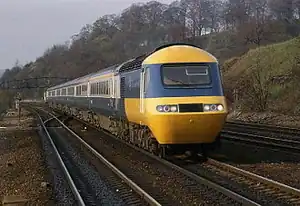

- British Rail Engineering Limited (BREL) – replaced British Rail's own Workshops Division, and responsible for design and manufacture of train sets (1969–1989)[35][36]
- British Railways ships
- British Transport Commission Police, later the British Transport Police
- Travellers-Fare – on-train catering brand from the 1970s[38]
- British Transport Hotels – operated hotels at train stations[39]
Branding and media
- British Rail § Branding and media
- British Rail brand names
- British Rail corporate liveries
- British Transport Films
- Advertisements:
- Night Mail (advert) – 1988 television advert
- The Age of the Train – 1970s advertising campaign
- Unified corporate identity
- British Rail Double Arrow
- Rail Alphabet – sans-serif typeface designed to increase readability[40]
- British Rail corporate liveries § Rail Blue
- Design Research Unit – responsible for the Double Arrow and change of trade name[41]
Rolling stock
- Locomotives by time period:
- List of British Rail classes
- List of British Rail departmental multiple unit classes
- List of British Rail diesel multiple unit classes
- List of British Rail electric multiple unit classes
- List of British Rail modern traction locomotive classes
- List of preserved British Rail diesel locomotives
- List of British Rail unbuilt locomotive classes
- Rolling stock storage and maintenance
Acts of parliament
This is a list of all acts of parliament between 1921 and 1994 that relate to the creation, running, or privatisation of British Rail, its subsidiaries, or its executives.[42]
Preceding
- Railways Act 1921 – reduced all railway companies to the 'Big Four'.[8][‡ 4]
- London Passenger Transport Act 1933 – created the London Passenger Transport Board as a separate transport authority for London[‡ 5]
During
- Transport Act 1947 – nationalised rail services into British Rail[‡ 2]
- Transport Act 1953 – dissolved the Railway Executive[‡ 6]
- Transport Act 1962 – dissolved the British Transport Commission in preference of five new bodies[‡ 3]
- British Railways Act 1966 – gave British Rail greater power to acquire land[‡ 7]
- Transport Act 1968 – created the public service obligation grant and passenger transport executives[‡ 8]
- Railways Act 1974 – executed amendments to railway legislation made necessary by the United Kingdom's accession to the European Union[‡ 9]
- Transport Act 1962 (Amendment) Act 1981 – allowed British Rail to discontinue experimental services more easily[‡ 10]
- Transport Act 1981 – an act primarily known for introducing compulsory seatbelts, but which also contained minor railway-related amendments such as in relation to railway fire safety.[‡ 11]
- Transport (Finance) Act 1982 – legislated the United Kingdom's membership in the European Company for the Financing of Railroad Rolling Stock (EUROFIMA)[‡ 12]
- Level Crossings Act 1983 – updated the necessary features and responsibilities in relation to level crossings[‡ 13]
- Channel Tunnel Act 1987 – permitted the construction of the Channel Tunnel[‡ 14]
- Transport and Works Act 1992 – ended the need for a private bill in order to construct a new section of line[‡ 15]
Succeeding
- British Coal and British Rail (Transfer Proposals) Act 1993 – gave the government the power to sell parts of British Rail into the private sector[‡ 16]
- Railways Act 1993 – set out the full privatisation of British Rail[‡ 1]
- British Railways Act 1994 – increased the powers of British Rail to acquire land[‡ 17]
Personnel
Transport ministers
As a secretary of state:[43]
- Alfred Barnes (1945–1951)
- John Maclay (1951–1952)
- Alan Lennox-Boyd (1952–1953)
- John Boyd-Carpenter (1954–1955)
- Harold Watkinson (1955–1959)
- Ernest Marples (1959–1964)
- Tom Fraser (1964–1965)
- Barbara Castle (1965–1968)
- Richard Marsh (1968–1969)
- Fred Mulley (1969–1970)
- John Peyton (1970)
As a junior minister:
- John Peyton (1970–1974)[44]
- Fred Mulley (1974–1975)[45]
- John Gilbert (1975–1976)[46]
As a secretary of state:[47]
- Bill Rodgers (1976–1979)
- Norman Fowler (1979–1981)
- David Howell (1981–1983)
- Tom King (1983)
- Nicholas Ridley (1983–1986)
- John Moore (1986–1987)
- Paul Channon (1987–1989)
- Cecil Parkinson (1989–1990)
- Malcolm Rifkind (1990–1992)
- John MacGregor (1992–1994)
- Brian Mawhinney (1994–1995)
- Sir George Young, 6th Baronet (1995–1997)


Timeline
Board chairmen
Chairmen of the Railway Executive:[49]
- Sir Eustace Missenden (1948–1951)
- Sir John Elliot (1951–1953)
Chairmen of the British Transport Commission:[50]
- Sir Cyril Hurcomb (1948–1953)
- Sir Brian Robertson (1953–1961)
- Dr Richard Beeching (1961–1963)
Chairmen of the British Railways Board:
- Dr Richard Beeching (1963–1965)[51]
- Sir Stanley Raymond (1965–1967)[51]
- Sir Henry Johnson (1967–1971)[51]
- Sir Richard Marsh (1971–1976)[52]
- Sir Peter Parker (1976–1983)[51][52]
- Sir Robert Reid (1983–1990)[52]
- Sir Bob Reid (1990–1995)[53]
- John Welsby (1995–1999)[54][55]


Timeline
Accidents and incidents
- List of accidents on British Rail
- List of rail accidents in the United Kingdom § 1948–1994: British Railways/Rail
Individual accidents and incidents
- Barnes (1955)[※ 7]
- Castlecary (1968)[※ 8]
- Colwich (1986)[※ 9]
- Coppenhall Junction (1962)[※ 10]
- Dagenham East (1958)[※ 11]
- Doncaster (1951)[※ 12]
- Ealing (1973)[※ 13]
- Eastbourne (1958)[※ 14]
- Eccles (1984)[※ 15]
- Eltham Well Hall (1972)[※ 16]
- Glanrhyd Bridge (1987)[※ 17]
- Harrow and Wealdstone (1952)[※ 18]
- Hither Green (1967)[56]
- Hixon (1968)[※ 19]
- Invergowrie (1979)[※ 20]
- Irk Valley Junction (1953)[※ 21]
- Knowle and Dorridge (1963)[※ 22]
- Lewisham (1957)[※ 23]
- Lockington (1986)[※ 24]
- Milton (1955)[※ 25]
- Nuneaton (1975)[※ 26]
- Penmanshiel Tunnel (1979)[※ 27]
- Polmont (1984)[※ 28]
- Morpeth (1969,[※ 29] 1984[※ 30])
- Severn Tunnel (1991)[※ 31]
- Stechford (1967)[※ 32]
- Summit Tunnel (1984)[※ 33]
- Sutton Coldfield (1955)[57]
- Thirsk (1967)[※ 34]
- Weedon (1951)[58]
- Welwyn Garden City (1957)[※ 35]
- Winsford (1948)[59]


Successor companies
Passenger transport
The original passenger franchisees that succeeded British Rail were:[60]
- Anglia Railways
- Arriva Trains Merseyside
- Arriva Trains Northern
- Central Trains
- Chiltern Railways
- Connex South Central
- Connex South Eastern
- c2c
- First Great Eastern
- First Great Western
- First North Western
- Gatwick Express
- GNER
- Island Line
- Midland Mainline
- ScotRail
- Silverlink
- South West Trains
- Thames Trains
- Thameslink
- Valley Lines
- Virgin CrossCountry
- Virgin Trains West Coast
- WAGN
- Wales & West
Freight and parcels
- Trainload Freight was originally intended to be sold as three separate regional entities, but all were bought by North and South Railways (NSR), which then became English Welsh and Scottish Railway (EWS)[61]
- Railfreight Distribution was split into Freightliner, which remained an independent company, and "Channel Tunnel", which was then sold to EWS in March 1997.[61]
- Rail Express Systems (parcels) was sold to NSR in December 1995[61]
On 28 June 2007, Deutsche Bahn announced it had agreed to purchase EWS, and so it became DB Cargo UK.[62][63]
Other
- Railtrack – infrastructure and stations[64][65]
- Waterloo & City line – became part of the London Underground in April 1994.[66]
- BRB (Residuary) Limited – all other responsibilities of the BRB not released elsewhere[67]
Image and legacy
- The wrong type of snow – a phrase used by British Rail to explain its service quality during one particular period of snow, which has become a general term for poor or lazy excuses.[68]
- British Rail sandwich – often cited as the epitome of the perceived poor quality and hospitality of British Rail[69]
Other
Primary sources
Legislation
References to legislation are represented with a double dagger (‡).
- 1 2 3 "Railways Act 1993". Her Majesty's Government; Her Majesty's Stationery Office. 5 November 1993. Archived from the original on 22 July 2026. Retrieved 29 July 2026 – via The Railways Archive.
- 1 2 "Transport Act 1947". His Majesty's Government; His Majesty's Stationery Office. 6 August 1947. Archived from the original on 27 February 2026. Retrieved 29 July 2026 – via The Railways Archive.
- 1 2 "Transport Act 1962". Her Majesty's Government; Her Majesty's Stationery Office. 1 August 1962. Archived from the original on 22 July 2026. Retrieved 29 July 2026 – via The Railways Archive.
- ↑ "Railways Act 1921". His Majesty's Government; His Majesty's Stationery Office. 19 August 1921. Archived from the original on 5 March 2026. Retrieved 29 July 2026 – via The Railways Archive.
- ↑ "London Passenger Transport Act 1933". His Majesty's Government; His Majesty's Stationery Office. 13 April 1933. Archived from the original on 29 November 2022. Retrieved 29 July 2026 – via The Railways Archive.
- ↑ "Transport Act 1953". Her Majesty's Government; Her Majesty's Stationery Office. 6 May 1953. Archived from the original on 22 July 2026. Retrieved 29 July 2026 – via The Railways Archive.
- ↑ "British Railways Act". Her Majesty's Government; Her Majesty's Stationery Office. 3 August 1966. Archived from the original on 29 June 2013. Retrieved 29 July 2026 – via The Railways Archive.
- ↑ "Transport Act 1968". Her Majesty's Government; Her Majesty's Stationery Office. 25 October 1968. Archived from the original on 6 December 2025. Retrieved 29 July 2026 – via The Railways Archive.
- ↑ "Railways Act 1974". Her Majesty's Government; Her Majesty's Stationery Office. 31 July 1974. Archived from the original on 29 June 2013. Retrieved 29 July 2026 – via The Railways Archive.
- ↑ "Transport Act 1962 (Amendment) Act 1981". Her Majesty's Government; Her Majesty's Stationery Office. 2 July 1981. Archived from the original on 22 July 2026. Retrieved 29 July 2026 – via The Railways Archive.
- ↑ "Transport Act 1981". Her Majesty's Government; Her Majesty's Stationery Office. 31 July 1981. Archived from the original on 22 July 2026. Retrieved 29 July 2026 – via The Railways Archive.
- ↑ "Transport (Finance) Act 1982". Her Majesty's Government; Her Majesty's Stationery Office. 25 February 1982. Archived from the original on 29 June 2013. Retrieved 29 July 2026 – via The Railways Archive.
- ↑ "Level Crossings Act 1983". Her Majesty's Government; Her Majesty's Government. 9 May 1983. Archived from the original on 19 January 2026. Retrieved 29 July 2026 – via The Railways Archive.
- ↑ "Channel Tunnel Act 1987". Her Majesty's Government; Her Majesty's Stationery Office. 23 July 1987. Archived from the original on 29 June 2013. Retrieved 29 July 2026 – via The Railways Archive.
- ↑ "Transport and Works Act 1992". Her Majesty's Government; Her Majesty's Stationery Office. 1992. Archived from the original on 30 June 2013. Retrieved 29 July 2026 – via The Railways Archive.
- ↑ "British Coal and British Rail (Transfer Proposals) Act 1993". Her Majesty's Government; Her Majesty's Government. 19 January 1993. Archived from the original on 16 April 2024. Retrieved 29 July 2026 – via The Railways Archive.
- ↑ "British Railways Act 1994". Her Majesty's Government; Her Majesty's Stationery Office. 31 March 1994. Archived from the original on 22 July 2026. Retrieved 29 July 2026 – via The Railways Archive.
Reports
References to official reports, including accident reports, are represented with a reference mark (※).
- 1 2 "Modernisation and Re-Equipment of British Rail". British Transport Commission. 1955. Archived from the original on 31 October 2006. Retrieved 22 July 2026 – via The Railways Archive.
- 1 2 "The Reshaping of British Railways – Part 1: Report". British Transport Commission; Her Majesty's Stationery Office. 1963. Retrieved 22 July 2026 – via The Railways Archive.
- 1 2 "The Reshaping of British Railways—Part 2: Maps". British Transport Commission; Her Majesty's Stationery Office. 1963. Archived from the original on 26 October 2006. Retrieved 25 November 2006 – via The Railways Archive.
- ↑ "The Development Of The Major Railway Trunk Routes". British Railways Board. February 1965. Archived from the original on 18 April 2012. Retrieved 27 March 2012 – via The Railways Archive.
- ↑ Serpell, Sir David (December 1982). "Railway Finances – Report of a Committee chaired by Sir David Serpell KCB CMG OBE". Her Majesty's Stationery Office. Archived from the original on 7 March 2025. Retrieved 23 July 2026 – via The Railways Archive.
- ↑ Serpell, Sir David (April 1983). "Serpell Committee Report on the Review of Railway Finances: Second Report from the Transport Committee". Her Majesty's Stationery Office. Archived from the original on 29 June 2013. Retrieved 23 July 2026 – via The Railways Archive.
- ↑ Wilson, Lieut. Col. G. R. S. (27 June 1956). "Report on the Collision which occurred on 2nd December 1955 near Barnes Station on the Southern Region British Railways". Ministry of Transport. Archived from the original on 29 June 2013. Retrieved 29 July 2026 – via The Railways Archive.
- ↑ McNaughton, Lieut. Col. I. K. A. (30 December 1969). "Report on the Collision that occurred on 9th September 1968 at Castlecary in the Scottish Region British Railways". Ministry of Transport. Archived from the original on 6 October 2025. Retrieved 29 July 2026 – via The Railways Archive.
- ↑ Olver, Major P. M. (29 February 1988). "Report on the Collision that occurred on 19th September 1986 at Colwich Junction in the London Midland Region of British Railways". Department of Transport. Archived from the original on 7 June 2026. Retrieved 29 July 2026 – via The Railways Archive.
- ↑ McMullen, Col. D. (11 June 1963). "Report on the Collision that occurred on 26th December 1962 between Winsford Station and Coppenhall Junction, Winsford in the London Midland Region British Railways". Ministry of Transport. Archived from the original on 29 June 2013. Retrieved 29 July 2026 – via The Railways Archive.
- ↑ Langley, Brigadier C. A. (16 June 1958). "Report on the Collision which occurred on 30th January 1958 at Dagenham East Station in the Eastern Region British Railways". Ministry of Transport. Archived from the original on 16 December 2024. Retrieved 29 July 2026 – via The Railways Archive.
- ↑ Wilson, Lieut. Col. G. R. S. (1 October 1951). "Report on the Derailment which occurred on 16th March 1951 at Bridge Junction, Doncaster in the Eastern Region British Railways". Ministry of Transport. Archived from the original on 29 June 2013. Retrieved 29 July 2026 – via The Railways Archive.
- ↑ McNaughton, Lieut. Col. I. K. A. (13 September 1974). "Report on the Derailment that occurred on 19th December 1973 near West Ealing in the Western Region British Railways". Department of the Environment. Archived from the original on 4 August 2024. Retrieved 29 July 2026 – via The Railways Archive.
- ↑ Reed, Col W. P. (16 January 1959). "Report on the Collision which occurred on 25th August 1958 at Eastbourne Station in the Southern Region British Railways". Ministry of Transport. Archived from the original on 6 December 2025. Retrieved 29 July 2026 – via The Railways Archive.
- ↑ "Railway Accident: Report on the Collision that occurred on 7th December 1984 at Eccles". Department of Transport; Her Majesty's Stationery Office. 10 June 1985. Archived from the original on 6 December 2025. Retrieved 29 July 2026 – via The Railways Archive.
- ↑ Robertson, Col. J. R. H. (1 June 1973). "Report on the Derailment that occurred on 11th June 1972 at Eltham (Well Hall) Station in the Southern Region British Railways". Department of the Environment. Archived from the original on 15 March 2026. Retrieved 29 July 2026 – via The Railways Archive.
- ↑ Cooksey, A (31 January 1990). "Report on the Collapse of Glanrhyd Bridge on 19th October 1987 in the Western Region of British Railways". Department of Transport. Archived from the original on 13 June 2025. Retrieved 29 July 2026 – via The Railways Archive.
- ↑ Wilson, Lieut. Col. G. R. S. (12 June 1953). "Report On The Double Collision Which Occurred On 8th October 1952 At Harrow And Wealdstone Station In The London Midland Region British Railways". Ministry of Transport. Archived from the original on 10 February 2026. Retrieved 29 July 2026 – via The Railways Archive.
- ↑ "Report of the Public Inquiry into the Accident at Hixon Level Crossing on January sixth, 1968". Ministry of Transport; Her Majesty's Stationery Office. 1 July 1968. Archived from the original on 19 November 2025. Retrieved 29 July 2026 – via The Railways Archive.
- ↑ Rose, Major C. F. (16 January 1981). "Report on the Collision that occurred on 22nd October 1979 at Invergowrie in the Scottish Region British Railways". Department of Transport. Archived from the original on 27 November 2024. Retrieved 29 July 2026 – via The Railways Archive.
- ↑ McMullen, Col. D. (12 October 1953). "Report on the Collision that occurred on 15th August 1953 at Irk Valley Junction, near Manchester (Victoria) in the London Midland Region British Railways". Ministry of Transport. Archived from the original on 29 June 2013. Retrieved 29 July 2026 – via The Railways Archive.
- ↑ McMullen, Col. D. (19 February 1964). "Report on the Collision that occurred on 15th August 1963 at Knowle and Dorridge (now Dorridge) in the London Midland Region British Railways". Ministry of Transport. Archived from the original on 21 February 2025. Retrieved 29 July 2026 – via The Railways Archive.
- ↑ Langley, Brigadier C. A. (15 June 1958). "Report On The Collision That Occurred On 4th December, 1957 Near Lewisham In The Southern Region British Railways". Her Majesty's Stationery Office. Archived from the original on 3 January 2023. Retrieved 29 July 2026 – via The Railways Archive.
- ↑ King, Maj. A. B. G. (21 August 1987). "Report on the Derailment that occurred on 26th July 1986 at Lockington Level Crossing in the Eastern Region British Railways". Department of Transport. Archived from the original on 13 September 2025. Retrieved 29 July 2026 – via The Railways Archive.
- ↑ Langley, Brigadier C. A. (26 March 1956). "Report on the Derailment which occurred on 20th November 1955 at Milton (near Didcot) in the Western Region British Railways". Ministry of Transport. Archived from the original on 8 October 2025. Retrieved 29 July 2026 – via The Railways Archive.
- ↑ Rose, Major C. F. (27 September 1976). "Report on the Derailment that occurred on 6th June 1975 at Nuneaton Trent Valley in the London Midland Region British Railways". Department of Transport. Archived from the original on 9 June 2025. Retrieved 29 July 2026 – via The Railways Archive.
- ↑ McNaughton, Lieut. Col. I. K. A. (2 August 1983). "Report on the Collapse of Penmanshiel Tunnel that occurred on 17th March 1979 in the Scottish Region British Railways". Department of Transport. Archived from the original on 26 May 2024. Retrieved 29 July 2026 – via The Railways Archive.
- ↑ King, Maj. A. B. G. (7 February 1985). "Report on the Derailment that occurred on 30th July 1984 near Polmont in the Scottish Region British Railways". Department of Transport. Archived from the original on 16 December 2025. Retrieved 29 July 2026 – via The Railways Archive.
- ↑ Robertson, Col. J. R. H. (12 December 1972). "Report on the Derailment that occurred on 7th May 1969 at Morpeth in the Eastern Region British Railways". Department of the Environment. Archived from the original on 7 February 2026. Retrieved 29 July 2026 – via The Railways Archive.
- ↑ "Railway Accident: Report on the Derailment that occurred on 24th June 1984 at Morpeth". Department of Transport; Her Majesty's Stationery Office. 11 September 1985. Archived from the original on 6 January 2026. Retrieved 29 July 2026 – via The Railways Archive.
- ↑ "Railway Accident in the Severn Tunnel: A Report on a Collision that occurred on 7 December 1991". Her Majesty's Railway Inspectorate; Health and Safety Executive. 3 November 1993. Archived from the original on 26 January 2025. Retrieved 29 July 2026 – via The Railways Archive.
- ↑ McMullen, Col. D. (8 December 1967). "Railway Accident: Report on the Collision that occurred on 28th February 1967 at Stechford". Her Majesty's Stationery Office. Archived from the original on 23 January 2025. Retrieved 29 July 2026 – via The Railways Archive.
- ↑ Sawer, D. A. (4 June 1986). "Railway Accident: Report on the Derailment and Fire that occurred on 20th December 1984 at Summit Tunnel, Littleborough". Her Majesty's Stationery Office. Archived from the original on 18 June 2023. Retrieved 29 July 2026 – via The Railways Archive.
- ↑ "Railway Accident: Report on the Derailment and subsequent Collision that occurred on 31st July, 1967, at Thirsk". Ministry of Transport; Her Majesty's Stationery Office. 5 September 1968. Archived from the original on 4 April 2015. Retrieved 29 July 2026 – via The Railways Archive.
- ↑ Wilson, Lieut. Col. G. R. S. (21 June 1957). "Report on the Collision which occurred on 7th January 1957 near Welwyn Garden City Station in the Eastern Region British Railways". Ministry of Transport. Archived from the original on 21 November 2025. Retrieved 29 July 2026 – via The Railways Archive.
Secondary sources
Citations
- ↑ Jackson 2013, "6: In Search of an Identity".
- ↑ Height & Cresswell 1979.
- ↑ Butcher, Louise (18 March 2010). "Railways: privatisation, 1987–1996" (PDF). House of Commons Library.
- ↑ Wolmar 2022, p. 17–18.
- 1 2 "Back to Beeching". BBC Radio 4. 27 February 2010. Archived from the original on 3 October 2009.
- 1 2 3 4 5 Jackson 2013, "2: Some Sort of an Organisation".
- ↑ Wolmar 2022, p. 81–82.
- 1 2 3 Acworth, W. M. (1923). "Grouping Under the Railways Act, 1921". The Economic Journal. 33 (129): 19–38. doi:10.2307/2222914. ISSN 0013-0133. JSTOR 2222914.
- ↑ Wolmar 2022, p. 19–20.
- ↑ Jackson 2013, "1: Towards National Integration".
- ↑ Wolmar 2022, p. 20–25.
- ↑ Wolmar 2022, p. 35–36, 51.
- ↑ Gourvish & Blake 1986, p. 286–290.
- ↑ Wolmar 2022, p. 56, 65.
- ↑ Wolmar 2022, p. 75–76, 79–82.
- ↑ Wolmar 2022, p. 86.
- ↑ Wolmar 2022, p. 12–16, 109–110.
- ↑ Wolmar 2022, p. 129–132, 136–138, 142–143.
- ↑ Wolmar 2022, p. 150–152, 225–226.
- ↑ "British Rail Engineering Limited formed". Railway Gazette. 5 December 1969. p. 882.
- ↑ Wolmar 2022, p. 171–174.
- ↑ Thomas, David St John; Whitehouse, Patrick (1990). BR in the Eighties. Newton Abbot: David & Charles. ISBN 978-0-7153-9854-8. OCLC 21292984. OL 11253354M. Wikidata Q112224535.
- ↑ Wolmar 2022, p. xi.
- ↑ Smith, Kevin (20 May 2021). "British government announces plans for major railway sector reform". International Railway Journal.
- ↑ Alexander, Heidi (4 December 2024). "First train services to return to public ownership revealed". UK Government (Press release). Department for Transport. Retrieved 4 December 2024.
- ↑ Wolmar 2022, p. xvii.
- ↑ Wolmar 2022, p. 59–61.
- ↑ Wolmar 2022, p. 79–82.
- ↑ "The Second Stage of Dr. Beeching's Reorganisation Proposals". The Times. 17 February 1965. p. 8.
- ↑ Rogers, Roy (21 January 1983). "Hostile reception for Serpell options". The Glasgow Herald. Retrieved 15 February 2017.
- ↑ Wolmar 2022, p. 150–152.
- ↑ "Branding and logo for Great British Railways unveiled". BBC News. BBC. 8 December 2025. Retrieved 8 December 2025.
- ↑ "About us". GOV.UK. DfT OLR Holdings.
- ↑ "InterCity Swallow". STEAM – Museum of the Great Western Railway. March 2025. Retrieved 2026-07-22.
- ↑ "British Rail Engineering Ltd". Science Museum Group. Retrieved 23 February 2020.
- ↑ "Buyer for BREL". The Railway Magazine. No. 1955. March 1989. p. 143.
- ↑ "Sealink". Science Museum Group. Archived from the original on 2025-05-27. Retrieved 2026-05-29.
- ↑ "How British Rail limited the butter on its sandwiches, and other Station Stories". National Railway Museum blog. 23 November 2012. Retrieved 19 September 2025.
- ↑ Carter, Oliver (1990). An illustrated history of British Railway Hotels: 1838-1983. St Michael's: Silver Link Publishing. ISBN 0-947971-36-X.
- ↑ Wolmar 2022, p. 110.
- ↑ McGuirk, Justin (12 October 2010). "Design Research Unit: the firm that branded Britain". The Guardian. Archived from the original on 30 November 2022.
- ↑ "Document Archive – Primary Legislation 1921–1997". The Railways Archive. Retrieved 22 July 2026.
- ↑ "Minister of Transport (Hansard)". api.parliament.uk. Retrieved 2026-05-31.
- ↑ "Lord Peyton of Yeovil". UK Parliament. Retrieved 30 December 2021.
- ↑ "Lord Mulley". UK Parliament. Retrieved 30 December 2021.
- ↑ "Lord Gilbert". UK Parliament. Retrieved 30 December 2021.
- ↑ "Secretary of State for Transport (Hansard)". api.parliament.uk. Retrieved 2026-05-31.
- ↑ Wolmar 2022, p. 132.
- ↑ "Railway Executive". Science Museum Group. Retrieved 22 July 2026.
- ↑ "British Transport Commission". Science Museum Group. Archived from the original on 2023-12-27. Retrieved 22 July 2026.
- 1 2 3 4 "British Railways Board". Science Museum Group. Retrieved 22 July 2026.
- 1 2 3 Terry Pattinson (18 December 1993). "Obituary: Sir Robert Reid". The Independent. Archived from the original on 26 May 2022.
- ↑ Adeney, Martin (30 May 2025). "Sir Bob Reid obituary". The Guardian. Retrieved 18 June 2025.
- ↑ Wolmar, Christian (7 March 1995). "Last chairman of BR appointed". The Independent. Retrieved 22 July 2026.
- ↑ "John K. Welsby (1941–2021)". Science Museum Group. Retrieved 22 July 2026.
- ↑ "Report On The Derailment That Occurred On 5th November, 1967 Near Hither Green In The Southern Region British Railways". Ministry of Transport. 8 August 1968. Archived from the original on 17 February 2026. Retrieved 29 July 2026 – via The Railways Archive.
- ↑ Wilson, Lieut. Col. G. R. S. (10 June 1955). "Report on the Derailment which occurred on 23rd January 1955 at Sutton Coldfield in the London Midland Region British Railways". Ministry of Transport. Archived from the original on 6 December 2025. Retrieved 29 July 2026 – via The Railways Archive.
- ↑ Wilson, Lieut. Col. G. R. S. (19 March 1952). "Report on the Derailment which occurred on 21st September 1951 near Weedon in the London Midland Region British Railways". Ministry of Transport. Archived from the original on 29 June 2013. Retrieved 29 July 2026 – via The Railways Archive.
- ↑ Wilson, Lieut. Col. G. R. S. (30 July 1948). "Report on the Collision which occurred on the 17th April, 1948, at Winsford in the London Midland Region British Railways". Ministry of Transport. Archived from the original on 6 December 2025. Retrieved 29 July 2026 – via The Railways Archive.
- ↑ "The Great British Rail Sale is Over". The Railway Magazine. No. 1152. April 1997. pp. 24, 25.
- 1 2 3 Butcher, Louise (18 March 2010). "Railways: privatisation, 1987–1996" (PDF). House of Commons Library. p. 12.
- ↑ "Transport Committee – Written evidence from DB Schenker". Parliament of the United Kingdom. 25 November 2013.
DB Schenker is wholly owned by Deutsche Bahn AG
- ↑ "Deutsche Bahn plans takeover of EWS and Transfesa". Deutsche Bahn. 28 June 2007. Archived from the original on 5 July 2007. Retrieved 28 June 2007.
- ↑ Strangleman, Tim (2002). "Nostalgia for Nationalisation – the Politics of Privatisation". Sociological Research Online. 7 (1): 92–105. doi:10.5153/sro.701. S2CID 144684740. Archived from the original on 5 December 2022. Retrieved 5 December 2022.
- ↑ "The great train sell-off: Who dunnit?". BBC News. 20 October 2000. Archived from the original on 5 December 2022. Retrieved 5 December 2022.
- ↑ "LUL to take over the Drain". Modern Railways. No. 547. April 1994. p. 201.
- ↑ "BRB Residuary axed as Government cuts back on Quangos". Rail Express. No. 175. December 2012. p. 10.
- ↑ Hartley, Peter; Bruckmann, Clive G. (2002). Business Communication. Routledge. p. 1. ISBN 0-415-19550-0.
- ↑ "Recipe secrets of world famous BR sandwich revealed!" (Press release). National Railway Museum. 2001-11-25. Archived from the original on 2009-06-01. Retrieved 2015-08-05.
Bibliography
- Wolmar, Christian (2022). British Rail: the Making and Breaking of Our Trains. Penguin. ISBN 978-1405946-27-8.
- Height, Frank; Cresswell, Roy (1979). Design for Passenger Transport. Pergamon. p. 118. ISBN 978-1-4831-5309-4. Retrieved 11 September 2015.
- Jackson, Tanya (2013). British Railways: The Nation's Railway. Stroud: The History Press. ISBN 978-0-7524-9742-6.
- Gourvish, Terry; Blake, N (1986). British Railways, 1948–73: a business history. Cambridge University Press. pp. 286–290.