Old Feather Store
| Old Feather Store | |
|---|---|
 19th century | |
Interactive map of the Old Feather Store area | |
Alternative names | Old Cocked Hat |
General information | |
| Location | Dock Square, Boston, Massachusetts |
| Coordinates | 42°21′36.52″N 71°3′24.64″W / 42.3601444°N 71.0568444°W |
Completed | 1680 |
| Demolished | 1860 |
| Technical details | |
| Floor count | 2.5 |
The Old Feather Store was a shop located at Dock Square and Ann Street in Boston, Massachusetts. It was also called the Old Cocked Hat.[1] Built in 1680 by Thomas Stanbury, it was demolished in 1860.[2][3]
Brief history
Through the years, the building had several owners and was used for varying commercial purposes. William Antram made hats, c. 1708; John Greenleaf ran an apothecary, 1766–1778; Samuel Wallis sold goods from West India, c. 1789; Samuel Richards sold hardware, c. 1789, as did Jonathan Phillips, c. 1803. Beginning in 1806, Daniel Pomeroy, John K. Simpson, Daniel P. Simpson, and William B. Simpson sold feathers. Charles Lovejoy sold clothes, c. 1806. William Tileston conducted business in the indigo trade, c. 1809.[2][4]
Its timber-frame architecture featured multi-level gables, and facades embedded with glass. A contemporary observer described its appearance in the mid-19th century, prior to its demolition:
The outside of the building was covered with a strong, and, as time has proved, durable cement, in which was observable coarse gravel and broken glass, the latter consisting of fragments of dark-colored junk bottles. At the upper part of the principle gable on the Dock square front the date of the time of erecting the building, 1680, was distinctly impressed into the rough-cast cement in Arabic figures, together with various ornamental devices.[4]
The "cement" material was called "roughcast" and was a material popular in England, used to cover the exterior of buildings. Roughcast was a suggested building covering after the great Boston fire of 1679, as it was less likely to catch fire than clapboards, which were used on many buildings due to their lower cost and the lack of a lime source in New England.
Gallery
 Drawing by unknown artist, 1839
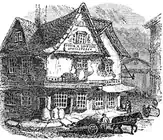 From Buckingham's America, 1841
 Painting by Eduard Hildebrandt, 1844
 Proximity to Faneuil Hall, 1845
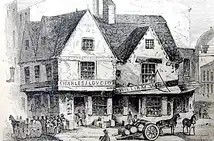 From Ballou's Pictorial, 1855
 Print by Louis Prang & Co., 1860
 From Our Young Folks, 1873
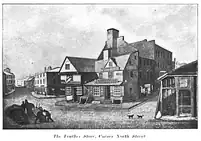 From Walks & Talks About Historic Boston, 1917
References
- ↑ Memorial History of Boston. 1880.
- 1 2 Albert William Mann. Walks & talks about historic Boston. The Mann publishing co., 1917; p.117.
- ↑ Michael Holleran. Boston's changeful times: origins of preservation and planning in America. 1998; p.89.
- 1 2 Nathaniel Bradstreet Shurtleff (1871), A topographical and historical description of Boston, Boston: Printed by request of the City Council, OCLC 4422090, OL 24156405M
Further reading
- Edward Griffin Porter. Rambles in Old Boston, New England. Cupples, Upham and Company, 1887.
- Abbott Lowell Cummings. The Old Feather Store in Boston. Old-time New England v.48, 1958.
- Old Boston in early photographs, 1850–1918: 174 prints from the collection of the Bostonian Society. Courier Dover Publications, 1990.
- D. Brenton Simons. Boston Beheld: Antique Town and Country Views. UPNE, 2008.
External links

- Bostonian Society. "Old Feather Store, Dock Square by Taylor Buzzell". Conservation. Archived from the original on October 10, 2009. Retrieved July 3, 2009.
- New York Public Library. Items related to Old Feather Store.
- Prang (1861). "Old warehouse, Dock Square". Boston Athenaeum catalog.