Olaf Andrésen
Olaf Andrésen | |
|---|---|
 Olaf Andrésen with his wife, Martha Dittrich, and his arranger, Bandmaster C.E. Donne (1969) | |
| Born | Hans Olaf Waldemar Rüdiger Emmerich Felix Januarius Andrésen January 14, 1902 Berlin, German Empire |
| Died | 1974 Johannesburg, South Africa |
| Occupation | Composer |
| Known for | Composer of Die Heidelied, marches for the Ossewabrandwag, founder of Melotoon Musiekuitgewers |
| Notable work | Die Heidelied, 1941 (song anthology), three operettas |
| Spouse | Marthel (Martha) Dittrich |
Olaf Andrésen (born Hans Olaf Waldemar Rüdiger Emmerich Felix Januarius Andrésen; 14 January 1902 – 1974) was a German-born South African composer and publisher. Best known for his patriotic song Die Heidelied and his prolific output of marches, operettas, and songs, Andrésen was also a fugitive during the Second World War and a musical propagandist for the Afrikaner fascist movement, the Ossewabrandwag. After the war, he became a cultural figure in apartheid-era South Africa.
Early life and education
Andrésen was born in Berlin in 1902. As a gifted young musician, he enrolled while still at school at the H. and P. Heller Conservatoire in Berlin, where he studied violin as well as theory and composition. At the age of 14, he made his public debut as a violinist.[1]
Travels and early career
In 1920, Andrésen embarked on a world tour that lasted six years. His travels took him to the Dutch East Indies, British India, the Philippines, Hong Kong, China, Japan, Hawaii, the United States, Canada, Mauritius, Mozambique, and South Africa. He worked as a bookkeeper, having qualified as an auditor in California, and performed with dance and chamber music ensembles in various locations.[1] He acquired conversational or working knowledge of several languages through these encounters.[2]
After a short return to Germany, he toured South America, performing in Colombia and Venezuela, before returning to South Africa in the early 1930s. He travelled widely on foot throughout the country—on one occasion walking from Durban to Cape Town and then to Johannesburg—and worked variously as a bookkeeper and insurance agent.
Life in South Africa and wartime internment
Andrésen settled in Johannesburg, where he became engaged to Marthel (Martha) Dittrich, an Afrikaans woman of Austrian descent. He returned briefly to Germany in 1938 to visit his mother, but rejoined Dittrich in Johannesburg in April 1939.[1]
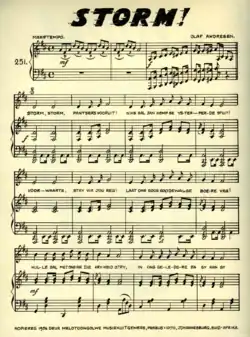
Following the outbreak of World War II, Andrésen was interned in Leeukop Prison as an enemy alien. After eight months, he escaped and spent nearly a year as a fugitive, evading the authorities across all South African provinces except Natal. During this period, he composed 22 marches and songs for the Ossewabrandwag, a pro-German Afrikaner nationalist movement.[3] The songs, written within three months, were published under the pseudonym Andries Cilliers and broadcast on the Nazi German shortwave station Zeesen. One of the compositions became the signature tune for Zeesen's Afrikaans programme.

In 1942, Andrésen and Dittrich fled to Portuguese East Africa.[4] He was granted asylum, but Dittrich was deported to South Africa and sentenced to three years in prison for her political involvement. After the war, the couple reunited and married in Lourenço Marques (now Maputo) in 1946. They returned to Johannesburg in 1948, following the National Party's rise to power.[1]
Professional career
After his return to South Africa, Andrésen became a full-time composer and music entrepreneur. He founded his own publishing house, Melotoon Musiekuitgewers, through which he printed and distributed his compositions and produced his own recordings.[1] He composed nearly 400 works, including a symphony, three operettas (popular in school performances) and numerous patriotic marches, waltzes, and songs.

His marches were arranged for military band by Lt. Charles Donne. His work was regularly broadcast and distributed, contributing to his status as a popular composer among white South African audiences of the 1950s and 1960s. The South African Music Encyclopaedia contains a works list of his musical output.[1]
Die Heidelied
Andrésen's best-known work is the strophic song Die Heidelied (The Heather Song), composed in 1932 and inspired by the heather-covered hills of South Africa's Western Cape. The song became widely beloved among Afrikaners. It was performed at the 1949 inauguration of the Voortrekker Monument, adopted as a march by the South African army, and later used as the theme for the Afrikaans film Hoor my lied (1967).[3]
Die Heidelied is a strophic, folk-like composition, employing a simple binary harmonic structure and a refrain asserting possession of the land (“Jy behoort aan my” / “You belong to me”). Scholars have noted its role in symbolically aligning Afrikaner nationalism with land and volk ideology.[3]
Legacy and influence
Andrésen's association with the Ossewabrandwag and his contributions to its musical culture place him among the most politically explicit composers in South African history. Despite the volume and popularity of his output, he is largely absent from mainstream South African music historiography. His life and work have been critically re-evaluated in recent scholarship as emblematic of the continuity between fascist ideology and apartheid-era cultural nationalism.[3]
Andrésen became a South African citizen in 1956.

See also
References
- 1 2 3 4 5 6 J.P. Malan, ed. (1980). South African Music Encyclopedia. Vol. 1. Cape Town: Oxford University Press. pp. 42–46.
- ↑ E.J. Verwey, ed. (1995). New Dictionary of South African Biography. Vol. 1. Pretoria: HSRC Publishers. pp. 5–7.
- 1 2 3 4 Muller, Stephanus (2025). "Sound Sentinels: Genealogies of Fascism in South African Music". Unpublished Manuscript: 3–6.
- ↑ Joan Kruger, "Magriet Andrésen vertel: Ons vlug oor die grens", Die Vaderland, 19 August 1971.