Ofe onugbu
 Ofe Onugbu | |
| Type | Soup |
|---|---|
| Place of origin | Southeast Nigeria (Igbo) |
| Region or state | South East |
| Serving temperature | Warm |
| Main ingredients |
|
| Ingredients generally used | Crayfish |


Ofe onugbu, (Igbo: [ɔ́fɛ́ ɔ̀nʊ́g͡bù] ⓘ) also known as bitterleaf soup, is a traditional delicacy of the Igbo people in the southeastern region of Nigeria. It is regarded as a native soup.[1] Although it is called 'bitterleaf soup,' the dish is not necessarily an inherently bitter soup, as the leaves are thoroughly washed to reduce the bitterness before cooking.[2] The dish is commonly eaten with Ụtara a carbohydrate-based staples such as akpụ, (ⓘ) Ụtara akpu, Ụtara ji, Garri, and other similar staples.[3] The leaf is also known scientifically as Vernonia amygdalina.[4]
Origin
Ofe Onugbu is widely regarded as a traditional delicacy of the Igbo people in southeastern Nigeria. The soup, made primarily from bitterleaf (onugbu), holds cultural significance across many Igbo communities and is commonly prepared for family meals, celebrations, and special occasions.[5] Although closely associated with Anambra cuisine, several variations of the soup exist across the region.[6] These differences may include:
- The use of achi (ⓘ) or cocoyam as a thickener,
- The preference for long leaf strands or finely shredded bitterleaf,
- The use of extracted palm fruit juice or palm oil, and
- The choice to cook the soup with or without ogiri, a fermented seasoning that adds a distinctive flavor.
Ingredients
The ingredients for making onugbu soup are[7]
- Bitterleaf (onugbu)
- Cocoyam (a specie locally known as ede ụrị ⓘ) paste
- Extracted Palm fruit juice or Palm oil
- Protein: a mix of meat, smoked fish, stockfish, tripe, or cow skin
- Crayfish
- Pepper
- Ogiri , (ⓘ local seasoning)
- Salt
- Seasoning cubes (optional)
Preparation

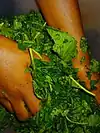
The preparation of ofe onugbu typically begins with processing the bitterleaf (onugbu). The leaves are plucked fresh and lightly sunned for some minutes to prevent them from disintegrating during washing. They are then washed repeatedly to reduce their natural bitterness. After several washes, the leaves are tasted to ensure they have reached the preferred level of mildness.
Cocoyam (a local specie called ede ụrị) and fresh palm fruits are washed and boiled together until soft. Once cooked, the water is drained. The palm fruits are pounded, and their juice is extracted for cooking. This palm fruit extract is often mixed with palm oil, eliminating the need to add extra oil during the soup preparation. The cocoyam is peeled and pounded into a smooth paste and set aside to be used as a thickener.
The protein base, which may include beef or goat meat, cow tripe, cow skin, smoked fish, and stockfish is washed, seasoned with salt and traditional spices, and boiled until tender to create a rich stock.[8]
The extracted palm kernel juice is poured into a pot, followed by the required amount of water, and allowed to come to a boil. Seasonings such as ground pepper, crayfish, salt, ogiri igbo, or other optional flavourings are added. The cooked proteins and their stock are introduced, after which small portions of the pounded cocoyam paste are added to serve as the thickener.
The soup is left to cook until the cocoyam dissolves and the texture becomes smooth. Finally, the washed bitterleaf is stirred in and allowed to simmer until the flavours blend and the leaves become tender. Once properly cooked, ofe onugbu is ready to be served.
Serving
Ofe onugbu is traditionally served hot or warm with a variety of Nigerian staples. It is most commonly paired with utara akpụ (ⓘ cassava staple), which is a popular choice in many Igbo households. However, some people prefer to enjoy it with utara ji (ⓘ pounded yam), garri (ⓘ fried cassava), Semolina, utara ede (ⓘ cocoyam staple), or wheatmeal, depending on personal preferences.
References
- ↑ Udevi, Obiamaka Angela (30 July 2019). "Origin of Nigerian Foods: Ofe Onugbu". Connectnigeria Articles. Retrieved 6 May 2026.
- ↑ Uguru, Chichi (28 August 2017). "Delicious Bitterleaf Soup (Ofe Onugbu)". My Diaspora Kitchen. Retrieved 3 December 2025.
- ↑ Jemimah, Sisi (10 April 2016). "Bitter Leaf Soup - Ofe Onugbu". Sisi Jemimah. Retrieved 3 December 2025.
- ↑ Degu, Sileshi; Meresa, Asfaw; Animaw, Zelalem; Jegnie, Mihretu; Asfaw, Asaye; Tegegn, Getachew (13 March 2024). "Vernonia amygdalina: a comprehensive review of the nutritional makeup, traditional medicinal use, and pharmacology of isolated phytochemicals and compounds". Frontiers in Natural Products. 3 1347855. doi:10.3389/fntpr.2024.1347855. ISSN 2813-2602.
- ↑ "Bitterleaf Soup (Ofe Onugbu): The Pride of Igbo Cuisine – Nigeria 234". Retrieved 6 May 2026.
- ↑ Adasrecipes (27 August 2017). "Bitter leaf Soup(Ofe Onugbu) Recipe | Ada's Recipes". Retrieved 3 December 2025.
- ↑ "Nigerian Bitterleaf Soup | How To Make Nigerian Soups". All Nigerian Foods. Retrieved 3 December 2025.
- ↑ "Bitterleaf Soup (Ofe Onugbu)". All Nigerian Recipes. Retrieved 3 December 2025.
See also
Igbo topics | |||||
|---|---|---|---|---|---|
| History (chronological order) | |||||
| Subgroups | |||||
| Politics | |||||
| Geography (Igboland) |
| ||||
| Demographics | |||||
| Culture | |||||
| Language |
| ||||
| Wikipedia | |||||
