Nurul Rashid Akhtar Shah Noor Siddiqui
Nurul Rashid Akhtar Shah Noor Siddiqui | |
|---|---|
نور الرشيد أختار شاه نور الصديقي | |
 Shrine of Nurul Rashid Akhtar Shah Noor Siddiqui | |
| Personal life | |
| Born | December 16, 1942 Oshkhain, Anwara Upazila |
| Died | October 13, 2011 (aged 68) Valikar Mor, Ruby Gate, Bayezid, Chittagong |
| Resting place | Valikar Mor, Ruby Gate, Bayezid, Chittagong 22°22′40″N 91°49′01″E / 22.37778°N 91.81694°E |
| Home town | Oshkhain, Anwara Upazila |
| Spouse | Mir Fatema Zohra |
| Children | 4 sons and 4 daughters Sons Maulana Mir Muhammad Moinuddin Noori Siddiqui Al-Quraishi Rajiuddin Kaden Muhammad Samir Qutubuddin Muhammad Sultan Sabbir Muhammad Sahilur Rashid Daughters Habibattunnisa Pran Hassannussaba Ayana Ghofranunnisa Ghofa Irfanunnisa Ifa |
| Parents |
|
| Main interest(s) | Fiqh, Sufism, Tafsir, Hadith |
| Religious life | |
| Religion | Islam |
| Denomination | Sunni |
| Order | Qadiriyya, Chishtiyya, Naqshbandi, Madariyya, Qalandariyya, Suhrawardiyya |
| Philosophy | Sufism |
| Jurisprudence | Hanafi |
| Muslim leader | |
| Predecessor | Shahsufi Aminur Rahman |
| Successor | Maulana Mir Muhammad Moinuddin Noori Siddiqui Al-Quraishi |
Influenced by
| |
Influenced
| |
| Arabic name | |
| Personal (Ism) | Nurul Rashid Akhtar Shah Noor Siddiqui نور الرشيد أختار شاه نور الصديقي |
| Patronymic (Nasab) | Darvesh Nurul Rashid Akhtar Ibn Mufti Aminur Rahman Ibn Shah Habibur Rahman Ibn Shah Sharafatullah Ibn Shah Ali Raza Kanu Fakir Ibn Shah Sachi Muhammad Ibn Bashir Mahmud Manohar Ibn Hamza Shah Ibn Paha Muhammad Fakhr Ibn Daulat Muhammad Ibn Meena Muhammad Siddiqui Al Quraishi الدرويش نور الرشيد أختار بن المفتي أمين الرحمن بن شاه حبيب الرحمن بن شاه شرف الله بن شاه علي رضا كانو فقير بن شاه ساشي محمد بن بشير محمود منوهر بن حمزة شاه بن باها محمد فخر بن دولت محمد بن مينا محمد الصديقي القريشي |
| Teknonymic (Kunya) | Nur Fakir, Nur Maula, Darvesh Maula نورو فقير، نورو مولا، درويش مولا |
| Epithet (Laqab) | Shah Nawaz, Akhtar Nawaz, Qutubul Alam, Mazhare Ali Raza, Zille Khwaja, Cherage Ghaus, Asadullah شاه نواز، أختار نواز، قطب العالم، مظهر علي رضا، ظل الخواجة، سراج الغوث، أسد الله |
Nurul Rashid Akhtar Shah Noor Siddiqui (popularly known as Darvesh Maula) was a Bangladeshi Sufi Scholar. His family claims descend from Abu Bakr, Rumi, and the 18th-century Bengali Sufi Ali Raza.[1] He was born on Wednesday, 16 December 1942 at the Oskhain Ali Nagar Darbar Sharif to Shah Sufi Aminur Rahman and Jaheda Khatun. According to his followers, writers, and researchers, he was widely known as a Dervish.
He received his early education under his father and completed his Dakhil, Alim, Fazil, and Kamil examinations at Makbulia Madrasa, Joara Madrasa, and Sobhania Madrasa in Chittagong. [2]
In 1983, Darvesh Maula married Mir Fatema Zohra, daughter of Syed Mir Zakir Hossain of Kismat Jafarabad village in Mirsarai. The couple had four sons and four daughters. [3]
Reforms and contributions to the literature
In 1995, the Research Divison of the Bangla Academy requested Darvesh Maula's assistance manuscripts regarding the works of Ali Raza. [4] In response, he provided advise to the Academy and began translating the original manuscripts from Madhurami dialect into modern Bengali.
Darvesh Maula authored several books on Sufism and Islamic Philosophy. His published works during his lifetime include Siddha Tarat Ratnamala and Kanu Babar Parichiti. Other works, such as Rahe Nurain FI Minhajul Muridain, Hushiyar, and Juz'yun Nur, were posthumously published by Maktubate Sayadatuj Zohra. His notable manuscripts include Murid Talkinnama, Aamle Nur, Daptare Waw, Sadhak Gunjan, Nugmaye Nur, Nukushe Kuwatul Haqiqiya, and Asmaye Batul Binte Rasul (SM). [5] [6] Between 1958 and 1995, he started collecting and preserving the literary works of his predecessors, and began writing books in 1984. His poem titled "Manush Hao" (Be Human) received appreciation from researchers.
Darvesh Maula adapted the book Gyan Sahar, originally written in the difficult Madhurami dialect,, into modern Bengali making it accessible to general readers and scholars. He also transliterated and modernized other historic works from same dialect including Shariatnama, Ebadatnama, Sifate Iman, Yoga Kalander, and Suratnama. [7]
A life of spiritual practice
Darvesh Maula engaged in spiritual retreats, meditation,and self-purification as part of his Sufi practices.
Darvesh Maula's spiritual practice emphasized detachment from worldly affairs and complete devotion to God. [8] His practices included spiritual retreats (*Bonobas*) and long travel's on foot (*Podobroj*).
Shah Saheb's Hill | |
|---|---|
Historical and spiritual sites | |
  Shah Saheb's Hill Location within Bangladesh | |
| Coordinates: 22°14′38″N 91°46′12″E / 22.2439371°N 91.7701256°E | |
| Country | Bangladesh |
| District | Chittagong Division |
| District | Chittagong Division |
| Upazila | Chandanaish Upazila |
| Features | The place of spiritual practice of Darvesh Maula for a long eight years |
In 1962, Darvesh Maula began an eight-year spiritual retreat on Shah Saheber Pahar (Shah Saheb's Hill) in Chandanaish Upazila, remaining there in isolation and deeply immersed in meditation until 1970 an act followed by Darvesh Maula described as following the "Sunnah" of the Muhammad meditation in the Cave of Hira [9]
From 1971 to 1974, Darvesh Maula stayed at the Shrine of Ali Shah in West Allahabad, Chandanaish, where he supported Bangladesh Liberation War both spiritually and materialistically. Between 1975 and 1976, he resided and meditated at the Satyapir Shrine in Baitul Izzat,Satkania Upazila. According to biographical accounts, he maintained a decade-long period of silence (*Maunabrata*) between 1962 and 1972, speaking when only necessary. [10]
Role in the propagation and dissemination of the religion of Islam, and social service
In 1974, Darvesh Maula returned to public life and renovated the shrine of Satyapir in Raozan Upazila. In 1980, he acquired land in Paharpur, Comilla and later, he purchased land in West Sholashahar, of East Nasirabad Mouza in Chittagong and established the Kayamuddin Kanu Asthana Khanqa's, which he later named the Oskhainiri Nuriya Bishu Darbar. Over his lifetime, he contributed to local infrastructure development, establishing nine mosques, seven Khanqa's and five roads. Among his notable establishments is the Oskhainiri Nuriya Bishu Manzil in West Sholashahar, of East Nasirabad Mouza in Chittagong. His infrastructure work includes constructing the Allahabad Darveshiya Road in Chandanaish (1972), a road connecting Ruby Gate to Bishu Manzil (1983), and the Qayamuddin Aulia Road in Anwara Upazila. [11]
Darvesh Maula laid the foundation stones for the Hazrat Shah Sharafatullah Jamiah Mosque and Shah Noor Nagar Jamiah Mosque, and renovated the Khizriya Nuriya Jamiah Mosque in Cox's Bazar. In 1983, he also renovated the shrine of Hazrat Makhdoom Allama Shah Qayamuddin Farooqi Al MAdani in Mirsharai Upazila. Additionally, he participated in social welfare activities, including anti-addiction campaigns and disaster relief operations during 1991,1994 and 2002 Cyclones and floods. [12]
He also maintained regular correspondence and exchanged greetings with carious Islamic Scholars and Sufi leaders (Pir-Mashayekh) around the world. [13]
Gallery
 Sample copy of the letter from the Bangla Academy
 Manuscript of Jnanasagar translated into modern Bengali
 Manuscript of Shariatnama translated into modern Bengali
 Manuscript of the Ibadatnama translated into modern Bengali
 A manuscript of the *Suratnama* transliterated into modern Bengali.
 Manuscript of Yoga Kalanda translated into modern Bengali
 Manuscript of Sifte Iman translated into modern Bengali
 Manuscript of the *Murid Talkin-nama*
 Manuscript of the Book of Light during the period
 Manuscript of the book "Wow" in the office
 Manuscript of the book Nugmay Nur
 Mawakiyun Nujum
 Rahe Nuraiyen
 Hushiar
 Naqsh-e-Salesh and Naqsh-e-Arba
 Various items used by the dervish maula 1
 Various items used by the dervish maula 2
 Various items used by the dervish maula 3
 Various items used by the dervish maula 4
 Sample copies of correspondence with Pirs and Mashayekh from various countries.
 A Collection of Durood Compiled by Darvesh Maola
 A Collection of Durood Compiled by Darvesh Maola
 The ajifa used during the sadhana period at Darvesh Maula Pahar
 The Five Kalimas handwritten by Darvesh Maola.
Demise
He died on Wednesday night at 3.00 AM on 13 October 2011 (14 Dhu al-Qadah 1432 AH / 28 AShwin 1418 BS). In accordance with his last wishes, his eldest son, Maulana Mir Muhammad Moinuddin Noori Siddiqui Al-Quraishi, led his funeral prayers (Janazah). He was buried within his shrine premises (Hujra Sharif). His annual ''Esal-e-Sawab Fateha Sharif'' (commemorative gathering) is held every year 0n 13 October (28 Ashwin) at the Nuriya Bishu Darbar Sharif located near Valikar Mor, Ruby Gate, Chittagong. [14] [15] [16]
References
- ↑ "Ali Raza". Banglapedia (in Bengali).
- ↑ Al Quraishi, Maulana Muhammad Moinuddin Noori (2024). Mawaqiyun Nujum (in Bengali). Maktabate Sayadatuj Zohra. pp. 22–29. ISBN 978-984-36-0214-5.
- ↑ Al Quraishi, Maulana Muhammad Moinuddin Noori (2024). Mawaqiyun Nujum (in Bengali). Maktabate Sayadatuj Zohra. p. 55. ISBN 978-984-36-0214-5.
- ↑ Al Quraishi, Maulana Muhammad Moinuddin Noori (2024). Mawaqiyun Nujum (in Bengali). Maktabate Sayadatuj Zohra. p. 680. ISBN 978-984-36-0214-5.
- ↑ Professor Dr. Muhammad Nure Alam (6 November 2025). "Shah Sufi Hazrat Nurul Rashid Akhtar (R.)'r Farsi Protibha O Chintadorshon" (in Bengali). Dainik Purbodesh. Retrieved 6 November 2025.
- ↑ Al Quraishi, Maulana Muhammad Moinuddin Noori (2024). Mawaqiyun Nujum (in Bengali). Maktabate Sayadatuj Zohra. pp. 126–137. ISBN 978-984-36-0214-5.
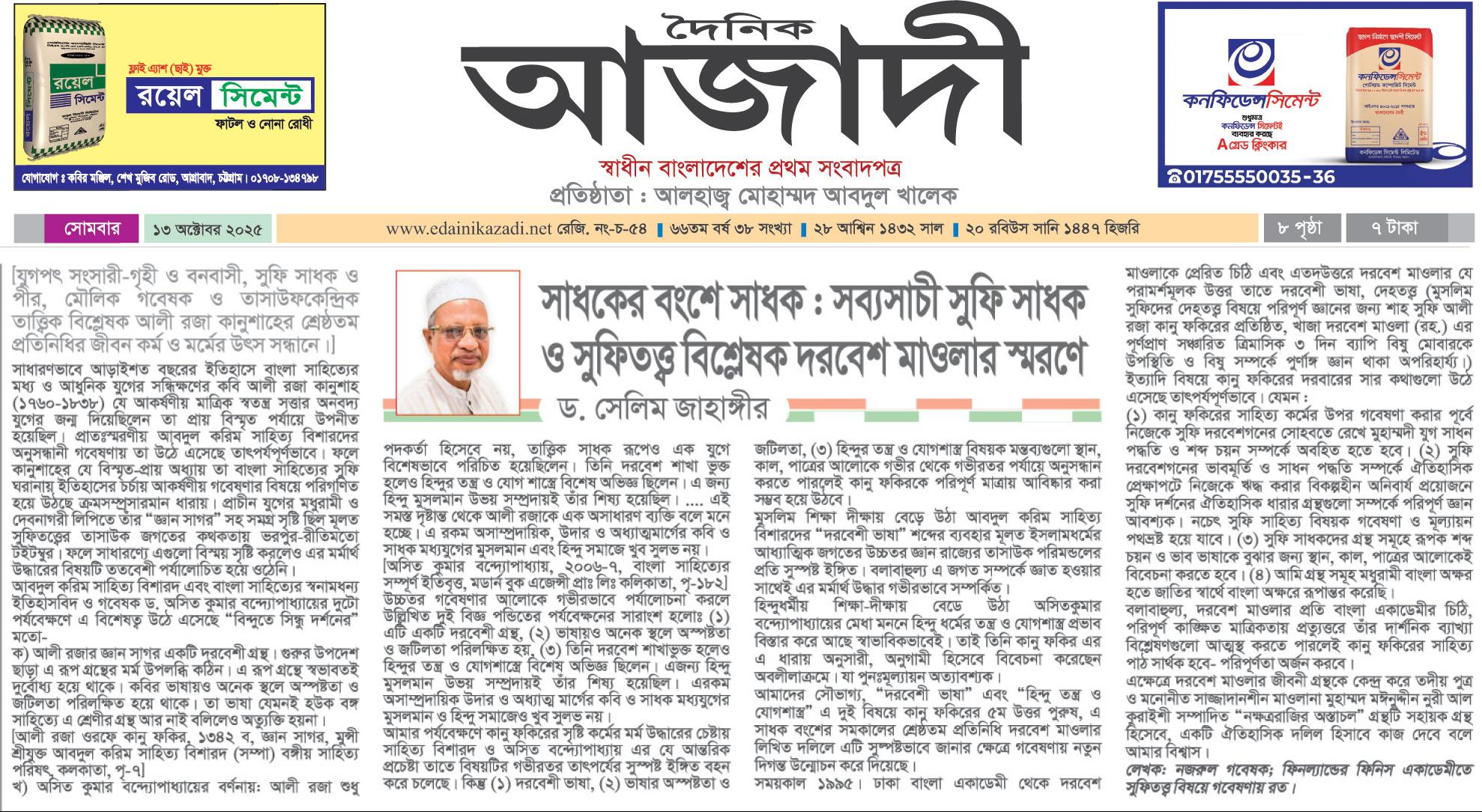
- ↑ Dr. Selim Jahangir (13 October 2025). "Sadhoker Bonshe Sadhok" (in Bengali). Dainik Azadi. Retrieved 13 October 2025.
- ↑ Dr. Hasan Muhammad Kafiluddin (13 October 2025). "Khwaja Darvesh Maula Boichitromoy Jiboner Adhikari" (in Bengali). Dainik Purbodesh. Retrieved 13 October 2025.
- ↑ Al Quraishi, Maulana Muhammad Moinuddin Noori (2024). Mawaqiyun Nujum (in Bengali). Maktabate Sayadatuj Zohra. pp. 147–153. ISBN 978-984-36-0214-5.
- ↑ Al Quraishi, Maulana Muhammad Moinuddin Noori (2024). Mawaqiyun Nujum (in Bengali). Maktabate Sayadatuj Zohra. p. 25. ISBN 978-984-36-0214-5.
- ↑ Al Quraishi, Maulana Muhammad Moinuddin Noori (2024). Mawaqiyun Nujum (in Bengali). Maktabate Sayadatuj Zohra. pp. 311–313. ISBN 978-984-36-0214-5.
- ↑ Al Quraishi, Maulana Muhammad Moinuddin Noori (2024). Mawaqiyun Nujum (in Bengali). Maktabate Sayadatuj Zohra. pp. 213–214. ISBN 978-984-36-0214-5.
- ↑ Al Quraishi, Maulana Muhammad Moinuddin Noori (2024). Mawaqiyun Nujum (in Bengali). Maktabate Sayadatuj Zohra. p. 681. ISBN 978-984-36-0214-5.
- ↑ Suman Sen Chittagong. "Oshkhainiri Nooria Bishu Darbar Sharife Khwaja Shah Noor Darvesh Maula (R.) Er Barshik Urs Sharif Udjapon" (in Bengali). Dainik Amader Matribhumi. Retrieved 6 October 2024.
- ↑ Md. Monirul Islam Riyad. "Khwaja Shah Noor Darvesh Maula (R.) Er Chandrabarshiki Ofat Sharif Uplokkhe Free Medical Camp" (in Bengali). Retrieved 1 January 2026.
- ↑ Md. Jamal Uddin (14 October 2025). "Hazrat Shahnur Darvesh Maula (R.) Er 14tom Orosh Somponno" (in Bengali). Chattalchitra. Archived from the original on 6 January 2026. Retrieved 14 October 2025.