Nososticta coelestina
| Green-blue threadtail | |
|---|---|
 | |
| Green-blue threadtail (male) | |
 | |
| Green-blue threadtail (female) | |
Scientific classification  | |
| Kingdom: | Animalia |
| Phylum: | Arthropoda |
| Clade: | Pancrustacea |
| Class: | Insecta |
| Order: | Odonata |
| Suborder: | Zygoptera |
| Family: | Platycnemididae |
| Genus: | Nososticta |
| Species: | N. coelestina |
| Binomial name | |
| Nososticta coelestina | |
 | |
| Synonyms[3] | |
| |

Nososticta coelestina is an Australian species of damselfly in the family Platycnemididae,[4] commonly known as the green-blue threadtail.[5]
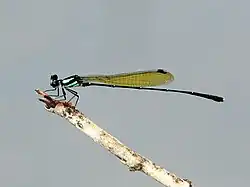
Its usual habitat is near rivers and streams. The adult is a medium-sized damselfly with a length of 35 to 40mm, and wingspan similar to its length. The thorax is black with vivid greenish-blue markings in the male, and pale brown in the female. The abdomen is dark with pale narrow bands between abdominal segments. The wings are tinted with yellow or lemon. In Australia, the distribution is in suitable habitat in the north and eastern part of the continent from the top end of the Northern Territory to central Queensland.[5] The taxon has been assessed in the IUCN Red List as being of Least Concern.
Etymology
The genus name Nososticta combines the Greek νόσος (nosos, "disease") with στικτός (stiktos, "spotted" or "marked"). The suffix -sticta is commonly used in names of taxa related to Protoneura and the subfamily Isostictinae.[6]
The species name coelestina is derived from the Latin caelestis ("heavenly" or "sky-blue"), referring to the pale blue appendages.[2][7]
Gallery
 Male
 Detail of Nososticta coelestina wing
 Photo of male wings
See also
References
- ↑ Hawking, J. (2009). "Nososticta coelestina". IUCN Red List of Threatened Species. 2009 e.T163557A5615794. doi:10.2305/IUCN.UK.2009-2.RLTS.T163557A5615794.en. Retrieved 19 November 2021.
- 1 2 Tillyard, R.J. (1906). "New Australian species of the family Agrionidae (Neuroptera: Odonata)". Proceedings of the Linnean Society of New South Wales. 31: 177–194 [184] – via Biodiversity Heritage Library.
- ↑ Paulson, D.; Schorr, M.; Abbott, J.; Bota-Sierra, C.; Deliry, C.; Dijkstra, K.-D.; Lozano, F. "World Odonata List". OdonataCentral. University of Alabama. Retrieved 3 April 2026.
- ↑ "Species Nososticta coelestina (Tillyard, 1906)". Australian Faunal Directory. Australian Biological Resources Study. 2012. Retrieved 14 April 2017.
- 1 2 Theischinger, G; Hawking, J (2006). The Complete Field Guide to Dragonflies of Australia. Collingwood Vic.: CSIRO Publishing. p. 64. ISBN 978-0-64309-073-6.
- ↑ Endersby, Ian; Fliedner, Heinrich (2015). The Naming of Australia's Dragonflies. Eltham, Victoria, Australia: Busybird Publishing. ISBN 9781925260625.
- ↑ Endersby, Ian (2012). "Etymology of the Dragonflies (Insecta: Odonata) named by R.J. Tillyard, F.R.S." Proceedings of the Linnean Society of New South Wales. 134: 1–16.

