Brain health and pollution
| External videos | |
|---|---|
 "How air pollution impacts our brains", Harvard T.H. Chan School of Public Health, Feb 27, 2024. |
The effects of pollution on the brain are felt throughout the lifespan.[1][2][3] Prenatal exposure to pollution is associated with an increased risk of negative fetal outcomes,[4][5] including central nervous system damage[6] and developmental delays.[7] Exposure to pollution can lead to neurodevelopmental disorders involving brain development, cognitive function, intellectual development, and emotional and behavioral regulation, often becoming apparent during childhood or adolescence (e.g. ADHD,[8] autism[9]). Pollution is also linked to mental health outcomes that are commonly diagnosed in adolescence or adulthood such as schizophrenia,[10] neuroticism, depression, anxiety,[11][3][12] and suicide.[13][14][15] Pollution is associated with neurological conditions such as migraines and stroke[16] and neurodegenerative disorders[17] such as multiple sclerosis,[18] Alzheimer's disease,[19][20] Parkinson's disease,[16] and dementia.[21]
Pollutants can be inhaled, eaten, drunk, or absorbed through skin.[22] The criteria air pollutants sulfur dioxide, nitrogen dioxide, particulate matter, carbon monoxide, ozone, and lead have been identified as harmful to human health by the World Health Organization[23] and the U.S. Environmental Protection Agency (EPA).[24] Many of them are linked to the burning of fossil fuels, through vehicle use, heating and cooking.[25][26] Substances in air pollution that have negative effects on the central nervous system (CNS) include particulate matter, dioxins, and heavy metals.[1] Indoor and outdoor air pollution can also contain endocrine-disrupting chemicals and microplastics that have negative effects on the central nervous system.[27][28] Neurotoxicity is mediated by processes such as oxidative stress, mitochondrial dysfunction, and neuroinflammation.[27] Pollutants such as ozone and microplastics can affect the neurophysiology of individuals after the structure of the CNS has become mostly stabilized, an example of neuroplasticity.[29][28][30]
As a contributor to disease burden, environmental pollution is potentially preventable.[31] Steps can be taken to minimize exposures to pollutants such as avoiding smoking, minimizing dust, using glass instead of plastics, carefully selecting cleaning products and cosmetics, and exercising away from heavy traffic routes.[32] Control strategies can also be implemented to improve industrial safety and public health.
Pollutants
Air pollution is a complex mixture that includes solids, liquids and gases. Particulate matter is made up of tiny particles of solid or liquid matter suspended in air.[33] Air pollution can result both from natural causes such as sea spray or desert dust and from human activities such as smoke from fires, first and second-hand tobacco and cannabis smoke, and automobile exhaust fumes from fossil fuel combustion.[21][34]
Particulate matter
Airborne particulate matter is a Group 1 carcinogen.[35] Particulates are the most harmful form (other than ultra-fines) of air pollution[36] as they can penetrate deep into the lungs and brain from blood streams, causing health problems such as heart disease, lung disease, and premature death.[37] There is no safe level of particulates.[38] Ultrafine particles are both manufactured and naturally occurring. Hot volcanic lava, ocean spray, and smoke are common natural UFPs sources. UFPs can be intentionally fabricated as fine particles to serve a vast range of applications in both medicine and technology. Other UFPs are byproducts, like emissions, from specific processes, combustion reactions, or equipment such as printer toner and automobile exhaust.[39][40] Anthropogenic sources of UFPs include combustion of gas, coal or hydrocarbons, biomass burning (i.e. agricultural burning, forest fires and waste disposal), vehicular traffic and industrial emissions, tire wear and tear from car brakes, air traffic, seaport, maritime transportation, construction, demolition, restoration and concrete processing, domestic wood stoves, outdoor burning, kitchen, and cigarette smoke.[41]
While hand-held power tools are very helpful (e.g., in renovation and construction), they also produce large amounts of vibrations[42] and particulates (particulate matter), including ultrafine particles,[43] from both fuel combustion and the mechanical tasks. Not only power tools, hand tools also generate UFPs.[44]
Many construction tasks create dust. High dust levels are caused by one of more the following:
- equipment – using high energy tools, such as cut-off saws, grinders, wall chasers and grit blasters produce a lot of dust in a very short time
- work method – dry sweeping can make a lot of dust when compared to vacuuming or wet brushing
- work area – the more enclosed a space, the more the dust will build up
- time – the longer one works the more dust there will be
Examples of high dust level tasks include:
- using power tools to cut, grind, drill or prepare a surface
- sanding taped plaster board joints
- dry sweeping[45]
Currently there seems to be no or little regulations on the size and amount of dust emitted by power tools. Some industry standards do exist,[46][47] though it appears that they are not widely known or used globally. Knowing that dust is generated throughout the construction process and can cause serious health hazards,[48] manufacturers are now marketing power tools that are equipped with dust collection system (e.g. HEPA vacuum cleaner) or integrated water delivery system which extract the dust after emission.[49][50] However, the use of such products is still not common in most places. As Q1 2024 petrol powered tools are banned in California.[51]
- Construction dust generated by power tools and heavy equipments


Dioxins
Organohalogen compounds, such as dioxins, are commonly found in pesticides or created as by-products of pesticide manufacture or degradation. These compounds can have a significant impact on the neurobiology of exposed organisms. Some observed effects of exposure to dioxins are altered astroglial intracellular calcium ion (Ca2+), decreased glutathione levels, modified neurotransmitter function in the CNS, and loss of pH maintenance.[52] A study of 350 chemical plant employees exposed to a dioxin precursor for herbicide synthesis between 1965 and 1968 showed that 80 of the employees displayed signs of dioxin poisoning.[53] The study suggested that the effects of dioxins were not limited to initial toxicity. Dioxins, through neuroplastic effects, may cause long-term damage that may not manifest itself for years or even decades.[53][54]
Heavy metals
Heavy metal exposure can result in an increased risk of various neurological diseases.[22] Among the most neurotoxic heavy metals are mercury, lead, and cadmium.[21][55] Mercury and lead are particularly neurotoxic for many reasons: they easily cross cell membranes, have oxidative effects on cells, react with sulfur in the body (leading to disturbances in the many functions that rely upon sulfhydryl groups), and reduce glutathione levels inside cells. Methylmercury, in particular, has an extremely high affinity for sulfhydryl groups.[56] Organomercury is a particularly damaging form of mercury because of its high absorbability[57] Lead also mimics calcium, a very important mineral in the CNS, and this mimicry leads to many adverse effects.[58] Mercury's neuroplastic mechanisms work by affecting protein production. Elevated mercury levels increase glutathione levels by affecting gene expression, and this in turn affects two proteins (MT1 and MT2) that are contained in astrocytes and neurons.[59]
Lead's ability to imitate calcium allows it to cross the blood–brain barrier. Lead also upregulates glutathione.[60] Blood lead concentrations ≥ 5·0 μg/dL could result in children scoring 3–5 points lower in intelligence tests than those with the concentrations < 5·0 μg/dL . Higher blood lead concentrations are also associated with serious cognitive function losses. "Lead-related IQ losses are associated with increased rates of school failure, behavioural disorders, diminished economic productivity, and global economic losses of almost $1 trillion annually."[61]
Effects across the lifespan
Prenatal effects
Research has consistently shown that exposure to pollutants can affect fertility, fetal development, health of offspring in later life, and the genetics of future generations. Potential mechanisms of action by toxic environmental chemicals include oxidative stress, inflammation, changes in placental function, endocrine disruption and genetic alterations.[5] Components of air pollution such as polycyclic aromatic hydrocarbons (PAHs) can negatively affect fetal brain development, with impacts on cognition and behavior.[63]
Autism
Heavy metal exposure, when combined with certain genetic predispositions, can place individuals at increased risk for developing autism. Many examples of CNS pathophysiology, such as oxidative stress, neuroinflammation, and mitochondrial dysfunction, could be by-products of environmental stressors such as pollution, as found in a 2010 study.[64]
Early-life exposure to air pollution may be a risk factor for autism. Children of mothers living near a freeway, and traffic-related pollution, during the third trimester of pregnancy were twice as likely to develop ASD.[65] A distance of 1,014 feet, or a little less than 3.5 football fields, was considered near a freeway. Children with a mutation in a gene called MET, combined with high levels of exposure to air pollution, may have increased risk.[65]
Prenatal and early childhood exposure to heavy metals, like mercury, lead, or arsenic; altered levels of essential metals like zinc or manganese; pesticides; and other contaminants cause concern.[65] A study of twins used baby teeth to determine and compare levels of lead, manganese, and zinc in children with autism to their twin without the condition.[65] Autistic children were low on manganese and zinc, metals essential to life, but had higher levels of lead, a harmful metal during specific developmental time periods studied. Altered zinc-copper cycles, which regulate metal metabolism in the body, are disrupted in ASD cases.[65]
Maternal exposure to insecticides during early pregnancy was associated with higher risk of autism in their children. Contaminants such as Bisphenol A, phthalates, flame retardants, and polychlorinated biphenyls are also being studied.[65]
Effects in adolescents
A 2008 study compared children and dogs raised in Mexico City (a location known for high pollution levels) with children and dogs raised in Polotitlán, Mexico (a city whose pollution levels meet the current US National Ambient Air Quality Standards).[66] Children raised in areas of higher pollution were found to score lower in intelligence (i.e., on IQ tests), and showed signs of lesions in MRI scanning of the brain. In contrast, children from the low pollution area scored as expected on IQ tests and showed no significant sign of the risk of brain lesions.
Effects in adults
Schizophrenia
Exposure to air pollution may be associated with elevated risk of schizophrenia.[67][68][69][10]
Epilepsy
Multiple air pollutants are probably associated with the risk of epilepsy,[70] e.g., carbon monoxide, ozone, sulfur dioxide, nitrogen dioxide, large particulate matter, and fine particulate matter. It was hypothesized that air pollutants increase epilepsy risk by increasing inflammatory mediators, and by providing a source of oxidative stress, eventually altering the blood–brain barrier's function and cause brain inflammation. Brain inflammation is known to be a risk factor for epilepsy; thus, the sequence of events provides a plausible mechanism by which pollution may increase epilepsy risk in individuals who are genetically vulnerable to the disease.[70]
Neurodegenerative disorders
Accelerated neural aging
Neuroinflammation is associated with increased rates of neurodegeneration.[71] Inflammation tends to increase naturally with age. By facilitating inflammation, pollutants such as air particulates and heavy metals cause the CNS to age more quickly. Many late-onset diseases are caused by neurodegeneration. Multiple sclerosis, Parkinson's disease, amyotrophic lateral sclerosis (ALS), and Alzheimer's disease[31] are all believed to be exacerbated by inflammatory processes, resulting in individuals displaying signs of these diseases at an earlier age than is typically expected.[71]
Multiple sclerosis occurs when chronic inflammation leads to the compromise of oligodendrocytes, which in turn leads to the destruction of the myelin sheath. Then axons begin exhibiting signs of damage, which in turn leads to neuron death. Multiple sclerosis has been correlated to living in areas with high particulate matter levels in the air.[72]
According to Lancet (2021), exposure to "environmental pollution with toxins, such as pesticides (eg, paraquat) or chemicals (eg, trichloroethylene), known to be harmful to Parkinson's disease-related neurons and brain circuits," is associated with Parkinson's disease.[73] Multi-decade studies have identified an increased likelihood of Parkinson's in association with agricultural work, pesticide exposure, and rural habitation. Chlorinated solvents, used in commercial and industrial application like dry cleaning and degreasing, are associated with increased PD risk, particularly trichloroethylene.[74][75] Other chemical risk factors include manganese, suspended particles from traffic fumes, and exposure to other heavy metals such as mercury and lead.[75][76]
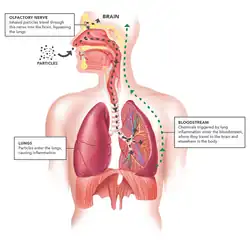
In the case of Alzheimer's disease, inflammatory processes lead to neuron death by inhibiting growth at axons and activating astrocytes that produce proteoglycans. This product can only be deposited in the hippocampus and cortex, indicating that this may be the reason these two areas show the highest levels of degeneration in Alzheimer's disease.[77] Tiny particles (e.g., engineered nanoparticles and combustion nanoparticle emissions, also called nanomaterials, including those containing manganese) can bypass the blood-brain barrier (the body's filtering system) and enter the brain as they are breathed in.[78][79][80]
Cognitive decline and dementia
Exposure to air pollution was positively associated with an increased risk of stroke hospital admission (PM2.5, PM10, SO2, NO2, CO, and O3), incidence (PM2.5, SO2, and NO2), and mortality (PM2.5, PM10, SO2, and NO2).[81] There is a "well-recognized link between PM2.5 and vascular injury and the role of vascular injury in dementia".[82] Air pollution in the cerebrovascular system may result in "stroke, vascular dementia, or other types of dementia".[83] The risk of dementia, including Alzheimer's disease and vascular dementia, may be increased by long-term exposure to PM2.5.[84]
Interest in the possible effects of air pollutants on the brain began in about 2002 when Calderon-Garciduenas and colleagues reported that dogs exposed to air pollution in Mexico City showed neuropathological changes of the type associated with Alzheimer's disease. This work was an extension of studies undertaken in the 1990s on the effects of Mexico City air pollution on the olfactory epithelium of humans and dogs. Later, interest in possible effects on the brain has been strengthened by epidemiological studies, which suggest that exposure to air pollutants is associated with a decline of cognitive function and the development of dementia.[85]
Magnetite nanoparticles have been found in the brain with a morphology that suggests an exogenous origin. Similar ferrous nanoparticles were found in air collected at traffic roadsides in the UK. These nanoparticles may be able to reach the brain via the olfactory nerves and olfactory bulb, or via the circumventricular organs where the blood-brain barrier is more permeable. In addition, the blood-brain barrier could be made less impermeable by systemic inflammation for which exposure to air pollutants is a known risk factor. The blood-brain barrier is also more permeable in the very young and old, making these two life stages opportunities for the entry of nanoparticles into the brain, and potential elicitation of neurological damage.[85]
In addition to the possible direct effects from nanoparticles reaching the brain, there are indirect mechanisms by which pollutants could potentially lead to brain injury. These include damage to the vasculature, leading to cerebral ischaemia or extravasation of neurotoxic proteins such as fibrinogen. Brain injury could also be secondary to systemic inflammatory responses to air pollution.[85]
Calderon-Garciduenas et al. reviewed their work in children and youngsters in Mexico City and reported neuropathological changes in children and young adults similar to those in Alzheimer's disease. There was increased neuro-inflammation and vascular damage: upregulated mRNA cyclooxygenase-2, interleukin-1β and CD14, and clusters of mononuclear cells around blood vessels and activated microglia in the frontal and temporal cortex, subiculum and brain stem. They also found deposits of amyloid-β42, α-synuclein, hyperphosphorylated tau, and evidence of oxidative stress, neuronal damage and death. Children in Mexico City (with high levels of air pollution) also had low serum BDNF concentrations.[85]
Studies of white matter volume found associations between exposure to air pollution and reduced white matter volume.[85] Evidence suggests that long-term exposure to air pollutants is associated with cognitive decline and with the risk of development of dementia.[85] There is epidemiological evidence suggestive of a causal association between exposure to a range of air pollutants and a number of effects on the nervous system including the acceleration of cognitive decline and the induction of dementia.[85]
Dementia is an umbrella term for a range of conditions that affect how the brain works, reducing the ability to remember, think and reason. It mainly affects older people and gets worse over time. Health and lifestyle factors such as high blood pressure and smoking are known to increase the risk of developing dementia.[86]
The Committee on the Medical Effects of Air Pollutants (COMEAP) in UK have reviewed nearly 70 studies in human populations (epidemiological studies) and think it is likely that air pollution can contribute to a decline in mental ability and dementia in older people. It is known that air pollution, particularly small particle pollution, can affect the heart and the circulatory system, including circulation to the brain. These effects are linked to vascular dementia (a form of dementia), which is caused by damage to the blood vessels in the brain.[86] Therefore, it is likely that air pollution contributes to mental decline and dementia caused by effects on the blood vessels. Air pollution might also stimulate the immune cells in the brain, which can then damage nerve cells.[86]
In 2022, COMEAP has concluded that the evidence is suggestive of an association between ambient air pollutants and an acceleration of the decline in cognitive function often associated with ageing, and with the risk of developing dementia.[86] There are a number of plausible biological mechanisms by which air pollutants could cause effects on the brain leading to accelerated cognitive decline and dementia. Some of these have been demonstrated in experimental studies. There is a strong case for the effects of air pollutants on the cardiovascular system having a secondary effect on the brain. COMEAP has already concluded that long-term exposure to air pollutants damages the cardiovascular system (COMEAP 2006, 2018). It is likely that such effects have an effect on the blood supply to the brain. That such an effect might well lead to damage to the brain seems likely. Therefore it is regarded that the association between exposure to air pollutants and effects on cognitive decline and dementia as likely to be causal with respect to this mechanism.[86]
A number of mechanisms have been suggested by which air pollutants could have direct effects on the brain. These include the translocation of small particles from the lung to the blood stream and thence to the brain. The evidence suggests that a small proportion of very small particles that are inhaled can enter the brain, both from the blood and via the olfactory nerves leading from the nasal passages to the olfactory bulbs.[86] What is much less clear is whether exposure to ambient concentrations of particulate material results in sufficient translocation to produce damage to the brain. Study of the literature has suggested that particles which enter the brain are cleared from the brain only slowly, if at all. This is clearly a point in favour of the suggestion that particulate material which does enter the brain might produce detrimental effects.[86] Animal and in vitro studies of ultrafine particulate material, diesel engine exhaust or ozone have all shown effects on the brain or brain cells. The mechanisms involved include the generation and release of free radicals within the brain and the induction of an inflammatory response; these 2 mechanisms seem likely to be linked. A number of common pollutants may affect brain function.[86]
COMEAP concluded that:
- The epidemiological evidence is suggestive of an association between exposure to ambient air pollutants and both the risk of developing dementia and acceleration of cognitive decline. The epidemiological literature is inconsistent as to which pollutant is most associated with these effects.[86]
- There is evidence that air pollution, particularly particulate air pollution, increases the risk of cardiovascular, including cerebrovascular, disease. These diseases are known to have adverse effects on cognitive function. There is likely to be a causal association between particulate air pollution and effects on cognitive function in older people.[86]
- As of 2022, direct quantification of cognitive decline or dementia associated with air pollution would be subject to unknown uncertainty.[86]
- It may be possible to develop an indirect method of quantification of cognitive effects secondary to the effects of particulate pollution on cardiovascular disease.[86]
Economics
Dementia
Dementia is a pressing public health challenge. Its prevalence is strongly age-related: doubling every 5–6 years over the age of 65 years. The number of people living with dementia worldwide is estimated at 50 million and expected to reach 152 million by 2050. Its current economic cost worldwide is US$818 billion/year (as of 2015) and it will rise in proportion to the numbers affected (WHO, 2019).[85]
Mitigations
Environmental pollution is a potentially preventable contributor to disease burden.[31] On an individual level, steps can be taken to minimize exposures to pollutants such as avoiding smoking, minimizing dust, using glass instead of plastics, carefully selecting cleaning products and cosmetics, and avoiding idling vehicles and heavy traffic routes.[32][87] Exposure to air pollutants may be lessened by staying away from places that have high levels of pollution, avoiding cross-contamination or secondary contamination (between persons and their personal belongings/environment), better personal hygiene, use of face masks and air purifiers, etc.
Control strategies can be implemented to improve industrial safety and public health. Urban planning can keep sources of pollutants away from residents and improve conditions. For point-source pollution: Do not produce the pollutants. If produced, remove at source as soon as possible. If not removed at source, use barriers. If barriers do not work well or not installed properly (i.e., pollutants escaped), neighbors need filtration, sealing, or proper ventilation / pollutant dilution, etc. for their premises. Large scale air cleaning system may also help as a passive measure. Clean-up programmes may be needed to prevent further secondary contamination or pollution.
At local,[88] state and national governmental levels, policies can be established and regulatory and cleanup activities can be taken to minimize population exposures to pollution. Governments can participate in international agreements to reduce air pollution, increase use of renewable energy and clean fuels, and support the use of low- or no-pollution vehicles such as electric cars. The most frequently used policy initiatives are directed at the transportation sector. In countries where air pollution control measures have been enacted, most cases have resulted in positive outcomes.[89][90]
Personal activities

Recommendations for personal strategies to minimise the effects of air pollution have been developed based on scientific research.[87][32] To minimize personal exposure to indoor pollution:
- Reduce sources of household air pollution including both first- and second-hand smoke.[87] Avoid tobacco, marijuana, and vaping.[91][92][93]
- Use clean fuels for heating and cooking rather than solid fuels, ventilate well, and use nonpolluting cooking stoves if possible.[87]
- Use portable air cleaners to improve ventilation (e.g. Portable air cleaners fitted with HEPA filters).[87][94]
- Eat a healthy, balanced diet high in fruits and vegetables and low in fats.[87]
- Remove and minimize dust: remove shoes when entering a house and use damp mops rather than dry sweeping when cleaning.[32]
- Use glass instead of plastics and avoid plastic packaging.[32]
- Carefully select cleaning products and cosmetics to avoid harmful ingredients.[32]
To minimize personal exposure to outdoor (ambient) pollution:
- Be aware of local air pollution levels using information from local air quality forecasts and maps.[87]
- Wear close-fitting facemasks (e.g. N95 or KN95) when ambient air pollution levels are high.[87]
- Exercise regularly but mimimise outdoor activity when ambient air pollution levels are high.[87]
- When possible, cycle or walk rather than using motorised fossil-fuel driven vehicles, to obtain the benefit of exercise and to minimize contributions to pollution.[87]
- Choose low-traffic routes and routes with open spaces to minimise near-road air pollution exposure. Minimise travel at peak times, and avoid waiting in areas of high air pollution.[87]
- Share rides and use public transportation.[95]
- Optimise driving style and vehicle settings: drive with windows closed when in traffic, use car air filtration systems, and avoid engine idling.[87]
Healthy life styles
Healthy lifestyle factors include avoiding smoking (tobacco, marijuana and vaping), not drinking alcohol, engaging in regular physical activity, and eating a healthy diet. These factors promote brain health by reducing inflammation, increasing neuroplasticity, and improving cardiovascular functioning. While air pollution can negatively affect cognitive and executive function, a healthy lifestyle can have beneficial effects and may help to counter the harmful effects of pollutants like particulate matter (PM2.5).[96][97] For example, one study suggests that an extra 13.6 minutes of moderate-to-vigorous physical activity (MVPA) can help to offset the negative cognitive effects of an increase of 10 μg/m3 of PM2.5.[98]
While exercising is beneficial, care should be taken to avoid exercising in polluted environments. Increased respiratory rates during aerobic exercise may increase the inhalation of harmful particulate matter into the lungs.[99][100] When particulate matter levels are reported to be high outside, consider exercising inside. Avoid exercising near high-pollution areas such as heavily-trafficked roads.[32]
Exercise such as walking and cycling usually stimulates the production of brain-derived neurotrophic factor (BDNF), a protein that helps the growth of new brain cells. Pollutants from heavy traffic or smog interferer with the production of BDNF.[101]
Diet
Vitamins
NIEHS-funded studies have found taking prenatal vitamins may help lower autism risk. Taking vitamins and supplements might provide protective effects for those exposed to certain environmental contaminants during pregnancy.[65] Women were less likely to have a child with autism if they took a daily prenatal vitamin during the three months before and first month of pregnancy, compared to women not taking vitamins. This finding was more evident in women and children with genetic variants that made them more susceptible to developing autism.[65]
Folic acid is a source of the protective effects of prenatal vitamins. Women who took the daily recommended dosage during the first month of pregnancy had a reduced risk of having a child with autism.[65] Folic acid intake during early pregnancy may reduce the risk of having a child with autism for those women with high exposure to air pollution, and pesticides.[65]
Pregnant mothers who used multivitamins, with or without additional iron or folic acid, were less likely to have a child with autism and intellectual disability.[65] Maternal prenatal vitamin intake during the first month of pregnancy may also reduce ASD recurrence in siblings of children with ASD in high-risk families.[65]
Professional activities
Urban planners can make the creation of green spaces, parks, and recreational areas away from roads and traffic a priority. Infrastructure that supports urban physical activity can be an important step towards brain health.[101] Best practices should include situating large sources of pollutants such as major roadways, ports, and rail yards away from residential areas, schools, day care centers, playgrounds, and hospitals. Planning efforts in areas such as Camden, New Jersey, and Los Angeles and Long Beach, California, have resulted in emissions reductions.[102]
Medical organizations such as the UK's Royal College of Physicians and the European Respiratory Society recommend that healthcare professionals be able to advise patients about the effects of air pollution and steps that can be taken to avoid negative effects. This is particularly important for higher-at-risk populations such as pregnant women, children, and older people.[87]
In 2022, academics and other stakeholders in the United Kingdom outlined a policy agenda for brain health, identifying priorities for the policy domains of research and funding, education and awareness, and policy evaluation. Education and awareness recommendations included (1) informing people about the importance of air quality as a public health issue (2) developing educational materials (3) providing publicly available monitoring, assessment and screening tools and (4) connecting air pollution and brain health to existing public health initiatives.[103]
Government policies
Policies enacted by governments tend to be either incentive policies (e.g. free public transportation to minimize use of private cars), supportive policies (e.g. subsidies for use of specific household fuels), or punitive policies (e.g. tolls for cars). In most cases where air pollution control measures have been enacted, outcomes have been positive.[89][90]
In the United States, ambient air quality management is a joint responsibility of the federal and state governments as outlined in the US Clean Air Act and its amendments.[102] Following these initiatives, concentrations of particulate matter (PM2.5) in the United States fell by about 40% between 2000 and 2016. Since then, the U.S.'s overall air quality has worsened.[1]
As of 2019, scientists identified a group of combustion-related air pollutants including particulate matter (PM2.5), nitrogen dioxide, polycyclic aromatic hydrocarbons (PAHs), and black carbon as critical targets for US air pollution policy.[102] Project TENDR (Targeting Environmental Neurodevelopmental Risks) recommended (1) that the US Environmental Protection Agency (EPA) consider the effects of air pollutants on neurodevelopment when setting standards and making cost-benefit assessments of health outcomes (2) strengthen and enforce federal fuel efficiency standards (3) advance clean energy policies to reduce reliance on fossil fuels (4) focus on reducing emissions of combustion-related pollutants from large sources near residential areas, such as major roadways, ports, and rail yards (5) restrict permitting of new sources of combustion-related air pollutants near residential areas (6) increase air monitoring near locations where children spend time such as schools and playgrounds (7) increase research into mitigation and (8) increase research into health effects of ultrafine particles.[102]
Incentives
Regulation
Clean-up campaign
Large scale cleaning system

Control measures
See also
Pollutants
- Ash | Soot
- Carbon disulfide
- Cement | Concrete | Construction aggregate
- Electronic waste
- Joss paper
- Neurotoxin
- Paint
- Pesticide | Paraquat | Rotenone
- Polychlorinated biphenyls
- Slag
- Solvent | Toluene | Trichloroethylene
- Volatile organic compound
Sources
- Black market#Fuel | Fuel dye#Fuel laundering
- Heavy industry
- Oil extraction | Oil refinery
- Metalworking
- Mining | Smelting
- Recycling#Health and environmental impact
- Renovation | DIY (home improvement)
- Roadworks
- Open burning of waste | Slash-and-burn | Stubble burning
- Welding
- Wildfire
Others
References
- 1 2 3 Peeples L (23 June 2020). "How air pollution threatens brain health". Proceedings of the National Academy of Sciences. 117 (25): 13856–13860. doi:10.1073/pnas.2008940117. PMC 7322062. PMID 32493753.
- ↑ Costa LG, Cole TB, Dao K, Chang YC, Coburn J, et al. (June 2020). "Effects of air pollution on the nervous system and its possible role in neurodevelopmental and neurodegenerative disorders". Pharmacology & Therapeutics. 210 107523. doi:10.1016/j.pharmthera.2020.107523. PMC 7245732. PMID 32165138.
- 1 2 Wu W, Fan Y (27 February 2026). "Genomic approach to investigate air pollution's causal impact on neurodevelopment and mental health: An extensive-scale 2-sample Mendelian randomization study". Medicine. 105 (9) e47836. doi:10.1097/MD.0000000000047836. PMC 12956189. PMID 41759998.
- ↑ Chavan R, Kaur J (September 2025). "Silent Harm: How Ambient Air Pollution Threatens Prenatal and Neonatal Health. A Systematic Review". Investigacion y Educacion en Enfermeria. 43 (3). doi:10.17533/udea.iee.v43n3e08. PMC 12674637. PMID 41289532.
- 1 2 Ward G, Correia Watts MP, Hansson SR (June 2025). "The unintended consequences of modernity: Pollution and its effect on reproductive, maternal and fetal health". Pregnancy Hypertension. 40 101204. doi:10.1016/j.preghy.2025.101204. PMID 40015200.
- ↑ Kim H, Kim WH, Kim YY, Park HY (2020). "Air Pollution and Central Nervous System Disease: A Review of the Impact of Fine Particulate Matter on Neurological Disorders". Frontiers in Public Health. 8 575330. Bibcode:2020FrPH....875330K. doi:10.3389/fpubh.2020.575330. PMC 7772244. PMID 33392129.
- ↑ Ha S, Yeung E, Bell E, Insaf T, Ghassabian A, et al. (July 2019). "Prenatal and early life exposures to ambient air pollution and development". Environmental Research. 174: 170–175. Bibcode:2019ER....174..170H. doi:10.1016/j.envres.2019.03.064. PMC 6541527. PMID 30979514.
- ↑ Ahmad S, K G N, Mani Babu A, Ranjan R, Kumar P (October 2024). "Association Between Ambient Air Pollution and Attention-Deficit/Hyperactivity Disorder (ADHD) in Children: A Systematic Review and Meta-Analysis". Cureus. 16 (10) e71527. doi:10.7759/cureus.71527. PMC 11562299. PMID 39544605.
- ↑ Chun H, Leung C, Wen SW, McDonald J, Shin HH (January 2020). "Maternal exposure to air pollution and risk of autism in children: A systematic review and meta-analysis". Environ Pollut. 256 113307. Bibcode:2020EPoll.25613307C. doi:10.1016/j.envpol.2019.113307. PMID 31733973.
- 1 2 Song R, Liu L, Wei N, Li X, Liu J, et al. (1 January 2023). "Short-term exposure to air pollution is an emerging but neglected risk factor for schizophrenia: A systematic review and meta-analysis". The Science of the Total Environment. 854 158823. Bibcode:2023ScTEn.85458823S. doi:10.1016/j.scitotenv.2022.158823. PMID 36116638.
- ↑ Robbins J (23 April 2023). "Depressed? Anxious? Air pollution may be a factor • Kansas Reflector". Kansas Reflector.
- ↑ Zundel CG, Ryan P, Brokamp C, Heeter A, Huang Y, et al. (December 2022). "Air pollution, depressive and anxiety disorders, and brain effects: A systematic review". Neurotoxicology. 93: 272–300. Bibcode:2022NeuTx..93..272Z. doi:10.1016/j.neuro.2022.10.011. PMC 10015654. PMID 36280190.
- ↑ Braithwaite I, Zhang S, Kirkbride JB, Osborn DP, Hayes JF (December 2019). "Air Pollution (Particulate Matter) Exposure and Associations with Depression, Anxiety, Bipolar, Psychosis and Suicide Risk: A Systematic Review and Meta-Analysis". Environ Health Perspect. 127 (12) 126002. Bibcode:2019EnvHP.127l6002B. doi:10.1289/EHP4595. PMC 6957283. PMID 31850801.
- ↑ Lu JG (April 2020). "Air pollution: A systematic review of its psychological, economic, and social effects". Current Opinion in Psychology. 32: 52–65. doi:10.1016/j.copsyc.2019.06.024. PMID 31557706. S2CID 199147061.
- ↑ Liu Q, Wang W, Gu X, Deng F, Wang X, et al. (February 2021). "Association between particulate matter air pollution and risk of depression and suicide: a systematic review and meta-analysis". Environ Sci Pollut Res Int. 28 (8): 9029–9049. Bibcode:2021ESPR...28.9029L. doi:10.1007/s11356-021-12357-3. PMID 33481201.
- 1 2 Louis S, Carlson AK, Suresh A, Rim J, Mays M, et al. (March 2023). "Impacts of Climate Change and Air Pollution on Neurologic Health, Disease, and Practice: A Scoping Review". Neurology (Review). 100 (10): 474–483. doi:10.1212/WNL.0000000000201630. PMC 9990849. PMID 36384657.
- ↑ Molot J, Sears M, Marshall LM, Bray RI (16 December 2022). "Neurological susceptibility to environmental exposures: pathophysiological mechanisms in neurodegeneration and multiple chemical sensitivity". Reviews on Environmental Health. 37 (4): 509–530. Bibcode:2022RvEH...37..509M. doi:10.1515/reveh-2021-0043. PMID 34529912.
- ↑ Toubasi AA, Al-Sayegh TN (July 2026). "Air Pollution and the Risk and Progression of Multiple Sclerosis: A Systematic Review and Meta-Analysis". Annals of Clinical and Translational Neurology. 13 (7): 1443–1451. doi:10.1002/acn3.70330. PMC 13358554. PMID 41664350.
- ↑ Fu P, Yung KK (2020). "Air Pollution and Alzheimer's Disease: A Systematic Review and Meta-Analysis". J Alzheimers Dis. 77 (2): 701–714. doi:10.3233/JAD-200483. PMID 32741830.
- ↑ Tsai TL, Lin YT, Hwang BF, Nakayama SF, Tsai CH, et al. (October 2019). "Fine particulate matter is a potential determinant of Alzheimer's disease: A systemic review and meta-analysis". Environ Res. 177 108638. Bibcode:2019ER....17708638T. doi:10.1016/j.envres.2019.108638. PMID 31421449.
- 1 2 3 Kotha SV, Kuo G, Kammula SV, Shi L, Zhang X, et al. (2025). "The Epidemiological and Toxicological Intersection of Air Pollution and Dementia". Reviews of Environmental Contamination and Toxicology. 263 (1): 25. Bibcode:2025RvECT.263...25K. doi:10.1007/s44169-025-00092-6. PMC 12513895. PMID 42238105.
- 1 2 Briffa J, Sinagra E, Blundell R (September 2020). "Heavy metal pollution in the environment and their toxicological effects on humans". Heliyon. 6 (9) e04691. Bibcode:2020Heliy...604691B. doi:10.1016/j.heliyon.2020.e04691. PMC 7490536. PMID 32964150.
- ↑ WHO global air quality guidelines: particulate matter (PM2.5 and PM10), ozone, nitrogen dioxide, sulfur dioxide and carbon monoxide. World Health Organization. 2021. ISBN 978-92-4-003422-8.
- ↑ "Criteria Air Pollutants". US EPA. 9 April 2014. Retrieved 23 June 2026.
- ↑ Shetty SS, D D, S H, Sonkusare S, Naik PB, et al. (September 2023). "Environmental pollutants and their effects on human health". Heliyon. 9 (9) e19496. Bibcode:2023Heliy...919496S. doi:10.1016/j.heliyon.2023.e19496. PMC 10472068. PMID 37662771.
- ↑ "Criteria Pollutants". NH Department of Environmental Services. Retrieved 23 June 2026.
- 1 2 Kovacs K, Bodis J, Vass RA (30 December 2025). "Microplastics, Endocrine Disruptors, and Oxidative Stress: Mechanisms and Health Implications". International Journal of Molecular Sciences. 27 (1): 399. doi:10.3390/ijms27010399. PMC 12785609. PMID 41516273.
- 1 2 Shi X, Wang Y, Xu L (2025). "An overview of research on the association between microplastics and central nervous system disorders". Frontiers in Public Health. 13 1629181. Bibcode:2025FrPH...1329181S. doi:10.3389/fpubh.2025.1629181. PMC 12547667. PMID 41142732.
- ↑ Bello-Medina PC, Rodríguez-Martínez E, Prado-Alcalá RA, Rivas-Arancibia S (May 2022). "Ozone pollution, oxidative stress, synaptic plasticity, and neurodegeneration". Neurologia. 37 (4): 277–286. doi:10.1016/j.nrl.2018.10.003. PMID 30857788.
- ↑ Zhang S, Wu J, Wu M, Qin Y, Zhu N, et al. (2025). "From environment to brain: the role of microplastics in neurobehavioral disorders". Frontiers in Neuroscience. 19 1691461. doi:10.3389/fnins.2025.1691461. PMC 12702878. PMID 41404032.
- 1 2 3 Domingo JL (8 June 2026). "Aging in a highly polluted world: challenges and solutions to prevent Alzheimer's disease". Archives of Toxicology. 100 (8): 3293–3314. Bibcode:2026ArTox.100.3293D. doi:10.1007/s00204-026-04469-x. ISSN 1432-0738. PMC 13379410. PMID 42259955.
- 1 2 3 4 5 6 7 Giudice LC (2024). "Environmental Toxicant Effects on Reproductive Health and Clinical Management to Mitigate Risk". The Global Library of Women's Medicine. doi:10.3843/GLOWM.421103. ISSN 1756-2228.
- ↑ Nagy A, Czitrovszky A, Lehoczki A, Farkas Á, Füri P, et al. (February 2025). "Creating respiratory pathogen-free environments in healthcare and nursing-care settings: a comprehensive review". GeroScience. 47 (1): 543–571. doi:10.1007/s11357-024-01379-7. PMC 11872867. PMID 39392557.
- ↑ Bara A, Ferland JN, Rompala G, Szutorisz H, Hurd YL (July 2021). "Cannabis and synaptic reprogramming of the developing brain". Nature Reviews. Neuroscience. 22 (7): 423–438. doi:10.1038/s41583-021-00465-5. PMC 8445589. PMID 34021274.
- ↑ "EHP – Outdoor Particulate Matter Exposure and Lung Cancer: A Systematic Review and Meta-Analysis". ehp.niehs.nih.gov. Archived from the original on 29 May 2016. Retrieved 2016-12-29.
- ↑ Wasley A, Heal A, Harvey F, Lainio M (13 June 2019). "Revealed: UK government failing to tackle rise of serious air pollutant". The Guardian.
- ↑ US EPA O (26 April 2016). "Health and Environmental Effects of Particulate Matter (PM)". US EPA. Retrieved 5 October 2019.
- ↑ Raaschou-Nielsen O, Andersen ZJ, Beelen R, Samoli E, Stafoggia M, et al. (August 2013). "Air pollution and lung cancer incidence in 17 European cohorts: prospective analyses from the European Study of Cohorts for Air Pollution Effects (ESCAPE)". The Lancet Oncology. 14 (9): 813–822. doi:10.1016/S1470-2045(13)70279-1. PMID 23849838. Archived from the original on May 30, 2020.
- ↑ B. Collins (3 August 2007). "HP Hits Back in Printer Health Scare Row". PC Pro. Archived from the original on 2007-08-10. Retrieved 2009-05-15.
- ↑ M. Benjamin (November 2007). "RT for Decision Makers in Respiratory Care". RT Magazine. Archived from the original on 2008-12-04. Retrieved 2009-05-15.
- ↑ Moreno-Ríos AL, Tejeda-Benítez LP, Bustillo-Lecompte CF (2022). "Sources, characteristics, toxicity, and control of ultrafine particles: An overview". Geoscience Frontiers. 13 (1) 101147. Bibcode:2022GeoFr..1301147M. doi:10.1016/j.gsf.2021.101147. hdl:11323/7995. S2CID 234159865.
- ↑ "NIOSH Power tools database". Archived from the original on 2009-11-12. Retrieved 2009-06-19.
- ↑ "Particulate matter emissions from activities of building refurbishment". 7 June 2015.
- ↑ De Paoli F, Agudelo-Castañeda DM, Teixeira EC, Silva LF, Kumar P (2018). "Number concentrations and size distributions of nanoparticles during the use of hand tools in refurbishment activities". Journal of Nanoparticle Research. 20 (10) 264. Bibcode:2018JNR....20..264D. doi:10.1007/s11051-018-4368-2.
- ↑
 This article incorporates text published under the British Open Government Licence: "Frequently asked questions – Dust". HSE GOV.UK. 13 Jun 2023. Retrieved 8 Apr 2024.
- ↑ "EN 50632-1".
- ↑ "EN 50632-2-5".
- ↑ "FAQs - Dust, HSE".
- ↑ "Beware of dust - Hilti Canada".
- ↑ "Dust control - Hilti Hong Kong".
- ↑ Shiffler A (2023-12-18). "California's Green Lawn Care Law: What You Need to Know". Lawn Care Blog | Lawn Love. Retrieved 2024-03-13.
- ↑ Mates J, Segura J, Alonso F, Marquez J (2010). "Roles of dioxins and heavy metals in cancer and neurological diseases using ros-mediated mechanisms". Free Radical Biology and Medicine. 49 (9): 1328–1341. doi:10.1016/j.freeradbiomed.2010.07.028. PMID 20696237.
- 1 2 Urban P, Pelclova D, Lukas E, Kupka K, Preiss J, et al. (2007). "Neurological and neurophysiological examinations on workers with chronic poisoning by 2,3,7,8-tcdd: follow-up 35 years after exposure". European Journal of Neurology. 14 (2): 213–218. doi:10.1111/j.1468-1331.2006.01618.x. PMID 17250732. S2CID 29676448.
- ↑ Kimura E (16 July 2025). "The Aryl Hydrocarbon Receptor in Neurotoxicity: An Intermediator Between Dioxins and Neurons in the Brain". Toxics. 13 (7): 596. Bibcode:2025Toxic..13..596K. doi:10.3390/toxics13070596. PMC 12299969. PMID 40711040.
- ↑ Cheng YF, Zhao YJ, Chen C, Zhang F (September 2025). "Heavy Metals Toxicity: Mechanism, Health Effects, and Therapeutic Interventions". MedComm. 6 (9) e70241. doi:10.1002/mco2.70241. PMC 12365346. PMID 40843132.
- ↑ Gundacker C, Gencik M, Hengstschlager M (2010). "The relevance of the individual genetic background for the toxicokinetics of two significant neurodevelopmental toxicants: mercury and lead". Mutation Research/Reviews in Mutation Research. 705 (2): 130–140. Bibcode:2010MRRMR.705..130G. doi:10.1016/j.mrrev.2010.06.003. PMID 20601101.
- ↑ Ng DK, Chan CH, SOO MT, Lee RS (2007). "Low-level chronic mercury exposure in children and adolescents: Meta-analysis". Pediatrics International. 49 (1): 80–87. doi:10.1111/j.1442-200X.2007.02303.x. PMID 17250511. S2CID 24367277.
- ↑ Bridges CC, Zalups RK (2005). "Molecular and ionic mimicry and the transport of toxic metals". Toxicol. Appl. Pharmacol. 204 (3): 274–308. Bibcode:2005ToxAP.204..274B. doi:10.1016/j.taap.2004.09.007. PMC 2409291. PMID 15845419.
- ↑ Liu J, Lei D, Waalkes MP, Beliles RP, Morgan DL (2003). "Genomic analysis of the rat lung following elemental mercury vapor exposure". Toxicol. Sci. 74 (1): 174–181. doi:10.1093/toxsci/kfg091. PMID 12730625.
- ↑ Stacchiotti A, Morandini F, Bettoni F, Schena I, Lavazza A, et al. (2009). "Stress proteins and oxidative damage in a renal derived cell line exposed to inorganic mercury and lead". Toxicology. 264 (3): 215–224. Bibcode:2009Toxgy.264..215S. doi:10.1016/j.tox.2009.08.014. PMID 19720107.
- ↑ Fuller R, Landrigan PJ, Balakrishnan K, Bathan G, Bose-O'Reilly S, et al. (June 2022). "Pollution and health: a progress update". Lancet Planet Health (review). 6 (6): e535–e547. Bibcode:2022LanPH...6.e535F. doi:10.1016/S2542-5196(22)00090-0. PMC 11995256. PMID 35594895.
- ↑ "Air Pollution and the Brain". California Air Resources Board. 31 Aug 2018. Retrieved 14 Mar 2024.
- ↑ Volk HE, Perera F, Braun JM, Kingsley SL, Gray K, et al. (May 2021). "Prenatal air pollution exposure and neurodevelopment: A review and blueprint for a harmonized approach within ECHO". Environmental Research. 196 110320. Bibcode:2021ER....19610320V. doi:10.1016/j.envres.2020.110320. PMC 8060371. PMID 33098817.
- ↑ Herbert MR (2010). "Contributions of the environment and environmentally vulnerable physiology to autism spectrum disorders". Current Opinion in Neurology (review). 23 (2): 103–110. doi:10.1097/wco.0b013e328336a01f. PMID 20087183. S2CID 17280526.
- 1 2 3 4 5 6 7 8 9 10 11 12 "Autism". National Institute of Environmental Health Sciences. 22 Mar 2024. Retrieved 25 Mar 2024.
 This article incorporates text from this source, which is in the public domain.
- ↑ Calderon-Garciduenas L, Mora-Tiscareno A, Ontiveros E, Gomez-Garza G, Barragan-Mejia G, et al. (2008). "Air pollution, cognitive deficits and brain abnormalities: A pilot study with children and dogs". Brain and Cognition. 68 (2): 117–127. doi:10.1016/j.bandc.2008.04.008. PMID 18550243. S2CID 7714924.
- ↑ Attademo L, Bernardini F, Garinella R, Compton MT (March 2017). "Environmental pollution and risk of psychotic disorders: A review of the science to date". Schizophr Res (review). 181: 55–59. doi:10.1016/j.schres.2016.10.003. PMID 27720315. S2CID 25505446. (2020 update: Pauselli L, Attademo L, Bernardini F, Compton M (2020). "M239. Environmental Pollution and Risk for Psychotic Disorders: An Update - PMC". Schizophrenia Bulletin. 46 (Suppl 1): S226–S227. doi:10.1093/schbul/sbaa030.551. PMC 7234013.)
- ↑ Attademo L, Bernardini F (2020). "Air Pollution as Risk Factor for Mental Disorders: In Search for a Possible Link with Alzheimer's Disease and Schizophrenia". J Alzheimers Dis (review). 76 (3): 825–830. doi:10.3233/JAD-200289. PMID 32568207. S2CID 219970625.
- ↑ Comer AL, Carrier M, Tremblay MÈ, Cruz-Martín A (2020). "The Inflamed Brain in Schizophrenia: The Convergence of Genetic and Environmental Risk Factors That Lead to Uncontrolled Neuroinflammation". Front Cell Neurosci (review). 14 274. doi:10.3389/fncel.2020.00274. PMC 7518314. PMID 33061891.
- 1 2 Cakmak S, Dales RE, Vidal CB (2010). "Air pollution and hospitalization for epilepsy in Chile". Environment International. 36 (6): 501–505. Bibcode:2010EnInt..36..501C. doi:10.1016/j.envint.2010.03.008. PMID 20452673.
- 1 2 Campbell A (2004). "Inflammation, Neurodegenerative Diseases, and Environmental Exposures". Annals of the New York Academy of Sciences. 1035 (1): 117–132. Bibcode:2004NYASA1035..117C. doi:10.1196/annals.1332.008. PMID 15681804. S2CID 21762775.
- ↑ Oikonen M, Laippala P, Oksaranta O, Lilius EM, Lindgren S, et al. (2003). "Ambient air quality and occurrence of multiple sclerosis relapse". Neuroepidemiology. 22 (1): 95–99. doi:10.1159/000067108. PMID 12566960. S2CID 26392841.
- ↑ Bloem BR, Okun MS, Klein C (June 2021). "Parkinson's disease" (PDF). Lancet. 397 (10291): 2284–2303. Bibcode:2021Lanc..397.2284B. doi:10.1016/S0140-6736(21)00218-X. PMID 33848468.
…However, this more accurate diagnostic process cannot explain why the age-adjusted prevalence of Parkinson's disease is growing faster than other neurological disorders, including diseases such as multiple sclerosis, which has seen substantial advances in diagnostic approaches. Other factors potentially contributing to this rise include prolonged survival and environmental pollution with toxins, such as pesticides (eg, paraquat) or chemicals (eg, trichloroethylene), known to be harmful to Parkinson's disease-related neurons and brain circuits
- ↑ Dorsey ER, Zafar M, Lettenberger SE, et al. (2023). "Trichloroethylene: An Invisible Cause of Parkinson's Disease?". J Parkinsons Dis. 13 (2): 203–218. doi:10.3233/JPD-225047. PMC 10041423. PMID 36938742.
- 1 2 Simon DK, Tanner CM, Brundin P (2020). "Parkinson Disease Epidemiology, Pathology, Genetics, and Pathophysiology". Clinical Geriatric Medicine. 36 (1): 1–12. doi:10.1016/j.cger.2019.08.002. PMC 6905381. PMID 31733690. S2CID 201961979.
- ↑ Bjorklund G, Stejskal V, Urbina MA, Dadar M, Chirumbolo S, et al. (2018). "Metals and Parkinson's Disease: Mechanisms and Biochemical Processes" (PDF). Curr Med Chem. 25 (19): 2198–2214. doi:10.2174/0929867325666171129124616. PMID 29189118. S2CID 4648656.
- ↑ Hoke A, Malemud CJ, Silver J (1994). "Regional differences in reactive gliosis induced by substrate-bound β-amyloid". Exp. Neurol. 130 (1): 56–66. doi:10.1006/exnr.1994.1185. PMID 7821397. S2CID 54293885.
- ↑ Calderón-Garcidueñas L, Ayala A (June 2022). "Air Pollution, Ultrafine Particles, and Your Brain: Are Combustion Nanoparticle Emissions and Engineered Nanoparticles Causing Preventable Fatal Neurodegenerative Diseases and Common Neuropsychiatric Outcomes?". Environ Sci Technol (review). 56 (11): 6847–6856. Bibcode:2022EnST...56.6847C. doi:10.1021/acs.est.1c04706. PMID 35193357.
- ↑ Hersh AM, Alomari S, Tyler BM (April 2022). "Crossing the Blood-Brain Barrier: Advances in Nanoparticle Technology for Drug Delivery in Neuro-Oncology". Section 2.1. Int J Mol Sci (review). 23 (8): 4153. doi:10.3390/ijms23084153. PMC 9032478. PMID 35456971.
- ↑ Kim H, Harrison FE, Aschner M, Bowman AB (July 2022). "Exposing the role of metals in neurological disorders: a focus on manganese". Trends Mol Med (review). 28 (7): 555–568. doi:10.1016/j.molmed.2022.04.011. PMC 9233117. PMID 35610122.
- ↑ Niu Z, Liu F, Yu H, Wu S, Xiang H (January 2021). "Association between exposure to ambient air pollution and hospital admission, incidence, and mortality of stroke: an updated systematic review and meta-analysis of more than 23 million participants". Environ Health Prev Med (systematic review and meta-analysis). 26 (1) 15. Bibcode:2021EHPM...26...15N. doi:10.1186/s12199-021-00937-1. PMC 7839211. PMID 33499804.
 This article incorporates text from this source, which is available under the CC BY 4.0 license.
- ↑ Calderón-Garcidueñas L (2021). Alzheimer's Disease and Air Pollution: The Development and Progression of a Fatal Disease from Childhood and the Opportunities for Early Prevention. Advances in Alzheimer's Disease. IOS Press. p. 136. ISBN 978-1-64368-159-7. Retrieved 8 Apr 2024.
- ↑ Butler C, Ibanez A, Parra M, Wang H, Chan K, et al. (2022). Dementia in Low and Middle Income Countries. Frontiers Research Topics. Frontiers Media SA. p. 242. ISBN 978-2-88976-426-6. Retrieved 8 Apr 2024.
- ↑ Cheng S, Jin Y, Dou Y, Zhao Y, Duan Y, et al. (November 2022). "Long-term particulate matter 2.5 exposure and dementia: a systematic review and meta-analysis". Public Health (systematic review and meta-analysis). 212: 33–41. doi:10.1016/j.puhe.2022.08.006. PMID 36201876.
in adults aged ≥40 years ... long-term exposure to fine particulate matter was related to an increased risk of dementia. A 10 μg/m3 increase in long-term exposure to PM2.5 was associated with an elevated risk of dementia by 40%, AD by 47% and VaD by 100% when adjusting for nearly all potential confounders
- 1 2 3 4 5 6 7 8 Delgado-Saborit JM, Guercio V, Gowers AM, Shaddick G, Fox NC, et al. (February 2021). "A critical review of the epidemiological evidence of effects of air pollution on dementia, cognitive function and cognitive decline in adult population". Sci Total Environ (review). 757 143734. Bibcode:2021ScTEn.75743734D. doi:10.1016/j.scitotenv.2020.143734. hdl:10234/192544. PMID 33340865. This article incorporates text from this source, which is available under the CC BY 4.0 license.
- 1 2 3 4 5 6 7 8 9 10 11 12 This article incorporates text published under the British Open Government Licence: UKHSA. "Cognitive decline, dementia and air pollution: a report by the Committee on the Medical Effects of Air Pollutants (COMEAP)" (PDF). GOV.UK. pp. v–viii. Retrieved 14 Mar 2024. (From https://www.gov.uk/government/publications/air-pollution-cognitive-decline-and-dementia)
- 1 2 3 4 5 6 7 8 9 10 11 12 13 Carlsten C, Salvi S, Wong G, Chung KF (June 2020). "Personal strategies to minimise effects of air pollution on respiratory health: advice for providers, patients and the public". The European Respiratory Journal. 55 (6). Bibcode:2020EurRJ..5502056C. doi:10.1183/13993003.02056-2019. PMC 7270362. PMID 32241830.
- ↑ "Five cities tackling air pollution". www.unep.org. 6 September 2022.
- 1 2 Jonidi Jafari A, Charkhloo E, Pasalari H (December 2021). "Urban air pollution control policies and strategies: a systematic review". Journal of Environmental Health Science & Engineering. 19 (2): 1911–1940. Bibcode:2021JEHSE..19.1911J. doi:10.1007/s40201-021-00744-4. PMC 8617239. PMID 34900316.
- 1 2 Walsh D (18 October 2023). "Air Pollution Study Finds G20 Countries Fall Short on Integrating Air Quality into Climate Plans". The Global Climate and Health Alliance.
- ↑ Ferrara P, Scaltrito F, Pastore M, Giardino I, Cannito S, et al. (June 2026). "Effects of adolescent psychoactive substance exposure: Developmental vulnerability and long-term pathophysiology outcomes". Global Pediatrics. 16 100339. doi:10.1016/j.gpeds.2026.100339. hdl:10447/706484.
- ↑ Saavedra MS, Thota P, Peresuodei TS, Gill A, Orji C, et al. (January 2024). "Neurocognitive Impact of Exposure to Cannabis Concentrates and Cannabinoids Including Vaping in Children and Adolescents: A Systematic Review". Cureus. 16 (1) e52362. doi:10.7759/cureus.52362. PMC 10867711. PMID 38361722.
- ↑ Xie Z, Ossip DJ, Rahman I, O'Connor RJ, Li D (2020). "Electronic cigarette use and subjective cognitive complaints in adults". PLOS ONE. 15 (11) e0241599. Bibcode:2020PLoSO..1541599X. doi:10.1371/journal.pone.0241599. PMC 7605645. PMID 33137145.
- ↑ Bennett DH, Moran RE, Krakowiak P, Tancredi DJ, Kenyon NJ, et al. (February 2022). "Reductions in particulate matter concentrations resulting from air filtration: A randomized sham-controlled crossover study". Indoor Air. 32 (2) e12982. Bibcode:2022InAir..3212982B. doi:10.1111/ina.12982. PMC 11174346. PMID 35225392.
- ↑ "Volatile Organic Compounds and Smog | Environmental Protection Department". www.epd.gov.hk. Retrieved 14 July 2026.
- ↑ Zhao Q, Feng Q, Hilal S, Seow WJ (19 September 2025). "Healthy lifestyle mitigates the adverse association of particulate matter with cognitive function: a 10-year longitudinal analysis of older adults in China". The Journals of Gerontology. Series A, Biological Sciences and Medical Sciences. 80 (10) glaf171. doi:10.1093/gerona/glaf171. PMC 12476579. PMID 40833783.
- ↑ Liu J, Liu R, Zhang Y, Lao X, Mandeville KL, et al. (September 2023). "Leisure-time physical activity mitigated the cognitive effect of PM(2.5) and PM(2.5) components exposure: Evidence from a nationwide longitudinal study". Environment International. 179 108143. doi:10.1016/j.envint.2023.108143. hdl:2031/f2fbff00-70a6-483d-91b9-a397abed93cd. PMID 37598596.
- ↑ Zhang Y, Ke L, Fu Y, Di Q, Ma X (February 2022). "Physical activity attenuates negative effects of short-term exposure to ambient air pollution on cognitive function". Environment International. 160 107070. Bibcode:2022EnInt.16007070Z. doi:10.1016/j.envint.2021.107070. PMID 34973588.
- ↑ Furlong MA, Alexander GE, Klimentidis YC, Raichlen DA (24 January 2022). "Association of Air Pollution and Physical Activity With Brain Volumes". Neurology. 98 (4): e416–e426. doi:10.1212/WNL.0000000000013031. PMC 8793107. PMID 34880089.
- ↑ Molina-Sotomayor E, González Orb M, Pradas de la Fuente F, Carozzi Figueroa G, Sánchez-Oliver AJ, et al. (16 January 2019). "Effects of Cardiorespiratory Exercise on Cognition in Older Women Exposed to Air Pollution". International Journal of Environmental Research and Public Health. 16 (2): 245. Bibcode:2019IJERP..16..245M. doi:10.3390/ijerph16020245. PMC 6352227. PMID 30654519.
- 1 2 Khalil MH (2025). "Urban physical activity for neurogenesis: infrastructure limitations". Frontiers in Public Health. 13 1638934. Bibcode:2025FrPH...1338934K. doi:10.3389/fpubh.2025.1638934. PMC 12399388. PMID 40900710.
- 1 2 3 4 Payne-Sturges DC, Marty MA, Perera F, Miller MD, Swanson M, et al. (April 2019). "Healthy Air, Healthy Brains: Advancing Air Pollution Policy to Protect Children's Health". American Journal of Public Health. 109 (4): 550–554. doi:10.2105/AJPH.2018.304902. PMC 6417586. PMID 30789769.
- ↑ Castellani B, Bartington S, Wistow J, Heckels N, Ellison A, et al. (December 2022). "Mitigating the impact of air pollution on dementia and brain health: Setting the policy agenda". Environmental Research. 215 (Pt 2) 114362. Bibcode:2022ER....21514362C. doi:10.1016/j.envres.2022.114362. hdl:10044/1/99989. PMID 36130664.