List of disasters in the Philippines
This is a list of disasters in the Philippines.
Earthquakes

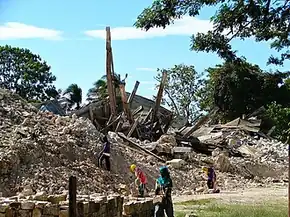
| Ten deadliest recorded earthquakes in the Philippines since the 1600s | ||||||||
|---|---|---|---|---|---|---|---|---|
| Magnitude | Location | Date | Deaths | Missing | Injured | Damage | Source | |
| 1 | 8.0 | Moro Gulf | August 16, 1976 | 4,791 | 2,288 | 9,928 | ||
| 2 | 7.8 | Luzon Island | July 16, 1990 | 1,621 | 1,000 | >3,000 | ₱ 10 billion | |
| 3 | 6.4 | Manila | June 3, 1863 | 1,000 | [1][2] | |||
| 4 | 7.5 | Luzon Island | November 30, 1645 | 600–3,000 | >3,000 | Unknown | ||
| 5 | 8.3 | Mati, Davao Oriental | April 14, 1924 | ~500 | [3][4] | |||
| 6 | 7.4 | Lanao del Sur | April 1, 1955 | 465 | Unknown | US$5 million | [5] | |
| 7 | 7.6 | Casiguran, Aurora | August 2, 1968 | 271 | 261 | |||
| 8 | 7.2 | Bohol and Cebu | October 15, 2013 | 222 | 8 | 796 | ₱ 4 billion (est.) | [6] |
| 9 | 6.7 | Negros Oriental | February 6, 2012 | 113 | 112 | ₱ 383 million | ||
| 10 | 6.9 | Cebu | September 30, 2025 | 79 | 1,271 | ₱ 16.2 billion | [7] | |
Tornadoes
| Rank | Areas | Date | Fatalities | F/EF | Notes | References |
|---|---|---|---|---|---|---|
| 1 | Manukan, Zamboanga del Norte | June 12, 1990 | 51 | F2 | [8] | |
| 2 | San Ricardo, Southern Leyte | December 19, 2003 | 50 | F2 | [9] | |
| 3 | Datu Piang, Maguindanao del Sur | November 26, 1994 | 14 | F1 | [10] | |
| – | Valencia, Bukidnon | September 29, 1995 | 14 | –[a] | It caused a landslide that buried houses. | [11] |
| – | Caibiran, Biliran | December 16, 2017 | 14 | –[a] | Spawned by Tropical Storm Kai-tak (2017). It caused a landslide that buried houses. | [12][13] |
| 6 | Malita, Davao del Sur | June 3, 1989 | 13 | F1 | [14] | |
| 7 | Macabebe–Masantol, Pampanga | June 13, 1968 | 12 | F1 | [15] | |
| – | Roxas, Oriental Mindoro | November 20, 2004 | 12 | –[a] | Spawned by Typhoon Muifa (2004). | [16] |
| – | Liguasan Marsh | March 25, 2013 | 12 | –[a] | It capsized an overloaded boat. | [17][18] |
| 10 | Cagayan de Oro, Misamis Oriental | October 23, 1988 | 10 | –[a] | Spawned by Typhoon Ruby (1988). | [19][20] |
Typhoons

| Rank | Storm | Season | Fatalities | Ref. |
|---|---|---|---|---|
| 1 | Yolanda (Haiyan) | 2013 | 6,300 | [21] |
| 2 | Uring (Thelma) | 1991 | 5,101–8,000 | [22] |
| 3 | Pablo (Bopha) | 2012 | 1,901 | [22] |
| 4 | "Angela" | 1867 | 1,800 | [23] |
| 5 | Winnie | 2004 | 1,593 | [23] |
| 6 | "October 1897" | 1897 | 1,500 | [23][24] |
| 7 | Nitang (Ike) | 1984 | 1,426 | [25] |
| 8 | Reming (Durian) | 2006 | 1,399 | [23][22] |
| 9 | Frank (Fengshen) | 2008 | 1,371 | [note 1][26][27] |
| 10 | Sendong (Washi) | 2011 | 1,292–2,546 | [28][29][30] |

| Precipitation | Storm | Location | Ref. | ||
|---|---|---|---|---|---|
| Rank | mm | in | |||
| 1 | 2210.0 | 87.01 | July 1911 cyclone | Baguio | [31] |
| 2 | 1854.3 | 73.00 | Pepeng (Parma) (2009) | Baguio | [32] |
| 3 | 1216.0 | 47.86 | Trining (Carla) (1967) | Baguio | [31] |
| 4 | 1116.0 | 43.94 | Iliang (Zeb) (1998) | La Trinidad, Benguet | [33] |
| 5 | 1085.8 | 42.74 | Feria (Utor) (2001) | Baguio | [34] |
| 6 | 1077.8 | 42.43 | Lando (Koppu) (2015) | Baguio | [32] |
| 7 | 1012.7 | 39.87 | Igme (Mindulle) (2004) | [35] | |
| 8 | 902.0 | 35.51 | Dante (Kujira) (2009) | [36] | |
| 9 | 879.9 | 34.64 | September 1929 typhoon | Virac, Catanduanes | [37] |
| 10 | 869.6 | 34.24 | Openg (Dinah) (1977) | Western Luzon | [38] |

| Rank | Storm | Season | Damage | Ref. | |
|---|---|---|---|---|---|
| PHP | USD | ||||
| 1 | Yolanda (Haiyan) | 2013 | ₱95.5 billion | $2.15 billion | [39] |
| 2 | Odette (Rai) | 2021 | ₱51.7 billion | $1.01 billion | [40] |
| 3 | Glenda (Rammasun) | 2014 | ₱38.6 billion | $771 million | [41] |
| 4 | Pablo (Bopha) | 2012 | ₱36.9 billion | $724 million | [42] |
| 5 | Ompong (Mangkhut) | 2018 | ₱33.9 billion | $627 million | [43] |
| 6 | Pepeng (Parma) | 2009 | ₱27.3 billion | $591 million | [44] |
| 7 | Ulysses (Vamco) | 2020 | ₱20.2 billion | $420 million | [45] |
| 8 | Kristine (Trami) | 2024 | ₱18.4 billion | $373 million | [46] |
| 9 | Rolly (Goni) | 2020 | ₱17.9 billion | $371 million | [45] |
| 10 | Egay (Doksuri) | 2023 | ₱14.8 billion | $267 million | [47] |
Volcanic eruptions


| Event | Date | Notes |
|---|---|---|
| Leonard Kniaseff | c.120 AD.[48] | There was a scare in 1995 but PHIVOLCS investigation at the time did not disclose any unusual activity, and no unusual activity has been reported since. |
| San Pablo Volcanic Field | 1350 AD +/- 100 | Last activity was the formation of Sampaloc Lake around 1350 AD +/- 100 years determined by anthropology[49] |
| Taal eruption | 1572 to 2022 | Currently on eruption since January 12, 2020. Eruptions have also destroyed numerous lakeside towns, burying them with volcanic ash or submerged them by rising lake waters displaced by the erupted material. The towns of Lipa, Taal, Sala, Bauan and Tanauan were formerly located along Taal Lake. Presently, only three towns are on the lake's shore. Remnants of the old lakeside towns are reported to be seen under the lake's waters.[50] |
| Mayon eruption | 1616 to 2018 | The most destructive eruption of Mayon occurred on February 1, 1814 (VEI=4). Lava flowed but not as much compared to the 1766 eruption; Instead, the volcano was belching dark ash and eventually bombarded the town of Cagsawa with tephra that buried it. Trees were burned; rivers were certainly damaged. Proximate areas were also devastated by the eruption, with ash accumulating to 9 m (30 ft) in depth. In Albay, a total of 2,200 locals perished in what is considered to be the most lethal eruption in Mayon's history; estimates by PHIVOLCS list the casualties at about 1,200, however. The eruption is believed to have contributed to the accumulation of atmospheric ash, capped by the catastrophic eruption of Mount Tambora in 1815, that led to the Year Without a Summer in 1816. |
| Pinatubo eruption | 1500 to 2021 | Reawakened in 1991 producing the 2nd largest eruption in the 20th century. Followed by milder eruptions in 1992 and 1993.[51] |
| Mt. Kanlaon eruption | 1886 to 2024 | The most active volcano in the Visayas, Kanlaon has erupted 26 times since 1919. Eruptions are typically phreatic explosions of small-to-moderate size that produce minor ash falls near the volcano. In 1902, the eruption was classified as strombolian, typified by the ejection of incandescent cinder, lapilli and lava bombs. |
| Bulusan eruption | 1886 to 2022 | Bulusan is generally known for its sudden steam-driven or phreatic explosions. It has erupted 16 times since 1885 and is considered as the 4th most active volcano in the Philippines after Mayon, Taal, and Kanlaon. There are evacuation procedures in place for parts of the peninsula, the farms nearest the volcano are evacuated, and many of the village schools are closed if it is considered possible that a more destructive eruption could occur. |
| Mt. Hibok-Hibok eruption | 1827, 1862, 1871 and 1948–1952 | On February 16, 1871, earthquakes and subterranean rumblings began to be felt in Camiguin, which increased in severity until April 30 when a volcanic fissure opened up 400 yards southwest of the village of Catarman, on the northwest flank of the Hibok-Hibok Volcano. From the opening, lava was continuously ejected and poured into the sea for four years destroying the town. At the same time, the vent started gaining in height and width thus forming Mt. Vulcan. In 1875, the Challenger expedition visited the area, and described the mountain as a dome, about 1,950 feet (590 m) in height, without any crater, but still smoking and incandescent at the top.[52] |
Notes
- ↑ The death and missing columns includes deaths caused by Typhoon Fengshen (Frank), in the MV Princess of the Stars disaster.
See also
- List of man-made disasters in the Philippines, for man-made disasters in the Philippines
- List of earthquakes in the Philippines
- List of Philippine tornadoes
- List of Philippine typhoons
- List of active volcanoes in the Philippines
- List of inactive volcanoes in the Philippines
- List of potentially active volcanoes in the Philippines
- PAGASA
- PHIVOLCS
References
- ↑ "The Project Gutenberg eBook of Catalogue of Violent and Destructive Earthquakes in the Philippines, by Rev. Miguel Saderra Masó, S.J." Retrieved 2022-07-29 – via Project Gutenberg.
- ↑ Gealogo, Francis A. (2016). "Historical Seismology and the Documentation of Postdisaster Conditions: The 1863 and 1880 Luzon Earthquakes". Philippine Studies: Historical and Ethnographic Viewpoints. 64 (3–4): 359–384. doi:10.1353/phs.2016.0033. JSTOR 26621935. S2CID 151885877.
- ↑ durianburgdavao (2015-06-19). "UPDATES: PHIVOLCS WARNS OF DAVAO 'KILLER QUAKE'". THE DURIAN POST. Archived from the original on July 29, 2022. Retrieved 2022-08-02.
- ↑ "M 8.1 – 6 km E of Tibanbang, Philippines". United States Geological Survey. Retrieved 2022-08-02.
- ↑ "Significant earthquakes: Philippines". National Geophysical Data Center / World Data Service (NGDC/WDS): NCEI/WDS Global Significant Earthquake Database. NOAA National Centers for Environmental Information. Retrieved 2023-12-18.
- ↑ "Massive extremely dangerous earthquake in Bohol, Philippines – At least 222 people killed, 8 missing, over 790 injured, around 4 billion PHP damage, 7 billion PHP reconstruction costs". Earthquake-Report.com. November 14, 2013. Archived from the original on November 26, 2013. Retrieved December 16, 2019.
- ↑ Argosino, Faith (October 17, 2025). "Cebu earthquake death toll rises to 79 – NDRRMC". Inquirer.net.
- ↑ Zambo Norte declared in state of calamity. Manila Standard. June 24, 1990.
- ↑ "Tornado destroys village 50 die in Southern Leyte". samarnews.com. Retrieved 2026-02-05.
- ↑ "Philippines Tornado Toll". Los Angeles Times. Associated Press. November 29, 1994. Retrieved November 21, 2020.
- ↑ "Tornado causes landslide, kills 14". UPI. September 30, 1995. Retrieved January 21, 2026.
- ↑ "25 dead, 26 missing". Philstar.com. Retrieved 2026-02-01.
- ↑ "'Urduja' weakens, leaves at least 31 dead". INQUIRER.net. 2017-12-18. Retrieved 2026-02-01.
- ↑ "Tornado Kills 13 in Davao". Manila Standard. June 4, 1989. Retrieved November 21, 2020.
- ↑ Grazulis, Thomas P. (2001). The Tornado: Nature's Ultimate Windstorm. University of Oklahoma Press. p. 259. ISBN 0-8061-3538-7.
- ↑ "Philippines: GMA releases P5 M for typhoon victims in Oriental Mindoro". ReliefWeb. 2004-11-25. Retrieved 2026-04-25.
- ↑ "'Freak tornado' leaves 12 dead". RAPPLER. 2013-03-27. Retrieved 2026-02-03.
- ↑ "Philippines (the): Tornado: 2013/03/25". Asian Disaster Reduction Center. Archived from the original on January 15, 2026. Retrieved 2026-05-16.
- ↑ "10 killed as tornado hits Philippines". The Canberra Times. October 24, 1988.
- ↑ "Typhoon spawns twister in Philippines". UPI. October 23, 1988. Retrieved March 5, 2026.
- ↑ Del Rosario, Eduardo D (August 9, 2011). Final Report on Typhoon "Yolanda" (Haiyan) (PDF) (Report). Philippine National Disaster Risk Reduction and Management Council. pp. 77–148. Archived (PDF) from the original on November 5, 2020. Retrieved March 27, 2022.
- 1 2 3 Alojado, Dominic (2015). Worst typhoons of the Philippines (1947-2014) (PDF) (Report). Weather Philippines. Retrieved September 25, 2015.
- 1 2 3 4 "10 Worst Typhoons that Went Down in Philippine History". M2Comms. August 3, 2016. Retrieved August 3, 2016.
- ↑ Lotilla, Raphael (November 20, 2013). "Flashback: 1897, Leyte and a strong typhoon". Rappler. Retrieved July 10, 2014.
- ↑ "Deadliest typhoons in the Philippines". ABS-CBNNews. November 8, 2013. Archived from the original on November 13, 2013. Retrieved November 8, 2013.
- ↑ Padua, David M (June 10, 2011). "Tropical Cyclone Logs: Fengshen (Frank)". Typhoon 2000. Archived from the original on December 1, 2010. Retrieved December 31, 2011.
- ↑ Rabonza, Glenn J. (July 31, 2008). Situation Report No. 33 on the Effects of Typhoon "Frank"(Fengshen) (PDF) (Report). National Disaster Coordinating Council (National Disaster Risk Reduction and Management Center). Archived (PDF) from the original on September 27, 2013. Retrieved December 31, 2011.
- ↑ Olavo Rasquinho; Jae Hyun Shim; Yun Tae Kim; Jae Chan Ahn; Chi Hun Lee; In Sung Jung; Gmma Dalena; Preminda Joseph Fernando; Susan R. Espinueva; Socrates F. Paat Jr.; Nivagine Nievares & Tess Pajarillo (December 2012). Assessment Report of the Damages Caused by Tropical Storm Washi (PDF) (Report). ESCAP/WMO Typhoon Committee. ISBN 978-99965-817-6-2. Retrieved May 1, 2015.
- ↑ Emergency appeal final report - Philippines: Tropical Storm Washi (PDF) (Report). International Federation of Red Cross and Red Crescent Societies. August 21, 2013. Retrieved May 1, 2015.
- ↑ Padua, David M (2011). "Tropical Cyclone Logs: Sendong (Washi) 2011". Typhoon 2000. Retrieved December 31, 2011.
- 1 2 J. L. H. Paulhaus (1973). World Meteorological Organization Operational Hydrology Report No. 1: Manual For Estimation of Probable Maximum Precipitation. World Meteorological Organization. p. 178.
- 1 2 Nick Wiltgen (October 21, 2015). "Former Super Typhoon Koppu (Lando) Weakens to Remnant Low over Northern Philippines". The Weather Channel. Retrieved October 21, 2015.
- ↑ Guillermo Q. Tabios III; David S. Rojas Jr. Rainfall Duration-Frequency Curve for Ungaged Sites in the High Rainfall, Benguet Mountain Region in the Philippines (PDF) (Report). Kyoto University. Retrieved June 2, 2015.
- ↑ Leoncio A. Amadore, Ph.D. Socio-Economic Impacts of Extreme Climatic Events in the Philippines. Retrieved on February 25, 2007.
- ↑ Padgett, Gary; Kevin Boyle; John Wallace; Huang Chunliang; Simon Clarke (October 26, 2006). "Monthly Global Tropical Cyclone Summary June 2004". Australian Severe Weather Index. Jimmy Deguara. Retrieved January 13, 2007.
- ↑ Steve Lang (May 7, 2009). "Hurricane Season 2009: Kujira (Western Pacific Ocean)". NASA. Retrieved December 23, 2011.
- ↑ Coronas, José (September 1929). "Typhoons and Depressions – a Destructive Typhoon Over Southern and Central Luzon on September 2 and 3, 1929" (PDF). Monthly Weather Review. 57 (9). American Meteorological Society: 398–399. Bibcode:1929MWRv...57..398C. doi:10.1175/1520-0493(1929)57<398b:TADDTO>2.0.CO;2. Archived from the original (PDF) on 25 Feb 2017. Retrieved September 26, 2015.
- ↑ Narciso O. Itoralba (December 1981). Annual Tropical Cyclone Report 1977. Philippine Atmospheric, Geophysical and Astronomical Services Administration. p. 65.
- ↑ Del Rosario, Eduardo D (13 November 2015). Final Report on Typhoon "Yolanda" (Haiyan) (PDF) (Report). Philippine National Disaster Risk Reduction and Management Council. Archived from the original (PDF) on 5 November 2020. Retrieved 8 October 2025.
- ↑ Annual Report on Philippine Tropical Cyclones 2021 (PDF) (Report). Philippine Atmospheric, Geophysical and Astronomical Services Administration. May 2024. ISSN 2799-0575. Archived (PDF) from the original on 26 February 2025. Retrieved 26 February 2025.
- ↑ Pama, Alexander P (16 September 2014). Final Report re: Effects of Typhoon Glenda (Rammasun) (PDF) (Report). Philippine National Disaster Risk Reduction and Management Council. Archived from the original (PDF) on 7 October 2016. Retrieved 28 September 2025.
- ↑ Ramos, Benito T (25 December 2012). Sitrep No: 38 re: Effects of Typhoon "Pablo" (Bopha) (PDF) (Report). Philippine National Disaster Risk Reduction and Management Council. Archived (PDF) from the original on 21 January 2013. Retrieved 1 October 2025.
- ↑ Annual Report on Philippine Tropical Cyclones (2018) (PDF) (Report). Philippine Atmospheric, Geophysical and Astronomical Services Administration. June 2020. ISSN 2799-0575. Archived (PDF) from the original on 3 January 2022. Retrieved 27 March 2022.
- ↑ Rabonza, Glenn J (27 September 2010). Final Report on Tropical Storm "Ondoy" (Ketsana) and Typhoon "Pepeng" (Parma) (PDF) (Report). Philippine National Disaster Coordinating Council. pp. 4–5. Archived (PDF) from the original on 19 January 2017. Retrieved 27 March 2022.
- 1 2 Annual Report on Philippine Tropical Cyclones 2020 (PDF) (Report). 17 March 2023. ISSN 2799-0575. Archived (PDF) from the original on 2 September 2023. Retrieved 2 September 2023.
- ↑ Situational Report No. 37 for Combined Effects of TCs Kristine and Leon (2024) (PDF) (Report). Philippine National Disaster Risk Reduction and Management Council. December 5, 2024. Retrieved December 5, 2024.
- ↑ Gile, Rob P; Bulquerin, J. E. M; Duran, Samuel F (22 August 2023). Tropical Cyclone Preliminary Report: Super Typhoon Egay (Doksuri) (PDF) (Report). Philippine Atmospheric, Geophysical and Astronomical Services Administration. Archived (PDF) from the original on 26 April 2025. Retrieved 27 September 2025.
- ↑ "Leonard Range Eruption History". Global Volcanism Program. Retrieved on 2011-08-18.
- ↑ "San Pablo Volcanic Field Eruption History". Global Volcanism Program. Retrieved on 2011-08-18.
- ↑ Hargrove, Thomas (1991). "The Mysteries of Taal, a Philippine volcano and lake, her sea life and lost towns". Bookmark, Manila. ISBN 971-569-046-7.
- ↑ USGS. "Earthquake Information for 1990". Archived from the original on 2009-12-06. Retrieved 2010-03-06.
- ↑ Becker, George F. (1901). "Report on the Geology of the Philippine Islands", p.42-43. Washington Government Printing Office, 1901.
External links
- DSWD Disaster Response Operations Monitoring, Information and Communication
- Official Website of the National Museum of Natural History
- PreventionWeb Philippines
| Overview |
| ||||||||||||||||||||||||||||||||||||||||||||
|---|---|---|---|---|---|---|---|---|---|---|---|---|---|---|---|---|---|---|---|---|---|---|---|---|---|---|---|---|---|---|---|---|---|---|---|---|---|---|---|---|---|---|---|---|---|
| Disasters |
| ||||||||||||||||||||||||||||||||||||||||||||
| Preparation | |||||||||||||||||||||||||||||||||||||||||||||
| Countermeasures | |||||||||||||||||||||||||||||||||||||||||||||
| Media | |||||||||||||||||||||||||||||||||||||||||||||
| Organizations | |||||||||||||||||||||||||||||||||||||||||||||
| |||||||||||||||||||||||||||||||||||||||||||||
