Monocrepidius exsul
| Monocrepidius exsul | |
|---|---|
 | |
Scientific classification  | |
| Kingdom: | Animalia |
| Phylum: | Arthropoda |
| Clade: | Pancrustacea |
| Class: | Insecta |
| Order: | Coleoptera |
| Suborder: | Polyphaga |
| Infraorder: | Elateriformia |
| Family: | Elateridae |
| Genus: | Monocrepidius |
| Species: | M. exsul |
| Binomial name | |
| Monocrepidius exsul (Sharp, 1877) | |
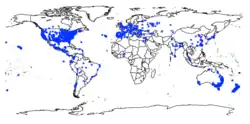 | |
| Distribution of Monocrepidius exsul from iNaturalist (as of August 2026) | |
| Synonyms | |
|
Conoderus exsul (Sharp, 1877) | |
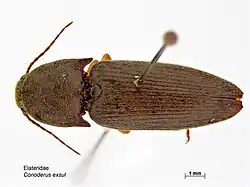
Monocrepidius exsul, known generally as the pasture wireworm or sugarcane wireworm, is a species of click beetle in the family Elateridae. It is native to New Zealand[1], Australia and Hawaii. It has been introduced to North America[2] and to Europe, such as France and Spain[3].
Description
Monocrepidius exsul are large click beetles with sexual size dimorphism as adults. Males are 8.5mm - 12 mm in length, while larger females are 11mm - 13mm in length[4]. Adults have elongated and narrow bodies with a cylindrical or flat body. They can be brown or black in colour[5].
The larvae of Monocrepidius exsul are white when young, however they become more cream in colour through moults[4]. A full grown larvae can be 15mm - 19mm long and 2.2mm - 2.8mm wide[4].
Pupae are opaque white at the start, but over time begin to appear cream in colouration with dark spots. These can vary from 8mm - 14mm in length and 2.5mm - 3.4mm in width[4].

Diet
Monocrepidius exsul are omnivores; they feed on plants and insects. Such as wheat seeds[6], grass grub, and larvae of white-fringed weevil and soldier flies[7][8]. In Hawaii and Australia, Monocrepidius exsul mainly eats sugar cane shoots[9]. As larvae, they feed on grass roots[9].
Lifecycle
Eggs are laid from June to early September. The eggs hatch into larvae, where they will remain in larval stage for 8 to 12 months. After the larval stage, there is the pupae stage, which can range from 14 to 18 days. The average adult stage length is 38 days[4].
Habitat
Monocrepidius exsul can be found underground in open areas[10] mainly dominated by grass[11]. They can be found in places like grasslands and pastures[12]. Larvae can be found within the soil[5].
References
- ↑ Sharp, D. (1877-05-01). "XXXIX.—On the Elateridæ of New Zealand". Annals and Magazine of Natural History. 19 (113). Taylor & Francis: 396–413. doi:10.1080/00222937708682163. ISSN 0374-5481.
- ↑ Johnson, P.; Steury, Brent (2021-01-01). "The Elateroid Beetles of the George Washington Memorial Parkway, Virginia, USA, including new state records". 8: 31–51.
{{cite journal}}: Cite journal requires|journal=(help) - ↑ Zapata de la Vega, José Luis; Sánchez Ruiz, Antonio (2022). "Nuevas aportaciones al catálogo de la familia Elateridae (Coleoptera) en la Península Ibérica e Islas Baleares, VIII". Arquivos Entomolóxicos (25). Fernando Prieto Piloña: 373–441. ISSN 1989-6581.
- 1 2 3 4 5 Stone, M.W. (October 1976). Notes on the Biology of the Introduced Elaterid Conoderus exsul (Sharp). The Pan-Pacific Entomologist.
{{cite book}}: CS1 maint: date and year (link) - 1 2 Barker, G. M.; Watt, J. C.; Klimaszewski, J. (October 1997). Coleoptera: Family-Group Review and Keys to Identification (Coleoptera). Balogh Scientific Books. ISBN 978-0-478-09312-4.
- ↑ Williams, E. M.; Galbreath, R. A. (January 1987). "Diet and development in Conoderus exsul and Agrypnus variabilis (Coleoptera: Elateridae)". New Zealand Journal of Zoology. 14 (1): 85–88. doi:10.1080/03014223.1987.10422684. ISSN 0301-4223.
- ↑ Robertson, L.n. (1987). "Food habits of pasture wireworm, Conoderus exsul (Coleoptera: Elateridae)". New Zealand Journal of Zoology. 14 (4): 535–542. doi:10.1080/03014223.1987.10423026. ISSN 1175-8821.
- ↑ Robertson, L. N.; Firth, A. C.; Davison, R. H. (1981-07-01). "Predation on Australian soldier fly, Inopus rubriceps (Diptera: Stratiomyidae), in pasture". New Zealand Journal of Zoology. 8 (3). John Wiley & Sons, Ltd: 431–439. doi:10.1080/03014223.1981.10430624. ISSN 1175-8821.
- 1 2 Stone, M. W. (1975). "Distribution of Four Introduced Conoderus Species in California (Coleoptera: Elateridae)". The Coleopterists Bulletin. 29 (3). The Coleopterists Society: 163–166. doi:10.5962/p.372772. ISSN 0010-065X. JSTOR 3999792.
- ↑ Watts, Corinne H.; Clarkson, Beverley R.; Didham, Raphael K. (2008-02-01). "Rapid beetle community convergence following experimental habitat restoration in a mined peat bog". Biological Conservation. 141 (2): 568–579. Bibcode:2008BCons.141..568W. doi:10.1016/j.biocon.2007.12.008. ISSN 0006-3207.
- ↑ "Insect diversity in forests and pastoral areas in Whangamata New Zealand". www.fao.org. Retrieved 2026-08-28.
- ↑ McClean, John A.; Jones, Diane C. (2006). "Beetle diversity in forest and pastoral areas, Whangamata, Coromandel Peninsula". New Zealand Natural Sciences. doi:10.26021/358. hdl:10092/100582.
{{cite journal}}: Cite journal requires|journal=(help)