Mohammed Yusuf (Boko Haram)
Mohammed Yusuf | |
|---|---|
 | |
| Born | 29 January 1970 |
| Died | 30 July 2009 (aged 39) |
Cause of death | Summary execution |
| Allegiance | Boko Haram |
Service years | 2002–2007 |
Rank | Leader |
Conflicts | Boko Haram insurgency |

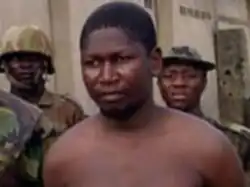
Mohammed Yusuf (29 January 1970 – 30 July 2009), also known by his nom de guerre Abu Yusuf al-Barnawi,[1] was a Nigerian militant who founded the Islamist militant group Boko Haram in 2002. He was its leader until he was killed during the 2009 Boko Haram uprising.[2]
Born in Girgi village, in Jakusko, present-day Yobe State, Nigeria, Yusuf received a university education.[3] Later he studied more of Islam and became a Salafi.[4]
Education and beliefs
According to scholar Paul Lubeck, as a young man Yusuf was instructed in Shia Islam.[5] He had the equivalent of a graduate education, according to Nigerian academic Hussain Zakaria. Yusuf was not as proficient in English as was reported. He believed in the strict application of Islamic law, Boko Haram hitmen would murder members of other Muslim sects like the Salafist Izala and the Sufi Tidjaniyya and Qadiriya fraternities.[6] In a 2009 BBC interview, Yusuf stated his belief that the concept of a spherical Earth is contrary to Islamic teaching and should be rejected. He also rejected Darwinian evolution, and the concept of the condensation cycle that produces rain.[7] In the interview he said:
There are prominent Islamic preachers who have seen and understood that the present Western-style education is mixed with issues that run contrary to our beliefs in Islam, he said.
Like rain. We believe it is a creation of God rather than an evaporation caused by the sun that condenses and becomes rain.
Like saying the world is a sphere. If it runs contrary to the teachings of Allah, we reject it. We also reject the theory of Darwinism.
Personal life
Yusuf had four wives and 11 children,[8] one of them being Abu Musab al-Barnawi, who claimed since 2016 to be the rightful leader of Boko Haram, opposing Abubakar Shekau.[9]
He was reported as living a lavish lifestyle, supposedly owning a Mercedes-Benz.[7]
Death
Following the July 2009 Boko Haram uprising, the Nigerian military captured Yusuf. They transferred him to the custody of the Nigerian police force.[10] The police summarily executed Yusuf in public view outside the police headquarters in Maiduguri.[11][12][13] Police officials initially claimed either that Yusuf was shot while trying to escape or died of wounds he sustained during a gun battle with the military.[12][13]
References
- ↑ Joscelyn, Thomas (4 August 2016). "Jihadists argue over leadership of Islamic State's West Africa province". FDD's Long War Journal. Archived from the original on 9 March 2026. Retrieved 1 January 2026.
- ↑ Boko Haram: The Emerging Jihadist Threat in West Africa – Background, Anti-Defamation League, 12 December 2011.
- ↑ Militancy and Violence in West Africa: Religion, politics and radicalisation Archived 6 September 2024 at the Wayback Machine edited by James Gow, Funmi Olonisakin, Ernst Dijxhoorn, ISBN 9780415821377, via books.google.co.uk, page 74
- ↑ Dowd, Robert A. (1 July 2015). Christianity, Islam, and Liberal Democracy: Lessons from Sub-Saharan Africa. Oxford University Press. p. 102. ISBN 9780190225216.
- ↑ Johnson, Toni (27 December 2011). "Backgrounder – Boko Haram". www.cfr.org. Council of Foreign Relations. Archived from the original on 25 May 2013. Retrieved 12 March 2012.
- ↑ Vicky, Alain (1 April 2012). "Aux origines de la secte Boko Haram". Le Monde diplomatique (in French). Archived from the original on 4 December 2019. Retrieved 4 December 2019.
- 1 2 "Nigeria's 'Taliban' enigma". BBC News. 28 July 2009. Archived from the original on 29 July 2009. Retrieved 28 July 2009.
- ↑ "Nigeria sect head dies in custody". BBC News. BBC. 31 July 2009. Archived from the original on 25 March 2012. Retrieved 25 May 2012.
- ↑ "Shekau Resurfaces, Accuses New Boko Haram Leader al-Barnawi Of Attempted Coup". 360nobs. 4 August 2016. Archived from the original on 17 July 2018. Retrieved 16 July 2018.
- ↑ "Nigeria row over militant killing". BBC News. 31 July 2009. Archived from the original on 30 June 2015. Retrieved 27 June 2015.
- ↑ Adam Nossiter & David D. Kirkpatrick (7 May 2014). "Abduction of Girls an Act Not Even Al Qaeda Can Condone". The New York Times. Archived from the original on 8 May 2014. Retrieved 8 May 2014.
- 1 2 Human Rights Watch (11 October 2012). "Spiraling Violence: Boko Haram Attacks and Security Force Abuses in Nigeria". Human Rights Watch. Archived from the original on 20 February 2015. Retrieved 27 June 2015.
- 1 2 "Video shows Nigeria 'executions'". Al Jazeera. 9 February 2010. Archived from the original on 25 July 2015. Retrieved 27 June 2015.
External links
- Al Jazeera (9 February 2010), Video shows Nigeria 'executions'
- Duodu, Cameron (6 August 2009), "Mohammed Yusuf's final days", The Guardian
- Human Rights Watch (2012), "Spiraling Violence: Boko Haram Attacks and Security Force Abuses in Nigeria", 11 October 2012
- Murtada, Ahmad (2013), Boko Haram: Its Beginnings, Principles and Activities in Nigeria, Islamic Studies Department, University of Bayero, Kano, Nigeria
- 1970 births
- 2009 deaths
- Boko Haram members
- Extrajudicial killings in Africa
- People shot dead by law enforcement officers in Nigeria
- People executed by Nigeria
- Prisoners who died in Nigerian detention
- Nigerian people who died in prison custody
- People from Yobe State
- Leaders of jihadist groups
- Nigerian Salafis
- Flat Earth proponents
- Muslim creationists
- Nigerian conspiracy theorists