Mohammad Yaqoobi
Muhammad al-Yaqoobi | |
|---|---|
محمد اليعقوبي | |
 | |
| Title | Grand Ayatollah |
| Personal life | |
| Born | September 9, 1960 |
| Website | www |
| Religious life | |
| Religion | Usuli Twelver Shi`a Islam |
| Senior posting | |
| Based in | Najaf, Iraq |
| Post | Grand Ayatollah |
Period in office | 2003–present |
| Predecessor | Mohammad Mohammad Sadeq al-Sadr |
| Part of a series on Shia Islam |
| Twelver Shi'ism |
|---|
 Shia Islam portal |
Mohammad al-Yaqoobi (Arabic: محمد اليعقوبي; born September 9, 1960) is a prominent Iraqi Twelver Shi'a Marja'.[1][2] He is the second most widely followed Marja' in Iraq, the most widely followed being Ali al-Sistani.[3] As well as heading the Al-Sadr Religious University in Najaf, he established one of the largest women's Hawzas in Iraq, and oversees many charitable organisations within Iraq.[4][5] He is an active figure within Iraqi politics, and is considered by the Hawza to be the spiritual successor of Mohammad Mohammad Sadeq al-Sadr and the school of Muhammad Baqir al-Sadr, with the former famously naming Yaqoobi his successor in an audio recording.[6]
Education
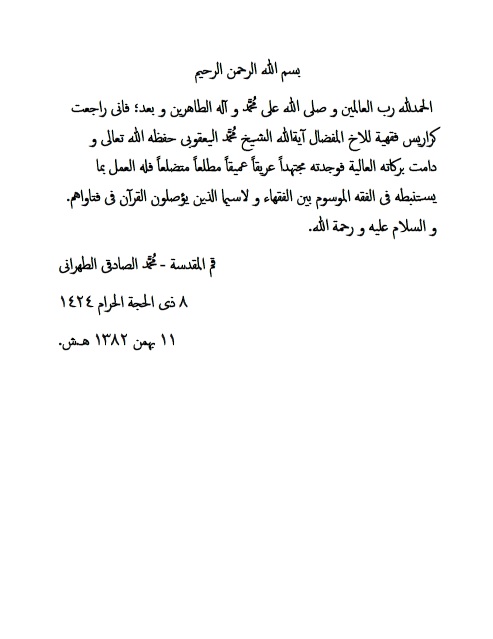
Yaqoobi graduated with a BA in civil engineering from the University of Baghdad in 1982 and joined the Hawza Najaf in 1988. In Najaf, he studied under various scholars, most notably Ayatollah Abu al-Qasim al-Khoei, under whom he was ordained with his religious turban, and Ayatollah Mohammad Mohammad Sadeq al-Sadr. He maintained a close relationship with Grand Ayatollah Mohammad Mohammad Sadeq al-Sadr, who, amongst others, granted him his Ijtihad in 1998.[7] Amongst these testimonies is the Ijtihad testimony of Mohammad Sadeqi Tehrani, the well known expert exegete of the Quran and student of Muhammad Husayn Tabatabai who in particular highlights Yaqoobi's expertise in deriving religious law from the Quran.[8]
Political views
On June 13, 2025, Mohammad Yaqoobi condemned the Israeli attack on Iran, calling the attacks on residential areas, nuclear facilities, and service centers in Iran “barbaric attacks.” He said that Israel was founded on oppression and aggression, and that these attacks were intended to force Muslim nations to surrender. Yaqubi also referred to the killing of Iranian commanders and nuclear scientists, saying that the fate of all humans is death, but there is a difference between someone who dies as a martyr and someone who faces humiliation and torment.[9][10]
On March 1, 2026, Mohammad Yaqubi issued a message condoling the death of Ali Khamenei, referring to him as the “leader of the Islamic Revolution.” Yaqubi said that Khamenei had achieved his long-sought wish of martyrdom in the way of God.[11]
See also
References
- ↑ "List of Maraji in Arabic". iraqshia.net. Archived from the original on November 2, 2012.
- ↑ "سماحة المرجع اليعقوبي (دام ظله)". www.yaqoobi.com (in Persian). Retrieved August 22, 2023.
- ↑ Fotini Christia, Elizabeth Dekeyser and Dean Knox, To Karbala: Surveying Religious Shia from Iran and Iraq, Massachusetts Institute of Technology (2016)
- ↑ "Najaf's return as a religious tourist destination". BBC. February 27, 2010.
- ↑ "Asia Times Online :: Middle East News, Iraq, Iran current affairs". www.atimes.com. Archived from the original on May 27, 2007. Retrieved January 14, 2022.
- ↑ Mervin Sabrina, Les mondes chiites et l'Iran, Karthala (2007)
- ↑ Ayatollah Al Sayyid Mohammad Al Yaqoobi niqash.org
- ↑ Yaghoobi bayanbox.ir (in Persian)
- ↑ "المرجع اليعقوبي عن هجوم إسرائيل: شتّان بين من يُختم له بالشهادة ومن يعيش المذلة". شبكة 964 (in Arabic). June 13, 2025. Retrieved August 15, 2026.
- ↑ "المرجع الديني الشيخ محمد اليعقوبي - أصدر سماحة المرجع الديني الشيخ محمد اليعقوبي (دام ظله) البيان التالي حول تعرّض المنشآت العسكرية والمدنية في جمهورية إيران الإسلامية للقصف الصهيوني". yaqoobi.com. Retrieved August 15, 2026.
- ↑ "المرجع اليعقوبي يعزي باستشهاد السيد الخامنئي » وكالة الانباء العراقية (واع)". وكالة الانباء العراقية (واع) (in Arabic). Retrieved August 15, 2026.