Mitra (crater)
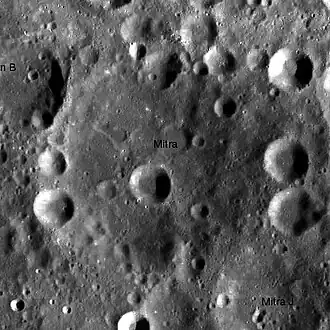 LRO WAC image | |
| Coordinates | 18°00′N 154°42′W / 18.0°N 154.7°W |
|---|---|
| Diameter | 92 km |
| Depth | Unknown |
| Colongitude | 155° at sunrise |
| Eponym | Sisir K. Mitra |
Mitra is a lunar impact crater on the far side of the Moon.[1] It is named after Sisir Kumar Mitra, who was an Indian physicist and Padma Bhushan award recipient known for his pioneering work in the field of ionosphere and radiophysics.[2] The crater was named in 1970 by the IAU.[3]
This is a heavily eroded formation with an outer rim that has been damaged by subsequent impacts. Attached to the exterior along the southeast is the satellite crater Mitra J. A number of smaller impacts lie along the rim edge, and very little of the original rim remains intact. Within the interior, a smaller crater occupies the southwestern part of the floor, and a small, cup-shaped crater lies across the northeast rim of this formation and very close to the midpoint of Mitra.
Mitra lies within the Dirichlet–Jackson Basin.[4] It is attached west of the larger crater Mach. Just to the west of Mitra is Bredikhin, and to the south-southeast lies Henyey.
Satellite craters
By convention these features are identified on lunar maps by placing the letter on the side of the crater midpoint that is closest to Mitra.
| Mitra | Latitude | Longitude | Diameter |
|---|---|---|---|
| A | 20.8° N | 154.1° W | 46 km |
| J | 15.9° N | 153.2° W | 46 km |
| Y | 21.5° N | 155.2° W | 26 km |
See also
References
- ↑ Moore, Patrick (2000). The Data Book of Astronomy. CRC Press. p. 70. ISBN 978-1-4200-3344-1.
- ↑ "ISRO releases fresh set of photos of moon craters". The Economic Times. 26 August 2019.
- ↑ Mitra, Gazetteer of Planetary Nomenclature, International Astronomical Union (IAU) Working Group for Planetary System Nomenclature (WGPSN)
- ↑ Deng, Jiayin; et al. (December 2022). "Diverse Geological Evolution of Impact Basins on the Moon". Remote Sensing. 14 (24): 6335. Bibcode:2022RemS...14.6335D. doi:10.3390/rs14246335.
Sources
- Andersson, L. E.; Whitaker, E. A. (1982). NASA Catalogue of Lunar Nomenclature. NASA RP-1097.
- Blue, Jennifer (July 25, 2007). "Gazetteer of Planetary Nomenclature". USGS. Retrieved 2007-08-05.
- Bussey, B.; Spudis, P. (2004). The Clementine Atlas of the Moon. New York: Cambridge University Press. ISBN 978-0-521-81528-4.
- Cocks, Elijah E.; Cocks, Josiah C. (1995). Who's Who on the Moon: A Biographical Dictionary of Lunar Nomenclature. Tudor Publishers. ISBN 978-0-936389-27-1.
- McDowell, Jonathan (July 15, 2007). "Lunar Nomenclature". Jonathan's Space Report. Archived from the original on 2012-02-08. Retrieved 2007-10-24.
- Menzel, D. H.; Minnaert, M.; Levin, B.; Dollfus, A.; Bell, B. (1971). "Report on Lunar Nomenclature by the Working Group of Commission 17 of the IAU". Space Science Reviews. 12 (2): 136–186. Bibcode:1971SSRv...12..136M. doi:10.1007/BF00171763. S2CID 122125855.
- Moore, Patrick (2001). On the Moon. Sterling Publishing Co. ISBN 978-0-304-35469-6.
- Price, Fred W. (1988). The Moon Observer's Handbook. Cambridge University Press. ISBN 978-0-521-33500-3.
- Rükl, Antonín (1990). Atlas of the Moon. Kalmbach Books. ISBN 978-0-913135-17-4.
- Webb, Rev. T. W. (1962). Celestial Objects for Common Telescopes (6th revised ed.). Dover. ISBN 978-0-486-20917-3.
{{cite book}}: ISBN / Date incompatibility (help) - Whitaker, Ewen A. (1999). Mapping and Naming the Moon. Cambridge University Press. ISBN 978-0-521-62248-6.
- Wlasuk, Peter T. (2000). Observing the Moon. Springer. ISBN 978-1-85233-193-1.