Milner–Rado paradox
In set theory, a branch of mathematics, the Milner–Rado paradox, found by Eric Charles Milner and Richard Rado (1965), states that every ordinal number less than the successor of a given cardinal number can be written as the union of sets where is of order type at most for a positive integer.


Proof
The proof is by transfinite induction. Let be a limit ordinal (the induction is trivial for successor ordinals), and for each , let be a partition of satisfying the requirements of the theorem.


Fix an increasing sequence cofinal in with .


Note .

Define:

Observe that:

and so .

Let be the order type of . As for the order types, clearly .


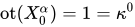
Noting that the sets form a consecutive sequence of ordinal intervals, and that each is a tail segment of , then:



References
- Milner, E. C.; Rado, R. (1965), "The pigeon-hole principle for ordinal numbers", Proceedings of the London Mathematical Society, Series 3, 15: 750–768, doi:10.1112/plms/s3-15.1.750, MR 0190003
- Hajnal, A.; Larson, J.A. (2010), "Partition Relations", in Foreman, M.; Kanamori, A. (eds.), Handbook of Set Theory, vol. 1, Springer, pp. 129–214
- How to prove Milner-Rado Paradox? - Mathematics Stack Exchange