Argentinian coral snake
| Argentinian coral snake | |
|---|---|
 | |
| Micrurus pyrrhocryptus | |
Scientific classification  | |
| Kingdom: | Animalia |
| Phylum: | Chordata |
| Class: | Reptilia |
| Order: | Squamata |
| Suborder: | Serpentes |
| Family: | Elapidae |
| Genus: | Micrurus |
| Species: | M. pyrrhocryptus |
| Binomial name | |
| Micrurus pyrrhocryptus (Cope, 1862) | |
 | |
| Synonyms[2] | |
| |

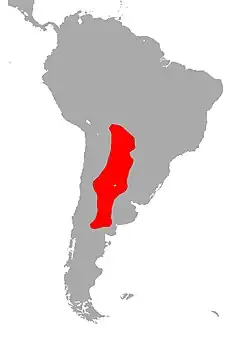
The Argentinian coral snake (Micrurus pyrrhocryptus) is a species of venomous snake in the family Elapidae. The species is native to central South America,[2] particularly the Dry Chaco region.[3]
Description
Large for the genus Micrurus, an adult of Micrurus pyrrhocryptus usually has a total length (tail included) of 70–90 cm (28–35 in). The maximum recorded total length is 1.24 m (4.1 ft).[4]
Like many other New World coral snakes, the color pattern consists of red, white, and black rings, with the black rings arranged in triads. The central ring of each black triad is 17–35 dorsal scales wide, and is usually wider than the outer black rings of the triad. There are 5–9 triads on the body. The red rings are 13–60 dorsal scales wide, the width varying inversely with the number of triads. The white rings are three dorsal scales wide, and these dorsal scales have black tips.[4]
There does not appear to be sexual dimorphism in scalation in this species, which is unusual for its genus. Males have 214–238 ventrals and 25–30 subcaudals, and females have 216–238 ventrals and 23–29 subcaudals.[4]
Geographic distribution
Micrurus pyrrhocryptus is found in northern Argentina, southeastern Bolivia, extreme southwestern Brazil, and western Paraguay.[1][2]
Habitat
Micrurus pyrrhocryptus occurs in a variety of semiarid habitats including forest, savanna, shrubland, and grassland, at elevations of 100–500 m (330–1,640 ft).[1]
Behavior
Micrurus pyrrhocryptus is terrestrial.[1]
Diet
Micrurus pyrrhocryptus preys on amphisbaenians and snakes, including its own species.[4][5]
Reproduction
Venom
Micrurus pyrrhocryptus possesses a powerful venom. The estimated lethal dose for an adult human is 8–10 mg (dry weight). When specimens were "milked" of their venom, the average venom yield was 8 mg. However, the maximum venom yield was 80 mg, which is eight to ten times the estimated lethal dose.[4]: 102
References
- 1 2 3 4 Scott, N.; Montero, R.; Carreira, S.; Cacciali, P. (2017). "Micrurus pyrrhocryptus ". IUCN Red List of Threatened Species. 2017 e.T174108A55928697. doi:10.2305/IUCN.UK.2017-2.RLTS.T174108A55928697.en. Retrieved 19 November 2021.
- 1 2 3 4 Micrurus pyrrhocryptus at the Reptarium.cz Reptile Database. Accessed 13 December 2016.
- ↑ Smith, Paul (2006). "Argentine Coral-Snake, Micrurus pyrrhocryptus ". Fauna Paraguay. www.faunaparaguay.com.
- 1 2 3 4 5 Roze, J.A. (1996). Coral Snakes of the Americas: Biology, Identification, and Venoms. Malabar, Florida: Krieger Publishing Company. ISBN 0-89464-847-0. xii + 328 pp., 38 maps, 63 color photographs, 49 color pattern drawings. (Micrurus pyrrhocryptus, pp. 211–212 + Map 34 + Pattern 42).
- ↑ Sosa, Ronald; Senzano, Marco; Schalk, Christopher M. (2019). "Micrurus pyrrhocryptus. Feeding Habits". Herpetological Review. 50 (3): 518–519.
Further reading
- Boulenger, G.A. (1902). "List of the Fishes, Batrachians, and Reptiles collected by the late Mr. P. O. Simons in the Provinces of Mendoza and Cordova, Argentina". Annals and Magazine of Natural History, Seventh Series. 9: 336–339. (Elaps simonsii, new species, pp. 338–339).
- Campbell, J.A.; Lamar, W.W. (2004). The Venomous Reptiles of the Western Hemisphere. Ithaca and London: Comstock Publishing Associates, a Division of Cornell University Press. ISBN 0-8014-4141-2. 870 pp., 1,500 plates. (in two volumes). (Micrurus pyrrhocryptus, p. 225).
- Cope, E.D. (1862). "Catalogue of the REPTILES obtained during the Explorations of the Parana, Paraguay, Vermejo and Uraguay [sic] Rivers, by Capt. Thos. J. Page, U. S. N., and of those procured by Lieut. N. Michler, U. S. Top. Eng., Commander of the Expedition conducting the Survey of the Atrato River". Proceedings of the Academy of Natural Sciences of Philadelphia. [14]: 346–359. (Elaps pyrrhocryptus, new species, p. 347).
- Freiberg, M. (1982). Snakes of South America. Hong Kong: T.F.H. Publications. ISBN 0-87666-912-7. 189 pp. (Micrurus frontalis pyrrhocryptus, p. 115 + color photograph on p. 187).
- Giraudo, A.R.; Arzamendia, V.; Nenda, S.J.; Silva, N.J. (2021). "Chapter 6. The Coralsnakes of Argentina, Paraguay, and Uruguay". In Silva, N.J.; Porras, L.W.; Aird, S.D.; Prudente, A.L.C. (eds.). Advances in Coralsnake Biology: with an Emphasis on South America. Eagle Mountain, Utah: Eagle Mountain Publishing. pp. 253–274. ISBN 978-0972015462. xxxix + 775 pp.
- Harvey, M.B.; Aparicio, J.; Gonzalez, L. (2003). "Revision of the Venomous Snakes of Bolivia: Part 1. The Coralsnakes (Elapidae: Micrurus)". Annals of Carnegie Museum. 72 (1): 1–52. (Micrurus pyrrhocryptus, pp. 27–34, Figures 10–12).