Micrurus proximans
| Micrurus proximans | |
|---|---|
Scientific classification  | |
| Kingdom: | Animalia |
| Phylum: | Chordata |
| Class: | Reptilia |
| Order: | Squamata |
| Suborder: | Serpentes |
| Family: | Elapidae |
| Genus: | Micrurus |
| Species: | M. proximans |
| Binomial name | |
| Micrurus proximans H.M. Smith & Chrapliwy, 1958 | |
 | |
| Synonyms[2] | |
| |

Micrurus proximans, also known commonly as the Nayarit coral snake and el coralillo de Nayarit in Mexican Spanish, is a species of venomous snake in the family Elapidae. The species is endemic to Mexico.[2]
Description
Micrurus proximans is small for its genus. Adults usually have a total length (tail included) of 40–50 cm (16–20 in). The maximum recorded total length is 56.5 cm (22.2 in).[3]
Like many other species of New World coral snakes, the color pattern consist of red, black, and white (or yellow) rings, with the black rings not arranged in triads. Unlike other species, the females of M. proximans have several black rings interrupted ventrally. The white (or yellow) rings are narrowest (1 dorsal and 1 ventral wide). The black rings are wider (2–3 dorsal and 2–3 ventrals wide). The red rings are widest, two times or more wider than the black rings, depending on the number of black rings present. Males have 21–24 black rings on the body. Females have 17–22 black rings on the body, 3–10 of which are complete.[3]
Males have supraanal tubercles, and have 202–207 ventrals and 47–53 subcaudals. Females have 210–218 ventrals and 36–42 subcaudals.[3]
Geographic distribution
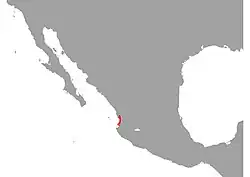
Micrurus proximans is found in western Mexico, in the Mexican states of Colima, Jalisco, and Nayarit.[2]
Habitat
The preferred natural habitat of Micrurus proximans is forest, at elevations from near sea level to 500 m (1,600 ft).[1]
Behavior
Micrurus proximans is terrestrial.[1]
Diet
Micrurus proximans is known to prey upon Rena dugesii, and probably upon other small snakes.[3]
Reproduction
References
- 1 2 3 Ponce-Campos, P.; García Aguayo, A. (2007). "Micrurus proximans ". IUCN Red List of Threatened Species. 2007 e.T64031A12738348. doi:10.2305/IUCN.UK.2007.RLTS.T64031A12738348.en. Retrieved 26 August 2023.
- 1 2 3 4 "Micrurus proximans ". The Reptile Database. Retrieved 10 December 2021.
- 1 2 3 4 Roze, J.A. (1996). Coral Snakes of the Americas: Biology, Identifacation, and Venoms. Malabar, Florida: Krieger Publishing Company. ISBN 0-89464-847-0. xii + 328 pp., 38 maps, 63 color photographs, 49 color pattern drawings. (Micrurus proximans, pp. 209–210 + Map 29 + Pattern 38).
Further reading
- Campbell, J.A.; Lamar, W.W. (1989). Venomous Reptiles of Latin America. Ithaca, New York: Comstock Publishing Associates, a Division of Cornell University Press. ISBN 978-0801420597. xiv + 430 pp., 568 figures, 109 distribution maps, 31 tables.
- Liner, E.A. (2007). "A Checklist of the Amphibians and Reptiles of México". Occasional Papers of the Museum of Natural Science, Louisiana State University (80): 1–60. (Micrurus proximans, p. 54).
- Roze, J.A. (1967). "A Checklist of the New World Venonous Coral Snakes (Elapidae), with Descriptions of New Forms". American Museum Novitates (2287): 1–60. (Micrurus proximans, new taxonomic status, p. 40).
- Slowinski, J.B. (1995). "A Phylogenetic Analysis of New World Coral Snakes (Elapidae: Leptomicrurus, Micruroides, and Micrurus) Based on Allozymic and Morphological Characters". Journal of Herpetology. 29 (3): 325–338.
- Smith, H.M.; Chrapliwy, P.S. (1958). "New and Noteworthy Mexican Herptiles from the Lidecker Collection". Herpetologica. 13 (4): 267–271. (Micrurus diastema proximans, new subspecies, p. 270).