Micrurus diastema
| Micrurus diastema | |
|---|---|
 | |
Scientific classification  | |
| Kingdom: | Animalia |
| Phylum: | Chordata |
| Class: | Reptilia |
| Order: | Squamata |
| Suborder: | Serpentes |
| Family: | Elapidae |
| Genus: | Micrurus |
| Species: | M. diastema |
| Binomial name | |
| Micrurus diastema | |
 | |
| Synonyms[2] | |
| |

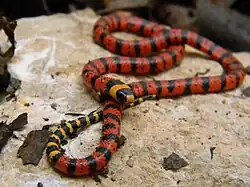
Micrurus diastema, commonly known as the diastema coral snake, the variable coral snake, and coral diastema in Spanish, is a species of venomous snake in the family Elapidae. The species is native to southeastern Mexico and northern Central America.[1] There are seven recognized subspecies.[3]
Geographic distribution
Micrurus diastema occurs in Belize, Guatemala, Honduras, and southeastern Mexico.[1][2]
Habitat
The preferred natural habitat of Micrurus diastema is tropical wet, moist, and dry forest from near sea level to 1,250 m (4,100 ft), but it tolerates habitat disturbance and is also found in agricultural areas.[1]
Behavior
Micrurus diastema is terrestrial.[1]
Reproduction
Subspecies
There are seven subspecies which are recognized as being valid, including the nominotypical subspecies.[3]
- Micrurus diastema affinis (Jan, 1858)
- Micrurus diastema aglaeope (Cope, 1860)
- Micrurus diastema alienus (F. Werner, 1903)
- Micrurus diastema apiatus (Jan, 1858)
- Micrurus diastema diastema (A.M.C. Duméril, Bibron & A.H.A. Duméril, 1854)
- Micrurus diastema macdougalli Roze, 1967
- Micrurus diastema sapperi (F. Werner, 1903)
Nota bene: A trinomial authority in parentheses indicates that the subspecies was originally described in a genus other than Micrurus.
Etymology
The subspecific name, macdougalli, is in honor of naturalist Thomas Baillie MacDougall (1896–1973).[4]
The subspecific name, sapperi, is in honor of German explorer Karl Theodor Sapper.[4]
References
- 1 2 3 4 5 Acevedo, M.; Ariano-Sánchez, D.; Lee, J.; Luque, I.; López-Luna, M.A.; Townsend, J.H. (2020). "Micrurus diastema". IUCN Red List of Threatened Species. 2020 e.T64021A176644473. doi:10.2305/IUCN.UK.2020-3.RLTS.T64021A176644473.en. Retrieved 12 November 2021.
- 1 2 3 Species Micrurus diastema at The Reptile Database . www.reptile-database.org.
- 1 2 "Micrurus diastema ". Integrated Taxonomic Information System. Retrieved 24 September 2011.
- 1 2 Beolens, Bo; Watkins, Michael; Grayson, Michael (2011). The Eponym Dictionary of Reptiles. Baltimore: Johns Hopkins University Press. xiii + 296 pp. ISBN 978-1-4214-0135-5. (Micrurus diastema macdougalli, p. 164; M. d. sapperi, p. 232).
Further reading

- Duméril A-M-C, Bibron G, Duméril A[-H-A] (1854). Erpétologie générale ou histoire naturelle complète des reptiles. Tome septième. Deuxième partie. Comprenant l'histoire des serpents venimeux (= General Herpetology or Complete Natural History of the Reptiles. Volume 7. Second Part. Containing the [Natural] History of the Venomous Snakes). Paris: Librairie Encyclopédique de Roret. xii + pp. 781–1536. (Elaps diastema, new species, p. 1222). (in French).
- Heimes P (2016). Snakes of Mexico: Herpetofauna Mexicana Vol. I. Frankfurt am Main, Germany: Edition Chimaira. 572 pp. ISBN 978-3899731002.
- Roze, J.A. (1996). Coral Snakes of the Americas: Biology, Identification, and Venoms. Malabar, Florida: Krieger Publishing Company. ISBN 0-89464-847-0. xii + 328 pp., 38 maps, 63 color photographs, 49 color pattern drawings. (Micrurus diastema, pp. 152–158, Figures 53–54 + Map 14 + Color 15–16 + Pattern 13–15).
- Schmidt KP (1933). "Preliminary Account of the Coral Snakes of Central America and Mexico". Zoological Series of Field Museum of Natural History 20 (6): 29–40. (Micrurus diastema, new combination, pp. 38–39).