Meso position (tetrapyrrole)

A meso position in a cyclic or linear tetrapyrrole is the bridge – a substituted or unsubstituted methine or methylene group (or a heteroatom) – that links two neighboring pyrrole rings.[note 1] With the unrelated stereochemical classification meso compound, it only shares the meaning "between/middle of/amidst" of the original Greek word "mésos" (fig. 1).
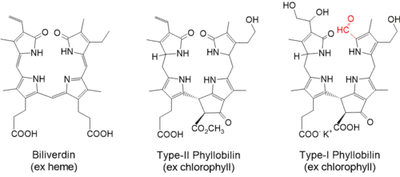
Unsaturated bonds including meso positions play an important role in the natural degradation of the important biomolecules heme[1] and chlorophyll[2] (fig. 2): in heme, both the C4-C5 and C5-C6 bonds are cleaved by heme oxygenase to the linear tetrapyrrole biliverdin, with loss of the C5 meso atom as carbon monoxide;[3] during chlorophyll degradation, pheophorbide a oxygenase (PAO) cleaves the C4-C5 bond of pheophorbide a,[4] conserving the C5 meso atom as a formyl group in type-I phyllobilins (marked red in fig. 2). In further degradation processes, this is either kept, or deformylated by the enzyme CYP89A9[5] to type-II phyllobilins.[2]
See also
Notes
- ↑ In trivial names introduced by Hans Fischer for porphyrins (mesoporphyrin), chlorins (e.g., mesochlorophyll a, mesopheophytin a), and bile pigments (mesobiliverdin, mesobilirubin, mesobilirubinogen), still in use,[6] meso has a completely different meaning, signifying the replacement of peripheral vinyl groups by ethyl.[7]
References
- 1 2 Beale, Samuel I. (1993). "Biosynthesis of phycobilins". Chemical Reviews. 93 (2): 785–802. doi:10.1021/cr00018a008. ISSN 0009-2665.
- 1 2 3 Kräutler, Bernhard (2016). "Breakdown of Chlorophyll in Higher Plants—Phyllobilins as Abundant, Yet Hardly Visible Signs of Ripening, Senescence, and Cell Death". Angewandte Chemie, International Edition. 55 (16): 4882–4907. doi:10.1002/anie.201508928. ISSN 1433-7851. PMC 4950323. PMID 26919572.
- 1 2 Ortiz de Montellano, Paul R.; Auclair, Karine (2003). "Heme Oxygenase Structure and Mechanism". In Kadish, Karl M.; Smith, Kevin M.; Guilard, Roger (eds.). The Porphyrin Handbook. Vol. 12. Oxford: Elsevier Science. pp. 183–210.
- ↑ Pružinská, Adriana; Tanner, Gaby; Anders, Iwona; Roca, Maria; Hörtensteiner, Stefan (2003). "Chlorophyll breakdown: Pheophorbide a oxygenase is a Rieske-type iron–sulfur protein, encoded by the accelerated cell death 1 gene". Proceedings of the National Academy of Sciences. 100 (25): 15259–15264. doi:10.1073/pnas.2036571100. ISSN 0027-8424. PMC 299977. PMID 14657372.
- ↑ Christ, Bastien; Süssenbacher, Iris; Moser, Simone; Bichsel, Nicole; Egert, Aurelie; Müller, Thomas; Kräutler, Bernhard; Hörtensteiner, Stefan (2013). "Cytochrome P450 CYP89A9 Is Involved in the Formation of Major Chlorophyll Catabolites during Leaf Senescence in Arabidopsis". The Plant Cell. 25 (5): 1868–1880. doi:10.1105/tpc.113.112151. ISSN 1532-298X. PMC 3694711. PMID 23723324.
- Moss, Gerard P. (1988). "Nomenclature of tetrapyrroles: Recommendations 1986". European Journal of Biochemistry. 178 (2): 277–328. doi:10.1111/j.1432-1033.1988.tb14453.x. ISSN 0014-2956.
- Lightner, David A. (1982). "Structure, photochemistry, and organic chemistry of bilirubin". In Heirwegh, Karel P. M.; Brown, Stanley B. (eds.). Bilirubin. Volume 1. Chemistry (reissued 2018 ed.). CRC Press. pp. 1–58. ISBN 978-1-315-89100-2. See p. 5