Merli–Missiroli–Pozzi experiment
| Inventor |
|
|---|---|
| Related items | Double-slit experiment, Electron biprism |
The Merli–Missiroli–Pozzi experiment was a physics experiment conducted in 1974 that provided the first conclusive evidence of electron interference involving the detection of single electrons. Performed by Italian physicists Pier Giorgio Merli, Gian Franco Missiroli, and Giulio Pozzi at the University of Bologna and the Italian Research Council (CNR), the experiment is physically similar to a double-slit experiment with electrons described as a thought experiment by Richard Feynman in 1961.[1]
A popular science poll conducted by Physics World in 2002 selected the single-electron double-slit experiment as the "most beautiful experiment in physics" of all time[2] but the history of the experiment was not well understood until subsequent historical research later that year.[3]
Historical context
Since the inception of quantum mechanics, the dual wave–particle nature of matter was a subject of intense theoretical debate. While light interference had been demonstrated by Thomas Young in 1801,[4] and electron diffraction by crystals was demonstrated in the 1920s,[5][6] the ability to observe single electron interference was considered a gedankenexperiment (thought experiment) by Richard Feynman in the early 1960s.[7][1]
Prior to the 1974 Bologna experiment, other scientists had made incremental steps. In 1909 Geoffrey Ingram Taylor demonstrated interference of light under such low intensity that single photons formed the image. In 1955, Gottfried Möllenstedt and Heinrich Düker applied their newly invented electron biprism to observe interference fringes with electron beams, confirming the de Broglie relation for electrons.[8] Claus Jönsson demonstrated of many-electron interference through micro-slits in 1961, again with electron beams.[9] However, the Merli–Missiroli–Pozzi team was the first to successfully use a low-intensity beam to ensure that only one electron at a time passed through the apparatus.[10][1] In 1976, the team produced a film titled Interferenza di elettroni (Interference of Electrons), documenting the pattern buildup.
In 1989, Akira Tonomura and colleagues published results from their work on interference with low-intensity electron sources using an electron biprism.[11] In 2002 an informal popular science poll highlighted "double-slit experiment with electrons" as the "most beautiful science experiment", but no one was credited with performing the experiment. A follow up article focusing on the double-slit experiment cited 1989 Tonomura version originally, but, prompted by a letter to the editor,[12] subsequently pointed to the earlier Merli–Missiroli–Pozzi work.[3]
Other versions of the experiment have also been performed. The Merli–Missiroli–Pozzi experiment used an electron biprism to demonstrate interference. A fully double slit experiment with electrons to match that used in experiments with light was published in 2013.[13]
Experimental setup

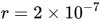
The experiment utilized a modified transmission electron microscope (TEM) equipped with an electron biprism.[15] The lenses of the microscope are used to create an effective source for the electrons that reach the biprism. The biprism was an extremely thin wire with a radius m placed between two grounded plates. When a voltage was applied to the wire, it created an electric field that deflected the electron beam differently depending upon which side of the wire the electrons passed on.[10] Further down the system the electrons from the two sides overlap over a region of width given by the formula:


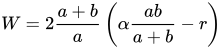
Where:
- : the distance between the effective electron source and the biprism wire.
- : the distance between the biprism wire and the observation plane.
- : the deflection angle produced by the biprism potential for electrons passing on the two sides.
- : the radius of the biprism wire.


If the electrons behaved as classical particles then the intensity over the region would be constant. With a coherent source such as a field emission gun fringes appear as the electrons behave as wave.[16]
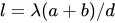
The system is equivalent to a Fresnel optical biprism where electrons appear to be emitted from two virtualsources, and , separated by a distance . Using the relativistically corrected wavelength ,[17] the fringes have a periodicity .[1]


Using a high-sensitivity television camera and a monitor, they observed the arrival of individual electrons. Each electron appeared as a single, localized dot, behaving like a particle when it was detected. Over time, the accumulated dots formed a characteristic interference pattern, demonstrating wave behavior where the intensity averaged over many millions of events follow the probability distribution similar to an optical biprism.[10]
See also
References
- 1 2 3 4 Rosa, R. (2012). "The Merli–Missiroli–Pozzi Two-Slit Electron-Interference Experiment". Physics in Perspective. 14 (2): 178–195. doi:10.1007/s00016-011-0079-0.
- ↑ Crease, R. P. (2002). "The most beautiful experiment". Physics World. 15 (9): 19–20.
- 1 2 Rodgers, Peter (September 1, 2002). "The double-slit experiment". Physics World. Retrieved 2026-03-04.
- ↑ "I. The Bakerian Lecture. Experiments and calculations relative to physical optics". Philosophical Transactions of the Royal Society of London. 94: 1–16. 1804-12-31. doi:10.1098/rstl.1804.0001. ISSN 0261-0523.
- ↑ Davisson, C.; Germer, L. H. (April 1927). "The Scattering of Electrons by a Single Crystal of Nickel". Nature. 119 (2998): 558–560. doi:10.1038/119558a0. ISSN 1476-4687.
- ↑ Thomson, G. P.; Reid, A. (June 1927). "Diffraction of Cathode Rays by a Thin Film". Nature. 119 (3007): 890–890. doi:10.1038/119890a0. ISSN 1476-4687.
- ↑ "The Feynman Lectures on Physics Vol. III Ch. 1: Quantum Behavior". www.feynmanlectures.caltech.edu. Retrieved 2026-03-04.
- ↑ Mollenstedt, G.; Duker, H. (June 1956). "Beobachtungen und Messungen an Biprisma-Interferenzen mit Elektronenwellen". Zeitschrift für Physik (in German). 145 (3): 377–397. doi:10.1007/BF01326780. ISSN 1434-6001.
- ↑ Jönsson, C. (1961). "Elektroneninterferenzen an mehreren künstlich hergestellten Feinspalten". Zeitschrift für Physik. 161 (4): 454–474. doi:10.1007/BF01342460.
- 1 2 3 Merli, P. G.; Missiroli, G. F.; Pozzi, G. (1976). "On the statistical aspect of electron interference phenomena". American Journal of Physics. 44 (3): 306–307. doi:10.1119/1.10184.
- ↑ Tonomura, A.; et al. (1989). "Demonstration of single-electron buildup of an interference pattern". American Journal of Physics. 57 (2): 117–120. doi:10.1119/1.16104.
- ↑ Steeds, J. (2003). "The first single-electron interference experiment". Physics World. 16 (5): 20.
- ↑ Bach, Roger; Pope, Damian; Liou, Sy-Hwang; Batelaan, Herman (March 13, 2013). "Controlled double-slit electron diffraction". New Journal of Physics. 15 (3) 033018. arXiv:1210.6243. doi:10.1088/1367-2630/15/3/033018. ISSN 1367-2630.
- ↑ Bach, Roger; Pope, Damian; Liou, Sy-Hwang; Batelaan, Herman (2013-03-13). "Controlled double-slit electron diffraction". New Journal of Physics. 15 (3) 033018. IOP Publishing. arXiv:1210.6243. Bibcode:2013NJPh...15c3018B. doi:10.1088/1367-2630/15/3/033018. ISSN 1367-2630. S2CID 832961.
- ↑ Mollenstedt, G.; Doker, H. (June 1956). "Beobachtungen und Messungen an Biprisma-Interferenzen mit Elektronenwellen". Zeitschrift für Physik (in German). 145 (3): 377–397. doi:10.1007/BF01326780. ISSN 1434-6001.
- ↑ Cowley, J. M. (1995). Diffraction physics. North-Holland personal library (3rd ed.). Amsterdam ; New York: Elsevier Science B.V. ISBN 978-0-444-82218-5.
- ↑ Fujiwara, Kunio (1961-11-15). "Relativistic Dynamical Theory of Electron Diffraction". Journal of the Physical Society of Japan. 16 (11): 2226–2238. doi:10.1143/JPSJ.16.2226. ISSN 0031-9015.
Further reading
- Tavabi, Amir H.; Boothroyd, Chris B.; Yücelen, Emrah; Frabboni, Stefano; Gazzadi, Gian Carlo; Dunin-Borkowski, Rafal E.; Pozzi, Giulio (2019-07-18). "The Young-Feynman controlled double-slit electron interference experiment". Scientific Reports. 9 (1): 10458. doi:10.1038/s41598-019-43323-2. ISSN 2045-2322. PMC 6639407. PMID 31320696.
- Harada, Ken (2021-02-01). "Interference and interferometry in electron holography". Microscopy. 70 (1): 3–16. doi:10.1093/jmicro/dfaa033. ISSN 2050-5698. PMC 7850541. PMID 32589205.