Menstrual migraine
| Menstrual migraine | |
|---|---|
| Other names | Catamenial migraine |
Menstrual migraine (also called catamenial migraine) is the term used to describe both pure menstrual migraines and menstrually related migraines. About 7%–14% of women have migraines only at the time of menstruation. These are pure menstrual migraines. Most female migraineurs experience migraine attacks throughout the menstruation cycle with an increased number around menstruation, these are menstrually related migraine.[1][2][3]
Menstrual-related migraines happen in around a quarter of women who have migraine headaches.[4] Menstrual migraine attacks usually last longer than other migraine attacks,[5] and short-term treatments do not work as well with menstrual migraine as they do with other kinds of migraine.[4] For predictable menstrual migraines, triptans can be taken in the days before the menstrual period starts to prevent menstrual migraines, for women that do not respond well to acute treatment and where lifestyle changes are ineffective.[6]
Signs and symptoms
Warning symptoms

Warning symptoms, also called prodrome symptoms, often happen before a migraine attack. These include:
- Sleepiness
- Fatigue
- Depression (feeling sad), euphoria (feeling very happy) or irritability
- Restlessness
- Excessive (too much) yawning
- Food cravings especially for sweet or salty foods or loss of appetite
- Increased thirst
- Diarrhea
- Nausea
- Bloating: the body retains (keeps) too much water
- Neck stiffness
- Talkativeness (talking too much)
- Feeling light-headed
- Uterine pain and cramping
Headache
A pounding throbbing headache with pain on one side of the head (unilateral). The headache often moves from one side of the head to another.
Associated conditions
Often, having one medical condition makes it more likely that a person will also have one or more other medical or psychiatric disorders. These other disorders are the "comorbid disorders" or "comorbidities".[8] There are various comorbid medical and psychiatric conditions associated with migraines. The treatment and prognosis (if a disease gets better, worse or stays the same over time)[9] of migraine is affected by the comorbid disorders which may be present and/or the chance of getting comorbid disorders.[10]
- Asthma – Premenstrual asthma (PMA): This is when asthma symptoms get worse during the premenstrual period. This condition may affect up to 40% of females with asthma. For a diagnosis of PMA to be made, it is necessary to have a detailed history of the timing of menstrual cycles along with asthma symptoms experienced, and the peak expiratory flow rate (PMA may cause the PEF to be lowered in the premenstrual period). In making a diagnosis, It is helpful to keep a diary of symptoms and peak expiratory flow (PEF) rates.[11][12]
- Raynaud syndrome: This is a circulatory disorder in which the smaller arteries that supply blood to the extremities – most often the hands, but it may also affect the toes, the tip of the nose and the ears – become narrower reducing blood flow. This causes the extremities to become numb and to be cooler than the core body temperature. It can be triggered by exposure to stress and cold.[13][14]
Causes
The exact causes of menstrual migraine are not known for sure, but there is a link between falling levels of the female hormone estrogen and the onset of a migraine attack. The estrogen level may fall after bleeding occurs during the menstrual cycle or when external sources of estrogen are no longer taken, like when a woman stops taking birth control pills or hormone pills in hormone replacement therapy.
Diagnosis
The diagnosis of a menstrual migraine is made by keeping track of when the migraines occur for a period of at least three months. Menstrually related migraine attacks usually occur between 2 days before and 3 days after the start of menstruation in at least 2 out of 3 menstrual cycles (periods) in a row.
The Menstrual Migraine Assessment Tool (MMAT) is a simple questionnaire with three questions that has shown to be fairly accurate in diagnosing menstrual migraine (Tepper SJ, 2008).[15] The three questions are:
- Do migraines occur in the space of time 2 days before the beginning of a woman's period until the third day after the start of the period? And does this happen in most months?
- Do headaches that happen during this time become very severe?
- Does the woman experience photophobia (which is when a medical problem causes light to bother a person's eyes)?
The answer to the first question has to be yes, and there has to be at least one yes answer to either question 2 or question 3.[16]
In order to keep track of what time of the month the migraines happen, it is helpful to use a headache diary. A person uses the headache diary to write down information about their headaches, like when they started, what kind of symptoms they had and how bad the pain was etc.
Prevention
For predictable menstrual migraines, triptans can be taken in the days before the menstrual period starts to prevent menstrual migraines, for women that do not respond well to acute treatment and where lifestyle changes are ineffective.[6]
Other preventative drugs may include:
- Beta blockers—such as propranolol, nadolol, atenolol, and metoprolol[17]
- Tricyclic antidepressants (TCAs) and other kinds of antidepressant medications are often used for migraine prevention. These include amitriptyline, nortriptyline, and doxepin.
- Prophylactic use of estrogen containing contraceptives[18]
Preventative treatments for menstrual migraine should be tried for at least 3 menstruation cycles to determine effectiveness.
Treatment
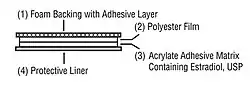
Acute treatments (short-term treatment) include drugs called nonsteroidal anti-inflammatory drugs (NSAIDs) (drugs that help stop inflammation which is redness, swelling, pain); triptans such as frovatriptan, ergotomines which are a kind of drug made from a fungus called ergot; and estrogen transdermal patches, which are patches worn on the skin that have estrogen in them which enters the body through the skin and then into the bloodstream.[19]
See also
References
- ↑ Robert A. Davidoff: Migraine:Manifestations, Pathogenesis, and Management: Manifestations p.122 (Oxford University Press, USA; 2nd edition, 2002): ISBN 0195137051
- ↑ "A1. Migraine". ICHD-3. Retrieved 2026-08-01.
- ↑ Robert B. Daroff, Gerald M Fenichel, Joseph Jankovic, John C Mazziotta. 2012. Bradley's Neurology in clinical practice: the neurological disorders. Volume 2. Editor: Walter George Bradle. Taylor and Francis. p.286 ISBN 1437704344
- 1 2 Khoo, Cindy Ciat-Wuah; Liu, Chan-Cheng; Lu, Michael; Huang, Yu-Chen; Weng, Hsing-Yu (2024). "Acute and preventive treatment of menstrual migraine: a meta-analysis". The Journal of Headache and Pain. 25 (1): 143. doi:10.1186/s10194-024-01848-6. ISSN 1129-2377. PMC 11373287. PMID 39227797.
- ↑ Pinkerman, B.; Holroyd, K. (2010). "Menstrual and nonmenstrual migraines differ in women with menstrually-related migraine". Cephalalgia: An International Journal of Headache. 30 (10): 1187–94. doi:10.1177/0333102409359315. PMID 20855364. S2CID 2131220.
- 1 2 "Scenario: Migraine in adults". NICE: Clinical Knowledge Summaries. April 2026.
- ↑ Allais, G.; Bussone, G.; Airola, G.; Borgogno, P.; Gabellari, I. C.; De Lorenzo, C.; Pavia, E.; Benedetto, C. (2008). "Oral contraceptive-induced menstrual migraine. Clinical aspects and response to frovatriptan". Neurological Sciences. 29 (Suppl 1): S186-90. doi:10.1007/s10072-008-0921-6. PMID 18545931. S2CID 5832150.
- ↑ : Free Merriam Webster Dictionary, 2012. Retrieved December 23, 2012
- ↑ prognoses: Free Merriam Webster Dictionary, 2012. Retrieved December 23, 2012
- ↑ Jean Schoenen, David W. Dodick, Peter Sándor, editors: Comorbidity in Migraine; Wiley-Blackwell; 1 edition, 2011 p.vi ISBN 1405185554
- ↑ Tan, K. S. (2001). "Premenstrual asthma: Epidemiology, pathogenesis and treatment". Drugs. 61 (14): 2079–86. doi:10.2165/00003495-200161140-00005. PMID 11735634. S2CID 46963718.
- ↑ Marc A. Fritz, M.D., Leon Speroff: Clinical Gynecologic Endocrinology and Infertility. Lippincott Williams & Wilkins; Eighth edition (2010), p.588 ISBN 0781779685
- ↑ Professional Guide to Diseases Lippincott Williams & Wilkins; Tenth edition, 2012; p.93 ISBN 1451144601
- ↑ Jonathan M. Borkum: Chronic Headaches: Biology, Psychology, and Behavioral Treatment. Psychology Press; 1 edition, 2007; p.110 ISBN 0805861998
- ↑ Stewart J. Tepper: The Cleveland Clinic Manual of Headache Therapy, Springer; 1st ed. 2011. pp. 15-16 ISBN 146140178X
- ↑ Tepper, S. J.; Zatochill, M.; Szeto, M.; Sheftell, F.; Tepper, D. E.; Bigal, M. (2008). "Development of a simple menstrual migraine screening tool for obstetric and gynecology clinics: The menstrual migraine assessment tool". Headache. 48 (10): 1419–25. doi:10.1111/j.1526-4610.2008.01304.x. PMID 19076645. S2CID 6566341.
- ↑ Garza, I; Swanson, JW (September 2006). "Prophylaxis of migraine". Neuropsychiatric Disease and Treatment. 2 (3): 281–91. doi:10.2147/nedt.2006.2.3.281. PMC 2671824. PMID 19412475.
- ↑ Calhoun AH. Hormonal Contraceptives and Migraine With Aura-Is There Still a Risk? Headache. 2017 Feb;57(2):184-193. doi: 10.1111/head.12960. Epub 2016 Oct 24. PMID 27774589
- ↑ Dailymed: ESTRADIOL patch