Melon (chemistry)

In chemistry, melon is a compound of carbon, nitrogen, and hydrogen of still somewhat uncertain composition, consisting mostly of heptazine units linked and closed by amine groups and bridges (−NH−, =NH, −NH2, etc.).[2] It is a pale yellow solid, insoluble in most solvents.[1]
A study in 2001 determined the formula C60N91H33 for melon. Comprising ten imino-heptazine units forming a linear chain connected by amino-bridges as H(−C6N8H2)−NH−)10(NH2).[1] Further research has proposed different structures.
Melon is the oldest known compound with a heptazine C6N7 core - having been described in the early 19th century - but was little-studied until recently. It has since been recognized as a photocatalyst and possible precursor to carbon nitride.[2]
History
Liebig first described the compounds melamine, melam, and melon in 1834.[3][4]
Melon received little attention for almost a century due to its inherent insolubility. In 1937, Linus Pauling characterised the structure of melon via X-ray crystallography, along with related compounds containing fused s-triazine rings.[4]
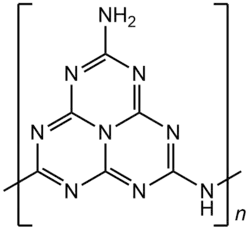
In 1940, C. E. Redemann and Howard J. Lucas proposed a structure consisting multiple 2-amino-heptazine units connected between carbons C5 and C8 by amine bridges.[1][5] This structure was revised in 2001 by T. Komatsu, who proposed an isomeric structure.[1][4]
Preparation
Melon can be extracted from solid residue produced by thermal decomposition of ammonium thiocyanate (NH4SCN) at 400 °C.[1][6] Alternatively, thermal decomposition of solid melem yields graphitic carbon nitride.[7]
Structure and properties

Komatsu characterized a form of melon which comprises an oligomer of 10 units, formed by condensation of a melem tautomer via loss of an ammonia (NH3) group.[1] The resulting structure consists 2-imino-heptazine units connected between a carbon (C8) on one unit to a nitrogen (N4) on the next via amino bridges. X-ray diffraction data, and other evidence, indicate the oligomer is planar, and the triangular heptazine cores have alternating orientations.[1]
The crystal structure of melon is orthorhombic, with estimated lattice constants a = 739.6 pm, b = 2092.4 pm and c = 1295.4 pm.[1]
Polymerization and decomposition
Heated to 700 °C, melon converts to a polymer of high molecular weight and longer chains with the same motif.[1]
Chlorination
Melon can be converted to 2,5,8-trichloroheptazine, a useful reagent for synthesis of heptazine derivatives.[6]
Applications
Photocatalysis
In 2009, Xinchen Wang et al. observed that melon could act as a catalyst for water splitting - to its respective hydrogen (H) and oxygen (O) ions - and, in the presence of uv light (sunlight), photocatalytic conversion of CO2 back to fuel. The latter reaction led to melon being circumscribed as the first metal-free photocatalyst providing several advantages compared previous catalytic compounds - namely, low material cost, simple synthesis, negligible toxicity, and very high chemical and thermal stability. Although melon is only modestly efficient at converting CO2, the reaction speed can be improved by doping or nanostructuring.[8][2]
Carbon nitride precursor
Another wave of interest for melon occurred in the 1990s, where theoretical computations suggested β-C3N4 - a hypothetical carbon nitride compound structurally analogous to β-Si3N4 - may be harder than diamond. In addition, melon showed promise as a useful precursor for "graphitic" carbon nitride (g-C3N4).[2]
See also
References
- 1 2 3 4 5 6 7 8 9 10 11 Tamikuni Komatsu (2001): "The First Synthesis and Characterization of Cyameluric High Polymers". Macromolecular Chemistry and Physics, volume 202, issue 1, pages 19-25. doi:10.1002/1521-3935(20010101)202:1<19::AID-MACP19>3.0.CO;2-G
- 1 2 3 4 Fabian Karl Keßler (2019): Structure and Reactivity of s-Triazine-Based Compounds in C/N/H Chemistry. Doctoral thesis, Fakultät für Chemie und Pharmazie, Ludwig-Maximilians-Universität München
- ↑ J. Liebig (1834): Annalen Pharmacie, 10, 1.
- 1 2 3 Elizabeth K. Wilson (May 26, 2004). "Old Molecules, New Chemistry. Long-mysterious heptazines are beginning to find use in making carbon nitride materials". Chemical & Engineering News. Archived from the original on June 5, 2004. Retrieved June 30, 2009.
- ↑ Redemann, C. E.; Lucas, H. J. (April 1940). "Some Derivatives of Cyameluric Acid and Probable Structures of Melam, Melem and Melon". Journal of the American Chemical Society. 62 (4): 842–846. doi:10.1021/ja01861a038.
- 1 2 Dale R. Miller, Dale C. Swenson, and Edward G. Gillan (2004): "Synthesis and Structure of 2,5,8-Triazido-s-Heptazine: An Energetic and Luminescent Precursor to Nitrogen-Rich Carbon Nitrides". Journal of the American Chemical Society, volume 126, issue 17, pages 5372-5373. doi:10.1021/ja048939y
- ↑ Barbara Jürgens, Elisabeth Irran, Jürgen Senker, Peter Kroll, Helen Müller, Wolfgang Schnick (2003): "Melem (2,5,8-Triamino-tri-s-triazine), an Important Intermediate during Condensation of Melamine Rings to Graphitic Carbon Nitride: Synthesis, Structure Determination by X-ray Powder Diffractometry, Solid-State NMR, and Theoretical Studies". Journal of the American Chemical Society, volume 125, issue 34, pages 10288-10300. doi:10.1021/ja0357689
- ↑ Xinchen Wang, Kazuhiko Maeda, Arne Thomas, Kazuhiro Takanabe, Gang Xin, Johan M. Carlsson, Kazunari Domen, and Markus Antonietti (2009): "A metal-free polymeric photocatalyst for hydrogen production from water under visible light", Nature Materials volume 8, pages 76-80. doi:10.1038/nmat2317