Mind or Instinct: An Inquiry Concerning the Manifestation of Mind by the Lower Orders of Animals
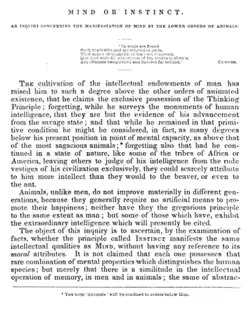 First page of "Mind or Instinct" in The Knickerbocker, November 1843 | |
| Author | Lewis H. Morgan as "Aquarius" |
|---|---|
| Language | English |
| Subjects | |
| Published | November–December 1843 |
| Publisher | The Knickerbocker |
| Publication place | United States |
"Mind or Instinct: An Inquiry Concerning the Manifestation of Mind by the Lower Orders of Animals" is an 1843 essay by American anthropologist Lewis H. Morgan. Published under the pseudonym "Aquarius" in The Knickerbocker, the essay argues that humans and other animals share the same intellectual principle and differ only in degree. Morgan draws on his rural upbringing, classical studies, interest in natural history, anecdotal reports, and classical authorities to discuss animal memory, abstraction, imagination, and reasoning. He rejects the view that animal behaviour is guided by instinct alone and ends with reflections on the ethical treatment of animals.
The essay attracted little attention at the time, but later scholars have discussed it as an early work in comparative psychology and as evidence of Morgan's early interest in questions of animal intelligence, human-animal continuity, and moral status.
Background

Lewis H. Morgan (1818–1881) was born on a farm near Aurora, New York. He studied classics at Cayuga Academy and then at Union College from 1838 to 1840 before returning to Aurora to read law. Alongside his legal training he developed interests in classics, natural history, geology, and social reform, and delivered public lectures on subjects including temperance and ancient Greece. He was admitted to the New York bar in 1842.[1]
Morgan wrote "Mind or Instinct" when he was 25. Carl Resek describes the essay as an attempt to show that animals adjust to their environments through thought rather than instinct alone. Morgan drew on Buffon's Natural History, farmers' almanacs, and neighbors' anecdotes to assemble examples of animals exhibiting memory, judgment, and deliberation.[2]
Signed "Aquarius. October 1843", the essay was published in two parts in the November and December 1843 issues of The Knickerbocker, a New York literary magazine.[3][4]
Content
That principle which remembers, abstracts, imagines, and reasons, is Mind. The principle called Instinct remembers, abstracts, imagines, and reasons. Therefore, this principle is Mind.
Both parts of the essay open with the same lines from William Cowper's poem The Task (book 6), described by Gillian Feeley-Harnik as "verse in praise of animals":[5]
In some are found
Such teachable and apprehensive parts,
That man's attainments in his own concerns,
Matched with th'expertness of the brutes in their's,
Are ofttimes vanquished and thrown far behind.
Feeley-Harnik notes that Morgan and other Anglo-American writers were influenced by Cowper's reflections on human-animal relations, as British readers had been by the Romantic poets of the early nineteenth century.[5][a]
Morgan asks whether instinct and mind are distinct faculties or whether they are names for the same intellectual principle. He argues that instinct is a descriptive label for animal intelligence, not a separate force. To support this claim, he identifies four faculties—memory, abstraction, imagination, and reason—and argues that animals exhibit each of them to varying degrees. In his view, humans and other animals differ in degree rather than in kind.[3]
Memory
Morgan begins with animal memory, citing examples such as bees returning to a food source after months, elephants recognizing former keepers after years, and pigeons navigating back to their lofts. From these examples he concludes that "instinct remembers", and that its operations are "identical, both in analysis and synthesis, with the phenomena of memory in the human mind."[3]
Abstraction
Morgan next considers abstraction. He argues that animals separate and compare properties when choosing among alternatives. His main example is the beaver's choice of a dam site, which he interprets as involving consideration of depth, width, current, food, and building materials. He also cites foxes selecting burrows and birds choosing nesting sites as evidence of abstract consideration.[3]
Imagination
On imagination, Morgan suggests that animals "fabricate images of things that have no existence".[3] He refers to playful behaviour in young animals, apparent dreaming in dogs, and migratory restlessness in birds as signs of imaginative projection. He also suggests that both humans and animals respond imaginatively to scenery and climate.[3]
Reason
In the final section, on animal reasoning, Morgan gives anecdotes of dogs seeking medical help, foxes using deception, and cooperative labour among ants, marmots, and beavers. He interprets these as cases of "the adaptation of means to an end", showing planning, division of labour, and cause-and-effect reasoning. Training and domestication are also used as evidence that animals learn through association and motivation, rather than through mechanical impulse.[4]
Ethical reflections
Morgan closes by drawing moral conclusions from his account of human-animal continuity. If animals and humans share the same intellectual principle, he argues, their happiness must be equally intended by God. He criticizes slaughter and sport hunting, and speculates that "an enlightened moral sense would teach us to abstain entirely from animal food, if we can live without it."[4] He rejects the view that animals were created solely for human use, or that some animals exist merely to be preyed upon by others, writing that "we can no more say that animals were made for our convenience exclusively, than that the hare was made for the lion". More broadly, he insists that "we are all alike creatures of God, and subjects of His will", and that divine protection extends "from man, the noblest of His creation, to the young ravens."[4][b]
Further writings on animal psychology
Morgan returned to the themes of "Mind or Instinct" in several later works. In an unpublished 1857 essay titled "Animal Psychology", he again rejected instinct as a distinct faculty, describing it as a "supernatural installation" that obstructed inquiry, and argued instead that a common "thinking principle" extended across species. He continued this argument in The American Beaver and His Works (1868), which used field observations in Michigan to show that beaver societies exhibited adaptation, memory, imagination, and gradual improvement, qualities he had earlier attributed to animals in "Mind or Instinct". These ideas also informed his later anthropological works, including Ancient Society (1877), where the idea of a "scale of mind" linking animals and humans formed part of his comparative method.[6]
Influence
According to historian James Gregory, the English banker and vegetarian advocate John Smith was led to adopt vegetarianism after reading a paper on "Manifestation of Mind",[c] which drew his attention to the mental similarities between humans and animals, including their shared capacity for pleasure and pain.[7]
Reception and analysis
Although it attracted little contemporary attention, the essay was included in two nineteenth-century bibliographies of works on immortality and the soul: the appendix to William Rounseville Alger's A Critical History of the Doctrine of a Future Life (1860), and Ezra Abbot's The Literature of the Doctrine of a Future Life (1871), an expanded catalogue based on the same appendix.[8][9] In a 1909 survey of early American psychology, J. Franklin Jameson mentions Morgan's essay but regards it as more literary than scientific.[10]
Timothy D. Johnston argues that "Mind or Instinct" deserves recognition as an early contribution to comparative psychology. He observes that Morgan advances a strong continuity thesis between human and animal intelligence, rejects "instinct" as a separate faculty, and treats animal constructions as evidence of reasoning rather than divine design. Although Morgan's argument is framed within a theistic worldview rather than evolutionary theory, Johnston argues that it anticipates later criticisms of the instinct concept in twentieth-century psychology. Johnston also notes Morgan's ethical reflections, which connect animal intelligence with moral status and vegetarianism, and concludes that his work foreshadows later developments in American psychology while remaining largely overlooked by its practitioners.[10]
A 1989 review in Science and Nature, by Gordon Welty, also notes Morgan's rejection of the instinct-mind distinction and his insistence on a graded continuity of intelligence across species. Welty emphasizes Morgan's claim that human superiority derives largely from cultural development rather than innate endowment, distinguishing him from contemporaries such as Louis Agassiz, who stressed immutable species differences to justify human hierarchies.[11]
Carl Resek argues that the significance of "Mind or Instinct" lies less in its immediate effect than in what it shows about Morgan's early thought. He identifies it as Morgan's first attempt to outline a rational history of animals, anticipating his later anthropological theories of human progress. By attributing a "thinking principle" to animals and rejecting a strict divide between instinct and reason, Resek argues that Morgan shows an early concern with continuity between human and non-human intelligence. Against metaphysical claims that animals lacked such a faculty, Morgan contends that humans themselves had advanced from similar mental beginnings. Resek compares these conclusions with Charles Darwin's youthful notes on animals, while emphasizing that Morgan expressed them in his own way, presenting animals as capable of reasoned adaptation rather than as beings driven only by instinct. Resek interprets the essay as youthful but revealing, and as an early attempt to address ideas that would later shape Morgan's scholarship.[2]
Thomas Trautmann describes the essay as Morgan's first statement of the "scale of mind" that links animals and humans in a single gradation. He notes that it already contains elements of Morgan's later anthropology: a comparative method, the idea of stages of savagery and civilization, and a unified scale of intelligence across species. Trautmann writes that Morgan's views on animal psychology remained largely unchanged throughout his career, even after the appearance of Darwin's works.[12]
Gillian Feeley-Harnik, in her chapter on Morgan in America's Darwin: Darwinian Theory and U.S. Literary Culture (2014), places "Mind or Instinct" within nineteenth-century debates about animal intelligence. She argues that Morgan rejects instinct as an explanatory category and proposes a single scale of intelligence uniting humans with other animals. Feeley-Harnik compares Morgan's conclusions with Darwin's contemporary notebook entries on animal memory, emotion, and suffering, noting that while Darwin approached these questions through descent and common ancestry, Morgan focused on gradual moral and intellectual improvement through reason. She adds that although Darwin's writings became central to comparative psychology, Morgan's early contribution was largely overlooked by later figures such as George Romanes and William James.[5]
See also
- Animal cognition
- Animal consciousness
- Evolutional Ethics and Animal Psychology – 1897 book by Edward Payson Evans
Notes
- ↑ Morgan and his wife are known to have owned a copy of The Works of Cowper and Thomson (1841), which includes these lines, and it remained in their household after their marriage in 1851.[5]
- ↑ The phrase "young ravens" is a biblical allusion, found for example in Job 38:41 and Psalm 147:9.
- ↑ The title given by Gregory appears to be a shortened form of Morgan's essay title.
References
- ↑ Feeley-Harnik, Gillian (2018). "Morgan, Lewis Henry (1818–81)". The International Encyclopedia of Anthropology. John Wiley & Sons, Ltd. pp. 1–6. doi:10.1002/9781118924396.wbiea2056.
- 1 2 Resek, Carl (1960). Lewis Henry Morgan, American Scholar. University of Chicago Press. pp. 18–19.
- 1 2 3 4 5 6 Morgan, Lewis H. (November 1843). "Mind or Instinct: An Inquiry Concerning the Manifestation of Mind by the Lower Orders of Animals". The Knickerbocker. 22 (5): 414–420.
- 1 2 3 4 5 Morgan, Lewis H. (December 1843). "Mind or Instinct: An Inquiry Concerning the Manifestation of Mind by the Lower Orders of Animals". The Knickerbocker. 22 (6): 507–516.
- 1 2 3 4 Feeley-Harnik, Gillian (2014). "Bodies, Words, and Works: Charles Darwin and Lewis Henry Morgan on Human-Animal Relations". In Gianquitto, Tina; Fisher, Lydia (eds.). America's Darwin: Darwinian Theory and U.S. Literary Culture. University of Georgia Press. pp. 265–301.
- ↑ Feeley-Harnik, Gillian (2021). "'The Mystery of Life in All Its Forms': Religious Dimensions of Culture in Early American Anthropology". In Mizruchi, Susan L. (ed.). Religion and Cultural Studies. Princeton University Press. pp. 140–191. ISBN 978-0-691-22404-6. Retrieved September 17, 2025.
- ↑ Gregory, James Richard Thomas Elliott (May 2002). "Biographical index of British vegetarians and food reformers of the Victorian era". The Vegetarian Movement in Britain c.1840–1901: A Study of Its Development, Personnel and Wider Connections (PDF) (PhD thesis). Vol. 2. University of Southampton. p. 108. Retrieved February 10, 2026.
- ↑ Alger, William Rounseville (1866). A Critical History of the Doctrine of a Future Life: With a Complete Bibliography of the Subject. New York: W. J. Widdleton. p. 872.
- ↑ Abbot, Ezra (1871). The Literature of the Doctrine of a Future Life; or, A Catalogue of Works Relating to the Nature, Origin, and Destiny of the Soul. New York: W. J. Widdleton. p. 872.
- 1 2 Johnston, Timothy D. (2003). "Three pioneers of comparative psychology in America, 1843-1890: Lewis H. Morgan, John Bascom, and Joseph LeConte". History of Psychology. 6 (1): 14–51. doi:10.1037/1093-4510.6.1.14. ISSN 1939-0610.
- ↑ Welty, Gordon (1989). "Mind or Instinct" (PDF). Science and Nature (9–10): 171–173. ISSN 0193-3396.
- ↑ Trautmann, Thomas R. (1987). Lewis Henry Morgan and the Invention of Kinship. Berkeley: University of California Press. pp. 18–35.
External links
- Part 1 and Part 2 at Project Gutenberg (transcribed text)
- Part 1 and Part 2 at the Internet Archive (page scans)

- 1843 essays
- American essays
- Animal cognition
- Animal ethics essays
- Animals in Christianity
- Comparative psychology
- History of psychology
- Philosophy of mind literature
- Social science essays
- Works by Lewis H. Morgan
- Works originally published in The Knickerbocker
- Works published under a pseudonym
- English-language essays