Batasang Pambansa (legislature)
Batasang Pambansa | |
|---|---|
| Philippines | |
 The seal of the Batasang Pambansa from 1978 to 1986, during which the Philippines had a unicameral legislature | |
| Type | |
| Type | |
| History | |
| Established | October 16–17, 1976 |
| Disbanded | February 2, 1987 |
| Preceded by | |
| Succeeded by | Congress of the Philippines |
| Leadership | |
| |
Hilario Davide Jr. (Region VII, Pusyon Bisaya) (1978–1984) Jose Laurel Jr. (Batangas, UNIDO) (1984–1986) | |
| Structure | |
| Seats | 179 members (1978); elected 200 members (1984); elected |
Length of term | 6 years |
| Authority | Article III, 1973 Constitution of the Philippines |
| Elections | |
| First-past-the-post voting | |
| Meeting place | |
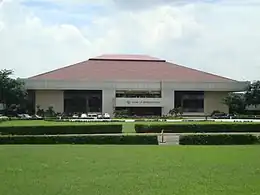 | |
| Batasang Pambansa Complex, Batasan Hills, Quezon City | |
The Batasang Pambansa (lit. 'National Legislature'), often referred to simply as the Batasan,[1] was the legislature of the Philippines, established first as an interim assembly in 1978 and later as a regular legislature in 1984. It was the fourth unicameral legislature in Philippine history. Members of the Batasang Pambansa were known as Mambabatas Pambansa (MP; lit. 'national lawmaker'), equivalent to a member of parliament.[2]
The Batasan was established under the 1973 Constitution promulgated during the presidency of Ferdinand Marcos, replacing the Congress of the Philippines established under the 1935 Constitution. It was abolished following the People Power Revolution in 1986, and Congress was restored under the 1987 Constitution.
History
The original provisions of the 1973 Constitution, which was ratified on January 17, 1973, provided for the establishment of a unicameral National Assembly. Upon its ratification, an Interim National Assembly composed of the president and the vice president, those who served as president of the 1971 Constitutional Convention, members of the Senate and the House of Representatives, and the delegates to the 1971 Constitutional Convention, was established and functioned as the legislature. Before the Regular Batasang Pambansa convened, a 120-member interim body served as the national legislature. The body was composed of the incumbent president, representatives elected from different regions and from different sectors, and select Cabinet officials appointed by the president. In 1981, the semi-parliamentary legislature was formally convened as the Batasang Pambansa, and in 1985, some dissident members unsuccessfully tried to impeach President Marcos.
On March 25, 1986, Proclamation No. 3, commonly known as the 1986 Freedom Constitution, was promulgated, effectively abolishing the Batasang Pambansa.[3]
See also
- Interim Batasang Pambansa (1978–1984)
- Regular Batasang Pambansa (1984–1986)
References
- ↑ Journal Service (1983–1984). Record of the Batasan. Vol. II. Quezon City, Philippines: Batasang Pambansa. Retrieved March 21, 2022 – via Google Books.
- ↑ Supreme Court Reports, Annotated, Volume 140, Central Book Supply, Incorporated, 1986, p. 140
- ↑ "Proclamation No. 3 – Declaring a National Policy to Implement Reforms Mandated by the People Protecting Their Basic Rights, Adopting a Provisional Constitution, and Providing for an Orderly Transition to a Government Under a New Constitution". Official Gazette. President of the Philippines. March 25, 1986. Retrieved March 21, 2022.


