Magnetic developer
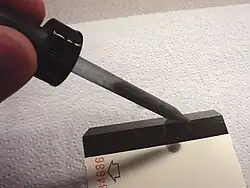
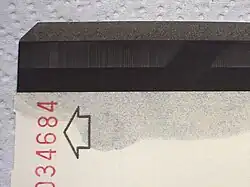
Magnetic developer is a fluid which makes the magnetic information written on magnetic tape or the magnetic stripe of a credit card or ATM card visible to the naked eye. Commercial brands of magnetic developer included Edivue[1] and Magnasee.
Magnetic developer can be found in liquid or aerosol form. When applied to a magnetic stripe, suspended metal particles will be attracted to the magnetically charged regions of the stripe as the liquid evaporates. The particles can be made of carbonyl iron.[2]
Magnetic developer was an important tool for video editing in the early days of quadruplex videotape, when editing was achieved by physically splicing the tape. However, cutting and rejoining the tape without paying attention to the timing of the video signal would result in a substantial picture disturbance at each edit point.[3][1] Magnetic developer was painted onto the tape at the edit point to make the timing signals visible, allowing the editor to splice the tape while maintaining the correct timing relationship between the two parts being joined.[4][1] Video tape splicing was made obsolete for editing purposes by the introduction of electronic editing techniques,[5] but it remained useful for repairing damaged tapes.[3]
Magnetic developer can be used to troubleshoot problems with magnetic stripes and the equipment that encodes and reads them. By making the encoding visible, one can see how encoding head alignment affects the position of the data tracks, and observe any possible magnetic damage that has occurred on the magnetic stripe.
See also
References
- 1 2 3 "New Techniques Simplify Splicing of 'Videotape'" (PDF). Technician-Engineer. Vol. 7, no. 2. Mar 1958. p. 4. Retrieved 25 August 2026.
- ↑ Daniel, Eric D.; Mee, C. Denis; Clark, Mark H. (1998-08-31). Magnetic Recording: The First 100 Years. John Wiley & Sons. ISBN 978-0-7803-4709-0.
- 1 2 Robinson, Richard (1978). The Video Primer. Quick Fox. p. 100. ISBN 0825631319. Retrieved 25 August 2026.
- ↑ Marsh, Ken (1980). Independent Video: a complete guide to the physics, operation, and application of the new television for the student, the artist, and for community TV. Simon and Schuster. p. 158. ISBN 0671218875. Retrieved 25 August 2026.
- ↑ Wurtzel, Alan (1979). Television Production. McGraw-Hill. p. 348. ISBN 0070721300. Retrieved 25 August 2026.