Macrocin O-methyltransferase
| Macrocin O-methyltransferase | |||||||||
|---|---|---|---|---|---|---|---|---|---|
| Identifiers | |||||||||
| EC no. | 2.1.1.101 | ||||||||
| CAS no. | 79468-52-3 | ||||||||
| Databases | |||||||||
| BRENDA | enzyme data | ||||||||
| ExPASy | NiceZyme view | ||||||||
| KEGG | enzyme entry | ||||||||
| MetaCyc | metabolic pathway | ||||||||
| Rhea | reactions | ||||||||
| PDB structures | RCSB PDB PDBe PDBsum | ||||||||
| Gene Ontology | AmiGO / QuickGO | ||||||||
| |||||||||
Macrocin O-methyltransferase (EC 2.1.1.101) is an enzyme that catalyzes the chemical reaction
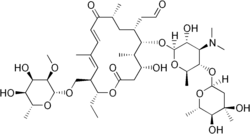

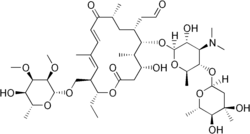
This is a methylation reaction in which the macrolide antibiotic, macrocin, is converted to tylosin by addition of a methyl group to a specific hydroxyl oxygen. The methyl is transferred from the cofactor, S-adenosyl methionine (SAM), which becomes S-adenosyl-L-homocysteine (SAH). The enzyme was characterised from Streptomyces fradiae.[1][2]
This enzyme belongs to the family of transferases, specifically those transferring one-carbon group methyltransferases. The systematic name of this enzyme class is S-adenosyl-L-methionine:macrocin 3"'-O-methyltransferase. Other names in common use include macrocin methyltransferase, and S-adenosyl-L-methionine-macrocin O-methyltransferase.[3]
References
- ↑ Bauer NJ, Kreuzman AJ, Dotzlaf JE, Yeh WK (1988). "Purification, characterization, and kinetic mechanism of S-adenosyl-L-methionine:macrocin O-methyltransferase from Streptomyces fradiae". J. Biol. Chem. 263 (30): 15619–25. doi:10.1016/S0021-9258(19)37633-1. PMID 3170601.
- ↑ Kreuzman AJ, Turner JR, Yeh WK (1988). "Two distinctive O-methyltransferases catalyzing penultimate and terminal reactions of macrolide antibiotic (tylosin) biosynthesis Substrate specificity, enzyme inhibition, and kinetic mechanism". J. Biol. Chem. 263 (30): 15626–33. doi:10.1016/S0021-9258(19)37634-3. PMID 3170602.
- ↑ Enzyme 2.1.1.101 at KEGG Pathway Database.
Categories: