Macrobius (crater)
 Apollo 17 mapping camera image | |
| Coordinates | 21°16′N 45°58′E / 21.26°N 45.97°E |
|---|---|
| Diameter | 62.79 km (39.02 mi) |
| Depth | 3.9 km[1] |
| Colongitude | 314° at sunrise |
| Formation | Lower Imbrian[2] |
| Eponym | Macrobius |


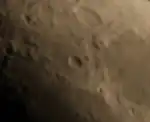
Macrobius is a prominent lunar impact crater located to the northwest of the Mare Crisium.[3] Its diameter is 63 km. It was named after ancient Roman writer Macrobius.[4] It lies on the southeast edge of the Lacus Bonitatis, a small lunar mare. The somewhat smaller crater Tisserand lies just to the east.
On the lunar geologic timescale, Macrobius dates to the Lower (Early) Imbrian age.[2] The outer wall of Macrobius has a multiply terraced inner surface, with some slumping along the top of the rim. The small satellite crater Macrobius C lies across the western rim, but the wall is otherwise relatively free of significant wear. In the center of the floor is a central mountain complex. There is a low ridge in the western interior, but the remainder of the floor is relatively level.
Satellite craters
By convention these features are identified on lunar maps by placing the letter on the side of the crater midpoint that is closest to Macrobius.
| Macrobius | Latitude | Longitude | Diameter |
|---|---|---|---|
| C | 20.8° N | 45.0° E | 10 km |
| E | 18.7° N | 46.8° E | 10 km |
| F | 22.5° N | 48.5° E | 11 km |
| K | 21.5° N | 40.2° E | 12 km |
| M | 25.0° N | 41.0° E | 42 km |
| N | 22.8° N | 40.8° E | 5 km |
| P | 23.0° N | 39.5° E | 18 km |
| Q | 20.4° N | 47.6° E | 9 km |
| S | 23.3° N | 49.6° E | 26 km |
| T | 23.8° N | 48.6° E | 29 km |
| U | 25.0° N | 42.8° E | 6 km |
| V | 25.4° N | 43.3° E | 5 km |
| W | 24.8° N | 44.6° E | 26 km |
| X | 23.0° N | 42.2° E | 4 km |
| Y | 23.6° N | 42.2° E | 5 km |
| Z | 24.3° N | 42.6° E | 5 km |
The following craters have been renamed by the IAU.[5]
- Macrobius A — See Carmichael.
- Macrobius B — See Hill.
- Macrobius D — See Fredholm.
- Macrobius L — See Esclangon.
References
- ↑ LTO-43C2 Macrobius — L&PI topographic map
- 1 2 Wilhelms, Don E.; McCauley, John F.; Trask, Newell J. (1987). The geologic history of the Moon. USGS Professional Paper 1348. Washington: U.S. Government Printing Office. doi:10.3133/pp1348. Table 10.2.
- ↑ Webb, Rev. T. W. (1962). Celestial Objects for Common Telescopes (6th revised ed.). Dover. pp. 110, 154–159. Reprint: ISBN 978-0-486-20917-3
- ↑ "Macrobius". Gazetteer of Planetary Nomenclature. USGS Astrogeology Research Program.
- ↑ Moore, Patrick; Rees, Robin (2014). Patrick Moore's Data Book of Astronomy (2 ed.). Cambridge University Press. pp. 50–79. ISBN 978-1-139-49522-6.
Sources
- Andersson, L. E.; Whitaker, E. A. (1982). NASA Catalogue of Lunar Nomenclature. NASA RP-1097.
- Bussey, B.; Spudis, P. (2004). The Clementine Atlas of the Moon. New York: Cambridge University Press. ISBN 978-0-521-81528-4.
- Cocks, Elijah E.; Cocks, Josiah C. (1995). Who's Who on the Moon: A Biographical Dictionary of Lunar Nomenclature. Tudor Publishers. ISBN 978-0-936389-27-1.
- McDowell, Jonathan (July 15, 2007). "Lunar Nomenclature". Jonathan's Space Report. Archived from the original on 2012-02-08. Retrieved 2007-10-24.
- Menzel, D. H.; Minnaert, M.; Levin, B.; Dollfus, A.; Bell, B. (1971). "Report on Lunar Nomenclature by the Working Group of Commission 17 of the IAU". Space Science Reviews. 12 (2): 136–186. Bibcode:1971SSRv...12..136M. doi:10.1007/BF00171763. S2CID 122125855.
- Moore, Patrick (2001). On the Moon. Sterling Publishing Co. ISBN 978-0-304-35469-6.
- Price, Fred W. (1988). The Moon Observer's Handbook. Cambridge University Press. ISBN 978-0-521-33500-3.
- Rükl, Antonín (1990). Atlas of the Moon. Kalmbach Books. ISBN 978-0-913135-17-4.
- Whitaker, Ewen A. (1999). Mapping and Naming the Moon. Cambridge University Press. ISBN 978-0-521-62248-6.
- Wlasuk, Peter T. (2000). Observing the Moon. Springer. ISBN 978-1-85233-193-1.

| Physical properties |  | |
|---|---|---|
| Orbit | ||
| Surface and features | ||
| Science | ||
| Exploration | ||
| Time-telling and navigation | ||
| Phases and names | ||
| Daily phenomena | ||
| Related |
| |
