MGM-16
 | |
| Clinical data | |
|---|---|
| Drug class | Opioid |
| Identifiers | |
| |
| CAS Number | |
| PubChem CID | |
| ChEMBL | |
| Chemical and physical data | |
| Formula | C23H31FN2O5 |
| Molar mass | 434.508 g·mol−1 |
| 3D model (JSmol) | |
| |
| |
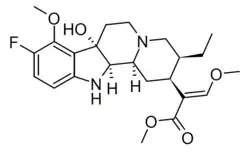
MGM-16 is an opioid drug which is a synthetic derivative of mitragynine, a natural product derived from the Southeast Asian tree kratom. It is the 9-fluoro derivative of another semi-synthetic mitragynine derivative MGM-15, and is a comparatively potent opioid analgesic with approximately 240x the potency of morphine.[1][2][3][4][5][6] While several semi-synthetic derivatives of mitragynine such as 7-hydroxymitragynine and MGM-15 were widely sold in the United States as unscheduled designer drug alternatives to illicit opioids from around 2023-2026, it is unclear whether MGM-16 has appeared on the market to any significant extent. Nevertheless, on 2 July 2026 the DEA published a notice of intent to schedule three 7-hydroxymitragynine-related substances (mitragynine pseudoindoxyl, MGM-15, and MGM-16) under Schedule I of the Controlled Substances Act.[7]
See also
References
- ↑ Matsumoto K, Narita M, Muramatsu N, Nakayama T, Misawa K, Kitajima M, et al. (March 2014). "Orally active opioid μ/δ dual agonist MGM-16, a derivative of the indole alkaloid mitragynine, exhibits potent antiallodynic effect on neuropathic pain in mice". The Journal of Pharmacology and Experimental Therapeutics. 348 (3): 383–392. doi:10.1124/jpet.113.208108. PMC 6067406. PMID 24345467.
- ↑ Raffa RB, ed. (2014). Kratom and Other Mitragynines. doi:10.1201/b17666. ISBN 978-1-4822-2519-8.
- ↑ Chin KY, Mark-Lee WF (2018). "A Review on the Antinociceptive Effects of Mitragyna speciosa and Its Derivatives on Animal Model". Current Drug Targets. 19 (12): 1359–1365. doi:10.2174/1389450118666170925154025. PMID 28950813.
- ↑ Bhowmik S, Galeta J, Havel V, Nelson M, Faouzi A, Bechand B, et al. (June 2021). "Site selective C-H functionalization of Mitragyna alkaloids reveals a molecular switch for tuning opioid receptor signaling efficacy". Nature Communications. 12 (1) 3858. Bibcode:2021NatCo..12.3858B. doi:10.1038/s41467-021-23736-2. PMC 8219695. PMID 34158473.
- ↑ Smith MT, Kong D, Kuo A, Imam MZ, Williams CM (February 2022). "Analgesic Opioid Ligand Discovery Based on Nonmorphinan Scaffolds Derived from Natural Sources". Journal of Medicinal Chemistry. 65 (3): 1612–1661. doi:10.1021/acs.jmedchem.0c01915. PMID 34995453.
- ↑ Gour A, Mukhopadhyay S, Henderson A, Awad A, Seabra MA, Pullman M, et al. (September 2025). "From Kratom to Semi-Synthetic Opioids: The Rise and Risks of MGM-15". Drug Testing and Analysis. 17 (12) dta.3952. doi:10.1002/dta.3952. PMID 40936282.
- ↑ "Schedules of Controlled Substances: Temporary Placement of Mitragynine Pseudoindoxyl, MGM-15, and MGM-16 in Schedule I". Federal Register. 2026-07-06. Retrieved 2026-07-03.