For the theoretical background, definitions, and uniqueness conditions (Nørlund principal solution, Abel–Plana formula), see
Indefinite sum.
This reference list assumes the reader is comfortable with the advanced mathematical concepts presented in the main article and is not intended for beginners.
Visualization of the property

for a 1-periodic function

. Because

(resp.

for the backward difference),

(resp.

). Thus, 1-periodic functions vanish under the difference operators.
This is a list of indefinite sums (also known as antidifferences) of various functions. An indefinite sum  is the inverse of the forward difference operator
 , defined as
 . It satisfies the relation
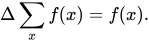
The operator is not unique; adding any 1-periodic function to a solution yields another solution.
To obtain a unique solution (up to an additive constant  ), the Nørlund principal solution is typically used. This imposes the condition that the solution has the minimal possible exponential type in the imaginary direction. The following formulas represent the principal solutions for the half-plane to the right of the rightmost singularity, unless otherwise stated.
Antidifferences of rational functions
For positive integer exponents, Faulhaber's formula can be used. Note that  in the result of Faulhaber's formula must be replaced with
 due to the offset, as Faulhaber's formula finds
 rather than
 .[1]
For negative integer exponents, the indefinite sum is closely related to the polygamma function:[2][3]

For fractions not listed in this section, one may use the polygamma function with partial fraction decomposition. More generally,[2][4]

where  are the generalized Bernoulli polynomials (see Temme, Eq. 2.20[4]),
 is the Hurwitz zeta function, and
 is the digamma function. This is related to the generalized harmonic numbers.
As the generalized harmonic numbers use reciprocal powers,  must be substituted for
 , and the most common form uses the inverse of the backward difference offset:[2]

Here,  is the constant .
The Bernoulli polynomials are also related via a partial derivative with respect to (Temme, Eq. 2.7 and Eq. 2.20[4]):

This relationship can be expressed via the inverse backward difference operator as:

Further generalization comes from use of the Lerch transcendent:[5]

which generalizes the generalized harmonic numbers as  when taking .
The sum of Bernoulli polynomials follows directly from their defining properties (Temme, Eqs. 2.6 and 2.7[4]) using summation by parts:

Antidifferences of exponential functions
 [1]
Antidifferences of logarithmic functions
 [1]
 [1]
Antidifferences of trigonometric functions
 [1]
 [1]


The antidifference of the normalized sinc function can be obtained by applying the Abel–Plana formula presented in Candelpergher[2] with the shift  , the condition
 , and recurrence of
 . Using the reflection formula for the digamma function, this simplifies to:

Antidifferences of hyperbolic functions


Antidifferences of special functions
 [6]
The indefinite sum (antidifference) of the Gamma function gives the Nørlund principal solution to the difference equation  , and is given by:
 [7]
where  is the incomplete gamma function and
 is Euler's number.
This specific closed form is derived directly from the incomplete Gamma function representation of the Kurepa function  (defined as
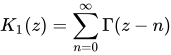 ), which satisfies the same functional equation
 . By converting Marichev's Cauchy Principal Value integral via Kummer's hypergeometric function, Malešević proved in Theorem 4.1 that
 is the antidifference operator. Substituting
 yields the expression above.
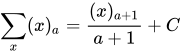 [1]
where  is the falling factorial.
For the super-exponential  , defined by the recurrence
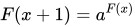 [8],
differentiating gives

For the base- case this derivative relation appears as Eq. (6.3) in[9].
Consequently,

Hence the antidifference is

The formula is not stated explicitly in the cited sources, but follows directly from their defining recurrence and derivative relation.
References
- 1 2 3 4 5 6 7 Jordan, Charles (1960). Calculus of Finite Differences (Second ed.). New York, NY: Chelsea Publishing Company. pp. 104–105.
- 1 2 3 4 Candelpergher, Bernard (2017). "Ramanujan Summation of Divergent Series" (PDF). HAL Archives Ouvertes. pp. 19–23.
- ↑ Abramowitz, Milton; Stegun, Irene A. (2013). Handbook of mathematical functions: with formulas, graphs, and mathematical tables (9. Dover print. ed.). New York, NY: Dover Publ. p. 260. ISBN 978-0486612720. Retrieved 18 June 2026.
- 1 2 3 4 Temme, Nico M. (1995). "Bernoulli Polynomials Old and New: Generalizations and Asymptotics". CWI Quarterly. 8 (1): 47–66. ISSN 0922-5366.
- ↑ Olver, Frank W. J. "§25.14 Lerch's Transcendent". DLMF. Retrieved 18 June 2026.
- ↑ Jordan, Charles (1960). Calculus of Finite Differences (Second ed.). New York, NY: Chelsea Publishing Company. p. 130.
- ↑ Malešević, Branko J. (2003). "Some considerations in connection with Kurepa's function". Publikacije Elektrotehničkog fakulteta - Serija Matematika. 14: 26–36. doi:10.2298/PETF0314026M. Zbl 1274.11116.
- ↑ Kouznetsov, Dmitrii; Trappmann, Henryk (2010). "Portrait of the four regular super-exponentials to base sqrt(2)" (PDF). Mathematics of Computation. 79 (271): 1727–1756. doi:10.1090/S0025-5718-10-02342-2. Retrieved 2026-08-29.
- ↑ Kouznetsov, Dmitrii (2009). "Solution of F(z+1) = exp(F(z)) in complex z-plane". Mathematics of Computation. 78 (267): 1647–1670. doi:10.1090/S0025-5718-09-02188-7. Retrieved 2026-08-29.