List of amphibians and reptiles of Norway
The Kingdom of Norway is home to several species of reptiles and amphibians, despite its cold climate.[1][2] According to the University of Bergen publication, "Today there is no active collecting of herptiles at the University Museum [of Bergen] and new material are mainly animals that have been found dead for various reasons."[3]
Reptiles
| Scientific name | Norwegian common name | Description | Image |
|---|---|---|---|
| Anguis fragilis[4] | Stålorm | slow worms are semifossorial (burrowing) lizards that spend their time hiding underneath objects. |  |
| Coronella austriaca[4] | Slettsnok | These snakes may bite people, although they are non-venomous. |  |
| Dermochelys coriacea[5] | Havlærskilpadde | The largest of all living turtles and the heaviest non-crocodilian reptile |  |
| Natrix natrix[4] | Buorm | The grass snake, ringed snake, or water snake, is a Eurasian semi-aquatic non-venomous colubrid snake. It is often found near water and feeds almost exclusively on amphibians. |  |
| Vipera berus[4] | Hoggorm | This snake is venomous but its bite is rarely fatal to humans. |  |
| Zootoca vivipara[4] | Nordfirfisle | This is one of the few lizards who gives birth to live offspring. |  |
Amphibians
| Scientific name | Norwegian common name | Description | Image |
|---|---|---|---|
| Bufo bufo[6] | Nordpadde | a toad found throughout most of Europe | 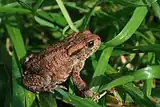 |
| Lissotriton vulgaris[6] | Småsalamander | The newts' skins are dry and velvety when they are living on land, but become smooth when they migrate into the water to breed |  |
| Triturus cristatus[6] | Storsalamander | During the breeding season, males develop a conspicuous jagged crest on their back and tail. | 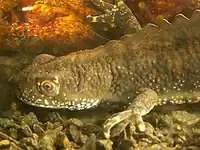 |
| Rana arvalis[6] | Spissnutefrosk | he frog makes use of various cryoprotectants i.e. antifreeze that decrease its internal freezing temperature. |  |
| Rana temporaria[6] | Buttsnutefrosk | frogs undergo metamorphosis through three distinct life stages — aquatic larva, terrestrial juvenile, and adult. They have plump bodies with rounded snouts, webbed feet, and long hind legs adapted for swimming and hopping on land. |  |
References
- ↑ Brears, Robert. "Amphibian, reptiles and herbivore mammals in the Arctic". Oceanwide Expeditions. Retrieved 2 February 2018.
- ↑ Skei, Jon. "Amphibians and reptiles in Norway - monitoring and research". Council of Europe. Retrieved 2 February 2017.
- ↑ Lislevand, Terje. "The Herptile (reptiles and amphibians) Collection of the University Museum of Bergen". doi:10.15468/56jwra.
{{cite journal}}: Cite journal requires|journal=(help) - 1 2 3 4 5 Anan'eva, Natalia (2006). The Reptiles of Northern Eurasia ble: Taxonomic Diversity, Distribution, and Conservation Status. Sofia, Bulgaria: Zoological Institute, Russian Academy of Sciences. pp. 32–137. ISBN 954-642-269-X.
- ↑ "Leatherbacks". SEE Turtles. Retrieved 2015-09-23.
- 1 2 3 4 5 Fede, Martin (1992). Environmental Physiology of the Amphibians. Chicago, IL, USA: University of Chicago Press. pp. 200–220. ISBN 0-226-23943-8.