Linker (peptide synthesis)
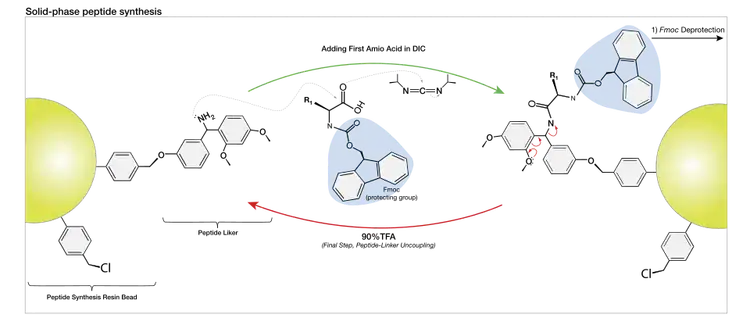
In solid phase peptide synthesis, a linker is a molecule that connects the solid phase (a beaded resin support) to the growing peptide chain. The linker is often permanently attached to the solid phase, but carries a transient covalent bond to the peptide (typically its C-terminus) that can be cleaved after completion of the synthesis to release the peptide. Cleavage can take place under various conditions depending on the linker type and result in different C-terminal functionalities of the released peptide, e.g. amides,[1] carboxylic acids,[2] esters,[3] lactams,[4] etc. Linkers that do not attach via the C-terminus do also exist.
References
- ↑ Bernatowicz MS, Daniels SB, Köster H (1989). "A comparison of acid labile linkage agents for the synthesis of peptide C-terminal amides". Tetrahedron Letters. 30 (35): 4645–4648. doi:10.1016/S0040-4039(01)80764-4.
- ↑ Wang SS (1973). "p-Alkoxybenzyl Alcohol Resin and p-Alkoxybenzyloxycarbonylhydrazide Resin for Solid Phase Synthesis of Protected Peptide Fragments". Journal of the American Chemical Society. 95 (4): 1328–1333. doi:10.1021/ja00785a602. PMID 4687686.
- ↑ Hansen J, Diness F, Meldal M (2016-02-18). "C-Terminally modified peptides via cleavage of the HMBA linker by O-, N- or S-nucleophiles". Organic & Biomolecular Chemistry. 14 (12): 3238–3245. doi:10.1039/c6ob00213g. PMID 26924021.
- ↑ Fischer NH, Nielsen DS, Palmer D, Meldal M, Diness F (December 2020). "C-Terminal lactamization of peptides". Chemical Communications. 57 (7): 895–898. doi:10.1039/d0cc06018f. PMID 33367306.
Categories: