Line T (Ferromex)
| Line T | |
|---|---|
 | |
| Overview | |
| Other name | Pacific North Railroad |
| Native name | Línea T |
| Owner | Federal government of Mexico |
| Locale | Northwestern Mexico |
| Termini | |
| Stations | 3 (active) |
| Service | |
| Type | |
| Operator | Ferromex |
| History | |
| Work began | 1879 |
| Opened | 25 October 1882 |
| Completed | 15 April 1927 |
| Technical | |
| Line length | 1,095 mi (1,762 km) |
| Number of tracks | 1 |
| Track gauge | 1,435 mm (4 ft 8+1⁄2 in) standard gauge |
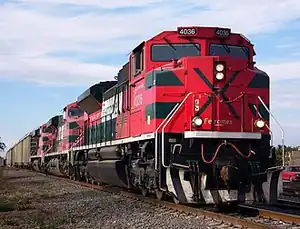
The Line T (Spanish: Línea T), also known as Pacific North Railroad (Spanish: Ferrocarril Pacifico-Norte), is a 1,095-mile (1,762 km)[1] railway line between Guadalajara and Nogales, Sonora. At its northern terminus in Nogales, the line directly intercharges with the Union Pacific Railroad's Nogales Subdivision at the Mexico–United States border. At its southern terminus in Guadalajara, it intercharges with Line I, which continues to Irapuato and Mexico City. The line is owned by the Federal government of Mexico and it's operated by Ferromex.[2]
History
The line was constructed by Atchison, Topeka and Santa Fe Railway as they organized the Sonora Railway in 1879. On September 14, 1880, Sonora Railway received a 99-year concession to build and operate from Guaymas to the United States border.[3] The construction of the Nogales–Guaymas section was completed on October 25, 1882, and it's opening ceremony was held at the border in Nogales.[4] In 1898, the Santa Fe leased the Sonora Railway to the Southern Pacific Railroad until December 1911, when the Southern Pacific Railroad purchased the Sonora Railway and became part of the Southern Pacific Railroad of Mexico (Spanish: Ferrocarril Sud Pacifico de Mexico). The line was known as the West Coast Route (Spanish: Ruta de la Costa Occidental).[5][6]
On April 15, 1927, the Southern Pacific Railroad of Mexico completed the extension to Guadalajara. Regular service began on April 16, operating from Nogales to Guadalajara, where a connection with the Ferrocarriles Nacionales de México (N de M) provided service to Buenavista station in Mexico City.[7][8] In 1951, the line was sold to the Mexican government and became part of the Ferrocarril del Pacífico,[9] which later merged into Ferrocarriles Nacionales de México in 1987.[10]
As President Ernesto Zedillo privatized the Ferrocarriles Nacionales de México in 1995, Grupo Ferroviario Mexicano, a consortium composed of Grupo México (74%) and Union Pacific Railroad (26%), was awarded the concession of the line with a bid of 3.1527 billion pesos in July 1997. The line subsequently became part of Ferromex.[11]
Passenger services

Although intercity passenger trains was discontinued in 1997, a few passenger trains still operate on the line in Jalisco section, which is currently used primarily by tourist trains:
- Cámara de Comercio de Guadalajara
- Tequila Express (Guadalajara–Tequila)
- Tequila Herradura Express (Guadalajara–Amatitán)
See also
References
- ↑ "Southern Pacific August 1935 Timetable" (PDF). p. 7. Retrieved July 20, 2026.
- ↑ "Mexico orders railroads to prioritize passenger train services over freight operations - two lines to reach Texas border cities". Texas Rail Advocates. November 26, 2023. Retrieved July 24, 2026.
- ↑ Trennert, Jr., Robert A. "The Southern Pacific Railroad of Mexico". Pacific Historical Review. 35. University of California Press: 265–284. doi:10.2307/3636788. Retrieved July 22, 2026.
- ↑ "Railroad Historical Almanac" (PDF). Washington DC Chapter: National Railway Historical Society. 2006–2013. p. 61. Retrieved July 24, 2026.
- ↑ J. G. George (1923). "The West Coast Route" Southern Pacific Railroad of Mexico". Nogales, Arizona. Retrieved July 24, 2026.
- ↑ Signor, John R.; Kirchner, John A. (January 1, 1987). "The Southern Pacific of Mexico and the West Coast Route". Goodreads. p. 168. ISBN 9780870950995. Retrieved July 24, 2026.
{{cite web}}: CS1 maint: periodical has ISBN (link) - ↑ "Railroad Historical Almanac" (PDF). Washington DC Chapter: National Railway Historical Society. 2006–2013. p. 123. Retrieved July 24, 2026.
- ↑ Schmal, John. "The Railroad as a Catalyst for Mexican Immigration (1877-1927)". Indigenous Mexico. Retrieved July 24, 2026.
- ↑ Black, Eugene R. (August 17, 1954). "INTERNATIONAL BANK FOR RECONSTRUCTION AND DEVELOPMENT REPORT AND RECOMMENDATIONS OF THE PRESIDENT TO EXECUTIVE DIRECTORS ON THE PROPOSED LOAN TO PACIFIC RAILROAD OF MEXICO FOR ITS REHABILITATION PROGRAM" (PDF). World Bank Document. Retrieved July 24, 2026.
- ↑ Cotey, Angela (June 2, 2006). "Mexico rail mergers 1960-1987". Trains. Retrieved July 24, 2026.
- ↑ Andalón L., Mabel A.; Lopez-Calva, Luis F. (January 2003). "What happens to workers when governments divest? Labor in the privatization of Mexican railroads". ResearchGate: 36. Retrieved July 24, 2026.
External links

- Ferromex - Vía Troncal Pacifico Norte (in Spanish)