Lillian Oppenheimer
Lillian Oppenheimer | |
|---|---|
 | |
| Born | Lillian Rose Vorhaus October 24, 1898 New York City, U.S. |
| Died | July 24, 1992 (aged 93) New York City, U.S. |
| Other name | Lillian Vorhaus Kruskal |
| Years active | 1953–1992 |
| Organization | The Friends of the Origami Center of America (co-founder) |
| Known for | Popularizing origami in the U.S. Establishing the term origami in English |
| Spouse(s) |
Joseph Kruskal
(m. 1918; died 1949)Harry Oppenheimer
(m. 1954; died 1962) |
| Children | 5, including William, Martin and Joseph Kruskal |
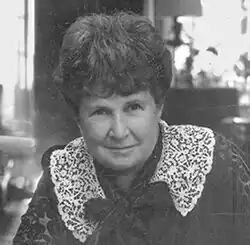
Lillian Vorhaus Oppenheimer (née Lillian Rose Vorhaus, formerly Lillian Vorhaus Kruskal; October 24, 1898 – July 24, 1992) was an American origami pioneer from New York City. During the latter half of her life, Oppenheimer became a leading figure in origami and is credited with popularizing the art form in the United States. She adopted the Japanese word origami because she liked the sound of it and felt like the English term paper folding was too vague. Origami eventually became the more common name.
In 1928, Oppenheimer entertained her sick daughter with an origami book. She picked origami up again as a hobby in 1953. After reading Robert Harbin's Paper Magic (1956), Oppenheimer stopped thinking of origami only as a pastime and began to consider it an art form in its own right. She began to teach origami professionally and corresponded with prominent paper folders, including Akira Yoshizawa of Japan and Ligia Montoya of Argentina. In 1958, The New York Times ran an article on Oppenheimer which gave origami more publicity in the U.S. than ever before.
To capitalize on the attention, Oppenheimer started holding regular lessons in New York City and dubbed her informal group "the Origami Center". It became the center of a new American school of origami. In 1980, Oppenheimer and her colleagues established The Friends of The Origami Center of America, a nonprofit sister organization. The Friends were renamed OrigamiUSA in 1994 and is the main origami organization in the United States, with numerous regional branches.
Early life and first marriage
Lillian Rose Vorhaus was born on October 24, 1898, in Manhattan, New York City, to Bernand Vorhaus and Mollie Grossman.[1] She was a Jew of Austrian, Hungarian, Czech, and Polish ancestry. Her father, Bernand, was a non-practicing attorney who immigrated from Poland and made a living importing furs.[2][3] Her mother was born in the United States.[3][a]
On October 11, 1918, Lillian married Joseph Bernard Kruskal (1885–1949).[1] Joseph was also Jewish,[4] and he owned a wholesale fur clothing firm with his brother.[5] Living in New Rochelle, New York, they had five children—William, Molly, Rosaly, Martin, and Joseph—between 1919 and 1928. Lillian's husband was irritated by her desire to join him in business, believing that she should pursue activities "[more] appropriate for a suburban matron".[3] Although Lillian enjoyed raising their children, the marriage was troubled and ultimately ended in divorce.[3]
In 1928, Lillian's seven-year-old daughter, Molly, had to be operated on after developing severe meningitis. To entertain Molly during her recovery, Lillian read Fun with Paperfolding (1928) with her and made some of the models in the book. Written by the magicians William D. Murray and Francis J. Rigney, Fun with Paperfolding was one of the earliest instructional books on paper folding,[b] which is now better known as origami.[2][7] Because the book's instructions were difficult to understand, Lillian did not learn the more complicated pieces. After Molly recovered, Lillian did not do origami for many years.[2]
In 1948, Lillian was visiting Joseph at the hospital and befriended Florence Temko, who was visiting her husband. Lillian took Temko to the hospital's craft shop, where they made woolly animals to pass the time. They continued this even after Joseph and Temko's husband had recovered and were able to sell them. Lillian and Temko remained friends, and Temko visited her every week until Joseph died in 1949 or 1950.[2][c] After Joseph's death, Lillian became the head of the family to her children and grandchildren.[3]
Career
Starting paper folding
At a family meeting c. 1950,[d] Lillian Kruskal was reintroduced to paper folding by Isaac Kramer, the stepfather of her daughter-in-law.[2][e] Kramer made for them the Flapping Bird, a model which flapped its wings when its tail was pulled.[9] Kruskal asked Kramer how to make her own Flapping Bird, but he said that he lacked the ability to teach it to others. In 1953, Kruskal was invited to an adult education class at the New School for Social Research by one Judy Oppenheimer, who wanted to give Kruskal something to do after the death of Kruskal's first husband.[2] Harry Centennial Oppenheimer (1889–1962),[10] Judy's father-in-law and Kruskal's future husband, was a director at the school.[2][9]
They attended a class where they used salvaged materials to create handicrafts. When their teacher, Emily Rosenthal, showed them how to make the Flapping Bird, Kruskal recognized it as the same model that Kramer had made. She asked Rosenthal to teach her more paper folding models.[2] Rosenthal referred her to another student, Frieda Lourie, who Rosenthal thought would be better able to help her.[2][9]
Kruskal and Lourie became friends, but it turned out that Lourie could not, in fact, teach her anything new. However, Kruskal and Lourie set out to learn new models and, with the help of Kruskal's copy of Fun with Paperfolding, began teaching others how to fold them. After learning the art from Kruskal, Kruskal's family grew to love paper folding just as she did. She sent her copy of Fun with Paperfolding to Tom, her grandson, after he folded fifty paper cups for her friends. Kruskal also taught paper folding to her friends. Temko, who she introduced to paper folding, became a prolific author of books on the subject.[2]
In 1954, Lillian Kruskal married Harry Oppenheimer.[2] In addition to his work at the New School for Social Research, Harry was the founder and president of Brand & Oppenheimer, Inc., a leading textile business, and a civic leader.[2][10] Harry was remarrying after the death of his first wife;[10] Lillian had four stepsons by him named Peter, Jack, Phillip and Herbert.[7] After getting married, the two moved to a penthouse apartment at the Hotel Irving in Gramercy Park, New York City. Harry was supportive of Lillian's activities and they had many shared interests, including music. She accompanied him when he traveled for frequent business-related meetings and found origami a convenient pastime while waiting.[2]
From a hobby to a career
At the start of 1957, Lillian Oppenheimer received a copy of Robert Harbin's Paper Magic (1956) from her son William. Harbin conducted extensive research for the book. It included an introduction with a lengthy history of origami in Japan and Europe, an analysis of common techniques, instructions for most of the models known in the Western world, and a bibliography. Gershon Legman informed him about the paper folding traditions in Japan and Spain, where the more inventive models were being created.[2] The British origami historian David Lister considered Paper Magic the "first time that anyone had written about paperfolding in such a comprehensive way."[2] It was a systematic treatment of paper folding that viewed it as a form of art rather than a children's game.[9]
At the time, Oppenheimer thought of paper folding as only a hobby. Lister wrote that Paper Magic changed her perception of paper folding from a simple, solitary pastime to a art form in its own right, with an active and connected movement behind it. In the summer of 1957, she went to Great Britain to meet with Harbin, the author of Paper Magic. Although she could not meet Legman because he was away from his home in France, she started to correspond with Legman and other notable paper folders, including Akira Yoshizawa of Japan and Ligia Montoya of Argentina.[2][8]
Oppenheimer later adopted origami (折り紙, lit. 'to fold paper'), the accepted Japanese term for recreational paper folding, instead of the English paper folding to refer to her art form.[2][11] The exact time that she did so is unknown, as is the time when origami overtook paper folding in use.[11] She was attracted to the Japanese word because she thought that the English term paper folding was "uninteresting" and too easily confused with other paper crafts. She also considered the Mandarin term (折纸, Pinyin: zhé zhǐ), but ultimately found it unappealing and difficult to pronounce. Before this, origami had only been used in the English language in English-language material from Japan.[2] Her efforts, and her later establishment of the Origami Center, led to origami becoming the dominant name for the art form not only in English-speaking countries, but an internationally recognised word as well.[2][11] Nick Robinson, the president of the British Origami Society, wrote that origami has been established in English since 1958.[8]
Oppenheimer was interested in origami for recreation. She would acquaint herself with other practitioners and steadily learned more about the art. In contrast, her paper folding partner Lourie, a therapist at Bellevue Hospital, used it for her patients. On Lourie's suggestion, the two began teaching origami to those who were interested—from groups at the Red Cross, Boy Scouts and Girl Scouts to nursing home residents—and they started doing origami professionally. Lourie acquired a studio where she could live and hold lessons at the Hotel Irving, where the Oppenheimers lived.[2]
Wider attention
Why should the Japanese have all the fun?
Although Lourie wanted to seek out publicity by approaching newspapers and museums, Oppenheimer believed that public attention would come in due course. Lourie was able to get three articles in Hokubei Shimpo, an English-language newspaper for Japanese expatriates in New York, but they attracted little attention. The concert pianist Sylvia Rabinof, one of Oppenheimer's closest friends, knew Meyer Berger, who wrote the popular column "About New York" for The New York Times. Oppenheimer was initially reluctant, but she allowed Rabinof to send the Hokubei Shimpo articles to Berger.[2]
To Oppenheimer's surprise, she promptly received a phone call from Berger and met with him the same night. On June 27, 1958, The New York Times printed Berger's column on Oppenheimer. The article outlined the history of origami and described some of Oppenheimer's favorite action models, including the Flapping Bird.[2]
The public reaction to the article was unexpected. Oppenheimer received letters and calls from people across New York and beyond, including requests for origami lessons. After she was interviewed on Tonight Starring Jack Paar, other talk shows wanted to have Oppenheimer on as a guest, and she made appearances on both radio and television. Origami had suddenly acquired massive popularity in the United States.[2][7]
Oppenheimer used the newfound publicity to organize monthly origami lessons at the Japan Society headquarters in Manhattan. Twenty-five people, included Temko and Lourie, attended the first lesson on October 6, 1958. Many of them would become members of what she dubbed "the Origami Center". The lessons soon came into such demand—aided by another mention in Berger's column—that Oppenheimer started additional weekly lessons on Tuesdays and extended their run. She also started a newsletter for the Center called The Origamian. When the Japan Society's headquarters became unavailable, Oppenheimer continued the monthly lessons in a nearby church and then held weekly lessons in her apartment, which came to an end in March 1959.[2] Robinson later wrote that, for the first time, origami had its own "centre of activity".[8]
After the lessons ended, Oppenheimer and her husband went on a world tour. After traveling extensively in Europe, Lillian went to Japan to meet Akira Yoshizawa,[2] who was considered "the preeminent folder of his time".[12] The meeting was covered internationally and the pair even appeared on Japanese television. However, on that first night in Japan, Oppenheimer was informed that her brother had died. She and her husband took the first flight back to New York City. When they returned to their apartment in the Hotel Irving, they learned that Lourie had also died that morning, having fallen off the roof of the hotel.[2]
Although both incidents affected her deeply, Oppenheimer carried on with her work and contributed to an exhibit at the Cooper Union Museum.[2] "Plane Geometry and Fancy Figures", the first origami exhibit in the United States,[13] ran at the museum in May 1959.[2] Although its focus was on Yoshizawa's art, the exhibit also featured the work of American folders who Oppenheimer had discovered. In addition, the exhibit included material on the history and mathematics of origami, which piqued the interest of both artists and academics.[2] Meanwhile, the Origami Center became the center of a new American school of folders. One of the early works to come from this group, Sam Randlett's The Art of Origami (1961), gave prominence to Oppenheimer and her Center.[2][8]
Oppenheimer's husband died on March 7, 1962.[10] His will dictated that she would receive one third of his estate and the associated income for life through a trust fund.[14] She moved to the Manhattan neighborhood of Greenwich Village afterwards.[15]
The Friends of The Origami Center of America
Despite the end of Oppenheimer's lessons in 1959, the Origami Center continued as an informal organization held together by Oppenheimer.[2] According to Robinson, "[to] be Lillian's friend was to automatically be a member."[8] Members of the new American school it had produced included George Rhoads, James Sakoda, Robert Neale, and Sam Randlett, all of whom were Oppenheimer's acquaintances and kept in close correspondence with each other.[2][8] Meanwhile, Oppenheimer accumulated a large collection of origami and started a business which sold origami books.[16]
After Michael Shall and Alice Gray proposed a formal sister organization to the Center, Oppenheimer, Shall, Gray, and their colleagues established The Friends of The Origami Center of America. The nonprofit company was incorporated in 1980 or 1981. When Gray retired, the Friends were able to continue using her office at the American Museum of Natural History and they slowly subsumed the Center's functions. They purchased Lillian's supplies business in 1987.[8][16]
Death and legacy
Akira Yoshizawa in Japan and Ligia Montoya in Argentine [sic] had explored new techniques of folding; Gershon Legman, [sic] had done extensive research; Robert Harbin had written the book [Paper Magic]. But without more, paperfolding might still have withered and relapsed into obscurity once more. Paperfolding required someone with the energy, enthusiasm and charisma needed to present it to the world for what it was now revealed to be. That person was Lillian Oppenheimer.
Lillian Vorhaus Oppenheimer died on July 24, 1992, at the Beth Israel Medical Center in Manhattan, following a heart operation. She was survived by her four remaining children—Molly died in 1978—and four stepsons, twenty-six grandchildren and thirty great-grandchildren.[1][7] The New York Times published an obituary crediting her with introducing Americans to origami.[7] Robinson concurred in the Encyclopædia Britannica's entry on the subject.[12] According to Robinson, the efforts of Oppenheimer in the United States, Harbin and Legman in Europe and Yoshizawa in Japan turned origami into an organized art form whose practitioners actively communicated.[8]
At the time of Oppenheimer's death, around thirty countries had origami societies, with England's and Israel's being established by her daughter Rosaly.[7] The Origami Center ceased to exist after Oppenheimer died. On July 1, 1994, the Friends were renamed OrigamiUSA. They still have their office at the American Museum of Natural History. Maintaining many regional branches and ties to origami societies in other countries, OrigamiUSA remains the main origami organization in the United States.[8][16]
In September 2005, OrigamiUSA proposed making Oppenheimer's birthday on October 24 an origami day before they were reminded that Japan already had an Origami Day on November 11. The organization then proposed recognizing the period between October 24 and November 11 as World Origami Days (WOD). They formed a WOD committee and hold annual events during this period.[17][18]
Bibliography
With Shari Lewis
During her second marriage, Oppenheimer befriended the puppeteer Shari Lewis, who inspired her to take up amateur ventriloquism and puppetry. Three books were published with the two as co-writers, but Lewis wrote while Oppenheimer merely supplied the models; Giuseppe Baggi also contributed models to Folding Paper Masks. The books helped Oppenheimer gain further publicity for her origami activities. After her husband's death, Oppenheimer held frequent puppetry meetings in her apartment, where she built a puppet theater. She was a founding member of the Puppetry Guild of Greater New York,[15] and active in the Storytelling Center of New York. She sometimes combined her three interests and told stories with origami puppets.[7]
- Lewis, Shari; Oppenheimer, Lillian (1962). Folding Paper Puppets. New York: Stein and Day. ASIN B000NWKJ24.
- Lewis, Shari; Oppenheimer, Lillian (1963). Folding Paper Toys. Lanham, Md.: Scarborough House.
- Lewis, Shari; Oppenheimer, Lillian (1965). Folding Paper Masks. New York: E. P. Dutton. ASIN B000K6G2BK.
With Natalie Epstein
- Oppenheimer, Lillian; Epstein, Natalie (1980). Decorative Napkin Folding for Beginners. Mineola, N.Y.: Dover Publications. ISBN 0-486237-97-4.
- Oppenheimer, Lillian; Epstein, Natalie (1984). More Decorative Napkin Folding. Mineola, N.Y.: Dover Publications. ISBN 9780486246734.
Chapters
- Oppenheimer, Lillian (1959). "Introduction". How to Make Origami: The Art of Paper Folding. McDowell, Obolensky.
- Oppenheimer, Lillian (1983). "Introduction". Origami for Christmas. Kodansha International. ISBN 9780870115288.
Notes
- ↑ One source states that she was born in St. Louis, Missouri,[1] and another states that she was born in New York City.[2]
- ↑ Dover Publications republished Fun with Paperfolding in 1960 as Paper Folding for Beginners; it is currently in print as Fun with Paper Folding and Origami. Although the origami historian David Lister wrote that it was the first English-language book "solely devoted to recreational paperfolding",[2] the British paperfolder Nick Robinson considered the Fröbelian books to be earlier.[6]
- ↑ He died in 1949[1] or 1950.[2]
- ↑ The exact date is not known.[2] Nick Robinson wrote that it was "about 1953".[8]
- ↑ Kramer's wife was the mother of Laura Kruskal, the wife of Lillian's son, Martin David Kruskal. Laura's mother remarried after her first husband died.[2]
Citations
- 1 2 3 4 5 Hirschberg, Dan. "Hecht family". Dan's Genealogy Page. Retrieved September 7, 2023.
- 1 2 3 4 5 6 7 8 9 10 11 12 13 14 15 16 17 18 19 20 21 22 23 24 25 26 27 28 29 30 31 32 33 34 35 36 37 38 Lister, David. "Lillian Oppenheimer". British Origami Society. Retrieved September 7, 2023.
- 1 2 3 4 5 Brown 1972, p. 84.
- ↑ Brown 1972, p. 76.
- ↑ Brown 1972, p. 82.
- ↑ Robinson 2004, p. 16.
- 1 2 3 4 5 6 7 Lambert, Bruce (July 27, 1992). "Lillian V. Oppenheimer, 93, Dies; Introduced Americans to Origami". The New York Times. p. D8.
- 1 2 3 4 5 6 7 8 9 10 Robinson 2004, pp. 18–19.
- 1 2 3 4 Matsuura 2021, p. 201.
- 1 2 3 4 "H.C. OPPENHEIMER, CIVIC LEADER, DIES; Textile Man Was Foe of Bias—Sydenham Hospital Head". The New York Times. March 9, 1962. p. 19.
- 1 2 3 Matsuura 2021, pp. 200, 202.
- 1 2 3 Robinson, Nick. "origami". Encyclopædia Britannica. Retrieved September 13, 2023.
- ↑ Cascone, Sarah (May 11, 2014). "Cooper Union to Host Incredible Origami Exhibition With World's Best Paper Artists". Artnet. Retrieved September 15, 2023.
- ↑ "OPPENHEIMER SHARES IN FATHER'S ESTATE". Norwalk Hour. March 31, 1967. p. 36.
- 1 2 Lister, David (August 1998). "Shari Lewis And Lillian Oppenheimer". British Origami Society. Retrieved September 15, 2023.
- 1 2 3 "History". OrigamiUSA. 19 March 2008. Retrieved September 12, 2023.
- ↑ Noguchi, Marcio (January–February 2012). Ku, Jason (ed.). "World Origami Days". The Fold. No. 8. OrigamiUSA. Retrieved September 13, 2023.
- ↑ Sugiyama, Mamoru (December 2021). ""Origami Is for Anyone, Anywhere, Any Time!": The History and Activities of OrigamiUSA". Highlighting Japan. Public Relations Office Government of Japan. Retrieved September 13, 2023.
References
- Brown, Richard D. (April 1972). "Two Baltic Families Who Came to America: The Jacobsons and the Kruskals, 1870–1970" (PDF). American Jewish Archives. 24: 39–93.
- Matsuura, Eiko (March 2021). "Origamiの誕生―リリアン・オッペンハイマーによる普及活動を中心に―" [The Birth of "Origami" : Focusing on the dissemination pursuits of Lillian Oppenheimer]. Toyo University Repository for Academic Resources (in Japanese). 57: 199–214. doi:10.34428/00012688.
- Robinson, Nick (2004). The Origami Bible: A Practical Guide to the Art of Paper Folding. Pavillion Books. pp. 18–19. ISBN 9781843401056.